

Phase 1: Empathy (Welcome to the Real Korea!)
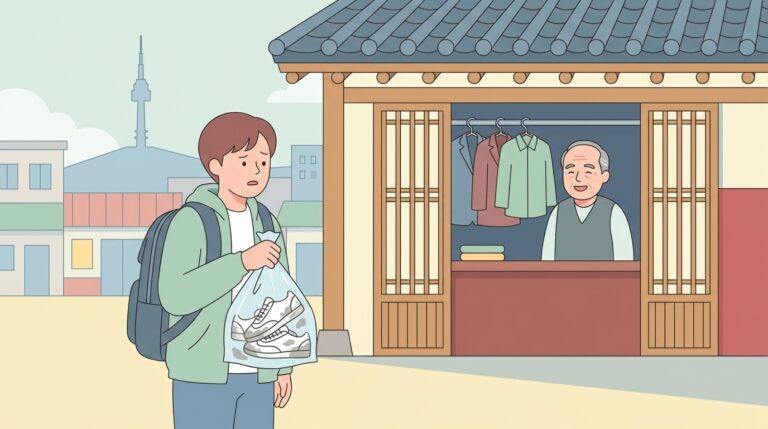
Hello! I’m your Daily Hangul Editor. Imagine this: You are in Seoul, wearing your favorite, crisp white sneakers. You’ve planned a perfect day—a cute cafe in Seongsu-dong, followed by a K-Pop fan meeting or a romantic date inspired by your favorite K-Drama. But suddenly… splash! A delivery scooter rushes by, leaving a massive mud puddle stain on your shoes.
Panic mode? Not at all! In K-Dramas, the male lead might romantically wipe the stain off with his handkerchief, but in real life? We go to the 세탁소 (Dry Cleaner).
Korea’s laundry service is incredibly fast and affordable, but walking into a local neighborhood shop run by an older Korean owner can be intimidating for beginners. What if they don’t speak English? Don’t worry. As a veteran tutor, I’ve seen countless students successfully rescue their shoes with just three magical, beginner-friendly phrases. Let’s learn them!
Phase 2: Core Expressions Deep Dive
1. 이거 세탁해 주세요. (Please clean this.)
- Pronunciation: [i-geo se-tak-hae ju-se-yo]
- Sound guide: ‘이거’ (ee-gaw) means ‘this’. ‘세탁’ (seh-tahk) sounds like ‘say-tock’. ‘해주세요’ (hae-joo-seh-yo) is your magical polite request word.
- Meaning: Literal: Please do the laundry for this. / Real nuance: Please clean these shoes.
- K-Culture Moment: You’ll see this phrase in any K-Drama where a character drops off a suit or clothes. It’s the universal “please take care of this” phrase at any service shop.
- Editor’s Insight: You don’t even need to know the Korean word for sneakers (운동화). Just point, say “이거” (this), and add the magic phrase.
- Situation Spectrum:
- Friends (Casual): 🚫 (You wouldn’t ask a friend to dry-clean your shoes!)
- Store Owner (Formal/Service): ✅
- 🤔 Think About It: Why use ‘이거’ (this) instead of exactly naming the item? Korean is a ‘high-context’ language. If you are holding the shoes, everyone knows what you are talking about. Less words, more action!
2. 언제 돼요? (When will it be ready?)
- Pronunciation: [eon-je dwae-yo?]
- Sound guide: ‘언제’ (uhn-jeh) means ‘when’. ‘돼요’ (dway-yo) sounds like ‘dway-yo’.
- Meaning: Literal: When does it become? / Real nuance: When will it be finished/ready?
- K-Culture Moment: This is the ultimate Ppali-ppali (hurry up) culture phrase. Koreans use this everywhere—at cafes, dry cleaners, and repair shops.
- Editor’s Insight: It’s short, natural, and sounds like a true local. Memorize this 4-syllable lifesaver!
- Situation Spectrum:
- Local Shops: ✅
- Corporate Business Meeting: ⚠️ (A bit too casual for high-stakes business)
3. 얼마예요? (How much is it?)
- Pronunciation: [eol-ma-ye-yo?]
- Sound guide: ‘얼’ (uhl) + ‘마’ (mah) + ‘예요’ (yeh-yo).
- Meaning: How much is it?
- K-Culture Moment: Whether you are buying street food at Gwangjang Market or paying for laundry, this is your survival phrase.
- Editor’s Insight: In Korean dry cleaners, you usually pay in advance (선불) when you drop the items off, not when you pick them up!
Phase 3: Textbook vs. Real Korean
[Dropping off your shoes]
* 📖 Textbook Korean: 제 운동화를 세탁해 주시겠습니까? (Would you please dry-clean my sneakers?)
* 🗣️ Real Korean: 이거 세탁해 주세요. (Please clean this.)
* 💡 Why is it different?: Textbooks teach full, grammatical sentences. But in real life, Koreans value efficiency. Drop the object particle, use a simple polite ending, and you sound much more natural.
[Asking for the timeline]
* 📖 Textbook Korean: 언제 찾으러 오면 됩니까? (When should I come to pick it up?)
* 🗣️ Real Korean: 언제 돼요? (When is it ready?)
* 💡 Why is it different?: Again, high-context culture! The owner knows you want to pick it up. No need to over-explain.
Bottom Note: For A1 beginners, don’t stress about complex grammar. Pointing and saying simple polite phrases (-yo) is 100% acceptable and respected!
Phase 4: Cultural Context — K-Culture Deep Dive
4-1. Non-Verbal Nunchi (눈치): The Plastic Bag Rule
In Korea, there is an unwritten rule of etiquette when bringing shoes to a dry cleaner: Do not hand dirty shoes bare-handed. Always put them in a plastic bag (비닐봉지) before putting them on the shop’s counter. It’s considered bad manners to place muddy shoes where clean clothes might rest. This is a perfect example of Nunchi (눈치)—the ability to read the room and show consideration for the owner’s space.
4-2. The ‘Ppali-Ppali’ Travel Connection
Korean laundry services are famously fast, a reflection of the Ppali-ppali (hurry, hurry) culture. Franchise shops like ‘크린토피아’ (Cleantopia) or local neighborhood shops (usually named after the neighborhood with ‘세탁소’ at the end) can often wash and dry sneakers perfectly in just 2-3 days. If you are traveling and need them for a flight, you can politely ask: “내일 돼요?” (nae-il dwae-yo? – Can it be done tomorrow?).
Phase 5: Real-Life Roleplay Scenario
Setting: A small neighborhood dry cleaner (세탁소) near your Airbnb in Hongdae. Clothes are hanging everywhere, and the smell of fresh steam fills the air. The owner, a friendly older man (아저씨 – Ajussi), is ironing a shirt.
Characters:
– YOU: A traveler whose white sneakers got ruined by a puddle. You need them clean for a K-Pop concert in 3 days.
– Ajussi (60s): The laundry master. Warm but speaks very fast.
Dialogue:
YOU: 안녕하세요! (an-nyeong-ha-se-yo!)
[Hello!]
(🎭 Stage Direction: You carefully place a plastic bag containing your shoes on the counter.)
Ajussi: 어서 와요. 세탁물이에요? (eo-seo wa-yo. se-tang-mul-i-e-yo?)
[Welcome. Is it laundry?]
YOU: 네. 이거 세탁해 주세요. (ne. i-geo se-tak-hae ju-se-yo.)
[Yes. Please clean this.]
Ajussi: (Taking out the muddy sneakers) 아이고, 많이 더럽네. (a-i-go, man-i deo-reom-ne.)
[Oh my, it’s very dirty.]
YOU: 언제 돼요? (eon-je dwae-yo?)
[When will it be ready?]
Ajussi: 신발은 이틀 걸려요. 모레 오세요. (sin-bal-eun i-teul geol-lyeo-yo. mo-re o-se-yo.)
[Shoes take two days. Come the day after tomorrow.]
YOU: 아, 네! 얼마예요? (a, ne! eol-ma-ye-yo?)
[Ah, yes! How much is it?]
Ajussi: 오천 원이에요. (o-cheon won-i-e-yo.)
[It is 5,000 won.]
🔀 Your Turn! Decision Point:
The Ajussi said it takes two days, but your concert is tomorrow! How do you ask if it can be done by tomorrow?
– A) 빨리 해 주세요!! (Do it fast!!)
– B) 내일 돼요? (Can it be done tomorrow?)
– C) 모레 안 돼요! (The day after tomorrow is a no!)✅ Best Choice: B — “내일 돼요?” is polite and asks if it’s possible.
⚠️ Choice A Analysis: Saying “빨리 해 주세요” can sound demanding, especially to an elder. In Korea, asking a question (Can it be done?) is always softer than giving a command (Do it!).
Phase 6: 10-Second Shadowing Drill
Speak out loud with me! Pay attention to the pauses (/) and the emotion.
🥺 (Looking slightly worried but polite)
이거 / 세탁해 / 주세요.
(i-geo / se-tak-hae / ju-se-yo.)
😊 (Brightly, asking for the timeline)
언제 / 돼요?
(eon-je / dwae-yo?)
Phase 7: K-Culture Mini Dictionary
1. 세탁소 (setakso)
* English: Dry cleaner / Laundromat
* Context: Unlike self-service coin laundries, a traditional setakso is operated by a master who dry-cleans, irons, and alters clothes. They work magic on sneakers!
2. 빨리빨리 (ppali-ppali)
* English: Hurry, hurry
* Context: The backbone of Korean service culture. Fast internet, fast delivery, and fast laundry!
3. 아저씨 / 아주머니 (ajussi / ajumoni)
* English: Middle-aged man / Middle-aged woman
* Context: A polite but common way to refer to older shop owners.
4. 비닐봉지 (binil bongji)
* English: Plastic bag
* Context: Essential for transporting dirty items in Korea. Handing dirty shoes without a bag is a cultural faux pas.
Phase 8: Traveler Survival Kit
Need to find a dry cleaner in your area?
🆘 Survival Expressions & Tips
– 🇰🇷 “영수증 주세요” (yeong-su-jeung ju-se-yo) – Please give me a receipt.
– 🗣️ Sound guide: young-soo-jung joo-seh-yo
– 💡 Pro Tip: Type “세탁소” or “크린토피아” into Naver Map or KakaoMap. Don’t use Google Maps, as it’s not highly updated for small local shops in Korea. Also, keep the paper receipt; you often need to show it when you pick up your shoes!📌 Editor’s Travel Note
– Payment: Local setakso might prefer cash or bank transfers, but franchise shops like Cleantopia take credit cards perfectly.
– Tipping: There is ZERO tipping culture in Korea. Do not leave extra money; the owner will chase you down the street thinking you forgot your change!
Phase 9: Critical Thinking — “One Step Deeper”
🧠 Think Deeper: Language & Age Hierarchy in Service
In many Western cultures, “The customer is king.” While Korean customer service is excellent, there’s a cultural twist: Age hierarchy. Even if you are the paying customer, if the shop owner is older than you (like an Ajussi), you must always use polite Korean (-yo). You wouldn’t use casual language (banmal) just because you are buying a service. The Korean language reflects mutual respect—you respect their age and expertise, and they respect you as a customer.💬 Your Turn: How does customer service language work in your country? Do people use the exact same tone with a young barista and an elderly shop owner? Share in the comments!
Phase 10: FAQ & Avoiding Misunderstandings
Q: Can I ask them to wash my shoes in 1 hour?
A: No. While Korea is fast, sneakers usually take 2 to 3 days because they dry them in special low-heat machines to prevent damage. If you are desperate, you can ask “내일 돼요?” (Can it be done tomorrow?) but be prepared for a polite “No.”
Q: Do they wash them by hand?
A: Most specialized shops hand-wash sneakers and treat specific stains. It’s much better than putting them in a washing machine yourself!
❌ Common Mistake #1: Picking up your shoes without the receipt.
✅ Do this instead: Always keep the small paper ticket they give you when you pay. The shop is filled with hundreds of items, and they organize them by phone number or ticket number.
Phase 11: Summary & Action Items
One-Liner Summary: To rescue your shoes at a Korean dry cleaner, just point and say “이거 세탁해 주세요” (Please clean this) and ask “언제 돼요?” (When is it ready?).
🎯 Action Mission:
– 🥉 Bronze: Stand in front of your mirror with your shoes and say “이거 세탁해 주세요” 3 times out loud.
– 🥈 Silver: Write “내일 돼요?” in your phone’s note app or a Korean learning forum to practice spelling.
– 🥇 Gold: During your trip to Korea, actually drop off a piece of clothing or shoes at a local 세탁소!
🇰🇷 K-Culture Mission: Open Naver Map on your phone right now, zoom into Hongdae or Gangnam, type “세탁소”, and see how many local shops pop up around residential areas!
Phase 12: Quiz — Interactive Challenge
1. Situational Judgment: You want to know when your sneakers will be clean. What is the most natural thing to say?
– A) 언제 돼요? (eon-je dwae-yo?)
– B) 내일 운동화? (nae-il un-dong-hwa?)
– C) 빨리 해 주세요. (ppal-li hae ju-se-yo.)
2. True or False – K-Culture Edition:
“It is polite to give the dry cleaner an extra tip of 2,000 won for cleaning your sneakers fast.”
3. Fill in the Blank:
To ask the price, you say: “[ ______ ]-예요?”
▼ Answers below ▼
(1. A – High-context and natural. C is too demanding! / 2. False – No tipping in Korea! / 3. 얼마 – eol-ma)
Frequently Asked Questions (FAQ)
Q: What does "이거 세탁해 주세요. (Please clean this.)" mean in Korean and how do you pronounce it?
A: In Korean, "이거 세탁해 주세요. (Please clean this.)" is pronounced [i-geo se-tak-hae ju-se-yo] and means: a key conversational Korean expression covered in this lesson.
Q: What does "언제 돼요? (When will it be ready?)" mean in Korean and how do you pronounce it?
A: In Korean, "언제 돼요? (When will it be ready?)" is pronounced [eon-je dwae-yo?] and means: a key conversational Korean expression covered in this lesson.
Q: What does "얼마예요? (How much is it?)" mean in Korean and how do you pronounce it?
A: In Korean, "얼마예요? (How much is it?)" is pronounced [eol-ma-ye-yo?] and means: a key conversational Korean expression covered in this lesson.






