

Phase 1: Empathy & The K-Culture Cold Open
Hello! I am the Lead Editor of Daily Hangul.
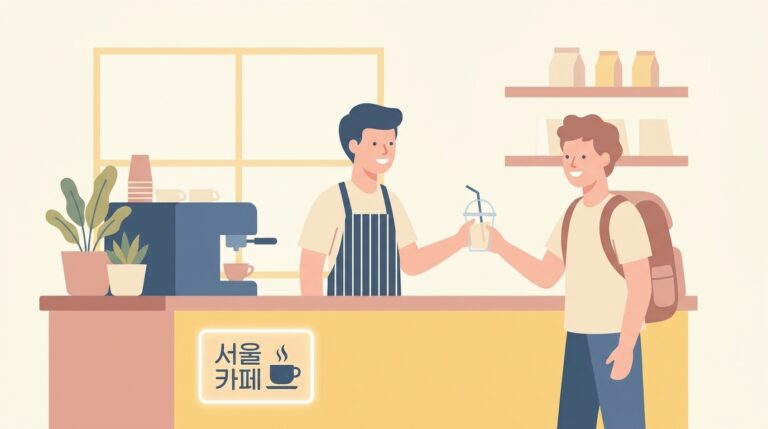
Picture this: You are in a beautifully designed, aesthetic cafe in Seongsu-dong, Seoul. A trendy K-Pop track is playing softly in the background. The aesthetic is right out of your favorite K-Drama, and the display case is full of delicious pastries. It is magical… until you reach the counter.
The barista smiles and says something rapidly in Korean. Your mind goes blank. You just wanted a simple Iced Americano, but suddenly you are sweating, pointing vaguely at the menu, and nervously saying, “Uh… coffee?”
Don’t worry, we have all been there! Ordering in a cafe is one of the most common situations you will face in Korea, but it can also be the most intimidating for beginners. Knowing just a few key phrases will not only get you your caffeine fix but also earn you a warm smile from the barista. This guide is based on real struggles from our students, designed to help you order with the confidence of a true local.
Phase 2: Core Expressions Deep Dive
Let’s master the magic words that will get you exactly what you want.
1. [~ 주세요]
- Pronunciation: [~ ju-se-yo] -> Sounds like “joo-seh-yo” (the ‘j’ is soft, like in ‘jump’).
- Meaning: (Literal) Give me ~ / (Real nuance) I would like to have ~, please.
- K-Culture Moment: In K-Dramas, you will often hear characters walk into a cafe and confidently say, “아메리카노 주세요” (Americano, please). It is the ultimate magic word in Korea. You can put literally ANY noun in front of “주세요” to ask for it politely.
- Editor’s Insight: This is your survival tool. If you forget everything else, just point at the menu and say “이거 주세요” (igeo juseyo – Give me this, please). It is polite, natural, and highly effective.
- Situation Spectrum:
- Friends (Casual): ⚠️ (Friends use “줘” [jwo] instead)
- Cafe Staff/Strangers (Semi-formal): ✅ (Perfect!)
- Elders/Boss (Formal): ✅ (Safe and respectful)
- 🤔 Think About It: Why does Korean rely so much on adding a “politeness marker” (요) at the end of sentences? How does your native language show respect to service workers?
2. [먹고 갈게요 / 포장해 주세요]
- Pronunciation: [meok-go gal-ge-yo / po-jang-hae ju-se-yo]
- Meaning: (Literal) I will eat and go / Please pack it. (Real nuance) For here / To go.
- K-Culture Moment: Due to environmental laws in Korea, cafes cannot give you disposable plastic cups if you stay inside. So, the barista will always ask if you are staying or leaving. If you get this right, you instantly look like an insider!
- Editor’s Insight: “포장” (po-jang) means packaging. So “포장해 주세요” literally means “please package it for me.” It works at cafes, restaurants, and even street food stalls!
- Situation Spectrum:
- Casual with staff: ✅
- Formal with staff: ✅
- 🤔 Think About It: In many Western countries, “To-go” is the standard phrase. In Korea, asking to “package” the food reflects a culture of carefully wrapping and transporting meals. Have you noticed the beautiful packaging in Korean bakeries?
3. [아아 한 잔 주세요]
- Pronunciation: [ah-ah han jan ju-se-yo]
- Meaning: (Literal) Give me one glass of Ah-Ah. (Real nuance) One Iced Americano, please.
- K-Culture Moment: “Ah-Ah” is the heartbeat of modern Korea. It is short for 아이스 아메리카노 (Iced Americano). Even in freezing winter (-15°C), many Koreans proudly order an “Ah-Ah.”
- Editor’s Insight: Saying “Ah-Ah” instead of the full name instantly makes you sound like a local. The barista will definitely be impressed!
- Situation Spectrum:
- Casual/Everyday: ✅
- High-end Hotel Cafe: ⚠️ (Better to use the full name there)
Phase 3: Textbook vs. Real Korean
[Ordering your Drink]
* 📖 Textbook Korean: 저는 아이스 아메리카노 한 잔을 마시겠습니다. (I will drink one cup of iced americano.)
* 🗣️ Real Korean: 아아 한 잔 주세요. (One Ah-Ah, please.)
* 💡 Why the difference?: The “Ppalli-Ppalli” (hurry up) culture loves efficiency. Dropping the subject (“I”) and abbreviating words saves precious seconds during the morning coffee rush.
[Asking for the Bill/Receipt]
* 📖 Textbook Korean: 영수증을 주시겠습니까? (Would you please give me the receipt?)
* 🗣️ Real Korean: 영수증 버려주세요. (Please throw away the receipt.)
* 💡 Why the difference?: Most Koreans check their bank apps on their phones instantly, so paper receipts are often unwanted. Asking the cashier to throw it away right after paying is incredibly common!
Phase 4: Cultural Context — K-Culture Deep Dive
4-1. Non-Verbal Magic: The Two-Handed Rule
When you hand your credit card to the barista, or when you receive your coffee, try to use both hands, or lightly support your right arm with your left hand. This is a crucial non-verbal sign of respect in Korea. If you do this while saying “주세요”, you will win their hearts!
4-2. The Cafe Kiosk & The Trust Society
Nowadays, many Korean cafes use electronic Kiosks (키오스크). Don’t panic! Usually, there is an “English” button at the top right. But here is the real culture shock: Have you noticed laptops, phones, and expensive bags left unattended on cafe tables while their owners go to the restroom? Korea is a high-trust society. If you need to reserve a table before ordering, just leave a jacket or a small packet of tissues on the seat. No one will touch it!
Phase 5: Real-life Roleplay Scenario
Setting: It is 1:00 PM on a Tuesday. You are at a busy, stylish cafe in Hongdae. The line is moving fast. You step up to the counter.
Characters:
* YOU: A traveler who desperately needs caffeine after a long morning of shopping.
* Barista (Jiwon): A friendly but busy university student working part-time.
Dialogue:
Jiwon: 안녕하세요, 주문하시겠어요? 😊
(an-nyeong-ha-se-yo, ju-mun-ha-si-ge-sseo-yo?)
[Hello, would you like to order?]
YOU: 네, 아이스 아메리카노 한 잔 주세요.
(ne, a-i-seu a-me-ri-ka-no han jan ju-se-yo.)
[Yes, one iced americano, please.]
Jiwon: 네, 드시고 가시나요?
(ne, deu-si-go ga-si-na-yo?)
[Okay, will you be having it here?]
(🎭 Stage Direction: Jiwon holds up a glass mug and a plastic to-go cup, waiting for your answer.)
🔀 Your Turn! How do you answer?
* A) 먹고 갈게요! (I’ll have it here!)
* B) 포장해 주세요! (To-go, please!)
* C) 아메리카노! (Americano!)✅ Best Choice: A or B! Depending on your plan, these are the perfect, natural responses.
⚠️ Choice C Analysis: Just repeating “Americano” ignores the barista’s question and might come off as rude or confusing.
(Let’s say you chose B)
YOU: 포장해 주세요.
(po-jang-hae ju-se-yo.)
[To-go, please.]
Jiwon: 네, 4,500원입니다. 카드를 꽂아주세요.
(ne, sa-cheon-o-baek-won-im-ni-da. ka-deu-reul kko-ja-ju-se-yo.)
[Okay, that’s 4,500 won. Please insert your card.]
YOU: (Hands over card) 영수증은 버려주세요.
(yeong-su-jeung-eun beo-ryeo-ju-se-yo.)
[Please throw away the receipt.]
Jiwon: 네, 진동벨 울리면 픽업대로 와주세요!
(ne, jin-dong-bel ul-ri-myeon pik-eop-dae-ro wa-ju-se-yo!)
[Okay, please come to the pickup counter when the buzzer rings!]
Phase 6: 10-Second Shadowing Drill
Let’s practice the rhythm! Pay attention to the slashes (/) for pauses.
😊 네 / 아-아 한 잔 / 주-세-요!
(ne / ah-ah han jan / ju-se-yo!)
[Tone: Friendly, bright, confident]
🙏 영-수-증은 / 버-려-주-세-요.
(yeong-su-jeung-eun / beo-ryeo-ju-se-yo.)
[Tone: Polite, slightly softer]
Phase 7: K-Culture Mini Dictionary
1. 눈치 (nunchi)
* English: Social awareness / Reading the room
* Context: If there is a long line behind you at the cafe, having nunchi means deciding your order quickly instead of staring at the menu for 10 minutes.
2. 얼죽아 (eol-juk-a)
* English: “Iced Americano even if I freeze to death”
* Context: A popular slang acronym describing Koreans’ die-hard love for iced coffee, regardless of the freezing winter weather.
3. 진동벨 (jindong-bel)
* English: Cafe buzzer / Pager
* Context: Instead of calling your name (like Starbucks in the US), most Korean cafes give you a small electronic disk that vibrates and flashes when your coffee is ready.
4. 1인 1음료 (il-in il-eum-nyo)
* English: One drink per person
* Context: A strict rule in most independent Korean cafes. If three people share a table, you must order at least three drinks to support the business.
Phase 8: Traveler’s Survival Kit
If you forget everything else, save these phrases on your phone!
🆘 Survival Phrase #1: Pointing & Ordering
* 🇰🇷 “이거 주세요.” (i-geo ju-se-yo)
* 🗣️ Pronunciation: ee-guh joo-seh-yo
* 📍 Where to use: Cafe menus, restaurants, bakeries, street food.🆘 Survival Phrase #2: Finding the Restroom
* 🇰🇷 “화장실 어디예요?” (hwa-jang-sil eo-di-ye-yo?)
* 🗣️ Pronunciation: hwa-jang-shil uh-dee-yeh-yo?
* 📍 Where to use: Anywhere! (Often, cafe restrooms require a password, which is usually printed on the receipt!).📌 Editor’s Travel Note
* Tipping: DO NOT leave a tip. There is no tipping culture in Korea. If you leave money on the counter, the barista might run down the street to return it to you!
* Cards vs. Cash: Korea is essentially a cashless society. 99% of cafes prefer or only accept credit cards (T-money cards work at some franchises too).
Phase 9: Critical Thinking Corner — “One Step Deeper”
🧠 Think Deeper: Global Era & Loanwords (Konglish)
Have you noticed that “Iced Americano” sounds almost identical in Korean (아이스 아메리카노)? As Korea modernized rapidly, many Western concepts were adopted directly into the language. In modern Korean cafes, almost the entire menu consists of English loanwords. Some linguistic purists worry that traditional Korean words are disappearing, but others argue it makes Korea highly accessible to global travelers.
💬 Your Turn: Does your country’s language borrow a lot of words from English for modern food and drinks? Let us know in the comments!
Phase 10: FAQ & Mistake Prevention
Q: “Can I just say my order in English?”
* A: Yes! Most Korean cafe workers understand basic English coffee terms. However, wrapping your English word in Korean grammar (e.g., “Latte ju-se-yo“) shows respect for the local culture and will be greatly appreciated!
Q: “What if they ask me a question I don’t understand?”
* A: Don’t panic. They are usually asking one of three things: 1) For here or to go? 2) Hot or Iced? 3) Do you need a receipt? Just point to a to-go cup or say “포장” (po-jang) and you will solve 90% of the confusion.
❌ Common Mistake #1: Pointing at the barista and saying “당신” (Dang-sin / You).
✅ Do this instead: Korean drops pronouns! Simply saying “주세요” implies that you want them to give it to you. You don’t need to translate the word “You” at all.
Phase 11: Summary & Action Items
- One-Liner Summary: Add “주세요” (ju-se-yo) after any item to politely order like a pro.
-
Action Mission:
- 🥉 Bronze (Solo): Look at a menu online and practice saying “[Item name] 주세요” out loud 3 times.
- 🥈 Silver (Online): Drop a comment below with what you would order at a Korean cafe! (Example: 바닐라 라떼 주세요!)
- 🥇 Gold (Real Life): Next time you visit a Korean cafe or restaurant, confidently use “아아 한 잔 주세요” or “포장해 주세요”!
- K-Culture Mission: Watch an episode of a modern K-Drama today. When the characters go to a cafe (they always do!), listen closely to hear if they say “아아” or “주세요”!
Phase 12: Quiz — Interactive Challenge
1. Fill in the Blank:
You want to order a slice of cheesecake from the display. You point at it and say:
“이거 [ ].”
(Hint: The magic word for “please give me”)
2. True or False — K-Culture Edition:
“If the barista was extremely friendly and made a great coffee, you should leave a 1,000 won tip in the tip jar.”
3. Situational Judgment:
The barista asks: “드시고 가시나요?” (Are you having it here?)
You want to take the coffee with you to the park. What do you say?
A) 먹고 갈게요.
B) 포장해 주세요.
C) 영수증 버려주세요.
(Answers: 1. 주세요(ju-se-yo), 2. False! No tipping in Korea. 3. B)
Frequently Asked Questions (FAQ)
Q: What does "[~ 주세요]" mean in Korean and how do you pronounce it?
A: In Korean, "[~ 주세요]" is pronounced [~ ju-se-yo] and means: (Literal) Give me ~ / (Real nuance) I would like to have ~, please.
Q: What does "[먹고 갈게요 / 포장해 주세요]" mean in Korean and how do you pronounce it?
A: In Korean, "[먹고 갈게요 / 포장해 주세요]" is pronounced [meok-go gal-ge-yo / po-jang-hae ju-se-yo] and means: (Literal) I will eat and go / Please pack it. (Real nuance) For here / To go.
Q: What does "[아아 한 잔 주세요]" mean in Korean and how do you pronounce it?
A: In Korean, "[아아 한 잔 주세요]" is pronounced [ah-ah han jan ju-se-yo] and means: (Literal) Give me one glass of Ah-Ah. (Real nuance) One Iced Americano, please.






