

Hello! I’m your Daily Hangul Editor.
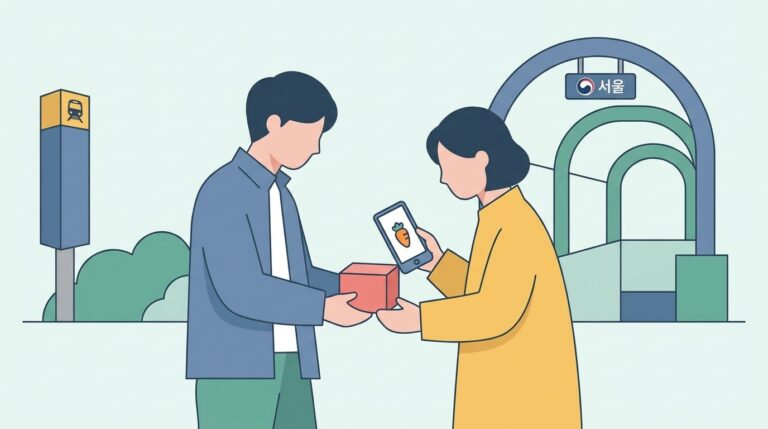
Picture this: You are standing at Exit 3 of Gangnam Station on a Friday evening. You are holding exactly 15,000 won in cash, looking nervously at your phone. Someone approaches you. They are holding a paper shopping bag, glancing at their phone, and then making hesitant eye contact with you.
In a K-Drama, this might be a secret spy handover. But in real Korean life? This is the iconic, heart-fluttering moment of Second-hand Trading (중고 거래) via Korea’s favorite app, Karrot (Danggeun Market).
Buying used items—like that sold-out K-Pop lightstick or a barely used film camera—is a fantastic way to experience local Korean life. But when you finally meet the seller, you can’t just grab the item and run! You need to check it first. If you don’t know what to say, you might end up buying something broken, or worse, making an awkward situation even more awkward.
Don’t worry! As a veteran tutor who has bought countless used items (and made my fair share of mistakes), I’m here to give you the exact survival phrases you need to check your item like a true local. Let’s dive in!
Phase 2: Core Expressions for Checking Items
Here are the top phrases you need when inspecting your second-hand treasure.
1. 저기… 혹시 당근이세요?
- Pronunciation: jeogi… hoksi danggeun-iseyo? [juh-gee… hok-shee dang-goon-ee-seh-yo?]
- Meaning: (Literal) Excuse me… by any chance, are you a carrot? / (Real nuance) Excuse me… are you the seller/buyer from the Karrot app?
- K-Culture Moment: This is the universal password in Korea. If you hear someone whispering “Danggeun…?” at a subway station, they are looking for their trading partner.
- Editor’s Insight: You must say this with a slightly rising, hesitant tone. You are asking a stranger if they are who you think they are. It’s a bit awkward, but everyone does it!
- Situation Spectrum:
- Casual (Strangers on the app): ✅
- Close Friends: 🚫 (They already know you!)
- 🤔 Think About It: Why do Koreans use the app’s name (“Carrot”) as a greeting instead of “Are you selling the camera?” It’s a discreet way to verify the person without announcing to the whole street what you are buying!
2. 물건 한번 봐도 될까요?
- Pronunciation: mulgeon hanbeon bwado doelkkayo? [mool-gun han-bun bwa-doh dwel-kka-yo?]
- Meaning: (Literal) Can I see the item once? / (Real nuance) Can I take a look at the item?
- K-Culture Moment: The seller hands you the bag. Before you dig your hands in, it is common courtesy to ask this. It shows respect for their property until the money is exchanged.
- Editor’s Insight: Adding 한번 (hanbeon – once) softens the request. It makes it sound casual and polite, like “just a quick look.”
- Situation Spectrum:
- Any seller (Polite form): ✅
- 🤔 Think About It: Korean culture values boundaries. Asking for permission, even when you are about to buy it, builds trust.
3. 이거 작동 잘 되나요?
- Pronunciation: igeo jakdong jal doenayo? [ee-guh jak-dong jal dweh-na-yo?]
- Meaning: Does this work well? / Is it functioning properly?
- K-Culture Moment: Crucial when buying K-Pop lightsticks (응원봉), mini-fans, or cameras. You usually press the button while asking this.
- Editor’s Insight: You can replace “작동” (operation) with other words depending on the item. For clothes, you might ask, “얼룩 없나요?” (Are there no stains?).
- Situation Spectrum:
- Any seller: ✅
4. 상태 좋네요. 이걸로 할게요.
- Pronunciation: sangtaega jonneyo. igeollo halgeyo. [sang-tae-ga john-neh-yo. ee-gul-lo hal-geh-yo.]
- Meaning: The condition is good. I’ll take this.
- K-Culture Moment: The sweet sound of a successful deal! Say this, smile, and hand over the cash or show the bank transfer screen.
- Editor’s Insight: “이걸로 할게요” (I will do it with this) is a magical phrase. You can also use it in cafes or restaurants when you decide what to order!
Phase 3: Textbook vs. Real Korean
Let’s see how textbook Korean compares to the streets of Seoul during a trade.
[Situation 1: Greeting the Seller]
* 📖 Textbook Korean: 중고 거래하러 오셨습니까? (Have you come to do second-hand trading?)
* 🗣️ Real Korean: 아, 혹시 당근…? (Ah, by any chance, Karrot…?)
* 💡 Why is it different?: Textbook Korean sounds like a police interrogation. Real Koreans prefer brief, coded interactions for privacy and efficiency.
[Situation 2: Pointing out a minor flaw]
* 📖 Textbook Korean: 여기에 흠집이 있습니다. (There is a scratch here.)
* 🗣️ Real Korean: 어? 여기 약간 스크래치가 있네요? (Oh? There’s a slight scratch here, right?)
* 💡 Why is it different?: Koreans often use Konglish/English words like ‘스크래치’ (scratch) for items. Adding ‘약간’ (a little bit) and ending with a question tone ‘네요?’ softens the criticism, preserving harmony (기분 – mood).
[Situation 3: Concluding the deal]
* 📖 Textbook Korean: 구매하겠습니다. 감사합니다. (I will purchase it. Thank you.)
* 🗣️ Real Korean: 네, 계좌번호 알려주세요~ (Yes, please let me know your bank account number~)
* 💡 Why is it different?: In Korea, cash is rare. Direct bank transfers (계좌이체) on the spot using mobile banking are the absolute norm.
Phase 4: Cultural Context — K-Culture Deep Dive
4-1. Non-Verbal Cues: The “Danggeun Stance”
When you meet, do not stare directly into the person’s eyes from far away. Stand casually, look at your phone, and hold a small shopping bag. When confirming the item, handle it gently with two hands. If everything is good, a slight bow of the head (a mini-bow) while saying “감사합니다” (Thank you) is the perfect finish.
4-2. The “Cool Deal” (쿨거래) Culture
In K-Dramas, you might see intense haggling at traditional markets. But on modern Korean second-hand apps, the trend is 쿨거래 (Cool georae). “Cool” means no drama, no excessive haggling at the meeting spot, and quick payment. If you start complaining about the item at the meeting place to lower the price, the seller might give you a bad “Manner Temperature” (매너온도) rating on the app. If the item matches the description, keep it cool, check it quickly, and pay!
Phase 5: Roleplay Scenario — “The Hongdae Exit 2 Handover”
Setting: Friday afternoon, Hongdae Station Exit 2. It’s crowded. You are trying to buy a second-hand K-Pop lightstick for a concert tomorrow.
Characters:
* YOU: A foreign student, huge K-Pop fan, slightly nervous.
* Minji (20s): The seller. She has a high “Manner Temperature” and looks friendly.
Dialogue:
YOU: 저기… 혹시 당근이세요? 🥕
(jeogi… hoksi danggeun-iseyo?)
[Excuse me… are you Danggeun?]
(🎭 Stage Direction: You hold up your phone slightly to show the app.)
Minji: 아! 네네, 맞아요. 안녕하세요~
(Ah! nene, majayo. annyeonghaseyo~)
[Ah! Yes yes, that’s right. Hello~]
YOU: 안녕하세요. 물건 한번 봐도 될까요?
(annyeonghaseyo. mulgeon hanbeon bwado doelkkayo?)
[Hello. Can I take a look at the item?]
Minji: 네, 여기요. 포장 상자도 그대로 있어요.
(ne, yeogiyo. pojang sangjado geudaero isseoyo.)
[Yes, here you go. The packaging box is still there too.]
(🎭 Stage Direction: Minji hands you the lightstick.)
YOU: 이거 작동 잘 되나요? 불 켜봐도 돼요?
(igeo jakdong jal doenayo? bul kyeobwado dwaeyo?)
[Does this work well? Can I try turning on the light?]
Minji: 네, 건전지 넣어놨어요. 눌러보세요.
(ne, geonjeonji neo-eonwasseoyo. nulleoboseyo.)
[Yes, I put batteries in. Try pressing it.]
(🎭 Stage Direction: You press the button. It lights up beautifully, but you notice a tiny scratch on the handle.)
🔀 Your Turn! How do you react?
– A) “아, 스크래치가 있네요. 안 살게요.” (Ah, there’s a scratch. I won’t buy it.)
– B) “어, 약간 스크래치가 있네요? 그래도 작동은 잘 되니까 이걸로 할게요.” (Oh, there’s a slight scratch. But since it works well, I’ll take it.)
– C) “스크래치! 5천원 깎아주세요!” (Scratch! Discount 5,000 won!)✅ Best Choice: B — It’s completely fine to politely point out a minor flaw if you notice it, but if it doesn’t affect the usage, accepting it smoothly is good manners.
⚠️ Choice C Analysis: Haggling on the spot (현장 네고) over something minor is considered rude in Korean “Cool Deal” culture. Haggling should be done in the app chat before meeting.
YOU: 상태 좋네요. 이걸로 할게요. 계좌번호 알려주세요.
(sangtaega jonneyo. igeollo halgeyo. gyejwabeonho allyeojuseyo.)
[Condition is good. I’ll take it. Please tell me your bank account number.]
Minji: 네, 챗으로 보낼게요. 예쁘게 쓰세요!
(ne, chaeseuro bonaelgeyo. yeppeuge sseuseyo!)
[Yes, I’ll send it via chat. Use it prettily (well)!]
Phase 6: 10-Second Shadowing Drill
Practice these lines with the right emotion and rhythm! Pause at the / marks.
- 🥺 (Hesitant, polite tone) 저기요… / 혹시 / 당근이세요?
(jeogiyo… / hoksi / danggeun-iseyo?) - 👀 (Curious tone) 물건 / 한번 / 봐도 될까요?
(mulgeon / hanbeon / bwado doelkkayo?) - 😊 (Satisfied tone) 상태가 / 좋네요. / 이걸로 할게요!
(sangtaega / jonneyo. / igeollo halgeyo!)
Phase 7: K-Culture Mini Dictionary
1. 당근마켓 (Karrot Market)
* Romanization: danggeun maket
* English: A neighborhood-based second-hand trading app.
* Context: It has become a verb in Korea. “이거 당근하자” (Let’s ‘carrot’ this) means “Let’s sell this second-hand.”
2. 쿨거래
* Romanization: kul-georae
* English: Cool deal.
* Context: A fast transaction without endless questions, complaining, or haggling. Sellers love buyers who do “cool georae.”
3. 네고
* Romanization: nego
* English: Negotiation / Haggling (short for negotiation).
* Context: Often written in item descriptions. “네고 불가” means “No haggling.”
4. 매너온도
* Romanization: maeneo-ondo
* English: Manner temperature.
* Context: The Karrot app rating system. It starts at 36.5°C (human body temperature). Good reviews make it go up. A seller with 50°C+ is highly trustworthy!
Phase 8: Traveler’s Survival Kit
Even if you don’t use a trading app, you will need to check items at flea markets (like Dongmyo) or underground shopping malls (like Goto Mall).
🆘 Survival Expressions for Markets
– 🇰🇷 “이거 입어봐도 돼요?” (igeo ibeobwado dwaeyo?)
– 🗣️ Meaning: Can I try this on?
– 📍 Where to use: Clothing stalls, vintage shops.
– 🇰🇷 “현금으로 하면 깎아주시나요?” (hyeongeumeuro hamyeon kkakajusinayo?)
– 🗣️ Meaning: If I pay with cash, do you give a discount?
– 📍 Where to use: Traditional markets.📌 Editor’s Travel Note
– Card vs. Cash: Korea is a card-heavy society, but at vintage markets or when buying used items directly from people, cash (or bank transfer) is king.
– Trying on clothes: In cheap underground malls, trying on white t-shirts or tight clothes is often not allowed to prevent makeup stains. Always ask first!
Phase 9: Critical Thinking — “One Step Deeper”
🧠 Think Deeper: Language & Power in Transactions
In many Western cultures, “The customer is king.” But in Korean second-hand trading, the buyer and seller are on equal footing as neighbors. You use polite language (존댓말 – jondaetmal) regardless of age because you are strangers. Notice how we say “봐도 될까요?” (Can I see?) instead of just grabbing it. This linguistic hesitation reflects a high-trust, community-based commerce system where maintaining social harmony is just as important as getting a good deal.💬 Your Turn: Have you ever bought something second-hand in your country? How do people greet each other when they meet for the trade? Share in the comments!
Phase 10: FAQ & Avoiding Mistakes
Q: What if I check the item and I really don’t want it?
Yes, you can cancel, but be polite! Say: “생각보다 상태가 안 좋네요. 죄송하지만 거래 안 할게요.” (The condition is worse than I thought. I’m sorry, but I won’t do the trade.) Bow slightly and leave.
Q: Can I use “당근이세요?” to a friend?
No! It’s a funny meme, but practically, it’s only for strangers you are meeting from the app.
❌ Common Mistake #1: Pointing out flaws aggressively to lower the price on the spot.
✅ Do this instead: If you find a flaw, mention it gently: “여기 스크래치가 있네요~” (There’s a scratch here~). Only ask for a discount if it’s a major flaw that wasn’t in the photos.
Phase 11: Summary & Action Items
One-Liner Summary: When checking a second-hand item, ask politely to see it, check its function, and confirm your purchase cleanly!
Action Mission 3 Steps:
* 🥉 Bronze (Solo): Stand in front of a mirror holding an object and ask, “물건 한번 봐도 될까요?” 3 times.
* 🥈 Silver (Online): Find a Korean YouTube vlog about “당근마켓 브이로그” (Danggeun Market Vlog) and listen for the phrase “당근이세요?”
* 🥇 Gold (Action): Next time you are in a Korean store or market, point to an item and say, “이걸로 할게요!” (I’ll take this!).
Phase 12: Quiz — Interactive Challenge
1. You are meeting a seller at a cafe. How should you greet them?
A) 중고 물건 내놓으세요. (Hand over the used item.)
B) 혹시 당근이세요? (By any chance, are you Karrot?)
C) 안녕! 물건 줘! (Hi! Give me the item!)
2. True or False – K-Culture Edition:
In Korea, it is considered good manners to demand a 50% discount right when you meet the seller face-to-face. (T / F)
3. Fill in the blank:
You checked the camera and it works perfectly. You say: “상태가 좋네요. _____ 할게요.”
(Hint: I will go with this.)
Answers (Click to reveal)
1. B – The universally polite and slightly coded greeting for second-hand trades.
2. False – This is terrible manners and will ruin your “Manner Temperature.” Haggling (Nego) should be done via chat before meeting.
3. 이걸로 (igeollo – with this)
Frequently Asked Questions (FAQ)
Q: What does "저기... 혹시 당근이세요?" mean in Korean and how do you pronounce it?
A: In Korean, "저기... 혹시 당근이세요?" is pronounced [jeogi... hoksi danggeun-iseyo? [juh-gee... hok-shee dang-goon-ee-seh-yo?] and means: (Literal) Excuse me... by any chance, are you a carrot? / (Real nuance) Excuse me... are you the seller/buyer from the Karrot app?
Q: What does "물건 한번 봐도 될까요?" mean in Korean and how do you pronounce it?
A: In Korean, "물건 한번 봐도 될까요?" is pronounced [mulgeon hanbeon bwado doelkkayo? [mool-gun han-bun bwa-doh dwel-kka-yo?] and means: (Literal) Can I see the item once? / (Real nuance) Can I take a look at the item?
Q: What does "이거 작동 잘 되나요?" mean in Korean and how do you pronounce it?
A: In Korean, "이거 작동 잘 되나요?" is pronounced [igeo jakdong jal doenayo? [ee-guh jak-dong jal dweh-na-yo?] and means: Does this work well? / Is it functioning properly?
Q: What does "상태 좋네요. 이걸로 할게요." mean in Korean and how do you pronounce it?
A: In Korean, "상태 좋네요. 이걸로 할게요." is pronounced [sangtaega jonneyo. igeollo halgeyo. [sang-tae-ga john-neh-yo. ee-gul-lo hal-geh-yo.] and means: The condition is good. I'll take this.







