

Phase 1: Empathy & Immersion (Cold Open)
Hello there! I’m your Daily Hangul Editor, your local insider and Korean language tutor.
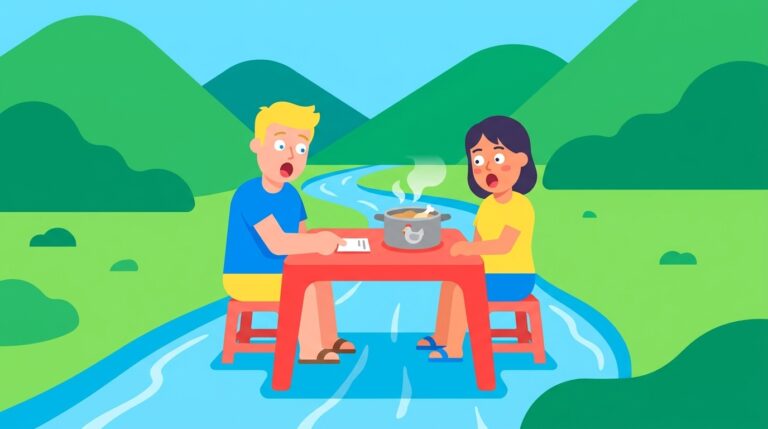
Imagine this: You’re watching a Korean variety show like 2 Days & 1 Night or a K-Drama summer special. The cast is splashing around in a crystal-clear mountain stream (계곡, gyegok), sitting on a red plastic table right in the water, and sharing a massive, steaming pot of whole chicken soup (백숙, baekseuk). It looks like the ultimate, idyllic Korean summer vacation.
So, you decide to try it yourself! You travel to Gapyeong, find a nice spot, order the chicken, and have a blast. But then, the bill arrives… 150,000 KRW (about $115) for one chicken?!
Wait, what?
Welcome to one of Korea’s most notorious summer controversies: The Gyegok Baekseuk Rip-off. Every summer, Korean news is flooded with angry vacationers exposing restaurants that illegally occupy public valleys and charge astronomical prices.
If you don’t know the right expressions, you might just end up paying the ‘foreigner tax’ or feeling frustrated without knowing how to voice your concerns. Today, we’re going to arm you with B2-level ‘survival Korean’ so you can navigate tourist traps, complain politely but firmly, and protect your wallet like a true local!
Phase 2: Core Expressions Deep Dive
Here are the top 3 expressions you need when you feel something isn’t quite right with the price.
1. 바가지 쓰다 / 바가지를 씌우다
- Pronunciation: [bagaji sseuda] / [bagajireul ssiuda] (Sounds like ba-ga-jee sseu-da)
- Meaning:
- Literal: To wear a gourd / to put a gourd on someone’s head.
- Real nuance: To get ripped off / to overcharge someone.
- K-Culture Moment: You’ll hear this on the news every July! Reporters will interview angry tourists saying, “휴가철 바가지요금 때문에 화가 납니다” (I’m angry because of the rip-off prices during the vacation season).
- Editor’s Insight: Bagaji is a plastic or wooden bowl (gourd). Historically, in a traditional gambling game, the loser had to wear a gourd on their head. Today, it means you’ve been scammed. Use “바가지 쓰다” for yourself (I got ripped off) and “바가지요금” (bagajiyogeum) to describe the rip-off price itself.
- Situation Spectrum:
- Casual with friends (Complaining about a store): ✅
- Semi-formal (Talking to a vendor): ⚠️ (Use cautiously, as it’s a direct accusation!)
- Formal/Elders: 🚫
- 🤔 Think About It: Why do you think Korean uses such a physical metaphor (“wearing a bowl”) to describe a financial loss? What’s the equivalent slang in your native language?
2. 자릿세
- Pronunciation: [jaritse] (Sounds like ja-rit-seh with a sharp ‘s’)
- Meaning:
- Literal: Seat tax.
- Real nuance: Cover charge, seating fee, or table charge.
- K-Culture Moment: In the valley restaurants, the food itself isn’t that expensive. The owners will claim, “The chicken is 50,000 won, but the jaritse (table fee by the water) is 100,000 won!”
- Editor’s Insight: While normal Korean restaurants never have a cover charge or a tipping culture, tourist spots often use jaritse as an excuse to inflate prices. Asking “자릿세가 따로 있어요?” (Is there a separate table charge?) before sitting down shows you are no rookie.
- Situation Spectrum:
- Casual with friends: ✅
- Semi-formal (Asking a restaurant owner): ✅
- Formal: ✅
- 🤔 Think About It: In Korea, water and side dishes are usually free. How does the sudden appearance of a “seating fee” in tourist spots clash with traditional Korean hospitality (Jeong, 정)?
3. 가격이 좀 심하네요
- Pronunciation: [gageogi jom simhaneyo] (Sounds like ga-gyeo-gi jom sheem-ha-ne-yo)
- Meaning:
- Literal: The price is a bit severe.
- Real nuance: This price is way out of line / This is too expensive (passive-aggressive but polite).
- K-Culture Moment: You are at a traditional market or a tourist spot, and a vendor quotes a ridiculous price. Instead of screaming “Scammer!”, a savvy Korean will slightly frown, tilt their head, and drop this phrase. It signals: “I know what you’re doing, and I’m not falling for it.”
- Editor’s Insight: Korean culture heavily values face (기분, gibun). Directly saying “You are a scammer” can cause a huge public fight. Saying “It’s a bit severe” gives the vendor a chance to gracefully back down and offer a “discount.”
- Situation Spectrum:
- Casual with friends: ⚠️ (Too formal, use “선 넘었네” instead)
- Semi-formal/Strangers: ✅ (Perfect for vendors)
- Formal: ⚠️
- 🤔 Think About It: Why does adding “좀” (a bit) make negative statements sound more polite in Korean?
Phase 3: Textbook vs. Real Korean
Let’s see how textbooks teach you to complain, versus how you should actually do it on the streets of Seoul (or the valleys of Gapyeong!).
[Situation 1: Discovering the price is way too high]
* 📖 Textbook Korean: 너무 비쌉니다. 깎아 주십시오. (It is very expensive. Please give me a discount.)
* 🗣️ Real Korean: 헉, 이거 바가지 아니에요? 좀 깎아주세요~ (Whoa, isn’t this a rip-off? Cut me some slack~)
* 💡 Why the difference?: Textbooks sound like business negotiations. Real Korean uses slightly playful but direct slang (bagaji) mixed with an elongated “요~” to soften the blow.
[Situation 2: Asking if the table by the water is free]
* 📖 Textbook Korean: 이 의자에 앉아도 됩니까? 요금이 있습니까? (May I sit on this chair? Is there a fee?)
* 🗣️ Real Korean: 사장님, 여기 혹시 자릿세 따로 있어요? (Boss, is there a separate seating fee for here by any chance?)
* 💡 Why the difference?: Starting with “사장님” (Boss) establishes rapport. Using “혹시” (by any chance) makes the question less accusatory.
Bottom Note: For B2 learners, mastering “혹시” (by any chance) and “좀” (a little/please) is the secret to sounding like a polite native speaker when dealing with tricky situations!
Phase 4: Cultural Context — K-Culture Deep Dive
4-1. The Non-Verbal Game: Nunchi at the Valley
When you suspect you’re being overcharged, don’t just use words. Korean communication relies heavily on Nunchi (눈치, reading the room).
* The Head Tilt: When quoted a high price, tilt your head about 15 degrees, suck in a little air through your teeth (Tsk), and look at your friend. This non-verbal cue universally means, “Yikes, that’s too expensive.”
* The Menu Scan: Don’t just sit down. Stand by the entrance, visibly scan the menu, and if prices are hidden (often written as ‘시가’ – Market Price), ask before taking a seat.
4-2. Food & Identity: Why go to the valley anyway?
If the food is overpriced, why do Koreans still flock to these valley restaurants? It’s deeply tied to Korean community culture (우리 문화, uri culture). Sharing a whole boiling chicken (Baekseuk) while sitting together in nature is seen as the ultimate form of bonding. It’s about “이열치열” (fighting heat with heat)—sweating out the summer humidity with hot, nutritious food, followed by a cold dip in the water. The drama is real, but so is the nostalgia!
Phase 5: Real-Life Roleplay Scenario
Setting: Saturday, 1:00 PM. A beautiful mountain valley in Gapyeong. The cicadas are buzzing. You and your Korean friend, Min-su (30, outgoing but hates getting scammed), just finished a delicious chicken soup. You ask for the bill.
Characters:
* YOU: An expat who has lived in Korea for a year. You speak decent B2 Korean.
* Min-su: Your Korean buddy.
* Owner: A middle-aged lady wearing a sun visor and an apron.
Dialogue:
Owner: 맛있게 드셨어요? 15만 원입니다.
(masitge deusyeosseoyo? siboman wonimnida.)
[Did you enjoy the meal? It’s 150,000 won.]
(🎭 Stage Direction: The owner casually hands you the card reader.)
YOU: 네? 15만 원이요? 메뉴판에는 백숙 5만 원이라고 적혀 있었는데요.
(ne? siboman woniyo? menyupaneneun baekseuk oman wonirago jeokhyeo isseonneundeyo.)
[Excuse me? 150,000 won? The menu said the chicken soup was 50,000 won.]
Owner: 아유, 계곡 바로 앞 자리는 원래 자릿세가 10만 원 따로 있어요.
(ayu, gyegok baro ap jarineun wollae jaritsega simman won ttaro isseoyo.)
[Oh dear, seats right in front of the valley naturally have a separate 100,000 won seating fee.]
Min-su: 사장님, 들어올 때 그런 말씀 없으셨잖아요. 이거 완전 바가지요금 아니에요?
(sajangnim, deureool ttae geureon malsseum eopseusyeotjanayo. igeo wanjeon bagajiyogeum anieyo?)
[Boss, you didn’t mention that when we came in. Isn’t this a total rip-off?]
Owner: 다른 데 가봐요 다 똑같지! 우리도 구청에 세금 내고 하는 거예요.
(dareun de gabwayo da ttokgatji! urido gucheonge segeum naego haneun geoyeyo.)
[Go anywhere else, it’s all the same! We pay taxes to the district office to run this too.]
(🎭 Stage Direction: The owner crosses her arms, looking defensive.)
YOU: 그래도 가격이 좀 심하네요.
(geuraedo gageogi jom simhaneyo.)
[Still, the price is a bit much.]
🔀 Your Turn! How should you handle this?
* A) “알겠습니다. 여기 카드요.” (I understand. Here’s my card.) – Safe, but you lose $100!
* B) “경찰 부를 거예요! 당신 사기꾼이야!” (I’m calling the cops! You’re a scammer!) – Too aggressive, might cause a dangerous scene.
* C) “영수증에 자릿세 항목 정확히 찍어서 주세요. 구청에 확인해 볼게요.” (Please give me a receipt with the seating fee itemized. I’ll check with the district office.)✅ Best Choice: C — Why? In Korea, demanding an itemized receipt (상세 영수증) and mentioning the district office (구청, gucheong) is a powerful, legal, and non-violent way to call their bluff. Illegal valley restaurants fear official reports more than anything.
Owner: (Flustered) 아유… 학생들인가 보네. 그럼 자릿세는 빼줄 테니까 5만 원만 내요.
(ayu… haksaengdeuringa bone. geureom jaritseneun ppaejul tenikka oman wonman naeyo.)
[Oh dear… you must be students. Then I’ll drop the seating fee, just pay 50,000 won.]
Min-su: 네, 여기 카드요. 다음부턴 미리 말씀해 주세요.
(ne, yeogi kadeuyo. daeumbuteon miri malsseumhae juseyo.)
[Yes, here is the card. Please tell people in advance from now on.]
YOU: 휴, 다행이다. 민수야, 고마워!
(hyu, dahaengida. minsuya, gomawo!)
[Phew, what a relief. Thanks, Min-su!]
🎭 Bonus K-Culture Roleplay: The Dongdaemun Market
You’re shopping for clothes late at night.
* Vendor: “언니(오빠), 이거 신상이야. 8만 원에 줄게!” (Sister/Brother, this is new arrival. I’ll give it to you for 80,000 won!)
* YOU: “에이~ 사장님, 저번에도 여기서 샀는데. 너무 비싸요. 깎아주세요~” (Aww~ Boss, I bought from here last time too. It’s too expensive. Give me a discount~)
* Vendor: “아이고, 내가 졌다. 그럼 현금으로 6만 원!” (Oh man, I lost. Then 60,000 won in cash!)
(Tip: In traditional markets, haggling is expected and part of the fun!)
Phase 6: 10-Second Shadowing Drill
Practice these lines until they roll off your tongue naturally!
- 😤 이거 / 바가지 / 아니에요?
(igeo / bagaji / anieyo?)
[Isn’t this a rip-off?] - 🤨 사장님, / 혹시 / 자릿세가 / 따로 / 있어요?
(sajangnim, / hoksi / jaritsega / ttaro / isseoyo?)
[Boss, by any chance, is there a separate seating fee?] - 🤔 그래도 / 가격이 / 좀 / 심하네요…
(geuraedo / gageogi / jom / simhaneyo…)
[Still, the price is a bit much…]
Phase 7: K-Culture Mini Dictionary
Here are the must-know keywords related to Korean summer vacations and pricing:
1. 바가지요금 (Bagajiyogeum)
* English: Rip-off pricing / Price gouging.
* Context: Extremely inflated prices targeting tourists during peak seasons (휴가철, hyugacheol).
2. 자릿세 (Jaritse)
* English: Seating fee / Cover charge.
* Context: Unlike Western cover charges at clubs, this is often an illegal fee demanded by restaurants occupying public spaces like beaches or valleys.
3. 눈치 (Nunchi)
* English: Social situational awareness / Reading the room.
* Context: You need nunchi to realize a restaurant looks like a tourist trap before you sit down.
4. 피서 (Piseo)
* English: Summer vacation (escaping the heat).
* Context: Literal meaning is “avoiding the heat.” Koreans go to gyegok (valleys) or oceans for piseo.
5. 시가 (Siga)
* English: Market price.
* Context: If a menu says ‘시가’ instead of a number, always ask for the exact price before ordering. It fluctuates and is a common trap for foreigners!
Phase 8: Traveler Survival Kit
Heading to a Korean tourist spot? Keep these survival phrases saved on your phone!
🆘 Survival Phrase #1: Pre-checking Prices
* 🇰🇷 “혹시 이거 자릿세 포함된 가격이에요?” (hoksi igeo jaritse pohamdoen gageogieyo?)
* 🗣️ English: Does this price include the seating fee?
* 📍 Where to use: Valleys, beachside seafood tents (Pojangmacha).🆘 Survival Phrase #2: Demanding Proof
* 🇰🇷 “상세 영수증 좀 뽑아주세요.” (sangse yeongsujeung jom ppobajuseyo.)
* 🗣️ English: Please print out an itemized receipt.
* 📍 Where to use: When the bill is suspiciously high.📌 Editor’s Travel Note
* Help is a call away: If you are genuinely being scammed or threatened at a tourist spot, dial 1330. It’s the Korea Travel Helpline, available 24/7 with English interpreters who can mediate with vendors or connect you to the Tourist Police.
* Cash vs Card: Korea is a cashless society! By law, businesses cannot charge you more for using a card. If a vendor says “It’s 50,000 won for cash, 55,000 won for card,” that is technically illegal, though common in underground markets.
* Tipping: There is NO tipping culture in Korea. Do not leave money on the table; the staff will run down the street thinking you forgot your change!
Phase 9: Critical Thinking — “One Step Deeper”
Media vs Reality: The K-Drama Illusion
🧠 Think Deeper:
When you watch Hospital Playlist or reality shows, eating at a mountain valley looks incredibly peaceful, communal, and romantic. However, the reality of these spots reveals a complex clash between public property and private enterprise. For decades, local merchants illegally cemented over public streams to set up tables, monopolizing nature. Recently, local governments (like in Gyeonggi-do) have cracked down hard, tearing down these illegal structures to return the “clean valleys” (청정 계곡) to the citizens. The Korean language reflects this shift—terms like bagaji and jaritse are no longer just complaints; they are social buzzwords for demanding fairness and public justice.💬 Your Turn: Does your country have issues with “tourist traps” or private businesses taking over public nature spots? How do locals complain about it? Share your stories in the comments!
Phase 10: FAQ & Avoiding Mistakes
Q: Can I haggle at a normal restaurant in Seoul?
* No! Haggling (흥정, heungjeong) is only acceptable at traditional markets (like Namdaemun) or unpriced street stalls. If you try to haggle at a normal franchise or restaurant, you will look very weird.
Q: What if I can’t explain the problem in Korean?
* Use the Papago app. Don’t use Google Translate; Papago is much better at capturing Korean honorifics and natural phrasing.
❌ Common Mistake #1: Yelling “사기꾼!” (Scammer!) when you think it’s expensive.
✅ Do this instead: Say “가격이 좀 심하네요” (The price is a bit harsh). Calling someone a scammer publicly can actually lead to defamation charges in Korea, even if they are overcharging!❌ Common Mistake #2: Sitting down at a table by the water without asking the price.
✅ Do this instead: Always confirm the price first: “여기 백숙 얼마예요? 자릿세 있어요?” (How much is the chicken here? Is there a seating fee?)
Phase 11: Summary & Action Items
One-Liner Summary: To survive Korean tourist traps, confirm the prices before you sit down, and politely but firmly call out bagaji (rip-off) prices if necessary!
Action Mission:
* 🥉 Bronze (Solo): Stand in front of a mirror and practice saying “이거 바가지 아니에요?” with a perfectly skeptical head tilt.
* 🥈 Silver (Online): Leave a comment below using the word “바가지요금” in a sentence about a time you got ripped off while traveling!
* 🥇 Gold (Real Life): Next time you go to a traditional market in Korea, try asking for a small discount playfully: “사장님~ 조금만 깎아주세요!”
🌟 K-Culture Mission:
Go to YouTube and search “계곡 바가지” (Gyegok rip-off). Watch just 1 minute of a Korean news report. You don’t need to understand everything, but listen closely—you are guaranteed to hear the words bagaji and jaritse within the first 30 seconds!
Phase 12: Interactive Quiz
Test your B2 survival skills!
1. Situational Judgment: You sit at a nice beachside tent. The owner brings you a plate of raw fish and says, “That’ll be 200,000 won because of the table charge.” What is the MOST appropriate response to challenge this without causing a fistfight?
* A) 당신 사기꾼이야! 경찰 부를 거야!
* B) 사장님, 자릿세는 너무 심하네요. 상세 영수증 뽑아주세요.
* C) 와, 대박! 너무 비싸요!
2. Fill in the Blank:
휴가철에 해운대에 갔는데, 평소 5만 원 하던 호텔이 30만 원이었어. 완전 _________ (을/를) 썼어.
(Hint: I wore a gourd!)
3. True or False – K-Culture Edition:
* If a Korean restaurant service is great, you should leave a 10% tip on the table. (T / F)
(Answers: 1. B – It’s firm, requests official documentation, and avoids illegal insults. / 2. 바가지 / 3. False – Tipping is not practiced in Korea and may cause confusion!)
Frequently Asked Questions (FAQ)
Q: What does "바가지 쓰다 / 바가지를 씌우다" mean in Korean and how do you pronounce it?
A: In Korean, "바가지 쓰다 / 바가지를 씌우다" is pronounced [bagaji sseuda] and means: Literal: To wear a gourd / to put a gourd on someone's head.
Q: What does "자릿세" mean in Korean and how do you pronounce it?
A: In Korean, "자릿세" is pronounced [jaritse] and means: Literal: Seat tax.
Q: What does "가격이 좀 심하네요" mean in Korean and how do you pronounce it?
A: In Korean, "가격이 좀 심하네요" is pronounced [gageogi jom simhaneyo] and means: Literal: The price is a bit severe.







