

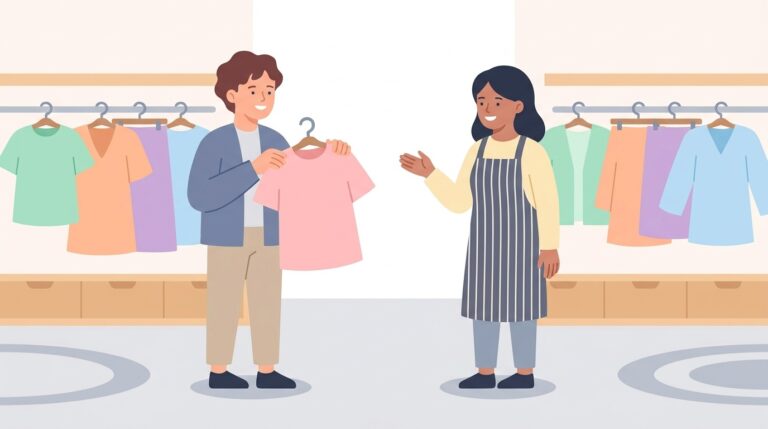
Phase 1: Empathy (Immersion Opening)
Hello! I’m the Lead Editor at Daily Hangul.
Picture this: You are walking down the vibrant streets of Hongdae. You walk into a trendy little boutique, and you spot it—the perfect coat. It’s exactly the style you saw the lead actress wearing in your favorite K-Drama. There’s just one tiny problem: the one on display is neon pink, and your aesthetic is strictly ‘all black everything.’
The friendly shop assistant approaches you with a warm smile. You want to ask, ‘Do you have this in black?’ or ‘Do you have another color?’… but the words get stuck. You end up just pointing at the coat, then pointing at your black t-shirt, hoping they get the hint.
Sound familiar? Don’t worry! Every beginner learning Korean has been there. Today, we are going to learn exactly what to say in a Korean clothing store so you can shop like a true local, without the awkward charades.
Note: This guide is based on real questions from our A1 beginner students who survived the underground shopping malls of Seoul!
Phase 2: Deep Dive into Core Expressions
Let’s break down the most essential phrases you need for your Seoul shopping spree.
1. 다른 색깔 있어요? (Do you have another color?)
- Pronunciation: dareun saekkal isseoyo?
- dareun sounds like ‘da-rune’ (with a soft r).
- saekkal sounds like ‘sack-kal’.
- isseoyo sounds like ‘ee-soh-yo’.
- Meaning:
- Literal: Different color exist?
- Real: Do you have this in a different color?
- K-Culture Moment: In bustling places like Myeongdong or Gotomall (Gangnam Terminal Underground Shopping Center), items are often tightly packed. The display might only show one color. Asking this simple phrase will prompt the clerk to magically pull out three other colors from a hidden drawer!
- Editor’s Insight: Notice that there is no ‘you’ or ‘I’ in this sentence. In Korean, if the context is obvious, we drop the subjects! It feels much more direct but polite.
- Situation Spectrum:
- Casual (Friends): ⚠️ (Use ‘있어?’ instead)
- Semi-formal (Store clerks): ✅
- Formal (Elders/Boss): 🚫 (Not used for people!)
- 🤔 Think About It: Why doesn’t Korean use ‘you’ (당신) when talking to a store clerk? In Korean culture, using the word ‘you’ directly to a stranger can actually sound confrontational. It’s much more polite to just talk about the object!
2. 더 큰 사이즈 있어요? (Do you have a bigger size?)
- Pronunciation: deo keun saijeu isseoyo?
- deo sounds like ‘duh’.
- keun rhymes with the disgusted sound you make when stepping in gum (‘ugh’) plus an ‘n’.
- saijeu is just the English word ‘size’ with a Korean accent (‘sah-ee-juh’).
- Meaning:
- Literal: More big size exist?
- Real: Do you have this in a larger size?
- K-Culture Moment: You might notice many Korean clothes are labeled ‘Free Size’ (프리사이즈). But if you’re shopping in a larger brand store or a department store, they have specific sizes. This is your go-to phrase!
- Editor’s Insight: ‘더 (deo)’ means ‘more’. You can put it in front of almost any adjective!
- Situation Spectrum:
- Casual: ⚠️
- Semi-formal: ✅
- Formal: ✅
- 🤔 Think About It: English borrows words from other languages, and so does Korean! We call these ‘Konglish’ (Korean + English). ‘Size’ (사이즈) is one of them. Can you spot other English words when Koreans speak?
3. 입어봐도 돼요? (Can I try this on?)
- Pronunciation: ibeobwado dwaeyo?
- ibeo sounds like ‘ee-buh’.
- bwado sounds like ‘bwa-doh’.
- dwaeyo sounds like ‘dway-yo’.
- Meaning:
- Literal: Wear and see is okay?
- Real: Can I try this on?
- K-Culture Moment: You grab a cute top and head to the fitting room. Before you walk in, make eye contact with the staff, lift the hanger slightly, and ask this. It shows great manners!
- Editor’s Insight: This phrase asks for permission. It’s soft, polite, and essential for navigating any retail space in Korea.
- Situation Spectrum:
- Casual: ⚠️
- Semi-formal: ✅
- Formal: ✅
- 🤔 Think About It: Korean culture values respect for shared spaces. Asking before acting (like entering a fitting room) is deeply tied to ‘Nunchi’ (reading the room).
Phase 3: Textbook vs. Real Korean
Textbooks often teach you the most formal, robotic ways to speak. Here is how people actually talk on the streets of Seoul.
[Situation 1: Asking for a different color]
* 📖 Textbook Korean: 이것과 다른 색깔을 보여 주시겠습니까? (Would you please show me a different color from this one?)
* 🗣️ Real Korean: 이거 다른 색 있어요? (igeo dareun saek isseoyo?)
* 💡 Why the difference?: Koreans love efficiency (‘Palli-palli’ culture). We shorten ‘saekkal’ (color) to just ‘saek’ and drop unnecessary grammar particles.
[Situation 2: When you are just browsing]
* 📖 Textbook Korean: 저는 단지 물건을 구경하고 있습니다. (I am merely observing the merchandise.)
* 🗣️ Real Korean: 그냥 보는 거예요. (geunyang boneun geoyeyo. – Just looking.)
* 💡 Why the difference?: A polite but firm ‘Just looking’ in casual everyday language prevents the clerk from following you too closely.
Bottom Note: For A1 beginners, sticking to phrases ending in ‘~있어요?’ (isseoyo) is the ultimate life hack. It is polite, natural, and easy to memorize!
Phase 4: Cultural Context — K-Culture Deep Dive
4-1. Non-verbal Communication
When asking ‘다른 색깔 있어요?’ (Do you have another color?), non-verbal cues are just as important as the words:
* The ‘Hanger Lift’: Gently lift the hanger or the sleeve of the clothing item slightly toward the clerk as you ask.
* Eye Contact: Make brief eye contact to get their attention, but you don’t need to stare them down.
* Nunchi in the store: If the store is incredibly busy (like during a weekend sale), wait until the clerk finishes with another customer. Tapping them on the shoulder is a big no-no. A simple ‘저기요’ (Jeogiyo – Excuse me) works best.
4-2. K-Travel Connection: The Fitting Room Etiquette
If you plan to travel to Korea, you must know about the Face Cover (페이스 커버).
If you ask ‘입어봐도 돼요?’ (Can I try this on?) and you are holding a top or a dress, the clerk will likely hand you a sheer white cloth bag. This is a face cover. Because K-Beauty standards involve wearing foundation and lip tints, stores require you to put this cover over your head before pulling the shirt on, to prevent makeup stains. If you don’t use it and stain the shirt, you might have to buy it!
Phase 5: Real-Life Roleplay Scenario
Setting: A bustling, neon-lit boutique in Hongdae on a Saturday afternoon. K-Pop music is blasting in the background. Racks are packed with clothes.
Characters:
* YOU: A traveler who just spotted the jacket of your dreams, but it’s bright yellow.
* Min-ji (20s): The stylish, fast-moving store clerk.
Dialogue:
Min-ji: 찾으시는 거 있으세요? 😊
(chajeusineun geo isseuseyo?)
[Translation] Are you looking for anything in particular?
YOU: 아, 이거 다른 색깔 있어요?
(a, igeo dareun saekkal isseoyo?)
[Translation] Ah, do you have this in another color?
Min-ji: 네, 검은색이랑 하얀색 있어요. 보여드릴까요?
(ne, geomeunsaegirang hayansaek isseoyo. boyeodeurilkkayo?)
[Translation] Yes, we have black and white. Shall I show you?
YOU: 검은색 부탁드려요.
(geomeunsaek butakdeuryeoyo.)
[Translation] The black one, please.
(🎭 Stage Direction: Min-ji grabs the black jacket from the back and hands it to you.)
Min-ji: 여기 있습니다. 걸쳐보셔도 돼요.
(yeogi itseumnida. geolchyeobosyeodo dwaeyo.)
[Translation] Here you go. You can try putting it on.
🔀 Your Turn! The jacket feels a bit tight. What do you say?
– A) 이거 안 좋아요. (igeo an joayo. – This is not good.)
– B) 더 큰 사이즈 있어요? (deo keun saijeu isseoyo? – Do you have a bigger size?)
– C) 당신은 큰 옷이 있어요? (dangsineun keun osi isseoyo? – Do you have big clothes?)✅ Best Choice: B — It perfectly communicates your need politely.
⚠️ Choice A Analysis: Too blunt! It sounds like you are insulting the jacket.
⚠️ Choice C Analysis: Remember Phase 2? Using ‘당신’ (you) sounds very unnatural and almost confrontational.
Phase 6: 10-Second Shadowing Drill
Practice speaking out loud! Follow the slashes (/) for natural pausing and intonation.
- 🧐 (Curiously) 이거 / 다른 색깔 / 있어요?
(igeo / dareun saekkal / isseoyo?) -
🥺 (Hoping for a yes) 더 / 큰 사이즈 / 있어요?
(deo / keun saijeu / isseoyo?) -
😊 (Politely asking) 이거 / 입어봐도 / 돼요?
(igeo / ibeobwado / dwaeyo?)
Phase 7: K-Culture Mini Dictionary
Here are 4 words you will absolutely see or hear when shopping in Korea!
1. 프리사이즈
* Romanization: peurisaijeu
* English: Free Size
* Context: ‘One size fits all.’ However, in Korea, this usually translates to a standard Women’s Small or Medium.
2. 눈팅
* Romanization: nunting
* English: Window shopping / Just looking
* Context: A slang combining ‘눈’ (eye) and ‘팅’ (from chatting). It means just looking at things with your eyes without buying.
3. 핏
* Romanization: pit
* English: Fit
* Context: Koreans use ‘fit’ almost like an adjective. If a coat looks great on you, someone will say ‘오, 핏이 예쁘다!’ (Oh, the fit is pretty!).
4. 지하상가
* Romanization: jihasangga
* English: Underground shopping mall
* Context: Located inside subway stations (like Gangnam or Express Bus Terminal). They offer the trendiest clothes at incredibly cheap prices, but you usually can’t try things on!
Phase 8: Traveler Survival Kit
Getting ready to hit the shops in Myeongdong? Keep these in your back pocket!
🆘 Survival Phrases for Shopping
– 🇰🇷 ‘이거 얼마예요?’ (igeo eolmayeyo?)
– 🗣️ Meaning: How much is this?
– 🇰🇷 ‘카드로 계산할게요.’ (kadeuro gyesanhalgeyo)
– 🗣️ Meaning: I will pay with a card.
– 🇰🇷 ‘봉투 필요 없어요.’ (bongtu piryo eopseoyo)
– 🗣️ Meaning: I don’t need a bag.📌 Editor’s Travel Note
– Exchanges/Refunds: In underground malls or small street boutiques, returning items or getting a refund is notoriously difficult (sometimes impossible). Buy carefully! In big department stores, it’s very easy.
– Payment: Korea is a cashless society. Your Visa/Mastercard will work 99% of the time, even for a $1 pair of socks!
Phase 9: Critical Thinking Corner — ‘One Step Deeper’
Media vs. Reality: The ‘Free Size’ Phenomenon
🧠 Think Deeper:
If you watch K-Dramas, you might notice actors sporting incredibly tailored, perfectly fitting clothes. But when you step into a regular Korean street shop, you will be overwhelmed by the word ‘프리사이즈’ (Free Size). Why is ‘Free Size’ so dominant in Korea?Historically, Korea’s rapid economic growth focused on mass production and efficiency. Producing one standard size was cheaper and faster. Culturally, it also reflects a society with a relatively homogenous standard of beauty and body shape. However, this is changing! Global influences and younger generations are pushing for more inclusive sizing, and larger brands are expanding their ranges.
💬 Your Turn: Does your country have a ‘One Size Fits All’ concept for clothes? How do you feel about it? Let us know in the comments!
Phase 10: FAQ & Avoiding Misunderstandings
Q: Can I try on white shirts in Korea?
A: Mostly No. In smaller boutiques and underground malls, store owners will politely decline if you ask to try on white t-shirts, shirts, or knitwear. They get stained too easily. Don’t be offended; it’s a standard rule!
Q: Can I haggle or ask for a discount?
A: In traditional markets (like Namdaemun) or underground malls if you are paying with cash, you might get a small ‘service’ discount. But in normal street shops, department stores, or franchises? No haggling!
❌ Common Mistake #1: Pointing at the clerk and saying ‘You have another color?’
✅ Do This Instead: Remember to drop the ‘you’! Just hold up the item and say ‘다른 색깔 있어요?’ (dareun saekkal isseoyo?).
Phase 11: Summary & Action Items
One-Liner Summary: To shop smoothly in Korea, remember to drop the ‘you’ and simply ask ‘다른 색깔 있어요?’ (dareun saekkal isseoyo?).
Action Mission 3 Steps:
* 🥉 Bronze (Solo): Stand in front of your closet, hold up a shirt, and practice saying ‘다른 색깔 있어요?’ 3 times.
* 🥈 Silver (Online): Find a picture of your favorite K-Pop idol’s outfit and comment ‘핏이 예쁘다!’ (The fit is pretty!) on their post.
* 🥇 Gold (Real World): Next time you visit a Korean store or market, ask about a color or size using today’s phrases!
K-Culture Mission:
Go to a Korean online shopping site (like Musinsa or Zigzag) and browse. Can you spot the word ‘프리사이즈’ (Free Size) or ‘핏’ (Fit) in the item descriptions?
Phase 12: Quiz — Interactive Challenge
1. Situational Judgment:
You are in a Zara in Seoul. You want to try on a jacket. What is the most natural thing to say to the fitting room attendant?
– A) 안녕! (annyeong!)
– B) 이거 입어봐도 돼요? (igeo ibeobwado dwaeyo?)
– C) 당신 옷 줘. (dangsin ot jwo.)
2. True or False — K-Culture Edition:
You are allowed to try on tight white t-shirts in small Korean underground shopping malls without asking.
– True or False?
(Answers: 1: B – It is polite and natural. A is too casual for a stranger, C is rude. / 2: False – Trying on white clothes is heavily restricted in small shops due to makeup stains!)
Loved this lesson? Drop a comment below with your favorite color in English, and I’ll reply with how to say it in Korean! Happy shopping! 🛍️
Frequently Asked Questions (FAQ)
Q: What does "다른 색깔 있어요? (Do you have another color?)" mean in Korean and how do you pronounce it?
A: In Korean, "다른 색깔 있어요? (Do you have another color?)" is pronounced [dareun saekkal isseoyo?] and means: a key conversational Korean expression covered in this lesson.
Q: What does "더 큰 사이즈 있어요? (Do you have a bigger size?)" mean in Korean and how do you pronounce it?
A: In Korean, "더 큰 사이즈 있어요? (Do you have a bigger size?)" is pronounced [deo keun saijeu isseoyo?] and means: a key conversational Korean expression covered in this lesson.
Q: What does "입어봐도 돼요? (Can I try this on?)" mean in Korean and how do you pronounce it?
A: In Korean, "입어봐도 돼요? (Can I try this on?)" is pronounced [ibeobwado dwaeyo?] and means: a key conversational Korean expression covered in this lesson.







