

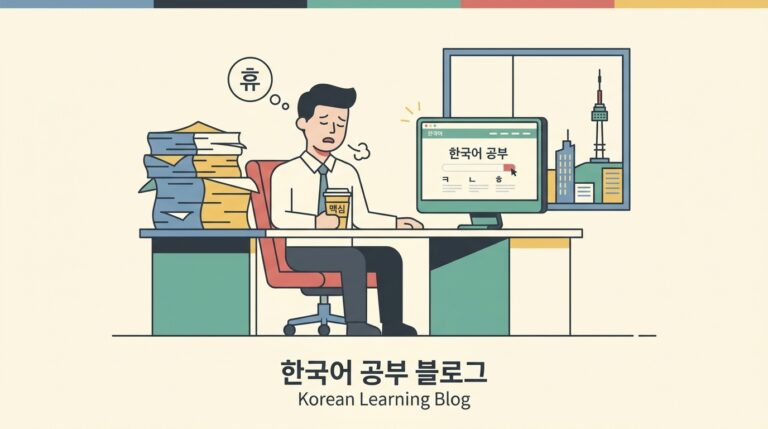
K-Drama Office Survival: How to Express Work Stress Naturally in Korean
Phase 1: Welcome to the Korean Corporate Jungle 🏢
Hello! This is the Lead Editor of Daily Hangul.
Picture this: You are watching your favorite K-Drama. The main character sits at a pojangmacha (a vibrant orange tent bar) late at night, a bottle of green soju on the table. They take a shot, let out a deep, soul-crushing sigh, and say something to their coworker. The English subtitles just say, “I’m so stressed.”
But as a veteran Korean tutor who has lived in Seoul for over a decade, let me tell you a secret: they didn’t just say “I am stressed.” They used a colorful, dramatic expression that perfectly captures the intensity of Korean office life.
Working in Korea—or even just talking to your Korean friends about work—can be overwhelming. If you just translate “I have a lot of work” literally, you might sound like a robot. Today, we are going completely off the textbook. We will learn how to express your frustration, bond with your coworkers over a heavy workload, and master the art of office Nunchi. This guide is built from the real tears and triumphs of my B1-level students who successfully navigated the Korean workplace. Let’s dive in!
Phase 2: Core Expressions Deep Dive 🕵️♀️
Let’s look at the absolute must-know expressions to vent your work stress like a true local.
1. 일이 산더미예요 (I have a mountain of work)
- Pronunciation: il-i sandeomi-yeyo [eel-ee sahn-duh-mee-yeh-yo]
- Meaning: Literal: Work is a mountain. / Real nuance: I am buried in work!
- K-Culture Moment: You’ll hear this when a coworker asks someone to grab a coffee, and they frantically point at their dual monitors. It’s a slightly dramatic but universally understood plea for sympathy.
- Editor’s Insight: 산더미 means a huge pile or mountain. Koreans love using visual metaphors to express the scale of their emotions or situations.
- Situation Spectrum:
- Close Friends (Casual): ✅ (일이 산더미야!)
- Coworkers (Semi-formal): ✅
- Boss/Seniors (Formal): ⚠️ (Use cautiously; you don’t want to sound like you’re complaining to the person who gave you the work!)
- 🤔 Think About It: Why do Koreans use geographic metaphors like “mountains” to describe abstract things like work? Does your native language have a similar physical metaphor for stress?
2. 오늘 야근각이에요 (It looks like I’m doing overtime today)
- Pronunciation: oneul yageun-gak-i-e-yo [oh-neul yah-geun-gahk-ee-eh-yo]
- Meaning: Literal: Today is an overtime angle. / Real nuance: I am 100% sure I’m stuck here working late tonight.
- K-Culture Moment: It’s 5:30 PM. The boss suddenly hands over a new project folder. The junior employees exchange a knowing look and text each other this exact phrase via the office messenger.
- Editor’s Insight: 야근 means night work (overtime). The slang suffix -각 (angle) comes from gaming culture, meaning “the setup is perfectly aligned for [X] to happen.” It’s extremely trendy and makes you sound like a true insider.
- Situation Spectrum:
- Close Friends (Casual): ✅
- Coworkers (Semi-formal): ✅
- Boss/Seniors (Formal): 🚫 (Never use slang with the boss!)
- 🤔 Think About It: The integration of gaming terms into daily office slang shows how heavily internet culture influences modern Korean. Are there slang words in your language that started online and moved into the office?
3. 스트레스 받아서 죽을 것 같아요 (I feel like I’m going to die from stress)
- Pronunciation: seuteureseu badaseo jugeul geot gatayo [seu-teu-reh-seu bah-dah-suh joo-geul gut gah-tah-yo]
- Meaning: Literal: I am receiving stress so it seems like I will die. / Real nuance: I’m so stressed I can’t take it anymore.
- K-Culture Moment: A dramatic scene in a drama where the protagonist storms out to the company rooftop, takes a deep breath of Seoul air, and screams this to their best friend over the phone.
- Editor’s Insight: Notice the verb 받다 (to receive). In Korean, you don’t “have” stress; you “receive” it. Also, adding 죽을 것 같다 (feels like I’ll die) is a common hyperbole in Korean to emphasize intense feelings.
- Situation Spectrum:
- Close Friends (Casual): ✅
- Coworkers (Semi-formal): ⚠️ (Only with close coworkers)
- Boss/Seniors (Formal): 🚫
- 🤔 Think About It: Koreans frequently use the phrase “feels like I’ll die” for positive things too (e.g., “It’s so delicious I could die”). Why do you think such extreme expressions are so common in everyday conversation?
Phase 3: Textbook vs. Real Korean 📚🗣️
Let’s compare what you studied in your B1 workbook with what you’ll actually hear in a Gangnam office.
[When describing a heavy workload]
* 📖 Textbook Korean: 저는 오늘 일이 아주 많습니다. (I have a lot of work today.)
* 🗣️ Real Korean: 하아… 오늘 일이 산더미네요. (Sigh… I’ve got a mountain of work today.)
* 💡 Why the difference?: Real Korean office conversation relies heavily on shared empathy. Adding a sigh and a metaphor invites the listener to comfort you, rather than just stating a dry fact.
[When realizing you have to stay late]
* 📖 Textbook Korean: 저는 오늘 밤에 늦게까지 일해야 합니다. (I must work until late at night today.)
* 🗣️ Real Korean: 아, 완전 야근각. 저 먼저 갈게요… (Ah, total overtime vibes. I’m a goner…)
* 💡 Why the difference?: Efficiency is key! Younger generations prefer punchy slang like 야근각 to convey complex, miserable situations in just three syllables.
Bottom Note: At a B1 level, you want to sound natural but polite. Use the “Real Korean” phrases with the -요 ending (e.g., 야근각이에요) when speaking to coworkers to hit that perfect sweet spot of friendly but respectful.
Phase 4: Cultural Context — K-Culture Deep Dive 🇰🇷
4-1. Non-verbal Cues: The Art of the “Office Sigh” 😮💨
Language isn’t just about words; it’s about how you carry yourself. When expressing stress in a Korean office, you rarely just state it with a straight face. You might softly massage the back of your neck (a classic K-Drama move indicating high blood pressure or stress).
More importantly, understand 눈치 (Nunchi) here. If your senior coworker is visibly stressed and sighing, your Nunchi should tell you not to ask them a trivial question right then. Conversely, your coworkers will use their Nunchi to read your stress levels, often resulting in them sliding a sweet treat onto your desk.
4-2. The “Mix Coffee” Therapy ☕
In countless office K-Dramas (like Misaeng), when the workload gets unbearable, you’ll see characters head to the office pantry. They rip open a small yellow packet of 맥심 믹스커피 (Maxim Mix Coffee), stir it with the wrapper, and stare blankly out the window.
In Korean corporate culture, asking a stressed coworker, “믹스커피 한잔 하실래요?” (Would you like a cup of mix coffee?) is the ultimate gesture of solidarity. The sugar and caffeine hit is an instant stress reliever, but the 5-minute vent session away from the desks is the real medicine. Next time you see a coworker drowning in work, offer them a Mix Coffee!
Phase 5: Real-Life Roleplay Scenario 🎭
Setting: It’s 7:30 PM on a Thursday. A Pojangmacha near your office. The smell of spicy stir-fried pork and the sound of clinking glasses fill the air. You are having a quick drink with your friendly Korean coworker, Minsu.
Characters:
– YOU: A foreign employee who has been overwhelmed with translation tasks all week.
– Minsu (32): Your supportive, slightly goofy Korean coworker who noticed you struggling.
Minsu: 00씨, 이번 주 내내 표정이 안 좋네요. 무슨 일 있어요?
(00-ssi, ibeon ju naenae pyojeong-i an jonneyo. Museun il isseoyo?)
[00, you haven’t looked good all week. Is something wrong?]
(🎭 Stage Direction: Minsu pours you a small glass of beer with a concerned look.)
YOU: 아… 네. 사실 요즘 스트레스를 너무 많이 받아서요.
(Ah… ne. Sasil yojeum seuteureseu-reul neomu mani badaseoyo.)
[Ah… yes. Actually, I’ve been receiving so much stress lately.]
Minsu: 에고, 새로운 프로젝트 때문이죠? 팀장님이 일을 너무 많이 주셨어요.
(Ego, saeroun peurojekteu ttaemunijyo? Timjangnim-i ir-eul neomu mani jusyeosseoyo.)
[Oh man, is it because of the new project? The team leader gave you too much work.]
🔀 Your Turn! How should you respond?
– A) 네. 팀장님이 너무 나빠요. (Yes. The team leader is very bad.)
– B) 맞아요. 일이 산더미라서 죽을 것 같아요. (That’s right. I have a mountain of work, I feel like I’m going to die.)
– C) 저는 야근을 좋아합니다. (I like working overtime.)✅ Best Choice: B — Reason: It uses natural B1-level expressions to safely vent to a peer.
⚠️ Choice A Analysis: Even with peers, outright calling the boss “bad” can be risky in a Korean workplace. It’s safer to blame the amount of work rather than directly insulting the boss’s character.
YOU: 맞아요. 일이 산더미라서 죽을 것 같아요.
(Majayo. Il-i sandeomi-raseo jugeul geot gatayo.)
[That’s right. I have a mountain of work, I feel like I’m going to die.]
Minsu: ㅋㅋㅋ 이해해요. 저도 오늘 완전 야근각이에요. 우리 마시고 잊어버려요! 건배!
(ㅋㅋㅋ ihaehaeyo. Jeodo oneul wanjeon yageun-gak-i-e-yo. Uri masigo ijeobeoryeoyo! Geonbae!)
[Hahaha I understand. I’m totally looking at overtime today too. Let’s drink and forget about it! Cheers!]
Phase 6: 10-Second Shadowing Drill 🗣️⏱️
Practice this sentence until it flows naturally. Pay attention to the pauses (/) and the emotion!
😤 하아… / 일이 / 산더미라서 / 오늘 / 야근각이에요.
(Haa… / ir-i / sandeomi-raseo / oneul / yageun-gak-i-e-yo.)
[Deep sigh]… Because work is a mountain, it looks like I’m doing overtime today.
Pronunciation Tip: When saying “하아…” (Haa…), physically drop your shoulders. The sigh is 50% of the vocabulary!
Phase 7: K-Culture Mini Dictionary 📖
Here are 4 essential keywords to survive Korean office culture:
1. 눈치
* Romanization: nunchi
* English: Situational awareness / emotional intelligence
* Context: The quintessential Korean social skill of reading the room. If your boss is angry, having nunchi means you quietly do your work and don’t ask for vacation time today.
2. 야근
* Romanization: yageun
* English: Overtime / Night work
* Context: A historically common part of Korean corporate culture. Though work-life balance is improving, yageun is still a frequent reality when deadlines loom.
3. 회식
* Romanization: hoesik
* English: Company dinner
* Context: After-work gatherings with coworkers and bosses, usually involving BBQ and alcohol. It’s considered an extension of work, used for team bonding.
4. 워라밸
* Romanization: worabael
* English: Work-Life Balance
* Context: A Konglish abbreviation (Work-Life Balance). Younger employees value worabael highly, often choosing it over higher salaries.
Phase 8: Traveler Survival Kit 🎒
Even if you aren’t working in Korea, travel can be exhausting! What if you get stressed and tired from a heavy travel itinerary?
🆘 Survival Phrases for the Exhausted Traveler
– 🇰🇷 “피로회복제 하나 주세요.” (piro-hoebok-je hana juseyo.)
– 🗣️ Pronunciation: [pee-ro-hweh-bohk-jeh ha-nah joo-seh-yo]
– 📍 Where to use: Pharmacies (약국) or Convenience Stores (편의점)
– 💡 Pro Tip: 피로회복제 translates to “fatigue recovery medicine.” If you say this at a pharmacy, they will usually hand you a small brown bottle of Bacchus (박카스), the legendary Korean energy drink that fuels tired office workers and tourists alike!
📌 Editor’s Travel Note
– Feeling stressed from getting lost? Use Naver Map or KakaoMap. Google Maps does not work well for walking directions in Korea!
– Late night taxi stress: If you stayed out late (maybe at a hoesik or just exploring), use the Kakao T app to call a taxi. Flagging one down on the street at midnight in Gangnam is a true test of your stress limits.
Phase 9: Critical Thinking — “A Step Deeper” 🧠
Corporate Culture & Collectivism: The Power of “수고하셨습니다”
In Korean workplaces, when leaving for the day, you never just say “Goodbye.” You say “수고하셨습니다” (Sugohasyeotseumnida), which roughly translates to “You worked hard” or “Thank you for your effort.” Why is this so crucial? Korean corporate culture is deeply rooted in collectivism. Acknowledging someone’s hard work is a way of saying, “I see the stress you are enduring for the sake of our team.” It validates their sandeomi (mountain) of work. It shows that in Korea, surviving a heavy workload isn’t just an individual struggle; it’s a shared communal experience.
💬 Your Turn: How do you say goodbye to coworkers in your country? Do you acknowledge their hard work, or is it a simple “See you tomorrow”? Share in the comments below!
Phase 10: FAQ & Avoiding Misunderstandings 🛑
Q: Can I use “야근각이에요” to my boss?
A: NO! Slang with the suffix -각 is strictly for peers or close junior colleagues. To your boss, stick to the textbook: “오늘 야근해야 할 것 같습니다” (I think I will have to work overtime today).
Q: If my Korean friend says they are stressed, should I offer solutions?
A: Maybe later. First, just empathize. Say “아이고… 진짜 힘들겠다” (Oh man… that must be really hard). Unsolicited advice can break the nunchi!
❌ Common Mistake #1: Translating “I am stressed” as “나는 스트레스이다” (I am the stress).
✅ Do this instead: Always use the verb 받다 (to receive) -> “스트레스를 받아요” (I receive stress).
Phase 11: Summary & Action Items 🎯
- One-Liner Summary: When work is burying you in Korea, remember you “receive” stress, your work is a “mountain” (산더미), and you’re likely facing the “overtime angle” (야근각).
Your 3-Step Action Mission:
– 🥉 Bronze (Solo): Stand in front of a mirror, let out a dramatic K-Drama sigh, and say “아… 일이 산더미예요” three times.
– 🥈 Silver (Online): Tweet or post on a language learning app: “Studying Korean is fun but vocabulary is 산더미예요! 😅”
– 🥇 Gold (Real World): Next time your Korean friend or tutor looks tired, ask them: “요즘 일이 산더미예요?” (Do you have a mountain of work lately?)
🎬 K-Culture Mission: Watch one episode of a Korean office drama (like Misaeng or Business Proposal). Spot the exact moment a character drinks mix coffee or rubs the back of their neck from stress!
Phase 12: Interactive Quiz 📝
Test your new office survival skills!
1. Situational Judgment: Your boss asks you if you can finish a massive report by tonight. You realize you’ll be staying late. What is the most appropriate thing to say to your BOSS?
– A) 부장님, 오늘 야근각이에요.
– B) 네, 오늘 늦게까지 일해야 할 것 같습니다.
– C) 일이 산더미라서 죽을 것 같아요.
2. Fill in the Blank:
Koreans don’t “have” stress, they “______” stress.
(Korean: 저는 요즘 스트레스를 많이 _______.)
3. True or False – K-Culture Edition:
If a Korean coworker is sighing heavily at their desk, the best thing to do with your Nunchi is to immediately ask them a lot of questions about their weekend to cheer them up. (T/F)
(Answers: 1: B – Never use slang like A or dramatic phrasing like C with the boss! / 2: 받아요 (receive) / 3: False – Read the room (nunchi) and give them space, or quietly offer a coffee!)
Did you enjoy this lesson? Don’t let your Korean studies become a mountain of stress! Bookmark this page and take it one step at a time. 화이팅! (Fighting!)
Frequently Asked Questions (FAQ)
Q: What does "일이 산더미예요 (I have a mountain of work)" mean in Korean and how do you pronounce it?
A: In Korean, "일이 산더미예요 (I have a mountain of work)" is pronounced [il-i sandeomi-yeyo [eel-ee sahn-duh-mee-yeh-yo] and means: Literal: Work is a mountain. / Real nuance: I am buried in work!
Q: What does "오늘 야근각이에요 (It looks like I'm doing overtime today)" mean in Korean and how do you pronounce it?
A: In Korean, "오늘 야근각이에요 (It looks like I'm doing overtime today)" is pronounced [oneul yageun-gak-i-e-yo [oh-neul yah-geun-gahk-ee-eh-yo] and means: Literal: Today is an overtime angle. / Real nuance: I am 100% sure I'm stuck here working late tonight.
Q: What does "스트레스 받아서 죽을 것 같아요 (I feel like I'm going to die from stress)" mean in Korean and how do you pronounce it?
A: In Korean, "스트레스 받아서 죽을 것 같아요 (I feel like I'm going to die from stress)" is pronounced [seuteureseu badaseo jugeul geot gatayo [seu-teu-reh-seu bah-dah-suh joo-geul gut gah-tah-yo] and means: Literal: I am receiving stress so it seems like I will die. / Real nuance: I'm so stressed I can't take it anymore.







