

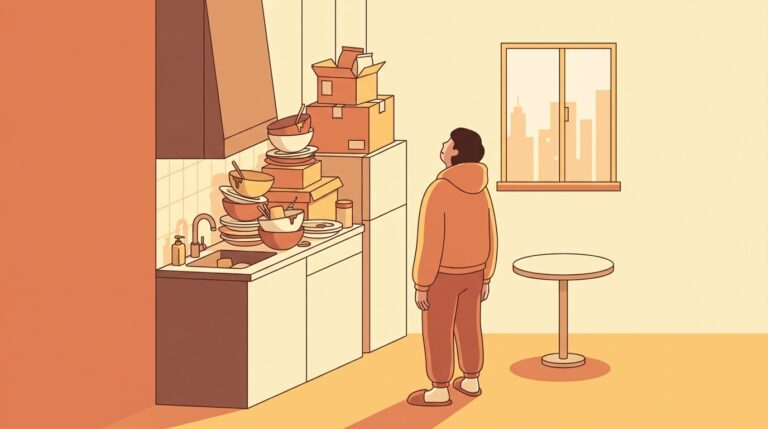
Phase 1: Empathy (Immersion Open)
Hello! I’m your Daily Hangul Editor.
Picture this: It’s Sunday evening. You’ve just finished a delicious meal of delivery Tteokbokki and fried chicken while binge-watching your favorite K-Drama. The credits roll, and you finally look over at your sink. It’s overflowing with delivery containers, greasy plates, and sticky chopsticks. In dramas, the protagonist usually lets out a dramatic sigh, stares at the ceiling, and mutters something under their breath before flopping onto their bed.
Have you ever felt that exact vibe? That universal feeling of “I really, really don’t want to do this right now”?
If you only know the textbook phrase “I do not want to wash the dishes” (저는 설거지를 하고 싶지 않습니다), you’re missing out on a massive part of Korean daily life. Knowing how to express this specific, heavy chore-dread won’t just help you complain—it will make you sound incredibly fluent. Plus, if you have a Korean roommate or partner, these phrases are your ultimate survival tools for negotiating chore duties! Let’s dive in.
Phase 2: Core Expressions Deep Dive
1. 설거지가 산더미야.
- Pronunciation: seolgeojiga sandeomiya. [sul-geo-ji-ga san-duh-mi-ya]
- Meaning: Literal: The dishes are a mountain. / Real nuance: There’s a massive pile of dishes to do.
- K-Culture Moment: You’ll often hear this phrase on reality TV shows like I Live Alone (나 혼자 산다) when the camera zooms in on a celebrity’s messy kitchen sink after a weekend of doing nothing.
- Editor’s Insight: The word ‘산더미’ (mountain-like pile) is crucial here. Koreans love using exaggerations to express frustration. You can use this for anything that piles up: “일이 산더미야” (I have a mountain of work) or “빨래가 산더미야” (I have a mountain of laundry).
- Situation Spectrum:
- Casual with friends/roommates: ✅
- Semi-formal with close colleagues: ⚠️ (Only if complaining about your own home)
- Formal/Boss: 🚫
- 🤔 Think About It: Why do Koreans use nature metaphors like “mountain” (산) to describe daily stress? Does your native language have a similar way of exaggerating chores?
2. 설거지하기 너무 귀찮아.
- Pronunciation: seolgeojihagi neomu gwichana. [sul-geo-ji-ha-gi nuh-mu gwee-chan-ah]
- Meaning: Literal: Doing dishes is too bothersome. / Real nuance: I really can’t be bothered to do the dishes; it’s such a hassle.
- K-Culture Moment: If you’re texting a Korean friend asking what they’re doing, and they reply with a photo of a messy sink, this is the exact phrase they’ll type next.
- Editor’s Insight: The word 귀찮다 (to be bothersome/a hassle) is the absolute soul of Korean daily complaints. It’s not that you “hate” the dishes (싫다); it’s that the physical and mental effort required feels overwhelmingly exhausting at this exact moment.
- Situation Spectrum:
- Casual with friends: ✅
- Semi-formal with colleagues: ⚠️
- Formal/Boss: 🚫
- 🤔 Think About It: Korean culture is famous for being fast-paced (빨리빨리 – ppalli-ppalli). Do you think the frequent use of “귀찮다” is a psychological reaction to this high-pressure, high-efficiency society?
3. 우리 설거지 가위바위보 할래?
- Pronunciation: uri seolgeoji gawibawibo hallae? [oo-ri sul-geo-ji ga-wi-ba-wi-bo hal-lae?]
- Meaning: Literal: Shall we do rock-paper-scissors for the dishes? / Real nuance: Let’s play rock-paper-scissors to decide who washes up.
- K-Culture Moment: On every Korean variety show, from Running Man to idol reality series, whenever there is a chore to be done or a bill to be paid, the ultimate decider is a game of rock-paper-scissors (가위바위보).
- Editor’s Insight: This is the ultimate “Insider” phrase. If you are sharing a meal with Korean friends at home and you suggest this, they will instantly recognize you as someone who truly understands Korean culture.
- Situation Spectrum:
- Casual with friends: ✅
- Semi-formal with colleagues: 🚫
- Formal/Boss: 🚫
- 🤔 Think About It: Why do Koreans rely on games to settle minor disputes or assign chores rather than just taking turns?
Phase 3: Textbook vs. Real Korean
[Situation 1: Expressing your dislike for the chore]
* 📖 Textbook Korean: 저는 설거지하는 것을 싫어합니다. (I do not like washing dishes.) – Too robotic and formal.
* 🗣️ Real Korean: 아, 설거지 극혐. (Ah, doing dishes is extreme disgust.)
* 💡 Why is it different?: ‘극혐’ (극도로 혐오하다 – extreme disgust) is popular internet slang adopted into daily speech to dramatically and comically express a minor annoyance.
[Situation 2: Postponing the chore]
* 📖 Textbook Korean: 설거지를 나중에 하겠습니다. (I will do the dishes later.)
* 🗣️ Real Korean: 설거지는 내일의 나에게 맡긴다. (I leave the dishes to tomorrow’s me.)
* 💡 Why is it different?: This humorous, slightly dramatic phrase reflects the modern millennial/Gen Z coping mechanism of procrastination—treating your future self as a completely different person.
Phase 4: Cultural Context — K-Culture Deep Dive
4-1. Non-Verbal Cues: The Art of the Sigh
When saying “설거지가 산더미야”, the language is only 50% of the communication. The other 50% is the 한숨 (sigh). Before you say the phrase, you must look at the sink, let out a deep, defeated sigh (“하아…”), and drop your shoulders. In Korean culture, audibly sighing is a way of releasing built-up frustration (답답함). Just don’t do it in front of elders—it’s considered bad manners (버릇없다)!
4-2. K-Drama vs Reality: The Tiny Kitchen Truth
In glamorous K-Dramas, wealthy CEOs have massive marble kitchens with dishwashers. But in relatable, slice-of-life dramas (or reality shows like I Live Alone), you’ll see the reality of Korean single-person households (1인 가구). Many young Koreans live in a ‘원룸’ (One-room/Studio apartment) where the kitchen sink is literally two steps away from the bed. Because the space is so small, leaving dishes in the sink instantly ruins the vibe of the entire apartment. That’s why the dread of “설거지” is so culturally potent—you literally cannot escape the sight of that mountain of dishes!
Phase 5: Real-Life Roleplay Scenario
Setting: Sunday night, 8 PM. You and your Korean roommate, Min-su, just finished a massive meal of delivery Jokbal (pig’s trotters) in your shared apartment. The table is a mess of bones, sauce packets, and empty plastic containers. The sink is already full of yesterday’s mugs.
Characters:
– YOU: An expat living in Seoul, trying to navigate shared chores.
– Min-su (28): Your Korean roommate. Friendly, but currently experiencing a massive food coma.
Dialogue:
Min-su: 와, 진짜 배부르다. 배 터질 것 같아. 😮💨
(wa, jinjja baebureuda. bae teojil geot gata.)
[Wow, I’m so full. I feel like my stomach is going to burst.]
YOU: 나도. 족발 진짜 맛있었어. 🍖
(nado. jokbal jinjja masisseosseo.)
[Me too. The Jokbal was really delicious.]
(🎭 Stage Direction: Min-su glances at the kitchen sink and avoids eye contact)
Min-su: 근데… 저기 설거지 산더미네.
(geunde… jeogi seolgeoji sandeomine.)
[But… there’s a mountain of dishes over there.]
YOU: 하아… 설거지하기 너무 귀찮아.
(haa… seolgeojihagi neomu gwichana.)
[Sigh… Doing dishes is such a hassle.]
Min-su: 그치? 내일 아침에 할까?
(geuchi? naeil achime halkka?)
[Right? Shall we do it tomorrow morning?]
🔀 Your Turn! How should you respond?
– A) “안 돼. 지금 당장 해!” (No. Do it right now!)
– B) “우리 설거지 가위바위보 할래?” (Shall we play rock-paper-scissors for the dishes?)
– C) “저는 설거지를 하고 싶지 않습니다.” (I do not want to wash the dishes.)✅ Best Choice: B — Reason: It brings humor into a stressful situation and perfectly uses Korean cultural habits to solve a problem fairly!
⚠️ Choice A Analysis: Too aggressive and direct. It might hurt Min-su’s feelings.
⚠️ Choice C Analysis: You will sound like a broken AI translation app.
YOU: (If you chose B) 우리 설거지 가위바위보 할래? ✌️✊🖐️
(uri seolgeoji gawibawibo hallae?)
Min-su: 오, 콜! 진 사람이 다 치우기! 안내면 진 거 가위 바위 보!
(o, kol! jin sarami da chiugi! annaemyeon jin geo gawi bawi bo!)
[Oh, deal! The loser cleans everything! Rock, paper, scissors, shoot!]
Phase 6: 10-Second Shadowing Drill
Ready to sound like a native? Practice the intonation and pauses. Pay attention to the deep sigh at the beginning!
😩 하아... / 설거지 산더미인데 / 진짜 / 귀찮아.
(Haa… / seolgeoji sandeomi-inde / jinjja / gwichana.)
Emotion tags: [Deep sigh] -> [Annoyed tone on ‘sandeomi’] -> [Emphasis on ‘jinjja’] -> [Dragging out ‘gwi-chan-a’ with fatigue]
Phase 7: K-Culture Mini Dictionary
Here are 4 cultural keywords related to today’s topic:
1. 귀찮다
* Romanization: gwichanta
* English: Bothersome / Annoying / Too much of a hassle
* Context: It describes the heavy feeling of not wanting to exert physical or mental energy. It’s a cornerstone of Korean daily vocabulary.
2. 산더미
* Romanization: sandeomi
* English: A mountain-like pile
* Context: Used to exaggerate the volume of things, mostly negative things like work (일), laundry (빨래), or dishes (설거지).
3. 배달 용기
* Romanization: baedal yonggi
* English: Delivery containers
* Context: Korea’s delivery culture is world-class, but it results in a massive amount of plastic containers that need to be washed before recycling. This is often the main culprit of the “dish mountain.”
4. 가위바위보
* Romanization: gawibawibo
* English: Rock, paper, scissors
* Context: The universal Korean method for conflict resolution, from deciding who buys coffee to who takes out the trash.
Phase 8: Traveler Survival Kit
Even if you aren’t living in Korea, if you stay at a Korean Airbnb, Guesthouse, or Hanok stay, you’ll need to know basic chore vocabulary to communicate with your host!
🆘 Survival Phrases for Guesthouses
– 🇰🇷 “설거지는 제가 할게요.” (seolgeojineun jaega halgeyo.) – I will do the dishes.
– 🇰🇷 “분리수거는 어디에 해요?” (bullisugeoneun eodie haeyo?) – Where do I do the recycling?
– 🇰🇷 “주방 세제 있어요?” (jubang seje isseoyo?) – Do you have dish soap?
– 📍 Where to use: Hostels, Airbnbs, Guesthouses.📌 Editor’s Travel Note: The Strict Laws of Trash
– Recycling (분리수거): Korea has one of the strictest recycling systems in the world. You must wash out delivery containers (배달 용기) before throwing them away. Hence, the dish mountain!
– Food Waste (음식물 쓰레기): Never throw food into the regular trash. It must go into specific yellow/green food waste bags. If you don’t know where to put it, always ask your host!
Phase 9: Critical Thinking — “A Step Deeper”
🧠 Think Deeper: Media vs Reality (The Single-Person Household)
When foreigners watch K-Dramas, they often see luxurious apartments and glamorous lifestyles. However, the reality for many young Koreans living in Seoul is the ‘One-Room’ (원룸) culture. As the number of single-person households (1인 가구) skyrockets, the culture of eating alone (혼밥) and relying on delivery food has grown massively. The phrases “설거지 산더미야” and “귀찮다” aren’t just complaints about chores; they subtly reflect the exhaustion of young workers coming home to a tiny space, too tired to cook or clean, yet pressured by strict recycling rules. The “mountain of dishes” is a modern symbol of burnout.
💬 Your Turn: In your culture, what is the one household chore that everyone universally hates and complains about? Do you use delivery apps often, and how do you handle the trash? Share in the comments!
Phase 10: FAQ & Avoiding Misunderstandings
Q1: Can I use “귀찮다” when my boss asks me to do a task?
NO. Absolutely not. 🚫 If you say “귀찮아요” to an elder or a boss, it sounds incredibly disrespectful and lazy. Use this only for your own personal chores or with close friends.
Q2: What is the difference between “싫다” and “귀찮다”?
“싫다” means you actively dislike or hate something (e.g., “I hate cucumbers”). “귀찮다” means the action requires too much energy right now (e.g., “I love eating, but cooking is 귀찮다”).
❌ Common Mistake #1:
Trying to be formal by saying “저는 설거지가 귀찮습니다.”
✅ Do this instead:
“귀찮다” is inherently a casual, emotional word. If you are speaking formally, you usually just state the fact gently: “설거지가 좀 많네요” (There are quite a few dishes).
Phase 11: Summary & Action Items
- One-Liner Summary: When the sink is full and your energy is zero, use “설거지가 산더미야, 너무 귀찮아” to vent like a true local.
-
Action Mission 3 Steps:
- 🥉 Bronze (Solo): Stand in front of your sink today, let out a deep sigh, and say “설거지하기 너무 귀찮아” out loud.
- 🥈 Silver (Online): Comment below with the Korean phrase for the chore you hate the most! (Hint: Laundry is 빨래, Cleaning is 청소).
- 🥇 Gold (Real Life): Next time you eat with a Korean friend, confidently suggest “가위바위보” to decide who cleans up!
- K-Culture Mission: Watch an episode of the variety show I Live Alone (나 혼자 산다). Pay attention to the celebrity’s kitchen—can you spot the ‘mountain of dishes’ (산더미)?
Phase 12: Quiz — Interactive Challenge
Q1. You are staying at a Korean Airbnb. You finished eating delivery food but don’t know where the recycling bins are. What is the most natural thing to text your host?
A) “분리수거 너무 귀찮아요.”
B) “분리수거는 어디에 해요?”
C) “설거지가 산더미야.”
(Answer: B. A and C are too casual and inappropriate for a host!)
Q2. Fill in the blank:
To decide who takes out the trash, Koreans usually play a game of ___________ (rock-paper-scissors).
(Answer: 가위바위보 – gawibawibo)
Q3. True or False – K-Culture Edition:
In Korea, it is perfectly fine to throw leftover food scraps in the regular trash bin.
(Answer: FALSE. Korea has a strict food waste (음식물 쓰레기) disposal system!)
Frequently Asked Questions (FAQ)
Q: What does "설거지가 산더미야." mean in Korean and how do you pronounce it?
A: In Korean, "설거지가 산더미야." is pronounced [seolgeojiga sandeomiya. [sul-geo-ji-ga san-duh-mi-ya] and means: Literal: The dishes are a mountain. / Real nuance: There's a massive pile of dishes to do.
Q: What does "설거지하기 너무 귀찮아." mean in Korean and how do you pronounce it?
A: In Korean, "설거지하기 너무 귀찮아." is pronounced [seolgeojihagi neomu gwichana. [sul-geo-ji-ha-gi nuh-mu gwee-chan-ah] and means: Literal: Doing dishes is too bothersome. / Real nuance: I really can't be bothered to do the dishes; it's such a hassle.
Q: What does "우리 설거지 가위바위보 할래?" mean in Korean and how do you pronounce it?
A: In Korean, "우리 설거지 가위바위보 할래?" is pronounced [uri seolgeoji gawibawibo hallae? [oo-ri sul-geo-ji ga-wi-ba-wi-bo hal-lae?] and means: Literal: Shall we do rock-paper-scissors for the dishes? / Real nuance: Let's play rock-paper-scissors to decide who washes up.







