

Phase 1: Empathy (Immersive Opening)
Hello there! I’m your Senior Editor at Daily Hangul.
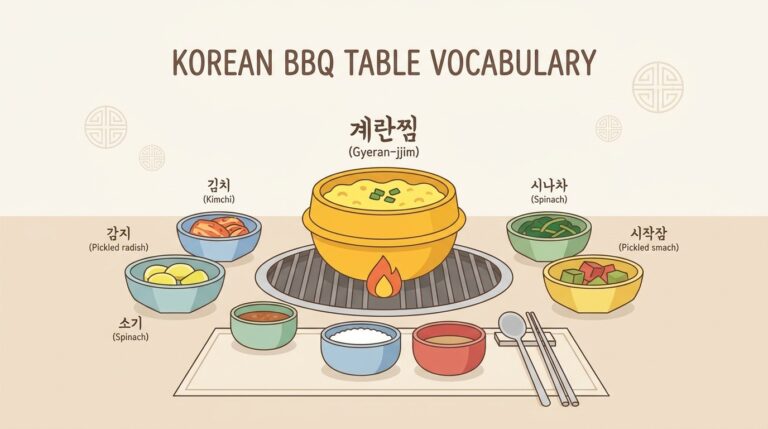
Picture this: It’s a Friday night in Seoul. You’re sitting at a vibrant, noisy BBQ restaurant (삼겹살집) with your friends. The pork belly is sizzling on the grill, the aroma of garlic is in the air, and your mouth is on fire from the spicy dipping sauce. Suddenly, the waiter drops a bubbling, volcanic, fluffy yellow cloud in a black clay pot on the table next to yours. It’s Gyeran-jjim (계란찜, steamed egg).
You want it. But wait, you look at the menu, and it’s 5,000 won. Yet, you overheard the table next to you getting it for free. You hear them say the magic word: “Service.”
If you’ve watched any K-Dramas featuring a late-night Soju tent (포장마차), you know the owner sometimes brings out a steaming bowl of soup or egg, winking and saying, “This is on the house.” But how do you actually navigate this in real life without sounding rude or demanding?
Today, we’re going to learn the delicate, highly cultural art of asking for “Service” (complimentary items) in Korea. This isn’t just about getting free food; it’s about understanding the very fabric of Korean hospitality. Let’s dive into the secret language of regular customers!
(Note: This guide is crafted from real questions asked by intermediate learners who wanted to sound less like a textbook and more like a local foodie.)
Phase 2: In-Depth Analysis of Core Expressions
1. 사장님, 이거 서비스예요?
- Pronunciation: Sajangnim, igeo seobiseuyeyo? [Sa-jang-nim, ee-geo seo-bee-seu-ye-yo?]
- Meaning: Literal: “Boss, is this a service?” / Real nuance: “Oh wow, is this on the house? Thank you!”
- K-Culture Moment: You didn’t order the Gyeran-jjim, but the owner brings it anyway because you ordered a lot of meat. You ask this with a pleasant, surprised tone. It acknowledges their generosity.
- Editor’s Insight: The word ‘서비스’ (service) in Korea doesn’t mean customer service; it specifically means a “freebie” or “complimentary item.” When using this phrase, your eyes should light up a bit!
- Situation Spectrum:
- Casual (Friends): ✅ (Used towards the restaurant owner)
- Semi-formal (Coworkers): ✅
- Formal (Seniors): ✅
- 🤔 Think About It: Why do Koreans use the English word “service” to mean “free”? How does your culture express the concept of “on the house”?
2. 혹시 계란찜 서비스로 주실 수 있나요?
- Pronunciation: Hoksi gyeranjjim seobiseuro jusil su innayo? [Hok-shee gye-ran-jjim seo-bee-seu-ro joo-shil soo in-na-yo?]
- Meaning: Literal: “By any chance, can you give steamed egg as a service?” / Real nuance: “We’re enjoying the food so much, could we possibly get some complimentary Gyeran-jjim?”
- K-Culture Moment: You’ve ordered 4 portions of meat and several drinks. The mood is great. You try your luck by politely asking the owner if a little bonus is possible.
- Editor’s Insight: The magic word here is 혹시 (hoksi – by any chance). It instantly softens the request, showing you are asking, not demanding. Combined with the polite grammar
~주실 수 있나요?(Can you give…?), it’s the perfect B2-level polite request.- Situation Spectrum:
- Casual (Friends): ⚠️ (A bit too formal for a casual eatery, but very polite)
- Semi-formal (Coworkers): ✅
- Formal (Seniors): ✅
- 🤔 Think About It: Notice how indirect the phrasing is. Why is preserving harmony and not forcing a “no” so important in Korean communication?
3. 저희 단골 할게요! 계란찜 하나만 서비스 안 될까요?
- Pronunciation: Jeo-hui dangol halgeyo! Gyeranjjim hanaman seobiseu an doelkkayo? [Jeo-hee dan-gol hal-ge-yo! Gye-ran-jjim ha-na-man seo-bee-seu ahn dwoel-kka-yo?]
- Meaning: Literal: “We will become regulars! Won’t one steamed egg work as a service?” / Real nuance: “We love it here and will come back! Could you slide us a free steamed egg?”
- K-Culture Moment: A university town pub (호프집). The students are charming the owner (이모님 – Auntie) to get some extra snacks to go with their beer.
- Editor’s Insight: This requires a bit of acting skills (애교 – aegyo). 단골 (dangol) means a regular customer. Promising to be a regular is the ultimate bargaining chip in Korean dining!
- Situation Spectrum:
- Casual (Friends): ✅
- Semi-formal (Coworkers): ⚠️ (Depends on the vibe)
- Formal (Seniors): 🚫 (Too playful if you are with strict superiors)
- 🤔 Think About It: The concept of ‘Dangol’ is built on trust. Does your culture have a specific word for the bond between a local shop owner and a frequent customer?
Phase 3: Textbook vs. Real Korean
[Asking for something free]
* 📖 Textbook Korean: 계란찜을 무료로 주시겠습니까? (Gyeranjjimeul muryoro jusigetseumnikka?)
* 🗣️ Real Korean: 사장님, 혹시 계란찜 서비스 안 될까요? (Sajangnim, hoksi gyeranjjim seobiseu an doelkkayo?)
* 💡 Why the difference?: ‘무료’ (free of charge) sounds like a banking or legal term. ‘서비스’ implies an emotional, relational exchange between the host and guest.
[Acknowledging the freebie]
* 📖 Textbook Korean: 공짜 음식을 주셔서 감사합니다. (Gongjja eumsigeul jusyeoseo gamsahamnida.)
* 🗣️ Real Korean: 와, 대박! 사장님 최고! 잘 먹겠습니다~ (Wa, daebak! Sajangnim choego! Jal meokgetseumnida~)
* 💡 Why the difference?: ‘공짜’ (free) can sound a bit cheap. Praising the owner (“Boss, you’re the best!”) shows appreciation and builds the ‘Jeong’ (affection).
Bottom Note: At a B2 level, focus on mastering the polite, indirect forms like
~주실 수 있나요?or~안 될까요?rather than direct commands. It shows high cultural fluency!
Phase 4: Cultural Context — K-Culture Deep Dive
4-1. Non-Verbal Elements
When asking for “service,” your attitude is everything. It should never feel like an entitlement.
* Eye Contact & Smile: Make eye contact with the owner, smile warmly, and slightly tilt your head.
* The Nunchi Game: Nunchi (눈치) is your ability to read the room. Don’t ask for service if you only ordered one cheap item. If your table is overflowing with empty plates and bottles, your nunchi should tell you it’s a good time to playfully ask!
4-2. K-Food Connection
Why steamed egg (Gyeran-jjim)? In Korean cuisine, meals are often about balance. If you are eating something intensely spicy like Tteokbokki (spicy rice cakes) or Dakbal (spicy chicken feet), your mouth needs a firefighter. The mild, savory, and soothing Gyeran-jjim acts as a palate cleanser and a stomach protector.
Furthermore, the “Service” culture is rooted in Jeong (정)—the Korean concept of warmth, affection, and community. An owner giving you a free steamed egg or a bottle of cola isn’t just a marketing tactic; it’s their way of saying, “I see you, I appreciate you eating well at my restaurant, let’s share a good feeling.”
Phase 5: Real-Life Roleplay Scenario
Setting: It’s 8:00 PM at a bustling spicy braised short rib (매운 갈비찜) restaurant in Hongdae. The spice level is intense. You are sweating a bit, and the drinks are flowing.
Characters:
* YOU: An expat who handles spice well, but your friends are struggling.
* Minsu: Your Korean friend, currently fanning his mouth.
* Sajangnim (Owner): A friendly, energetic middle-aged woman wearing an apron.
Dialogue:
Minsu: 아, 진짜 맵다. 물 좀 더 마셔야겠어. 🥵
(A, jinjja maepda. Mul jom deo masyeoyagesseo.)
[Ah, it’s really spicy. I need to drink more water.]
(🎭 Stage Direction: Minsu downs his glass of water.)
YOU: 그러니까요. 우리 계란찜 하나 시킬까요?
(Geureonilkkayo. Uri gyeranjjim hana sikilkkayo?)
[I know, right. Should we order a steamed egg?]
Minsu: 잠깐만, 우리가 고기를 3인분이나 먹었잖아. 사장님한테 한 번 물어볼게. 저기요, 사장님!
(Jamkkanman, uriga gogireul saminbunina meogeotjana. Sajangnimhante han beon mureobolge. Jeogiyo, sajangnim!)
[Wait, we ate 3 portions of meat. I’ll ask the owner. Excuse me, Boss!]
Sajangnim: 네~ 필요한 거 있으세요?
(Ne~ piryohan geo isseuseyo?)
[Yes~ Do you need anything?]
(🎭 Stage Direction: She walks over, wiping her hands on her apron.)
🔀 Your Turn! Minsu nudges you to practice your Korean. How do you ask?
– A) “사장님, 저희 계란찜 무료로 주세요!” (Boss, give us steamed egg for free!)
– B) “사장님, 고기 너무 맛있어요! 혹시… 계란찜 서비스 안 될까요? ㅎㅎ”
– C) “계란찜 하나 추가할게요.”✅ Best Choice: B — Reason: You start with a compliment (the food is delicious), then use the magic word “Hoksi” and a soft, indirect question. This is peak B2 level communication!
⚠️ Choice A Analysis: This sounds like a demand and is considered very rude.
⚠️ Choice C Analysis: Perfectly fine if you want to pay, but you miss out on the cultural interaction of asking for service.
Sajangnim: (Laughing) 아이고, 외국인 손님이 한국말을 너무 잘하네! 알겠어요. 맛있게 드시니까 내가 하나 서비스로 줄게요!
(Aigo, oegugin sonnimi hangungmareul neomu jalhane! Algesseoyo. Masitge deusinikka naega hana seobiseuro julgeyo!)
[Oh my, our foreign guest speaks Korean so well! Alright. Since you are eating so well, I’ll give you one as a service!]
YOU: 우와, 감사합니다! 잘 먹겠습니다!
(Uwa, gamsahamnida! Jal meokgetseumnida!)
[Wow, thank you! We will eat it well!]
Phase 6: 10-Second Shadowing Drill
Let’s practice the most natural way to ask. Pay attention to the pauses (/) and the feeling!
🥺 애교 섞어서 (With a slightly pleading, friendly tone)
사장님~ / 고기가 너무 맛있어요! / 혹시 / 계란찜 / 서비스로 주실 수 있나요? ㅎㅎ
(Sajangnim~ / gogiga neomu masisseoyo! / hoksi / gyeranjjim / seobiseuro jusil su innayo?)
Phase 7: K-Culture Mini-Dictionary
1. 서비스 (Seobiseu)
* Romanization: seobiseu
* English: Complimentary item / On the house
* Context: In Korean restaurants, it refers to free food or drinks given by the owner as a sign of goodwill, not the quality of waiting staff.
2. 사장님 (Sajangnim)
* Romanization: sajangnim
* English: Boss / Owner
* Context: The most polite and common way to call a restaurant owner or an older staff member, even if you aren’t sure they own the place.
3. 정 (Jeong)
* Romanization: jeong
* English: Deep affection / Human connection
* Context: The foundational Korean emotion of collective warmth and generosity. Giving ‘service’ is an act of Jeong.
4. 단골 (Dangol)
* Romanization: dangol
* English: Regular customer
* Context: A highly valued status in Korea. Dangols are treated like extended family and often receive copious amounts of ‘service’.
Phase 8: Traveler’s Survival Kit
Even if you are too shy to ask for a free steamed egg, you will need these crucial restaurant phrases when navigating K-Food spots!
🆘 Survival Phrases for K-Restaurants
– 🇰🇷 “여기요!” (Yeogiyo!) or “저기요!” (Jeogiyo!)
– 🗣️ Pronunciation: [Yeo-gee-yo / Jeo-gee-yo]
– 📍 Where to use: Shouting (politely) across the room to get the waiter’s attention.
- 🇰🇷 “반찬 좀 더 주시겠어요?” (Banchan jom deo jusigesseoyo?)
- 🗣️ Pronunciation: [Ban-chan jom deo joo-shee-ge-sseo-yo?]
- 📍 Where to use: Asking for a refill of side dishes (which is almost always free!).
🇰🇷 “덜 맵게 해주세요.” (Deol maepge haejuseyo.)
- 🗣️ Pronunciation: [Deol maep-ge hae-joo-se-yo]
- 📍 Where to use: When ordering spicy food, asking them to make it less spicy.
📌 Editor’s Travel Note
– No Tipping! Please remember, there is absolutely no tipping culture in Korea. Trying to leave a tip will confuse the staff, and they might chase you down the street to give your money back! The “Service” flows from them to you, not the other way around.
– Call Bells: Look for the little button on your table. Press it once, and they will come. No need to wave your arms!
Phase 9: Critical Thinking Corner — “One Step Deeper”
🧠 Think Deeper: Food & Identity (음식과 정체성)
Why is the Korean dining table so overflowing with free side dishes (banchan) and “service”? It stems from Korea’s history as an agricultural society where sharing a meal (식구 – family, literally “mouths that eat together”) was a symbol of survival and community. In many Western cultures, you pay exactly for what you order on the menu. In Korea, the boundaries blur. The owner giving you a free steamed egg is extending the boundary of ‘our table’ to include you. It’s a culinary manifestation of community spirit.💬 Your Turn: Does your home country have a similar concept of restaurants giving away free “bonus” food to regulars? How is hospitality expressed differently where you live? Share in the comments!
Phase 10: FAQ & Mistake Prevention
Q: Can I ask for ‘service’ at a big franchise like McDonald’s or a fancy cafe?
A: No. The ‘service’ culture mainly exists in independent mom-and-pop restaurants, pubs, and traditional markets. Corporate franchises have strict inventory rules.
Q: What if they say no when I ask for service?
A: Just smile and say, “아, 네! 그럼 하나 주문할게요!” (Ah, okay! Then I’ll order one!). Don’t make it awkward. Sometimes eggs are expensive!
❌ Common Mistake #1: Demanding “service” as if it is your right just because you are a foreigner.
✅ Do This Instead: Treat it like a fun interaction. Ask playfully and politely only after you’ve shown you are a good customer by ordering sufficiently.❌ Common Mistake #2: Using the word “서비스” when referring to the waiter’s attitude.
✅ Do This Instead: If you want to say the waiter was nice, say “여기 친절해요” (It’s kind here), not “여기 서비스 좋아요” (which usually implies they give a lot of free food).
Phase 11: Summary & Action Items
One-Liner Summary: To score free Gyeran-jjim like a local, use the polite, indirect phrase “혹시 서비스 주실 수 있나요?” with a warm smile.
Action Mission:
– 🥉 Bronze (Solo): Stand in front of a mirror and practice saying “사장님~ 혹시 계란찜 서비스 안 될까요?” with your best friendly face 3 times.
– 🥈 Silver (Online): Go to a YouTube vlog of someone eating Korean BBQ and see if you can spot the free Gyeran-jjim on their table.
– 🥇 Gold (Real Life): Next time you are at a Korean restaurant and order a heavy meal, try asking the owner for ‘service’ using today’s phrase!
K-Culture Mission: Watch an episode of a K-Drama featuring a restaurant scene (like Itaewon Class or Hospital Playlist) and count how many times they say “Sajangnim”!
Did you ever get something for free at a Korean restaurant? What was it? Let me know below! 👇
Phase 12: Interactive Challenge (Quiz)
1. Fill in the Blank:
You want to gently ask if a free steamed egg is possible.
“사장님, [ ______ ] 계란찜 서비스 주실 수 있나요?”
(Hint: It means ‘by any chance’ and softens the request).
2. Situational Judgment:
You are at a cozy neighborhood BBQ place. You’ve ordered 4 plates of pork belly. You want to ask for a free drink. Which is the MOST culturally appropriate?
– A) “사장님, 콜라 하나 공짜로 주세요!”
– B) “사장님, 저희 고기 많이 먹었는데 혹시 콜라 하나 서비스 주실 수 있어요?”
– C) (Leave a 10,000 won tip and ask for a cola)
3. True or False – K-Culture Edition:
“If the service was excellent at a Korean restaurant, you should leave a 15% tip to show your appreciation.”
(Answers: 1. 혹시 (hoksi) / 2. B – It uses polite grammar and acknowledges the large order / 3. False. Korea is a no-tipping culture!)
Frequently Asked Questions (FAQ)
Q: What does "사장님, 이거 서비스예요?" mean in Korean and how do you pronounce it?
A: In Korean, "사장님, 이거 서비스예요?" is pronounced [Sajangnim, igeo seobiseuyeyo? [Sa-jang-nim, ee-geo seo-bee-seu-ye-yo?] and means: Literal: "Boss, is this a service?" / Real nuance: "Oh wow, is this on the house? Thank you!"
Q: What does "혹시 계란찜 서비스로 주실 수 있나요?" mean in Korean and how do you pronounce it?
A: In Korean, "혹시 계란찜 서비스로 주실 수 있나요?" is pronounced [Hoksi gyeranjjim seobiseuro jusil su innayo? [Hok-shee gye-ran-jjim seo-bee-seu-ro joo-shil soo in-na-yo?] and means: Literal: "By any chance, can you give steamed egg as a service?" / Real nuance: "We're enjoying the food so much, could we possibly get some complimentary Gyeran-jjim?"
Q: What does "저희 단골 할게요! 계란찜 하나만 서비스 안 될까요?" mean in Korean and how do you pronounce it?
A: In Korean, "저희 단골 할게요! 계란찜 하나만 서비스 안 될까요?" is pronounced [Jeo-hui dangol halgeyo! Gyeranjjim hanaman seobiseu an doelkkayo? [Jeo-hee dan-gol hal-ge-yo! Gye-ran-jjim ha-na-man seo-bee-seu ahn dwoel-kka-yo?] and means: Literal: "We will become regulars! Won't one steamed egg work as a service?" / Real nuance: "We love it here and will come back! Could you slide us a free steamed egg?"







