

Phase 1: Empathy & The Immersive Open
Hello! Daily Hangul Editor here.
Picture this: You are sitting in an 80°C (176°F) red clay sauna room. The heat is seeping into your bones, sweat is pouring down your forehead, and your breathing slows down. You step out into the cool, air-conditioned main hall, wearing those iconic matching cotton shorts and T-shirt. Your friend folds a towel into a Yangmeori (sheep head) and puts it on your head. You look at each other, and you know exactly what time it is.
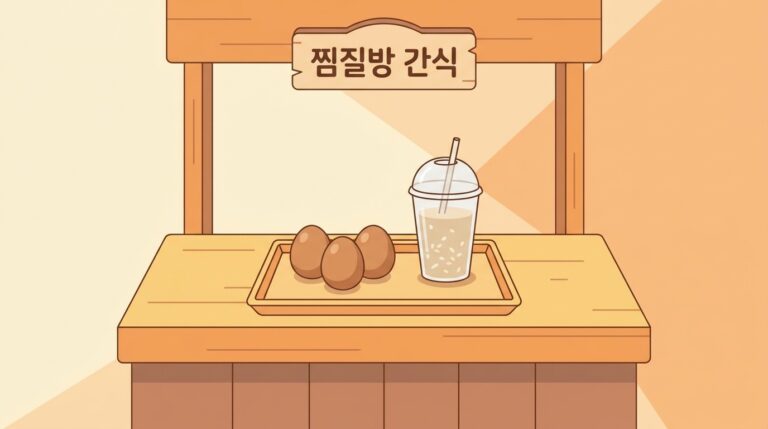
It’s time for the ultimate K-Drama Jjimjilbang ritual: Ice-cold Sikhye (sweet rice punch) and Maekbanseok Gyeran (stone-roasted eggs).
But as you approach the Maejeom (snack bar), you freeze. How do you order? Do you need your wallet? Why is everyone tapping their wrists on a machine? In textbooks, you might have learned basic ordering phrases for restaurants, but the Jjimjilbang operates on its own unique ecosystem. Mastering this moment doesn’t just quench your thirst; it elevates you from a bewildered tourist to a true Jjimjilbang insider.
(Transparency Note: This guide is crafted from the real-life struggles of our intermediate learners who tried to bring their soggy cash wallets into the sauna!)
Phase 2: Core Expressions Deep Dive
Let’s break down the 3 essential phrases you need at the snack counter.
1. 식혜 하나랑 구운 계란 세 개 주세요.
- Pronunciation: [Sikhye hanarang gu-un gyeran se gae juseyo.] (See-kyeh ha-na-rang koo-oon gyeh-ran seh geh joo-seh-yo)
- Meaning: Literal: Give me one Sikhye and three roasted eggs. / Real nuance: I’d like a Sikhye and three baked eggs, please.
- K-Culture Moment: You’ll hear this non-stop at any sauna. Often, families will order a large shaker (통/tong) of Sikhye and a massive plate of eggs to share on the heated floor.
- Editor’s Insight: Notice the use of ‘랑/이랑’ (with/and). At B2 level, you know ‘와/과’ or ‘하고’, but in real-life spoken Korean, ‘랑/이랑’ sounds much more natural and fluent when listing items at a counter.
- Situation Spectrum:
- Friends & Snack Bar Auntie (Casual/Polite): ✅
- High-end Restaurant (Formal): ⚠️ (Use ‘와/과’ instead)
- 🤔 Think About It: Why do Koreans specifically eat roasted eggs (brown eggs) at saunas instead of regular boiled white eggs? It’s about shelf life in the heat and that irresistible chewy texture!
2. 락커 키로 결제할게요.
- Pronunciation: [Rakkeo ki-ro gyeolje-halgeyo.] (Rah-kuh kee-ro gyul-jeh-hal-geh-yo)
- Meaning: Literal: I will pay with the locker key. / Real nuance: Put it on my wristband, please.
- K-Culture Moment: You reach into your pocket, but wait—you don’t have pockets! In modern Jjimjilbangs, your RFID locker wristband is your credit card.
- Editor’s Insight: ‘결제하다’ (to pay/process payment) is a great B2 vocabulary word. It sounds slightly more polished than ‘돈 낼게요’ (I will pay money) and is the standard term for electronic transactions.
- Situation Spectrum:
- Any Jjimjilbang/Waterpark Counter: ✅
- 🤔 Think About It: South Korea is moving rapidly toward a completely cashless society. How does wearing your ‘wallet’ on your wrist change the psychology of spending while relaxing?
3. 머리에 깨도 돼요?
- Pronunciation: [Meorie kkaedo dwaeyo?] (Muh-ree-eh kkeh-do dweh-yo?)
- Meaning: Literal: Can I break it on the head? / Real nuance: Can I crack this egg on your head?
- K-Culture Moment: This is the classic K-Drama trope! (Think Crash Landing on You or Reply 1988). Friends play rock-paper-scissors, and the loser gets an egg smashed on their head to crack the shell.
- Editor’s Insight: Use this playfully with your friends. ‘깨다’ means to break/crack. It adds a whole layer of fun to the experience, but make sure you are holding a cooked egg, not a raw one!
- Situation Spectrum:
- Close friends/Partner (Casual): ✅
- Strangers/Elders (Formal): 🚫 (Absolutely not!)
- 🤔 Think About It: Physical boundaries in Korea are unique. Slapping a friend’s back while laughing or cracking an egg on their head shows a level of intimate bonding (정/Jeong). Would this physical playfulness be acceptable in your culture?
Phase 3: Textbook vs. Real Korean
Here is why you might sound a bit robotic if you only rely on your textbook at the sauna.
[Ordering the Food]
* 📖 Textbook Korean: 식혜 한 잔과 구운 계란 세 개 주시겠습니까? (Would you please give me a cup of Sikhye and three baked eggs?)
* 🗣️ Real Korean: 이모님, 식혜 하나랑 계란 세 개요. (Auntie, one Sikhye and three eggs.)
* 💡 Why the difference?: Using ‘주시겠습니까’ at a busy, noisy sauna snack bar is overkill. Dropping verbs and ending with ‘요’ (noun + 요) is the ultimate sign of Korean conversational efficiency.
[Paying the Bill]
* 📖 Textbook Korean: 현금으로 지불해도 괜찮습니까? (Is it acceptable to pay with cash?)
* 🗣️ Real Korean: 여기 키결제 되죠? (I can pay with the key here, right?)
* 💡 Why the difference?: ‘지불하다’ is a formal written word. ‘결제하다’ is the everyday standard. Plus, assuming key payment is the default (‘되죠?’) shows you know how the system works.
Bottom Note: At the B2 level, your goal is flow and natural rhythm. Don’t overcomplicate your sentences with advanced grammar when a simple noun + particle will do perfectly!
Phase 4: Cultural Context — K-Culture Deep Dive
4-1. Non-verbal Cue: The Wristband Tap
When you say “락커 키로 결제할게요,” you don’t hand the key to the staff. You simply lift your wrist and tap the RFID chip against the terminal they point to. It requires a bit of 눈치 (Nunchi)—watch what the person in front of you does. Once you hear the ‘beep’, you just nod, say “감사합니다,” and take your tray.
4-2. The K-Drama Trope: The Egg Roulette
If there is one thing K-Dramas have taught us, it’s that Jjimjilbang eggs are weapons of affection. In dramas, characters often use the egg-cracking ritual to break the ice after an argument or to show a quirky, teasing romance.
Critical Check: In dramas, they hit the egg really hard for comedic effect. In reality, Maekbanseok eggs have surprisingly hard shells because they are baked on stones. If you hit your friend’s head with K-Drama force, you might genuinely hurt them! Tap it gently, or stick to the floor if they give you the side-eye.
Phase 5: Real-Life Roleplay Scenario
Setting: A Friday night at ‘Dragon Hill Spa’ (or any massive Jjimjilbang in Seoul). You just survived 15 minutes in the salt room. You are wearing a pink oversized T-shirt, a sheep-head towel, and you’re parched. You walk up to the brightly lit snack bar.
Characters:
* YOU: An intermediate Korean learner, determined to order naturally.
* Imo-nim (이모님): The snack bar auntie (late 50s, fast-paced, friendly but all about efficiency).
Dialogue:
YOU: 저기요, 이모님!
(Jeogiyo, imo-nim!)
[Excuse me, Auntie!]
(🎭 Stage Direction: You lean against the counter, looking at the menu.)
Imo-nim: 네~ 뭐 드릴까?
(Ne~ mwo deurilkka?)
[Yes~ what can I get you?]
YOU: 식혜 두 잔이랑요… 아, 통으로도 팔아요?
(Sikhye du jan-irang-yo… ah, tong-euro-do parayo?)
[Two cups of Sikhye, and… ah, do you sell it by the bottle?]
Imo-nim: 그럼, 큰 통 있지. 계란은 안 필요해?
(Geureom, keun tong itji. Gyeran-eun an piryohae?)
[Of course, we have a big bottle. Don’t you need eggs?]
🔀 Your Turn! How do you respond?
* A) “아니요, 계란은 먹지 않겠습니다.” (Textbook, a bit cold)
* B) “아, 맞다! 맥반석 계란 세 개 같이 주세요!” (Natural, enthusiastic)
* C) “계란 비싸요? 깎아주세요.” (Wait, we don’t haggle here!)✅ Best Choice: B — Showing realization (“아, 맞다!”) and using ‘같이 주세요’ (please give them together) makes you sound like a true local.
YOU: 아, 맞다! 맥반석 계란 세 개 같이 주세요!
(Ah, matda! Maekbanseok gyeran se gae gachi juseyo!)
[Oh, right! Please give me three stone-baked eggs together with it!]
Imo-nim: 네~ 8천 원. 손목 이쪽으로 대세요.
(Ne~ pal-cheon won. Sonmok ijjok-euro daeseyo.)
[Okay~ 8,000 won. Please put your wrist over here.]
YOU: (Taps wristband) 띡! 결제됐나요?
(Ttik! Gyeolje-dwaennayo?)
[Beep! Did the payment go through?]
Imo-nim: 네, 나왔습니다~ 맛있게 먹어요!
(Ne, nawasseumnida~ masitge meogeoyo!)
[Yes, here it is~ Enjoy!]
Phase 6: 10-Second Shadowing Drill
Read this aloud. Pay attention to the pauses / and the emotion tags!
😊 이모님, / 식혜 큰 거 하나랑 / 🥚 계란 세 개 주세요! (i-mo-nim, / si-kye keun geo ha-na-rang / gye-ran se gae ju-se-yo!)
😎 아, / 결제는 / ⌚️ 락커 키로 할게요. (a, / gyeol-je-neun / rak-keo ki-ro hal-ge-yo.)
Phase 7: K-Culture Mini Dictionary
1. 찜질방 (Jjimjilbang)
* Romanization: jjim-jil-bang
* English: Korean public bathhouse and sauna
* Context: ‘Jjimjil’ means to heat/foment, and ‘Bang’ means room. It’s a 24/7 facility for bathing, sweating, eating, and even sleeping.
2. 맥반석 계란 (Maekbanseok Gyeran)
* Romanization: maek-ban-seok gye-ran
* English: Elvan stone-roasted eggs
* Context: Eggs slowly baked on heated stones. They turn brown inside, have a slightly nutty flavor, and a chewy, jelly-like texture.
3. 양머리 (Yangmeori)
* Romanization: yang-meo-ri
* English: Sheep head towel
* Context: A specific way of folding a standard Jjimjilbang towel to look like sheep horns. Popularized by early 2000s K-Dramas like My Lovely Sam Soon.
4. 매점 (Maejeom)
* Romanization: mae-jeom
* English: Snack counter / Kiosk
* Context: The central hub of the Jjimjilbang. If the hot rooms are the heart of the sauna, the Maejeom is the stomach.
Phase 8: Traveler Survival Kit
Even if you forget the grammar, keep these phrases in your back pocket for any sauna trip!
🆘 Survival Phrases at the Sauna
* 🇰🇷 “이거 키로 결제되나요?” (igeo ki-ro gyeolje-doenayo?)
* 🗣️ Meaning: Can I pay for this with my key?
* 📍 When to use: At the snack bar, massage chair, or arcade inside the sauna.
* 🇰🇷 “수건 한 장 더 주실 수 있나요?” (sugeon han jang deo jusil su innayo?)
* 🗣️ Meaning: Can you give me one more towel?
* 📍 When to use: At the front desk. (Note: Women’s baths usually have a towel limit, while men’s often have a free-for-all stack!)
* 🇰🇷 “얼음 많이 넣어주세요.” (eoreum mani neoeojuseyo.)
* 🗣️ Meaning: Please put a lot of ice in it.
* 📍 When to use: Ordering your Sikhye after a particularly intense sweat session.📌 Editor’s Travel Note
* Cash vs. Key: 95% of modern saunas in cities use key-payments. You settle the final bill at the front desk when you leave. Do NOT lose your key, or you’ll face a hefty penalty fee!
* Tattoos: Unlike traditional Japanese onsens, most Korean Jjimjilbangs are tolerant of tattoos, though massive gang-style tattoos might still get you turned away at older, conservative spots.
Phase 9: Critical Thinking — “One Step Deeper”
Food & Identity: The Communal Bond of the Jjimjilbang
🧠 Think Deeper:
Why is eating so central to the Jjimjilbang experience? In Korea, eating together is the ultimate form of bonding (Sikgu – family, literally means ‘mouths that eat together’). But the Jjimjilbang strips away societal statuses. Everyone wears the same uniform, no one is wearing makeup, and everyone is sweating together. In this highly vulnerable, equalized space, sitting cross-legged on the floor, cracking eggs, and sharing a single large jug of Sikhye with multiple straws creates a profound sense of community and egalitarianism. You aren’t a CEO or a student; you are just someone enjoying sweet rice punch on a warm floor.💬 Your Turn: Is there a place in your culture where people shed their societal status and bond over a specific food or activity? Share it in the comments!
Phase 10: FAQ & Avoiding Mistakes
Q: Can I call the snack bar worker “아줌마 (Ajumma)”?
* Editor’s Advice: NO. While “Ajumma” means a middle-aged woman, it can sound dismissive or rude in modern service settings. Use “이모님 (Imo-nim – literally ‘Aunt’)” or simply “사장님 (Sajang-nim – Boss/Owner)”. It shows respect and gets you better service!
Q: Do I tip the snack bar worker?
* Editor’s Advice: NO. Korea is strictly a no-tip culture. If you try to tip, they might chase you down thinking you forgot your change!
❌ Common Mistake #1: Bringing your credit card or phone to the sauna room.
✅ Do this instead: Leave your phone and wallet in the locker! The saunas get up to 90°C. Your phone will overheat and shut down, and your plastic cards might warp. Just bring your locker key wristband.
Phase 11: Summary & Action Items
One-Liner Summary: Ditch the textbook politeness, use your wristband key (‘락커 키’), and confidently order your Sikhye and eggs with a natural ‘하나랑 세 개 주세요!’
Your Action Missions:
* 🥉 Bronze (Solo): Stand in front of your mirror, hold an imaginary egg, and say “머리에 깨도 돼요?”
* 🥈 Silver (Online): Drop a comment below using the word ‘결제하다’ (to pay) in a sentence!
* 🥇 Gold (Real World): Visit a local Korean sauna (or Korean market), order a Sikhye using “식혜 하나 주세요”, and see if you can taste the malt and rice bits!
K-Culture Mission 🍿:
Find a clip on YouTube of “Crash Landing on You Jjimjilbang scene” or “Korean sauna egg cracking” and observe the Nunchi and physical comedy involved. How hard do they actually hit the egg?
Phase 12: Interactive Quiz Challenge
Test your Jjimjilbang survival skills!
1. Situational Judgment: You want to pay for your Sikhye at a modern sauna in Seoul. Which phrase is the most natural to use?
* A) 현금으로 내겠습니다. (I will pay with cash.)
* B) 키로 결제할게요. (I’ll pay with the key.)
* C) 공짜로 주시겠어요? (Will you give it for free?)
2. Fill in the Blank:
식혜 한 통 ___ 계란 세 개 주세요. (I’d like one bottle of Sikhye AND three eggs.)
Hint: It’s the natural spoken particle for ‘and/with’.
3. True or False – K-Culture Edition:
It is considered polite to call the snack bar lady “아줌마 (Ajumma)” loudly to get her attention. (T / F)
Click here for Answers!
1. B – Modern saunas use wristbands. ‘결제하다’ is the perfect verb here. Option A is too formal, and C will get you kicked out!
2. 이랑 (or 랑) – ‘식혜 한 통이랑…’
3. False – Use ‘이모님 (Imo-nim)’ or ‘저기요 (Excuse me)’ instead to be respectful and friendly!
Ready to hit the sauna? Let us know in the comments if you prefer sweet Sikhye or salty roasted eggs!
Frequently Asked Questions (FAQ)
Q: What does "식혜 하나랑 구운 계란 세 개 주세요." mean in Korean and how do you pronounce it?
A: In Korean, "식혜 하나랑 구운 계란 세 개 주세요." is pronounced [Sikhye hanarang gu-un gyeran se gae juseyo.] and means: Literal: Give me one Sikhye and three roasted eggs. / Real nuance: I'd like a Sikhye and three baked eggs, please.
Q: What does "락커 키로 결제할게요." mean in Korean and how do you pronounce it?
A: In Korean, "락커 키로 결제할게요." is pronounced [Rakkeo ki-ro gyeolje-halgeyo.] and means: Literal: I will pay with the locker key. / Real nuance: Put it on my wristband, please.
Q: What does "머리에 깨도 돼요?" mean in Korean and how do you pronounce it?
A: In Korean, "머리에 깨도 돼요?" is pronounced [Meorie kkaedo dwaeyo?] and means: Literal: Can I break it on the head? / Real nuance: Can I crack this egg on your head?







