

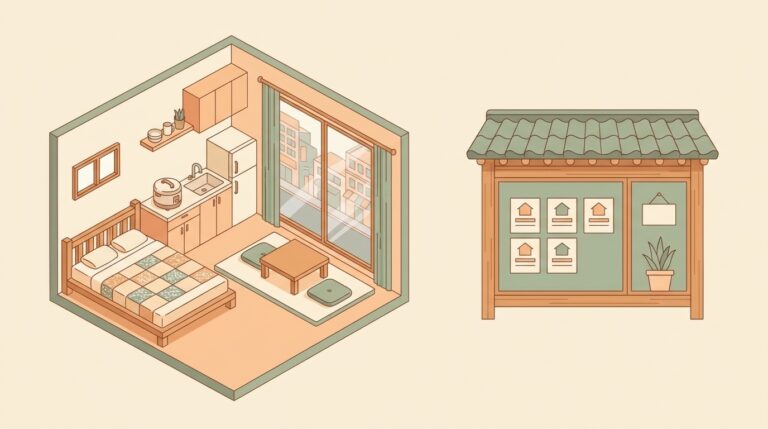
Phase 1: Empathy & The “Why”
Hello! I’m the lead editor of Daily Hangul.
Picture this: You are watching a K-Drama. The main character, who just moved to Seoul, is standing on a beautiful rooftop at sunset, looking out over the city. Or maybe they are carrying a tiny box into a semi-basement apartment. In Korea, where you live and how many rooms you have is more than just a matter of space—it’s a reflection of your life stage.
But what happens when you actually come to Korea? Maybe you are booking an Airbnb, checking into a guesthouse, or even hunting for your first apartment in Seoul. The textbook teaches you to say, “There is one room” (방이 하나 있습니다). But if you walk into a Korean real estate office (부동산) and say that, they might tilt their head. Why? Because real-life Koreans use a totally different system to talk about house sizes!
This guide is built on the real struggles of expats and travelers in Korea. Let’s learn how to talk about rooms so you sound like a true local, not a walking textbook.
Phase 2: Core Expressions Deep Dive
Let’s look at the absolute must-know words for talking about your living space.
1. 방이 몇 개예요?
- Pronunciation: bang-i myeot gaeyeyo? [bahng-ee myuht gae-yeh-yo?]
- Meaning: How many rooms are there?
- K-Culture Moment: You’ll hear this when friends visit your new place or when you are negotiating at an Airbnb. In Korea, asking about someone’s living arrangement is a common way to show care and interest.
- Editor’s Insight: The word 개 (gae) is the counter for items. When counting rooms, we use Native Korean numbers (하나, 둘, 셋) + 개 = 한 개, 두 개, 세 개.
- Situation Spectrum:
- Close friends (Casual): ✅ (방 몇 개야?)
- Acquaintances (Semi-formal): ✅ (방이 몇 개예요?)
- Formal/Elders: ⚠️ (Usually asked more politely: 방이 몇 개입니까?)
- 🤔 Think About It: Why do Koreans often ask about your house size or rent? While it might seem private in Western cultures, in Korea, it’s often a sign of closeness. Does your culture talk openly about housing sizes?
2. 원룸 / 투룸
- Pronunciation: won-rum / tu-rum [wuhn-room / too-room]
- Meaning: Studio apartment (One-room) / Two-room apartment
- K-Culture Moment: If you watch a K-Drama featuring college students or young professionals, they almost always live in a 원룸 (won-rum). It’s a classic symbol of independence!
- Editor’s Insight: This is pure “Konglish” (Korean-English). Instead of saying “a house with one room,” Koreans just combined “One” and “Room.” It feels young, trendy, and efficient.
- Situation Spectrum:
- Close friends (Casual): ✅
- Real estate agent (Semi-formal): ✅
- Formal/Elders: ✅ (It has become a standard noun!)
- 🤔 Think About It: “Konglish” makes communication much faster. Can you think of other English words that changed meaning when adopted into your language?
3. 거실
- Pronunciation: geo-sil [guh-shil]
- Meaning: Living room
- K-Culture Moment: In K-Dramas, the 거실 is where the family gathers to eat fruit, watch TV, and have dramatic arguments!
- Editor’s Insight: If you have a “투룸” (Two-room), it usually means two bedrooms plus a small living area. But if someone says “방 두 개, 거실 하나” (Two rooms, one living room), it’s a very clear way to describe a family-sized house.
- Situation Spectrum:
- Everywhere: ✅
Phase 3: Textbook vs. Real Korean
Let’s compare what you studied with what you’ll actually hear on the streets of Seoul.
[Describing a Studio Apartment]
* 📖 Textbook: 방이 한 개 있습니다. (There is one room.)
* 🗣️ Real Korean: 여기 원룸이에요. (This is a one-room.)
* 💡 Why the difference?: Real estate in Korea moves incredibly fast. Using standardized Konglish terms like ‘원룸’ (One-room) or ‘오피스텔’ (Officetel) immediately tells the listener the exact layout and building style.
[Asking for a bigger place]
* 📖 Textbook: 방이 두 개인 집을 원합니다. (I want a house that has two rooms.)
* 🗣️ Real Korean: 투룸 찾고 있어요. (I’m looking for a two-room.)
* 💡 Why the difference?: Adding “~고 있어요” (I am ~ing) sounds much more natural and conversational than the stiff “원합니다” (I want).
Phase 4: Cultural Context — K-Culture Deep Dive
4-1. Non-Verbal Cues: The Art of “Nunchi” in Real Estate
When you visit a Korean apartment, you must take off your shoes. It’s an unbreakable rule! If you walk into a bedroom with your shoes on, the host’s eyes will widen in shock. Also, when talking to an older real estate agent, keep your hands out of your pockets to show respect.
4-2. K-Drama Connection: The “Budongsan” Trope
In almost every romantic comedy, there is a scene where the main character goes to a neighborhood 부동산 (Budongsan – Real Estate Agency). There’s always a sliding door, a map of the neighborhood on the wall, and a friendly (or sometimes grumpy) agent offering instant coffee.
Critical View: Dramas often romanticize rooftop rooms (옥탑방 – oktapbang) as cozy party spaces. In reality, they can be extremely hot in the summer and freezing in the winter! When you look for rooms, keep reality in mind.
Phase 5: Real-Life Roleplay Scenario
Setting: A small real estate office near Hongdae. The walls are covered in property listings. You are sitting across from a friendly agent, drinking sweet instant coffee.
Characters:
– YOU: An expat looking for a new place to live.
– Agent Kim (50s): A warm, chatty real estate agent who wants to help you.
Agent Kim: 어서 오세요! 어떤 집 찾으세요? ☕
(eoseo oseyo! eotteon jip chajeuseyo?)
[Welcome! What kind of house are you looking for?]
YOU: 안녕하세요. 방을 좀 보려고요.
(annyeonghaseyo. bangeul jom boryeogoyo.)
[Hello. I’d like to look at some rooms.]
Agent Kim: 학생이에요? 원룸 찾아요?
(haksaengieyo? wonrum chajayo?)
[Are you a student? Are you looking for a one-room?]
🔀 Your Turn! How do you reply?
– A) 네, 방이 한 개 있습니다. (Yes, there is one room.)
– B) 아뇨, 짐이 많아서 투룸 찾고 있어요. (No, I have a lot of stuff, so I’m looking for a two-room.)
– C) 대박! 투룸 주세요! (Awesome! Give me a two-room!)✅ Best Choice: B — It clearly states your need using the natural local term (투룸) and politely explains why.
⚠️ Choice A Analysis: This means “Yes, I already have one room.” It’s grammatically correct but contextually wrong.
⚠️ Choice C Analysis: “대박” (Daebak) is too casual for someone you just met, especially someone older!
(Assuming you chose B)
Agent Kim: 아, 투룸! 예산이 어떻게 되세요?
(a, turum! yesani eotteoke doeseyo?)
[Ah, a two-room! What is your budget?]
YOU: 월세 100만 원 정도요.
(wolse baengman won jeongdoyo.)
[Around 1 million won for monthly rent.]
(🎭 Stage Direction: Agent Kim types furiously on her keyboard, nodding.)
Agent Kim: 좋은 집이 하나 있어요. 지금 보러 갈까요?
(joeun jibi hana isseoyo. jigeum boreo galkkayo?)
[I have a good house. Shall we go see it now?]
Phase 6: 10-Second Shadowing Drill
Practice speaking like a local! Pay attention to the pauses (/) and the mood.
- 😊 밝게 (Brightly):
여기 / 원룸이에요?(yeogi / won-rumieyo?) – Is this a studio apartment? - 🤔 궁금하게 (Curiously):
방이 / 몇 개예요?(bang-i / myeot gaeyeyo?) – How many rooms are there? - 😤 단호하게 (Firmly):
저는 / 투룸 / 찾고 있어요.(jeoneun / tu-rum / chatgo isseoyo.) – I am looking for a two-room.
Phase 7: K-Culture Mini Dictionary
1. 부동산 (Budongsan)
* Romanization: budongsan
* English: Real Estate Agency / Property
* Context: The physical office where you rent or buy houses. In Korea, you rarely rent directly from a landlord; you always go through a Budongsan.
2. 보증금 (Bojeunggeum)
* Romanization: bojeunggeum
* English: Security Deposit
* Context: Korean housing requires massive deposits. A typical studio might require $5,000 to $10,000 USD just as a deposit!
3. 고시원 (Goshiwon)
* Romanization: goshiwon
* English: Micro-room / Study room
* Context: Extremely tiny, cheap rooms (usually without a private bathroom) originally meant for students studying for state exams. Now, a cheap option for travelers and expats.
4. 눈치 (Nunchi)
* Romanization: nunchi
* English: Situational awareness / Reading the room
* Context: When viewing a house, you use your nunchi to see if the landlord is strict, or to gauge if the agent is hiding a flaw (like water pressure!) in the house.
Phase 8: Traveler Survival Kit
Even if you aren’t moving to Korea, you’ll need these when booking Airbnbs or hotels!
🆘 Survival Phrases for Accommodation
– 🇰🇷 “방에 에어컨 있어요?” (bange eeokeon isseoyo?)
– 🗣️ Pronunciation: [bang-eh air-con iss-uh-yo?]
– 📍 Use case: Asking an Airbnb host or guesthouse if the room has AC (crucial for Korean summers!).
- 🇰🇷 “체크아웃 몇 시예요?” (chekeu-aut myeot siyeyo?)
- 🗣️ Pronunciation: [check-out myuht shee-yeh-yo?]
- 📍 Use case: Asking for the checkout time at a hotel.
📌 Editor’s Travel Note
– Floor Heating: Most Korean rooms don’t have radiators. We use 온돌 (Ondol) or 보일러 (Boiler), which heats the floor. It’s incredibly cozy!
– No Shoes: Never, ever wear outdoor shoes inside a Korean room. You will usually see a small entryway called a 현관 (hyongwan) to leave your shoes.
Phase 9: Critical Thinking — “A Step Deeper”
🧠 Think Deeper: Media vs. Reality in Korean Housing
If you’ve watched K-Dramas like Penthouse or movies like Parasite, you’ve seen the extreme ends of Korean housing. The glamorous high-rise apartments with giant living rooms vs. the cramped, dark semi-basements (반지하). In reality, most young Koreans start their independent lives in a humble ‘원룸’ (One-room). The media often dramatizes these spaces to highlight social inequality. When learning Korean, it’s fascinating to see how deeply housing vocabulary is tied to social status.
💬 Your Turn: Does your country have a specific type of housing that represents “young independence” or “student life”? Share it in the comments!
Phase 10: FAQ & Mistake Prevention
Q: Do Koreans measure rooms in square meters or feet?
Actually, neither! Officially, Korea uses square meters (㎡). But in daily life, almost everyone uses a traditional measurement called 평 (Pyeong). 1 Pyeong is about 3.3 square meters (the size of a standard double bed). A typical studio is about 5 to 7 Pyeong.
Q: Can I use “원룸” when talking to older people?
Yes! Although it’s Konglish, “원룸” is a fully integrated standard noun now. It’s perfectly polite to use with anyone.
❌ Common Mistake: Translating “One bedroom apartment” literally to “방 하나 아파트” (A house with one room).
✅ Do this instead: Just say 원룸 (for a studio) or 투룸 (for a one-bedroom apartment with a separate living room). It saves time and prevents confusion!
Phase 11: Summary & Action Items
One-Liner Summary: Don’t count rooms with numbers; use “원룸” (One-room) and “투룸” (Two-room) to sound like a true Seoulite!
Action Mission:
– 🥉 Bronze (Solo): Look around the room you are in right now. Say “방” (bang) or “거실” (geosil) out loud!
– 🥈 Silver (Online): Go to a Korean property app like Zigbang (직방) or even Airbnb, and search for ‘원룸’ in Seoul.
– 🥇 Gold (Real Life): Message your Korean host or a Korean friend and ask, “집이 방이 몇 개예요?” (How many rooms are in your house?)
K-Culture Mission: Watch an episode of a K-Drama today and spot the moment they take their shoes off before entering the living room (거실)!
Did you know about the ‘원룸’ Konglish before? Let us know in the comments below!
Frequently Asked Questions (FAQ)
Q: What does "방이 몇 개예요?" mean in Korean and how do you pronounce it?
A: In Korean, "방이 몇 개예요?" is pronounced [bang-i myeot gaeyeyo? [bahng-ee myuht gae-yeh-yo?] and means: How many rooms are there?
Q: What does "원룸 / 투룸" mean in Korean and how do you pronounce it?
A: In Korean, "원룸 / 투룸" is pronounced [won-rum / tu-rum [wuhn-room / too-room] and means: Studio apartment (One-room) / Two-room apartment
Q: What does "거실" mean in Korean and how do you pronounce it?
A: In Korean, "거실" is pronounced [geo-sil [guh-shil] and means: Living room







