

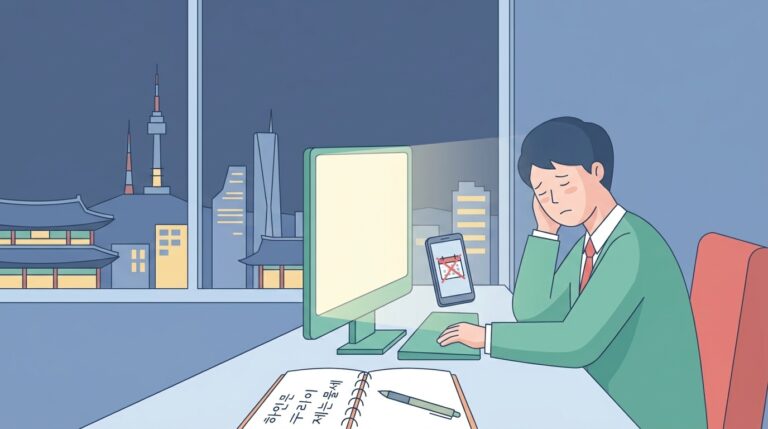
Phase 1: Empathy & The “K-Drama” Cold Open
Hello there! It’s your Daily Hangul Editor.
Picture this: It’s 5:50 PM on a Friday. You’re practically tasting the crispy pork belly (samgyeopsal) you’re about to eat in Hongdae. You reach for your coat, but suddenly, a shadow falls over your desk. It’s your team leader, holding a thick stack of files.
“Can we get this done by tomorrow morning?”
If you’ve watched any K-Drama featuring office romance or corporate life, you know exactly what happens next. The protagonist sighs, stares at their glowing monitor in the dark office, and texts their friend (or lover): “I’m so sorry… I have to work late.”
In textbooks, saying “I will cancel our plans” is grammatically straightforward. But in real Korean culture, directly canceling a plan sounds as cold as an icy Seoul winter. Canceling because of work requires a delicate mix of genuine sorrow, soft-cushioning phrases, and the ultimate Korean promise: food.
Today, we are going to learn how to expertly navigate this painful but common K-Office scenario without hurting anyone’s feelings. Let’s dive in!
Phase 2: Core Expressions Deep Dive
Here are the lifesaver phrases you need when the office traps you.
1. 나 오늘 야근해야 돼.
- Pronunciation: [Na oneul yageun-haeya dwae.] + [Nah oh-neul yah-geun-heh-yah dweh.]
- Meaning: Literal: I must do night work today. / Real nuance: I’m stuck at the office working overtime tonight.
- K-Culture Moment: 야근 (yageun) is almost a rite of passage in traditional Korean corporate culture. When a Korean friend sends you this text, it’s usually followed by a string of crying emojis (ㅠㅠㅠㅠ).
- Editor’s Insight: The word ‘야근’ is heavily loaded with exhaustion. You don’t just say it; you sigh it out. It’s the perfect excuse because no Korean will ever question the pain of unexpected overtime.
- Situation Spectrum:
- 친구 사이(Casual): ✅ (Perfect)
- 직장 동료(Semi-formal): ⚠️ (Use ‘야근해야 해요’ instead)
- 직장 상사·어른(Formal): 🚫 (You wouldn’t tell your boss you’re doing overtime, they are the ones making you do it!)
- 🤔 Think About It: Why does Korea have a specific, highly used noun just for “night work”? How does this reflect the rapid economic growth and work ethic of the “Pall-ppalli” (hurry up) culture?
2. 저녁 약속 미뤄야 할 것 같아.
- Pronunciation: [Jeonyeok yaksok mirwoya hal geot gata.] + [Juh-nyuk yahk-sohk mee-rwoh-yah hal guht gah-tah.]
- Meaning: Literal: I think I have to postpone our evening promise. / Real nuance: I’m so sorry, but I think we need to push our dinner plans back (or cancel for tonight).
- K-Culture Moment: Notice how we say “postpone” (미루다) instead of “cancel” (취소하다)? In Korea, flat-out canceling sounds like you never want to see them again.
- Editor’s Insight: The magic here is ~할 것 같아 (I think / It seems like). Even though you know 100% you are canceling, saying “I think I have to…” softens the blow. It shows you are reluctant to break the plans.
- Situation Spectrum:
- 친구 사이(Casual): ✅
- 직장 동료(Semi-formal): ⚠️ (Use ‘미뤄야 할 것 같아요’)
- 직장 상사·어른(Formal): 🚫
- 🤔 Think About It: Korean is a “high-context” language where protecting the other person’s feelings (saving face) is crucial. Do you use softening phrases like “I think” in your native language when delivering bad news?
3. 진짜 미안! 다음에 내가 밥 살게!
- Pronunciation: [Jinjja mian! Daeume naega bap salge!] + [Jeen-jjah mee-ahn! Dah-eu-meh neh-gah bahp sahl-geh!]
- Meaning: Literal: Really sorry! Next time I will buy rice! / Real nuance: I am so incredibly sorry! Dinner is on me next time to make up for this!
- K-Culture Moment: In Korea, food is love, an apology, and a binding contract. Offering to buy a meal is the ultimate way to show you genuinely value the relationship and intend to reschedule.
- Editor’s Insight: If you cancel without saying “I’ll buy you a meal next time,” your friend might actually feel a little hurt. It’s the mandatory closing statement of any canceled plan.
- Situation Spectrum:
- 친구 사이(Casual): ✅
- 직장 동료(Semi-formal): ⚠️ (Use ‘제가 밥 한 번 살게요’)
- 직장 상사·어른(Formal): 🚫
Phase 3: Textbook vs. Real Korean
Let’s upgrade your vocabulary from “language exchange newbie” to “Seoulite insider.”
[Scenario 1: Saying you have to work late]
* 📖 Textbook Korean: 저는 오늘 초과 근무를 합니다. (I do overtime work today.)
* 🗣️ Real Korean: 나 오늘 야근각이야. (Looks like it’s an overtime angle today.)
* 💡 Why the difference?: Adding ~각 (gak – angle/trajectory) is a popular slang among MZ generation to predict an inevitable situation (e.g., “It’s totally looking like overtime tonight”).
[Scenario 2: Canceling the plan]
* 📖 Textbook Korean: 오늘 약속을 취소하겠습니다. (I will cancel the appointment today.)
* 🗣️ Real Korean: 아 ㅠㅠ 오늘 파투 내야 할 것 같아. (Ah ㅠㅠ I think we have to call off today’s plan.)
* 💡 Why the difference?: “파투(Patu)” originally comes from a card game term meaning the game is nullified. It’s now commonly used to casually say a casual plan fell through.
Bottom Note: For B1 learners, using “야근해야 돼” and “다음에 밥 살게” is the safest and most natural approach. Save “파투” for your really close, same-age Korean friends!
Phase 4: Cultural Context — K-Culture Deep Dive
4-1. The Non-Verbal “Nunchi” (눈치)
When you have to cancel plans because of work, it’s rarely just about the work. It’s about Nunchi. Even if your tasks are done, if the team leader isn’t leaving, the juniors often feel they can’t leave either. When typing this text to your friend, the unspoken emotion is often frustration wrapped in helplessness. Sending a photo of your computer monitor or an empty coffee cup is a great non-verbal way to prove: “I really want to leave, but I am trapped!”
4-2. The “Overtime Romance” vs. Reality (K-Drama Connection)
In K-Dramas like What’s Wrong with Secretary Kim or Business Proposal, overtime (야근) is often a magical time where the office empties out, the main leads accidentally touch hands while reaching for the same document, and they share instant noodles in the breakroom.
Critical View: In reality? There’s no background music. Your hair gets greasy, you order delivery food that you eat too fast, and you’re just exhausted. When you tell a friend “나 야근이야” (I’m working overtime), they won’t imagine a romantic scene; they will pity you and immediately forgive you for canceling.
Phase 5: Interactive Roleplay Scenario
Setting: It’s 6:30 PM. A rainy Tuesday near Gangnam Station. You’re hiding in the office pantry, quickly texting your close friend, Minji. She’s already near the restaurant you two booked weeks ago.
Characters:
– YOU: An expat working in a Korean marketing firm. Exhausted.
– Minji (28): Your Korean best friend. She is obsessed with the spicy tteokbokki place you were supposed to visit tonight.
Dialogue:
Minji: 야, 너 어디쯤이야? 나 가게 앞이야! 떡볶이 냄새 대박🤤
(Ya, neo eodijjeumiya? Na gage apiya! Tteokbokki naemsae daebak)
[Hey, where are you? I’m in front of the store! The tteokbokki smells amazing🤤]
YOU: 민지야… 나 어떡해 ㅠㅠ 나 오늘 야근해야 될 것 같아…
(Minji-ya… na eotteokhae ㅠㅠ na oneul yageunhaeya doel geot gata…)
[Minji… what do I do ㅠㅠ I think I have to work late today…]
Minji: 헐? 장난해? 팀장님이 또 일 주셨어? 🤬
(Heol? Jangnanhae? Timjangnimi tto il jusyeosseo?)
[OMG? Are you kidding? Did the team leader give you more work again?]
YOU: 응… 내일 아침까지 보고서 수정하래 ㅠㅠ 미안해서 어떡하지?
(Eung… naeil achimkkaji bogoseo sujeongharae ㅠㅠ mianhaeseo eotteokhaji?)
[Yeah… he told me to revise the report by tomorrow morning ㅠㅠ I’m so sorry, what do I do?]
Minji: 아휴… 직장인의 삶이란… 알았어. 무리하지 말고 일해! ㅠㅠ
(Ahyu… jikjanginui salmiran… arasseo. Murihaji malgo ilhae! ㅠㅠ)
[Sigh… the life of an office worker… Got it. Don’t push yourself too hard and do your work! ㅠㅠ]
🔀 Your Turn! How should you reply to wrap this up nicely?
– A) 그래, 내일 봐. (Okay, see you tomorrow.)
– B) 아 진짜 미안! 이번 주말에 내가 꼭 밥 살게!
– C) 오늘 약속 취소합니다.✅ Best Choice: B — “Ah, I’m really sorry! I’ll definitely buy you a meal this weekend!”
Why?: A sounds a bit too detached after she waited for you. C sounds like a robotic customer service message. B provides the apology and the cultural promise of food, keeping the friendship strong!
Phase 6: 10-Second Shadowing Drill
Let’s practice saying this naturally so you sound genuinely sorry, not like a robot!
😢 아 진짜 미안! / 오늘 / 야근해야 될 것 같아 ㅠㅠ
(Ah jinjja mian! / oneul / yageunhaeya doel geot gata ㅠㅠ)
Pro-tip: Drag out the “진짜~~~” (jinjja) a little bit to show how truly sorry you are. The tone should drop slightly at the end to show disappointment.
Phase 7: K-Culture Mini Dictionary
1. 야근 (yageun)
* English: Overtime / Night work
* Context: The dreaded extra hours after 6 PM. A core reason for stress (and canceled plans) in Seoul.
2. 칼퇴 (kal-toe)
* English: Leaving work exactly on time
* Context: ‘칼’ means knife, and ‘퇴근’ means leaving work. It means cutting off work sharply at 6 PM. The ultimate dream of every office worker.
3. 파투 (patu)
* English: Plans falling through / getting canceled
* Context: Used casually among friends when someone cancels. “오늘 파투 났어” (Today’s plans fell through).
4. 밥약 (bap-yak)
* English: Meal appointment
* Context: Short for 밥 약속 (Rice promise). In university or office life, making a “bap-yak” is how you build networks.
Phase 8: Traveler Survival Kit
Even if you aren’t working in an office, travelers often need to cancel plans—maybe you got lost, feel too tired, or your itinerary ran late!
🆘 Survival Phrases for Travelers: Canceling/Changing Plans
– 🇰🇷 “죄송한데, 예약을 취소할 수 있을까요?” (joesonghande, yeyageul chwisohal su isseulkkayo?)
– 🗣️ English: I’m sorry, but could I cancel my reservation?
– 📍 Where to use: Hotels, restaurants, tour agencies.
– 💡 Pro Tip: If you call a restaurant to cancel, just say this and “죄송합니다” (Sorry). They appreciate a cancellation much more than a “no-show”!📌 Editor’s Travel Note
– Useful Apps: CatchTable (캐치테이블) is wildly popular for restaurant reservations in Korea. If you need to cancel, you can easily do it on the app with a push of a button instead of calling!
– Korean time: Koreans are generally punctual. If you are going to be more than 15 minutes late, it’s polite to text and let them know, or offer to reschedule.
Phase 9: Critical Thinking Corner — “A Step Deeper”
Language & Power (언어와 권력)
Have you noticed that in Korean, we rarely say “I am canceling”? Instead, we use passive or softened structures like “미뤄야 할 것 같아” (I think it needs to be postponed). This isn’t just about grammar; it’s a reflection of a society that values group harmony over individual assertiveness. Being too direct can be perceived as aggressive or selfish. By saying “I think we have to…,” you leave room for the other person’s reaction and protect their feelings.
💬 Your Turn: In your culture, is it better to be direct and say “I have to cancel,” or do you also use softening words? Share your thoughts in the comments!
Phase 10: FAQ & Avoiding Common Mistakes
Q: Can I say “야근해야 돼요” to my boss if I am working late?
No! It sounds a bit weird. “야근” is usually how employees complain to each other. To your boss, you would say something like “오늘 잔업이 좀 남았습니다” (I have some remaining work today) or simply “일 좀 더 하고 가겠습니다” (I will work a bit more before leaving).
Q: If my Korean friend cancels and says “I’ll buy you a meal next time,” do they really mean it?
Usually, yes! It’s not just an empty greeting. Don’t be surprised if they literally pull out their wallet and insist on paying for your entire meal the next time you meet.
❌ Common Mistake #1: Saying “취소할게 (I will cancel)” to a friend.
✅ Do this instead: Use “미뤄야 할 것 같아” (Let’s push it back) or “다음에 봐야 할 것 같아” (I think we have to see each other next time). It protects the relationship.
Phase 11: Summary & Action Items
One-Liner Summary: When work steals your evening, soften the blow with “~할 것 같아” and always promise to buy the next meal!
Your Action Missions:
– 🥉 Bronze: Stand in front of your mirror, sigh deeply like a K-Drama lead, and say “나 오늘 야근해야 될 것 같아.”
– 🥈 Silver: Text a Korean-learning friend “저녁 약속 미뤄야 할 것 같아!” and see if they know how to reply.
– 🥇 Gold (For those in Korea): Next time you actually have to cancel a casual meet-up, use the “다음에 밥 살게!” combo to smooth things over.
K-Culture Mission:
Watch one episode of an office-themed K-Drama (like Misaeng or Business Proposal). Look out for the moment someone says “야근”—I guarantee it will happen within the first 3 episodes!
What is your go-to excuse for canceling plans in your home country? Let me know in the comments below! 👇
Phase 12: Interactive Quiz
1. Situational Judgment:
Your coworker (same level) asks if you want to grab a beer after work. You have a mountain of paperwork left. What’s the best reply?
* A) “저는 야근을 합니다.”
* B) “아, 오늘 야근해야 할 것 같아요 ㅠㅠ”
* C) “오늘 약속 취소합니다.”
(Answer: B. It’s polite, shows regret, and uses the natural “할 것 같아요” form.)
2. True or False – K-Culture Edition:
* “If a Korean friend cancels plans and says they will buy you food next time, you should insist on splitting the bill anyway.”
(Answer: False. Let them pay! It relieves their guilt for canceling on you. You can offer to buy the coffee/dessert afterward!)
3. Fill in the blank:
* “진짜 미안! 다음에 내가 ( _____ ) 살게!”
(Answer: 밥 – bap / meal)
Frequently Asked Questions (FAQ)
Q: What does "나 오늘 야근해야 돼." mean in Korean and how do you pronounce it?
A: In Korean, "나 오늘 야근해야 돼." is pronounced [Na oneul yageun-haeya dwae.] and means: Literal: I must do night work today. / Real nuance: I'm stuck at the office working overtime tonight.
Q: What does "저녁 약속 미뤄야 할 것 같아." mean in Korean and how do you pronounce it?
A: In Korean, "저녁 약속 미뤄야 할 것 같아." is pronounced [Jeonyeok yaksok mirwoya hal geot gata.] and means: Literal: I think I have to postpone our evening promise. / Real nuance: I'm so sorry, but I think we need to push our dinner plans back (or cancel for tonight).
Q: What does "진짜 미안! 다음에 내가 밥 살게!" mean in Korean and how do you pronounce it?
A: In Korean, "진짜 미안! 다음에 내가 밥 살게!" is pronounced [Jinjja mian! Daeume naega bap salge!] and means: Literal: Really sorry! Next time I will buy rice! / Real nuance: I am so incredibly sorry! Dinner is on me next time to make up for this!







