

Phase 1: Empathy (Immersive Open)
Hello! Daily Hangul Editor here.
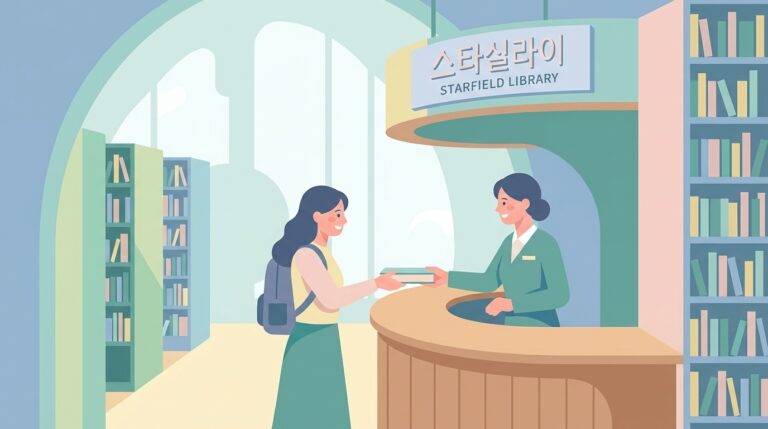
Picture this: You are standing in the middle of the breathtaking Starfield Library inside COEX Mall. It looks exactly like that scene from your favorite K-Drama where the main characters accidentally brush hands while reaching for the same book. You spot a beautiful photo essay book about Seoul, or maybe a beginner Korean textbook you’ve been dying to read.
You walk up to the counter, the librarian smiles at you… and your mind goes completely blank.
How do I say ‘borrow’? Do I just point and say ‘Please’? What if they ask me when I’ll bring it back?
Don’t worry! Many beginner students freeze at this exact moment. But learning how to borrow a book isn’t just about libraries. The words you learn here are the exact same words you’ll use to rent a beautiful Hanbok at Gyeongbokgung Palace, or borrow a friend’s K-Pop lightstick for a concert! Today, we are going to learn the ‘insider’ phrases that will make you sound natural, polite, and confident.
Phase 2: Core Expressions Deep Dive
1. 이거 빌릴 수 있어요?
- Pronunciation: Igeo billil su isseoyo? [ee-geo beel-leel soo ee-sseo-yo?]
(Tip: The ‘eo’ in igeo sounds like the ‘u’ in ‘uh-oh’. The ‘ll’ in billil sounds like a soft ‘L’ with your tongue touching the roof of your mouth!)- Meaning:
- Literal: Can (I) borrow this?
- Real nuance: I would like to borrow this / check this out.
- K-Culture Moment: You are at a trendy indie bookstore in Hongdae that has a small library section, or you’re asking your Korean friend if you can borrow their umbrella because it suddenly started pouring rain (classic K-Drama trope!).
- Editor’s Insight: The magic word here is 빌리다 (to borrow). By adding “수 있어요?” (Can I?), you make it soft and polite. It’s much more natural than saying “I want to borrow.”
- Situation Spectrum:
- 친구 사이(Casual): ✅ (Just drop the ‘yo’: 이거 빌릴 수 있어?)
- 직장 동료(Semi-formal): ✅
- 직장 상사·어른(Formal): ⚠️ (Use ‘빌려도 될까요?’ instead for strict bosses)
- 🤔 Think About It: Notice how the word “I” (저는) is completely missing? Why do Koreans omit the subject so often? (Hint: It’s all about the context! If you are holding the book, it’s obvious you want to borrow it. Efficiency is key!)
2. 언제까지 반납해요?
- Pronunciation: Eonjekkaji bannaphaeyo? [eon-je-kka-jee ban-na-pae-yo?]
- Meaning:
- Literal: Until when do (I) return?
- Real nuance: When is the due date?
- K-Culture Moment: You just rented a stunning Hanbok to visit the palaces. You need to know exactly when to bring it back so you don’t pay late fees.
- Editor’s Insight: 언제까지 (Until when) is a life-saving phrase in Korea! You can use it anywhere. “반납하다” means to return something you borrowed.
- Situation Spectrum:
- 친구 사이(Casual): ⚠️ (Friends don’t usually use the formal word ‘반납’. They say ‘언제 줄까?’ – When should I give it back?)
- 도서관/가게(Library/Shops): ✅
- 직장 상사·어른(Formal): ✅
- 🤔 Think About It: Why does Korea have such a strong culture of strict return times? How does this connect to the famous ‘Pali-pali’ (hurry-hurry) culture?
3. 대출증 만들어 주세요.
- Pronunciation: Daechuljeung mandeureo juseyo. [dae-chool-jjeung man-deu-reo joo-se-yo]
(Tip: ‘eu’ in mandeureo sounds like the disgusted sound you make when stepping in gum!)- Meaning:
- Literal: Please make a borrowing card.
- Real nuance: I’d like to sign up for a library card.
- K-Culture Moment: You finally got your Alien Registration Card (ARC) in Korea, and you want to feel like a real local by joining the neighborhood library.
- Editor’s Insight: ~주세요 (Please do X for me) is the most powerful A1 grammar point. “대출증” is a library card.
- Situation Spectrum:
- 친구 사이(Casual): 🚫
- 공공기관(Public Institutions): ✅
- 직장 상사·어른(Formal): ✅
- 🤔 Think About It: In Korean, we don’t say “I want to apply.” We ask the staff to “make it for me.” How does this reflect the service culture in Korea?
Phase 3: Textbook vs. Real Korean
[Situation 1: Approaching the librarian to check out a book]
* 📖 Textbook Korean: 저는 이 책을 대출하고 싶습니다. (I want to check out this book.)
* 🗣️ Real Korean: 이거 빌릴게요. (I’ll borrow this.)
* 💡 Why is it different?: Real Korean drops unnecessary words like “I” and “Book” (since you are holding it). Also, everyday people prefer the native Korean word “빌리다” (to borrow) over the formal Chinese-character word “대출하다” (to loan).
[Situation 2: Asking for the due date]
* 📖 Textbook Korean: 반납 기한이 언제입니까? (When is the return deadline?)
* 🗣️ Real Korean: 며칠까지예요? (Until what date is it?)
* 💡 Why is it different?: Shorter, simpler, and much friendlier! Koreans prefer asking “Until what day?” rather than using heavy words like “deadline” (기한) in casual daily life.
Bottom Note: For A1 beginners, don’t stress about complex formal grammar. Pointing at the item and using polite conversational Korean ending in “~요 (yo)” is perfectly respectful and natural!
Phase 4: Cultural Context — K-Culture Deep Dive
4-1. Non-Verbal Communication
Language is only half the battle! When handing your book or ID card to the librarian, always use two hands, or support your right arm with your left hand. In Korea, handing things with one hand to someone older or in a service position can be seen as rude. This is where Nunchi (the art of reading the room) comes in. If the library is dead silent, don’t practice your Korean too loudly!
4-2. The “Study Cafe” & Library Culture
If you watch K-Dramas, libraries are often romantic places where the leads hide behind bookshelves and fall in love (think Record of Youth or My Love from the Star).
But in reality? Korean public libraries and “Study Cafes” are serious business! Because of the intense education system, libraries are packed with students preparing for university entrance exams (Suneung) or adults studying for civil service exams. It’s a culture of intense focus. So if you visit a local library to borrow a book, make sure your phone is on silent!
Phase 5: Real-Life Roleplay Scenario
Setting: Saturday afternoon, 2:00 PM. The local community library in Seoul. The air smells like old paper and floor wax. You found a beginner-level Korean children’s book you want to practice with. You approach the front desk.
Characters:
– YOU: An expat living in Seoul, eager to practice your basic Korean.
– Librarian (사서 선생님): Friendly, mid-30s, appreciates foreigners trying to speak Korean.
Dialogue:
YOU: 안녕하세요!
(Annyeonghaseyo!)
[Hello!]
Librarian: 네, 안녕하세요. 도와드릴까요?
(Ne, annyeonghaseyo. Dowadeurilkkayo?)
[Yes, hello. Can I help you?]
(🎭 Stage Direction: The librarian smiles and looks at the book in your hand)
YOU: 이거 빌릴 수 있어요?
(Igeo billil su isseoyo?)
[Can I borrow this?]
Librarian: 네, 대출증 있으세요?
(Ne, daechuljeung isseuseyo?)
[Yes, do you have a library card?]
YOU: 아니요, 없어요. 대출증 만들어 주세요.
(Aniyo, eopseoyo. Daechuljeung mandeureo juseyo.)
[No, I don’t. Please make a library card for me.]
Librarian: 네, 그럼 신분증 주시겠어요?
(Ne, geureom sinbunjeung jusigesseoyo?)
[Yes, then could you give me your ID?]
🔀 Your Turn! How should you respond?
– A) 여기요. (Yeogiyo.) – [Here.] (Handing it with one hand)
– B) 여기 있습니다. (Yeogi itseumnida.) – [Here it is.] (Handing it with two hands)
– C) 왜요? (Waeyo?) – [Why?]✅ Best Choice: B — “여기 있습니다” is polite, and using two hands is the ultimate Korean cultural respect move.
⚠️ Choice A / C Analysis: “여기요” is okay, but with one hand it lacks respect. “왜요?” (Why?) sounds defensive and slightly rude to staff doing their job!
YOU: 네, 여기 있습니다.
(Ne, yeogi itseumnida.)
[Yes, here it is.]
(🎭 Stage Direction: You hand over your Alien Registration Card with two hands)
Librarian: 감사합니다. 등록 다 되셨고요. 책은 언제까지 반납하시는지 아세요?
(Gamsahamnida. Deungnok da doesyeotgoyo. Chaegeun eonjekkaji bannaphasineunji aseyo?)
[Thank you. You are all registered. Do you know until when to return the book?]
YOU: 아니요, 언제까지 반납해요?
(Aniyo, eonjekkaji bannaphaeyo?)
[No, until when do I return it?]
Librarian: 2주일 뒤, 15일까지예요.
(I-juil dwi, sibo-il-kkajiyeyo.)
[Two weeks later, until the 15th.]
Phase 6: 10-Second Shadowing Drill
Practice reading this out loud. Pay attention to the pauses (/) and the emotion tags!
😊 저기요, / 이거 / 빌릴 수 / 있어요? (Jeogiyo, / igeo / billil su / isseoyo?)
🥺 언제까지 / 반납해요? (Eonjekkaji / bannaphaeyo?)
Phase 7: K-Culture Mini Dictionary
1. 눈치 (Nunchi)
* Romanization: nunchi
* English: Situational awareness / Reading the room.
* Context: The core social skill in Korea. Knowing to be quiet in a library or using two hands is all part of having “quick nunchi.”
2. 신분증 (Sinbunjeung)
* Romanization: sinbunjeung
* English: ID Card.
* Context: In Korea, for foreigners, this usually means your Passport or your ARC (Alien Registration Card). You need this to borrow almost anything official.
3. 대출 (Daechul)
* Romanization: daechul
* English: Loan / Borrowing.
* Context: You will see this word in libraries (book loan) and in banks (bank loan)!
4. 교보문고 (Kyobo Mungo)
* Romanization: gyobo mungo
* English: Kyobo Bookstore.
* Context: The most famous mega-bookstore chain in Korea. A must-visit cultural space where people sit on the floor and read books for free.
Phase 8: Traveler Survival Kit
Even if you don’t go to a library, you WILL need to rent or borrow things in Korea (like Hanboks, bicycles, or umbrellas).
🆘 Survival Phrases TOP 3
– 🇰🇷 “이거 빌리고 싶어요.” (Igeo billigo sipeoyo.)
– 🗣️ Meaning: I want to rent/borrow this.
– 📍 Where to use: Hanbok rental shops, ski resorts, bike rentals.
- 🇰🇷 “얼마예요?” (Eolmayeyo?)
- 🗣️ Meaning: How much is it?
- 📍 Where to use: Everywhere!
🇰🇷 “보증금 있어요?” (Bojeunggeum isseoyo?)
- 🗣️ Meaning: Is there a deposit?
- 📍 Where to use: Renting lockers, borrowing portable chargers.
📌 Editor’s Travel Note
– Can tourists get a library card? Usually, public libraries require an ARC (Alien Registration Card). However, tourists can freely enter, sit, and read books inside large libraries like Starfield COEX or local spots without a card!
– Renting as a tourist: For Hanbok or bike rentals, shops often ask you to leave your physical Passport or a cash deposit (보증금) as collateral.
Phase 9: Critical Thinking Corner — “One Step Deeper”
🧠 Think Deeper: Language & Power in Korea
Notice how in our expressions we use words like “주세요” (Please do this for me)? Korean culture places a heavy emphasis on respect and social harmony. When you borrow a book, you are technically asking the institution for a favor. The polite ending “~요 (yo)” and the physical action of using two hands show that you acknowledge the relationship between the service provider and the guest. It’s not just about rules; it’s about mutual respect.💬 Your Turn: Does your culture have a physical gesture (like using two hands) that shows respect when handing something over? Let me know in the comments!
Phase 10: FAQ & Avoiding Mistakes
Q: Can I use “이거 빌릴 수 있어요?” to my boss if I want to borrow their pen?
Editor says: Maybe, but be careful! While “~요” is polite, directly asking a strict boss to borrow something using basic words can sound a bit direct. For a boss, it’s safer to say, “펜 좀 빌려도 될까요?” (May I borrow a pen?). But for A1 level, if you use two hands and smile, they will understand and appreciate your effort!
Q: Can I take photos inside a Korean library?
Editor says: Usually NO. Unless it’s a tourist designated library like Starfield COEX, taking photos in a public library is frowned upon because it disturbs people studying.
❌ Common Mistake #1: Saying “빌려줘” (Billyeojwo) to the librarian.
✅ Do this instead: “빌려줘” is highly informal (banmal) and only used with close friends. Always ensure you hear the “~요 (yo)” at the end of your sentence: “빌려주세요” (Billyeojuseyo).
Phase 11: Summary & Action Items
💡 One-Liner Summary: To borrow anything in Korea, remember the magic word “빌리다” (to borrow) and always use two hands!
🎬 Action Mission 3 Steps:
– 🥉 Bronze (Solo): Stand in front of your mirror, hold a book with two hands, and say “이거 빌릴 수 있어요?” 3 times.
– 🥈 Silver (Online): Find a picture of your favorite Korean book or K-Pop album online and post it in your study group with the caption: “이거 빌릴게요!”
– 🥇 Gold (Real Life): Next time you are with a Korean friend, point to their pen and ask to borrow it using today’s phrase!
🌟 K-Culture Mission:
Go to Google Maps or Naver Map, search for “Starfield Library” (별마당 도서관) in Seoul. Look at the photos and imagine yourself walking up to the desk and successfully asking, “언제까지 반납해요?”
Did you enjoy today’s lesson? What is the first book you want to borrow from a Korean library? Tell me below! 👇
Phase 12: Quiz — Interactive Challenge
1. Situational Judgment:
You are at a Hanbok rental shop in Bukchon Hanok Village. You want to know what time you need to bring the beautiful dress back. What do you say?
– A) 이거 얼마예요? (How much is this?)
– B) 언제까지 반납해요? (Until when do I return it?)
– C) 대출증 만들어 주세요. (Please make a library card.)
2. True or False – K-Culture Edition:
“In Korean public libraries, it is totally fine to talk loudly on your phone because it is a public space.” (T/F)
3. Fill in the Blank:
You want to borrow a textbook.
“이거 ______ 수 있어요?”
– A) 반납할 (bannaphal)
– B) 빌릴 (billil)
(Answers: 1: B, 2: False – Libraries are very quiet study zones!, 3: B)
Frequently Asked Questions (FAQ)
Q: What does "이거 빌릴 수 있어요?" mean in Korean and how do you pronounce it?
A: In Korean, "이거 빌릴 수 있어요?" is pronounced [Igeo billil su isseoyo? [ee-geo beel-leel soo ee-sseo-yo?] and means: Literal: Can (I) borrow this?
Q: What does "언제까지 반납해요?" mean in Korean and how do you pronounce it?
A: In Korean, "언제까지 반납해요?" is pronounced [Eonjekkaji bannaphaeyo? [eon-je-kka-jee ban-na-pae-yo?] and means: Literal: Until when do (I) return?
Q: What does "대출증 만들어 주세요." mean in Korean and how do you pronounce it?
A: In Korean, "대출증 만들어 주세요." is pronounced [Daechuljeung mandeureo juseyo. [dae-chool-jjeung man-deu-reo joo-se-yo] and means: Literal: Please make a borrowing card.







