

Phase 1: Empathy (Stepping into the Scene)
Hello! It is your Daily Hangul Editor.
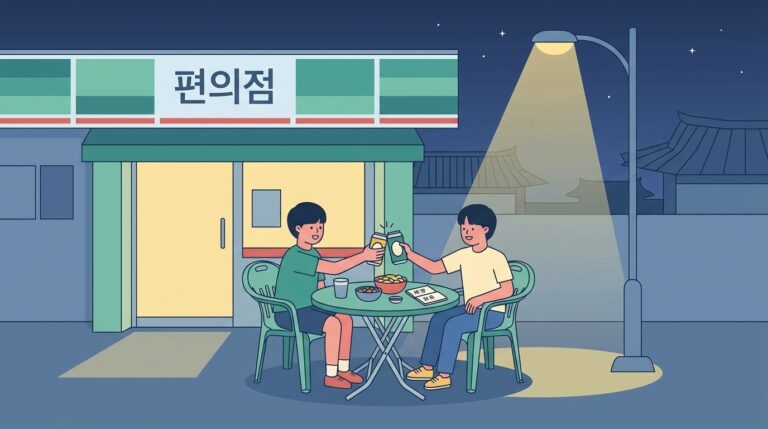
Picture this: The sun has just set over Seoul. The glowing neon sign of a GS25 or CU illuminates the quiet street. You see people sitting on flimsy plastic chairs around a bright patio table, cracking open cans of beer and peeling string cheese. In almost every slice-of-life K-Drama, this is where the main characters end up after a rough day at work or a confusing romantic encounter. They clink cans, let out a deep sigh, and say exactly what is on their mind.
But what happens when you want to experience this iconic “Pyeon-maek” (편맥 – convenience store beer) moment? Do you just grab a beer and sit down? Where do you throw away your trash? What if the clerk yells at you in rapid-fire Korean?
Do not worry. Today, I am going to teach you how to master the outdoor convenience store table like a local. This guide is built on real questions from expat students who wanted to live out their K-Drama dreams but felt too intimidated to take a seat.
Phase 2: Core Expressions Deep Dive
1. 우리 편맥할까? (Shall we do convenience store beer?)
- Pronunciation: [u-ri pyeon-maek-hal-kka?] / ‘Pyeon’ sounds like the ‘pun’ in ‘punish’, ‘maek’ rhymes with ‘back’.
- Meaning: Literal: Shall we do convenience store beer? vs Real Nuance: Want to grab a cheap, casual beer outside?
- K-Culture Moment: You will hear this among college students finishing a group project or coworkers who want a quick drink before heading home. It implies zero pressure—no fancy appetizers, no huge bills.
- Editor’s Insight: “편맥” is a portmanteau of 편의점 (convenience store) and 맥주 (beer). It is the ultimate casual invitation.
- Situation Spectrum:
- Casual (Friends): ✅
- Semi-formal (Close Coworkers): ⚠️ (Only if you are on very friendly terms)
- Formal (Boss/Elders): 🚫
- 🤔 Think About It: Why do Koreans love creating abbreviations like ‘편맥’? How does the fast-paced ‘빨리빨리’ (Ppal-i ppal-i) culture influence the evolution of the Korean language?
2. 밖에서 먹고 갈게요. (I will eat/drink outside.)
- Pronunciation: [ba-kkay-seo meok-go gal-ge-yo] / ‘meok-go’ has a hard ‘k’ stop, almost like ‘muck-go’.
- Meaning: Literal: I will eat outside and go. vs Real Nuance: I am going to use the patio tables.
- K-Culture Moment: When checking out, the cashier might ask if you need a plastic bag. You say this to let them know you are staying. Often, they will nod and might even hand you extra paper cups or point out the microwave.
- Editor’s Insight: At level B2, you know that -(으)ㄹ게요 indicates a promise or future intention. Here, it is just polite information-sharing. Koreans highly appreciate this heads-up!
- Situation Spectrum:
- Casual: ✅
- Semi-formal: ✅
- Formal: ✅ (Perfectly polite to the clerk)
- 🤔 Think About It: The phrase literally ends with ‘and go’ (갈게요). Why is it so important in Korean culture to verbally express that you will not overstay your welcome in a shared space?
3. 다 먹고 분리수거는 어디에 해요? (Where do I recycle after eating?)
- Pronunciation: [da meok-go bun-ri-su-geo-neun eo-di-e hae-yo?]
- Meaning: Literal: Where do I do separate collection after eating all? vs Real Nuance: Where are the recycling bins?
- K-Culture Moment: The golden rule of Pyeon-maek is cleaning up after yourself. Leaving trash on the table is a huge faux pas.
- Editor’s Insight: Koreans are serious about ‘분리수거’ (recycling). Convenience stores have specific bins for plastic, cans, and general waste. Asking this shows you respect local norms.
- Situation Spectrum:
- Casual: ✅
- Semi-formal: ✅
- Formal: ✅
- 🤔 Think About It: South Korea has one of the strictest recycling systems in the world. How does this reflect the collective responsibility in Korean society compared to your home country?
Phase 3: Textbook vs Real Korean
[Inviting someone for a drink]
* 📖 Textbook Korean: 편의점에서 맥주를 마실까요? (Shall we drink beer at the convenience store?)
* 🗣️ Real Korean: 편맥 콜? (Pyeon-maek call?)
* 💡 Why the difference?: ‘콜’ (Call) is English slang adopted by Koreans meaning ‘Deal!’ or ‘I am in!’. It shows how seamlessly English loanwords integrate into casual slang.
[Picking out snacks]
* 📖 Textbook Korean: 맥주와 함께 먹을 안주를 고릅시다. (Let’s choose snacks to eat with the beer.)
* 🗣️ Real Korean: 안주는 뭐 먹을래? 과자? 아님 소시지? (What do you want for snacks? Chips? Or sausage?)
* 💡 Why the difference?: Koreans use the word ‘안주’ (Anju) to describe any food paired with alcohol. Even a cheap bag of potato chips elevates to ‘안주’ the moment a beer is opened.
Bottom Note: For B2 learners, using words like ‘콜?’ or ‘편맥’ with peers shows you are not just studying from a book, but actually living and breathing the modern culture.
Phase 4: Cultural Context — K-Culture Deep Dive
4-1. Non-verbal Cues (The Unspoken Rules)
When drinking outside a convenience store, Nunchi (눈치) is crucial. You are often in a residential area, so being too loud is frowned upon. Notice how Koreans will lean in closer and lower their voices as the night gets deeper. Also, when clinking cans with someone older or a senior coworker, slightly lower your can below theirs—yes, even with cheap convenience store beer! It is an ingrained habit of respect.
4-2. The K-Drama Connection
Have you noticed that K-Drama leads rarely go to expensive restaurants when they need to confess a secret or cry about a breakup? They go to the convenience store. Why? Because it represents the ultimate unpretentious space.
- Critical View: Dramas often romanticize this. The leads sit there looking flawless under the neon lights, but in reality, you are fighting off mosquitoes in the summer and shivering in the winter! Still, the intimacy it creates is 100% real. The physical closeness of the small plastic tables forces you to focus entirely on the person in front of you, without the distractions of a loud bar or restaurant.
Phase 5: Real-life Roleplay Scenario
Scenario A: The Friday Night Unwind
- Setting: Friday, 8:00 PM. Outside a CU near the Han River. The weather is perfectly breezy. You and your coworker just escaped a grueling week of overtime.
- Characters:
- YOU: Expat working in Seoul. Exhausted but craving a cold drink.
- Minji (29): Your Korean coworker. Friendly, reliable, and knows the best snack combos.
Minji: 아, 이번 주 진짜 불태웠다. 집에 그냥 가기 너무 아쉬운데요? 😩
(A, i-beon ju jin-jja bul-tae-wot-da. Jip-e geu-nyang ga-gi neo-mu a-swi-un-de-yo?)
[Ah, I really burned out this week. It is a shame to just go straight home.]
(🎭 Stage Direction: Minji stretches her arms and looks at the brightly lit CU)
YOU: 제 말이요! 우리 저기서 편맥 한잔하고 갈래요?
(Je mal-i-yo! U-ri jeo-gi-seo pyeon-maek han-jan-ha-go gal-lae-yo?)
[That is what I am saying! Do you want to grab a pyeon-maek over there?]
Minji: 오, 완전 좋아요! 오늘 맥주는 제가 쏩니다! 🍻
(O, wan-jeon jo-a-yo! O-neul maek-ju-neun je-ga ssom-ni-da!)
[Oh, totally! I am buying the beers today!]
YOU: 에이, 지난번에도 사셨잖아요. 제가 살게요.
(E-i, ji-nan-beon-e-do sa-syot-ja-na-yo. Je-ga sal-ge-yo.)
[Hey, you bought them last time. I will buy them.]
Minji: 아니에요, 오늘은 진짜 제가 사고 싶어서 그래요. 대신 안주 맛있는 거 골라주세요!
(A-ni-e-yo, o-neul-eun jin-jja je-ga sa-go si-peo-seo geu-rae-yo. Dae-sin an-ju ma-sin-neun geo gol-la-ju-se-yo!)
[No, it is because I really want to treat today. Instead, pick out some delicious snacks!]
🔀 Your Turn! How do you respond?
– A) “아니에요. 무조건 제가 살게요!” (No. I will absolutely buy!)
– B) “그럼 감사히 잘 먹겠습니다! 제가 과자 쏠게요!” (Then I will thankfully enjoy it! I will treat us to chips!)
– C) “알겠어요. 땡큐!” (Got it. Thank you!)✅ Best Choice: B — In Korea, doing the ‘polite push-back’ once or twice is standard. But once they insist, gratefully accepting and offering to buy the smaller item (snacks) is the most charming and natural response.
⚠️ Choice C Analysis: ‘C’ is too casual for a professional setting. Even if you are friendly with your coworker, simply saying ‘땡큐’ without a polite acknowledgement of their generosity can come off as slightly rude.
YOU: (Choosing B) 그럼 감사히 잘 먹겠습니다! 제가 과자랑 소시지 쏠게요!
(Geu-reom gam-sa-hi jal meok-get-seum-ni-da! Je-ga gwa-ja-rang so-si-ji ssol-ge-yo!)
[Then I will thankfully enjoy it! I will treat us to chips and sausages!]
Minji: 좋아요! 저기 빈 테이블 있으니까 먼저 가서 앉아 계세요.
(Jo-a-yo! Jeo-gi bin te-i-beul i-sseu-ni-kka meon-jeo ga-seo an-ja gye-se-yo.)
[Great! There is an empty table over there, so go grab a seat first.]
YOU: 네, 밖에서 먹고 갈 거니까 물티슈도 하나 부탁해요!
(Ne, ba-kkay-seo meok-go gal geo-ni-kka mul-ti-syu-do ha-na bu-tak-hae-yo!)
[Okay, since we are eating outside, please grab some wet wipes too!]
Minji: 맡겨만 주세요! 🫡
(Mat-gyeo-man ju-se-yo!)
[Leave it to me!]
YOU: 아, 맥주 4캔 행사 하는 걸로 골라요!
(A, maek-ju ne-kaen haeng-sa ha-neun geol-lo gol-la-yo!)
[Ah, make sure to pick the beers doing the 4-can promo!]
Minji: ㅋㅋㅋ 당연하죠! 센스쟁이.
(Kkk dang-yeon-ha-jyo! Sen-seu-jaeng-i.)
[Hahaha of course! You have such good sense.]
Scenario B: The ‘Lost Traveler’ Mini Roleplay
- Setting: You are buying late-night snacks alone at a convenience store.
- Clerk: 봉투 필요하세요?
(Bong-tu pi-ryo-ha-se-yo?) [Do you need a bag?] - YOU: 아, 아니요. 밖에서 먹고 갈게요.
(A, a-ni-yo. Ba-kkay-seo meok-go gal-ge-yo.) [Ah, no. I will eat outside.] - Clerk: 네, 다 드신 쓰레기는 저기 문 옆에 분리수거 해주세요.
(Ne, da deu-sin sseu-re-gi-neun jeo-gi mun yeo-pe bun-ri-su-geo hae-ju-se-yo.) [Okay, please recycle your trash over there next to the door when you are done.]
Phase 6: 10-Second Shadowing Drill
Try this out loud! Pay attention to the pauses (/) and the intonation tags.
- 😊 Friendly & Upbeat:
우리 오늘 / 퇴근하고 / 편맥 한잔 / 어때요?
(u-ri o-neul / toe-geun-ha-go / pyeon-maek han-jan / eo-ttae-yo?) -
🥺 Polite & Soft:
다 먹고 / 쓰레기는 / 어디에 / 버려요?
(da meok-go / sseu-re-gi-neun / eo-di-e / beo-ryeo-yo?)
Phase 7: K-Culture Mini Dictionary
1. 편맥 (Pyeon-maek)
* Romanization: pyeon-maek
* English: Convenience store beer
* Context: A staple of Korean casual socializing. It represents cheap, accessible, and laid-back drinking culture.
2. 안주 (Anju)
* Romanization: an-ju
* English: Food paired with alcohol
* Context: In Korea, you rarely drink alcohol without eating something. At a convenience store, this ranges from microwavable sausages to cup ramen and nachos.
3. 노상 (Nosang)
* Romanization: no-sang
* English: Drinking/eating outdoors on the street
* Context: “노상 까다” (Nosang kkada) is a slang term for drinking outdoors. It is extremely popular in spring and autumn.
4. 분리수거 (Bun-ri-su-geo)
* Romanization: bun-ri-su-geo
* English: Waste sorting / Recycling
* Context: A crucial civic duty in Korea. Fiddling with plastic films and washing out ramen cups before throwing them away is expected behavior.
Phase 8: Traveler Survival Kit
🆘 Survival Phrases TOP 3
– 🇰🇷 “전자레인지는 어디 있어요?” (jeon-ja-re-in-ji-neun eo-di i-sseo-yo?)
– 🗣️ Meaning: Where is the microwave?
– 🇰🇷 “이거 투플러스원 맞아요?” (i-geo tu-peul-leo-seu-won ma-ja-yo?)
– 🗣️ Meaning: Is this ‘Buy 2 Get 1 Free’? (Essential for shopping! Keep an eye out for 2+1 or 1+1 price tags.)
– 🇰🇷 “화장실 비밀번호가 뭐예요?” (hwa-jang-sil bi-mil-beon-ho-ga mwo-ye-yo?)
– 🗣️ Meaning: What is the bathroom passcode?📌 Editor’s Travel Note
– Checking IDs: Even if you look older, convenience store clerks might ask for your ID/Passport when buying alcohol. Take it as a compliment and always carry a physical ID!
– Table Etiquette: Not all convenience stores allow drinking at their outdoor tables (some lack the specific permit). If there are no chairs, do not just sit on the curb outside the door.
– Time Limits: Some stores fold up their outdoor tables after 10 PM or 11 PM to prevent noise complaints from neighbors. Always respect the clerk’s instructions.
Phase 9: Critical Thinking Corner — “Going One Step Deeper”
🧠 Think Deeper: Food & Identity (The Power of ‘Anju’)
Why is it that in Korea, drinking is almost never an isolated event? The concept of Anju (안주) is deeply tied to the Korean cultural identity of ‘Jeong’ (정 – communal affection). Even at a plastic table outside a 7-Eleven, Koreans will buy multiple snacks—chips, dried squid, sausages—open them all up, and place them right in the middle of the table to share. It is rarely “my chips” and “your chips”; it immediately becomes “our food.” This act of sharing food, even cheap convenience store snacks, instantly breaks down social walls and creates a sense of collective belonging.💬 Your Turn: Does your culture have a concept similar to ‘Anju’ where food must always accompany drinks? How do you usually split snacks with friends in your country? Let me know in the comments!
Phase 10: FAQ & Avoiding Mistakes
Q: “Is it legally okay to drink alcohol on the street in Korea?”
Yes! Unlike many Western countries with strict open-container laws, drinking in public spaces (like parks or convenience store tables) is generally legal in Korea. However, causing a public disturbance or leaving a massive mess is strictly policed and socially unacceptable.
Q: “Can I use formal Korean (존댓말) to the convenience store clerk even if they are much younger than me?”
Absolutely YES. In the service industry, you are strangers. Using polite forms (요) is a sign of your character, regardless of age. Speaking in ‘Banmal’ (informal Korean) to a service worker is considered incredibly rude.
❌ Common Mistake #1: Leaving a mess on the table.
✅ How to fix it: Unlike restaurants where servers clean up, convenience store tables are 100% DIY. You must wipe up spills, throw away trash in the proper recycling bins, and push your chair in.❌ Common Mistake #2: Assuming you can take the shopping basket outside.
✅ How to fix it: Leave the plastic shopping baskets inside the store. Carry your purchased goods outside in your hands or buy a plastic/paper bag at the counter.
Phase 11: Summary & Action Items
- One-Liner Summary: Mastering ‘Pyeon-maek’ requires knowing how to casually ask for table space, sharing your snacks, and perfectly recycling your trash like a Seoul local.
-
Action Mission 3 Steps:
- 🥉 Bronze (Solo): Say “밖에서 먹고 갈게요” out loud three times while visualizing the convenience store counter.
- 🥈 Silver (Online): Comment below with your favorite beer and snack combination!
- 🥇 Gold (Real World): Next time you are in Korea, invite a friend by saying “오늘 편맥 콜?”
- K-Culture Mission: Watch a modern K-Drama (like My Liberation Notes or Itaewon Class) and spot the scene where characters drink green bottles at a convenience store patio. Notice their body language!
Engagement: What is your go-to convenience store snack when you watch K-Dramas? Share it in the comments below!
Phase 12: Quiz — Interactive Challenge
1. Situational Judgment: You just finished your beer and chips outside the GS25. What is your next step?
– A) Leave the trash neatly piled on the table. The clerk will come outside to get it.
– B) Toss everything into the nearest public trash can you see on the street.
– C) Find the designated recycling bins near the store door, separate the plastics and cans, and throw them away.
Check Answer
Answer: C. (A is a huge faux pas, B ignores Korea’s strict recycling laws and puts the burden on street cleaners!)
2. Fill in the Blank:
Friend: “아 스트레스 받아. 우리 오늘 ____ 할까?” (Ah, I am stressed. Should we do ____ today?)
– A) 회식 (Company dinner)
– B) 편맥 (Convenience store beer)
– C) 눈치 (Nunchi)
Check Answer
Answer: B.
3. True or False – K-Culture Edition:
“If you are clearly 30 years old, the convenience store clerk will never ask for your ID when you buy beer.”
Check Answer
Answer: False! Store clerks face heavy fines if they accidentally sell to minors, so they frequently card adults, especially foreigners whose ages might be harder for them to guess. Take it as a compliment!
Frequently Asked Questions (FAQ)
Q: What does "우리 편맥할까? (Shall we do convenience store beer?)" mean in Korean and how do you pronounce it?
A: In Korean, "우리 편맥할까? (Shall we do convenience store beer?)" is pronounced [u-ri pyeon-maek-hal-kka?] and means: Literal: Shall we do convenience store beer? vs Real Nuance: Want to grab a cheap, casual beer outside?
Q: What does "밖에서 먹고 갈게요. (I will eat/drink outside.)" mean in Korean and how do you pronounce it?
A: In Korean, "밖에서 먹고 갈게요. (I will eat/drink outside.)" is pronounced [ba-kkay-seo meok-go gal-ge-yo] and means: Literal: I will eat outside and go. vs Real Nuance: I am going to use the patio tables.
Q: What does "다 먹고 분리수거는 어디에 해요? (Where do I recycle after eating?)" mean in Korean and how do you pronounce it?
A: In Korean, "다 먹고 분리수거는 어디에 해요? (Where do I recycle after eating?)" is pronounced [da meok-go bun-ri-su-geo-neun eo-di-e hae-yo?] and means: Literal: Where do I do separate collection after eating all? vs Real Nuance: Where are the recycling bins?







