

Hello! I’m your Daily Hangul editor.
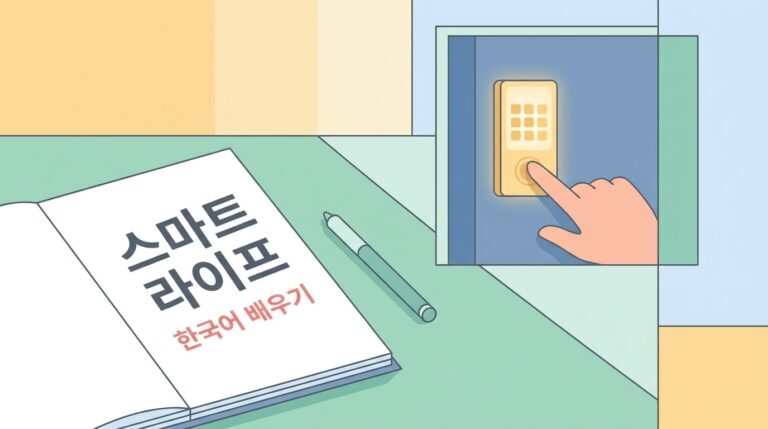
Imagine this: You’re watching a K-Drama. The handsome male lead is standing in front of his sleek apartment door. He doesn’t reach for a metal key. Instead, he lifts a small plastic cover, a digital keypad lights up, and beep-boop-beep-boop-tara! The door unlocks. Or maybe you’ve just arrived at your Seoul Airbnb after a 14-hour flight. You’re exhausted, dragging your luggage, and suddenly you realize… there is no keyhole! Welcome to the world of Korean digital door locks!
In Korea, almost everyone lives in an 아파트 (a-pa-teu, apartment) or a villa, and physical keys are practically extinct. If you don’t know how to navigate the “passcode culture,” you might find yourself locked out in the cold. But don’t worry! As your veteran tutor and local Seoulite friend, I’m going to teach you exactly what to say and do.
This guide is based on real panic moments from my A1 beginner students. Let’s unlock this mystery together!
Phase 2: Core Expressions – Unlocking the Door
Let’s learn the absolutely essential survival phrases for getting through a Korean door.
1. 비밀번호가 뭐예요?
- Pronunciation: bi-mil-beon-ho-ga mwo-ye-yo? [bee-meel-bun-ho-gah mwoh-yeh-yo]
- Meaning: (Literal) Secret number is what? / (Real nuance) What’s the passcode?
- K-Culture Moment: You just arrived at your Airbnb, or you’re visiting a Korean friend’s apartment for the first time. You stand awkwardly at the door while they unload groceries.
- Editor’s Insight: ‘비밀’ (bi-mil) means secret, and ‘번호’ (beon-ho) means number. Put them together, and you get a password! Use this whenever you need the Wi-Fi password, too.
- Situation Spectrum:
- Casual with friends: ✅ (Just say “비밀번호가 뭐야?” – drop the ‘yo’)
- Semi-formal (Airbnb host): ✅
- Formal (Boss/Elders): ⚠️ (Better to ask more politely)
- 🤔 Think About It: Why do Koreans call a password a “secret number”? Does your native language have a specific word for a door code versus a computer password?
2. 문 열어주세요.
- Pronunciation: mun yeol-eo-ju-se-yo. [moon yuhl-uh-joo-seh-yo]
- Meaning: Please open the door.
- K-Culture Moment: You went out to the convenience store to buy late-night ramen, forgot the passcode, and now you’re ringing the apartment intercom, begging your friend to let you in.
- Editor’s Insight: The word ‘문’ (mun) means door. ‘-주세요’ (ju-se-yo) is the magic A1 word meaning “Please give me” or “Please do this for me.” It’s direct but polite!
- Situation Spectrum:
- Casual: ✅
- Semi-formal: ✅
- Formal: 🚫
- 🤔 Think About It: Koreans use “주세요” (Please do it for me) very often. It shows a culture based on interdependence and helping each other out.
Phase 3: Textbook vs Real Korean
Books teach you the grammar, but the streets of Seoul teach you the rhythm. Let’s see how Koreans actually talk about passcodes!
[When asking for the password]
* 📖 Textbook Korean: 비밀번호를 알려주시겠습니까? (Could you please inform me of the password?)
* 🗣️ Real Korean: 비번 뭐예요? (bi-beon mwo-ye-yo?)
* 💡 Why the difference?: Koreans love efficiency and the “빨리빨리” (ppalli-ppalli, hurry up) culture. So, 비밀번호 (bi-mil-beon-ho) is almost always shortened to 비번 (bi-beon) in daily life!
[When telling a friend to unlock the door]
* 📖 Textbook Korean: 번호를 눌러주세요. (Please press the numbers.)
* 🗣️ Real Korean: 비번 쳐! (bi-beon chyeo!) or 문 열어! (mun yeol-eo!)
* 💡 Why the difference?: Between close friends, honorifics (like -요) are completely dropped to show intimacy.
Bottom Note: Since you are at the A1 (Beginner) level, stick to “비번 뭐예요?” (bi-beon mwo-ye-yo?). It’s short, natural, and polite enough for daily use!
Phase 4: Cultural Context — K-Culture Deep Dive
4-1. The “Look Away” Nunchi (눈치)
When you are standing next to a Korean friend while they are typing in their passcode, what should you do? Stare at their fingers? Absolutely NOT!
In Korea, it is an unspoken rule of Nunchi (social tact) to immediately look at the ceiling, check your phone, or completely turn your back when someone is pressing their passcode. Respecting privacy in a high-density apartment environment is crucial!
4-2. The K-Drama Trope: The Heartbreak Passcode
If you’ve watched over 10 K-Dramas, you’ve definitely seen this scene: The main couple breaks up. The female lead comes home, crying, and types in her passcode. It’s her ex-boyfriend’s birthday. In Korean dramas, passcodes are rarely random numbers; they are plot devices! Anniversaries, birthdays, or the day they first met.
A word of advice: In real life, Korean digital locks often require a random 2-digit number to be pressed before the actual passcode to prevent fingerprint smudges from revealing the code. High tech, right?
Phase 5: Real-Life Roleplay Scenario
Let’s put you in the scene.
Setting: It’s 11:00 PM. You and your Korean friend, Min-su, just got back to his apartment with a plastic bag full of hot, crispy Korean fried chicken and beer. His hands are completely full.
Characters:
* YOU: An A1 Korean learner, hungry and excited for chicken.
* Min-su: Your friendly 28-year-old Korean buddy.
Dialogue:
Min-su: 아, 무거워! 🍗
(a, mu-geo-wo!)
[Ah, it’s heavy!]
YOU: 내가 도와줄까요?
(nae-ga do-wa-jul-kka-yo?)
[Shall I help you?]
Min-su: 응, 네가 문 좀 열어줘.
(eung, ne-ga mun jom yeol-eo-jwo.)
[Yeah, please open the door for me.]
(🎭 Stage Direction: Min-su nods toward the dark digital door lock.)
YOU: (You wake up the keypad by touching it.)
🔀 Your Turn! How do you ask Min-su for the code?
– A) “비밀번호를 알려주시겠습니까?”
– B) “비번 뭐예요?”
– C) “열려라 참깨!” (Open sesame!)✅ Best Choice: B — “비번 뭐예요?” is perfectly natural, quick, and fits the casual but polite boundary for a beginner.
⚠️ Choice A Analysis: Way too robotic. Min-su might drop the chicken from laughing.
⚠️ Choice C Analysis: A cute joke, but the chicken is getting cold!
Min-su: 1004 누르고 별표() 눌러!
(cheon-sa nu-reu-go byeol-pyo nul-leo!)
[Press 1-0-0-4 and then the star button!]
*(💡 Pro Tip: 1004 is pronounced ‘cheon-sa’, which sounds exactly like the Korean word for ‘Angel’. A very common passcode!)
Phase 6: 10-Second Shadowing Drill
Speak out loud! Follow the emotion tags and pause where you see the slash (/).
- 🧐 Curious: 비번 / 뭐예요?
(bi-beon / mwo-ye-yo?) -
🥺 Pleading (locked out!): 문 / 열어주세요!
(mun / yeol-eo-ju-se-yo!) -
😊 Helpful: 제가 / 누를게요!
(je-ga / nu-reul-ge-yo!) -> I will press it!
Phase 7: K-Culture Mini Dictionary
Here are 4 words you will see and hear constantly around Korean apartments.
1. 도어락
* Romanization: do-eo-rak
* English: Door lock (Digital)
* Context: The electronic device on the door. It’s Konglish (Korean + English)!
2. 비번
* Romanization: bi-beon
* English: Passcode/Password
* Context: The shortened form of 비밀번호. Used for doors, Wi-Fi, and phones.
3. 별표
* Romanization: byeol-pyo
* English: The Star button (*)
* Context: Most Korean door locks require you to press the * key after entering your numbers to enter the house.
4. 배달
* Romanization: bae-dal
* English: Food Delivery
* Context: When ordering food, the app will ask for the 공동현관 (Common entrance) passcode so the rider can reach your apartment door.
Phase 8: Traveler Survival Kit
If you’re staying at an Airbnb in Korea, you must know these phrases when things go wrong.
🆘 Survival Phrases for the Door Lock
– 🇰🇷 “비밀번호가 안 맞아요.” (bi-mil-beon-ho-ga an ma-ja-yo)
– 🗣️ English Guide: The password doesn’t match/work.
– 🇰🇷 “문이 안 열려요.” (mu-ni an yeol-lyeo-yo)
– 🗣️ English Guide: The door won’t open.📌 Editor’s Travel Note
– Waking up the screen: Sometimes pressing one finger doesn’t turn on the keypad. You often need to touch the screen with your entire palm to wake it up!
– The battery emergency: If the door lock battery dies, it plays a sad little melody. If you’re locked out because of a dead battery, you can buy a 9-volt rectangular battery at a convenience store and hold it against the emergency silver prongs on the outside to give it juice!
Phase 9: Critical Thinking — “One Step Deeper”
Tech Culture vs High Trust Society (기술과 신뢰 사회)
🧠 Think Deeper:
Why did Korea adopt digital door locks so completely that physical keys are rare? It’s a mix of Korea’s famous “Ppalli-ppalli” (hurry up) culture and its status as a high-trust society. Carrying a key is annoying; memorizing 4 digits is fast and efficient. Also, Korea has a very low rate of home burglaries, which makes people feel safe relying purely on electronics without heavy deadbolts.💬 Your Turn: Does your country use digital locks or physical keys? Would you feel safe without a physical key to your home? Let me know in the comments!
Phase 10: FAQ & Avoiding Mistakes
Q: Is it rude to ask my Airbnb host for the “비번” instead of “비밀번호”?
Yes! While “비번” is great for friends, if you are texting an older Airbnb host or a hotel staff member, use the full word: “비밀번호가 뭐예요?” for respect.
Q: Should I put my room passcode in the food delivery app?
No! Only give the code to the first floor common entrance (공동현관). For your own door, they will just ring the bell or leave the food outside. Never share your personal door code.
❌ Common Mistake #1: Forgetting to press the star (*) button. You type “1234” and wait… nothing happens. In Korea, you almost always have to press * to finalize the entry!
Phase 11: Summary & Action Items
One-Liner Summary: Ditch the keys, remember your “비번” (bi-beon), and always look away when your friend is pressing their code!
Action Mission:
– 🥉 Bronze (Solo): Stand at your own front door today, point at the handle, and say “비번 뭐예요?” 3 times.
– 🥈 Silver (Online): Change your phone’s lock screen password today and say “비밀번호” in your head as you do it.
– 🥇 Gold (Real World): If you are in Korea, ask a cafe staff member for the Wi-Fi using today’s phrase: “와이파이 비밀번호가 뭐예요?” (Wi-Fi bi-mil-beon-ho-ga mwo-ye-yo?)
K-Culture Mission:
Watch one episode of a K-Drama tonight. I guarantee you will see a digital door lock within the first 30 minutes. When you hear the beep-boop sound, shout “도어락!” (do-eo-rak).
Phase 12: Quiz — Interactive Challenge
1. You are standing with your Korean friend while they open their door. What is the most “Korean” thing to do?
A) Stare closely at their fingers to memorize it.
B) Offer to press it for them.
C) Look at the ceiling or turn your back immediately.
(Answer: C! The art of Nunchi demands you protect their privacy!)
2. Fill in the blank: If you want to ask your friend for the shortened version of ‘password’, you say: “___ 뭐예요?”
(Answer: 비번 – bi-beon)
3. True or False: You should always give the food delivery driver your personal apartment room passcode so they can put the food inside.
(Answer: False! Only give the common entrance code!)
How did you do? Let me know in the comments if you’ve ever had a door lock panic moment in Korea! See you next time! 👋
Frequently Asked Questions (FAQ)
Q: What does "비밀번호가 뭐예요?" mean in Korean and how do you pronounce it?
A: In Korean, "비밀번호가 뭐예요?" is pronounced [bi-mil-beon-ho-ga mwo-ye-yo? [bee-meel-bun-ho-gah mwoh-yeh-yo] and means: (Literal) Secret number is what? / (Real nuance) What's the passcode?
Q: What does "문 열어주세요." mean in Korean and how do you pronounce it?
A: In Korean, "문 열어주세요." is pronounced [mun yeol-eo-ju-se-yo. [moon yuhl-uh-joo-seh-yo] and means: Please open the door.






