

Phase 1: Empathy & K-Culture Cold Open
Hello! I am the Lead Editor of Daily Hangul.
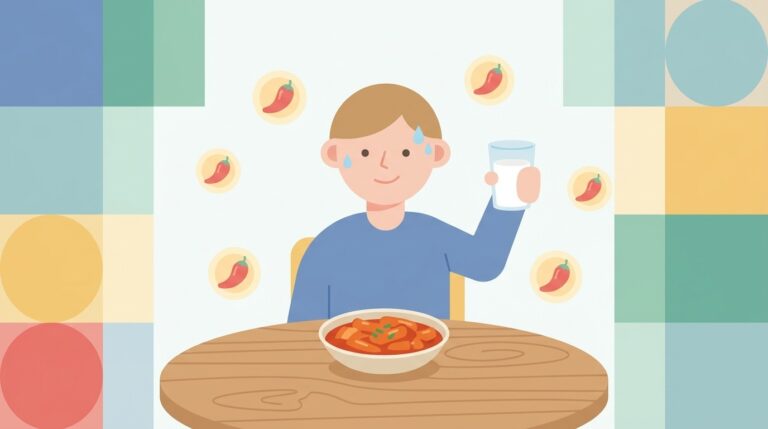
Picture this: You are watching a K-Drama. The main character sits at a pojangmacha (street tent), crying over a bright red plate of tteokbokki. They say it is delicious, but they are sweating profusely. The subtitles simply say, ‘It is good,’ but the intense red color tells a completely different story!
Now, imagine you are in Seoul, sitting in a famous Dakgalbi (spicy stir-fried chicken) restaurant. The menu photos are entirely red. Your mouth is already watering, but your stomach is panicking. You want to experience authentic K-Food, but you do not want to end up in tears in front of your Korean friends or colleagues.
If you do not know how to adjust the spice level in Korea, you might end up drinking three bottles of water instead of enjoying your meal! This guide is based on real SOS messages from my students who bravely ordered the ‘original spicy flavor’ and instantly regretted it. Let us save your tastebuds and make you a true restaurant insider!
Phase 2: Core Expressions Deep Dive
1. 덜 맵게 해주세요
- Pronunciation: deol maepge haejuseyo (Sound-alike: dull map-geh hae-joo-seh-yo. Note: The ‘eu’ in juseyo sounds slightly like the disgusted sound you make when stepping in gum!)
- Meaning: Literal: Please make it less spicy. / Real nuance: Please tone down the spiciness.
- K-Culture Moment: When ordering delivery food on apps like Baedal Minjok, there is usually a request box. Typing this phrase is a lifesaver. It is the most standard, polite way to ask the chef to go easy on the chili flakes without altering the core taste of the dish.
- Editor’s Insight: This phrase is your magic shield! It shows you still want to enjoy the dish the way it is meant to be eaten, just with a little mercy.
- Situation Spectrum:
- Casual with friends: 덜 맵게 해달라고 하자 (Let’s ask them to make it less spicy) ✅
- Semi-formal with coworkers: 덜 맵게 해달라고 할까요? (Should we ask them to make it less spicy?) ⚠️
- Formal to restaurant staff: 덜 맵게 해주세요 (Please make it less spicy) ✅
- 🤔 Think About It: Why does Korean have so many specific adverbs for adjusting food (less, a little bit, moderately)? How does this reflect the Korean culture of customizing service?
2. 안 맵게 해주세요
- Pronunciation: an maepge haejuseyo (Sound-alike: ahn map-geh hae-joo-seh-yo)
- Meaning: Literal: Please make it not spicy. / Real nuance: I want zero spice, please.
- K-Culture Moment: You will often hear Korean parents say this when ordering food for their toddlers at family restaurants. If your spice tolerance is absolutely zero, this is your go-to.
- Editor’s Insight: Use this with caution! For some traditional red dishes (like Kimchi Stew), asking for it to be ‘not spicy at all’ might confuse the chef, as the base itself is spicy.
- Situation Spectrum:
- Casual with friends: 안 매운 거 먹자 (Let’s eat something not spicy) ✅
- Semi-formal with coworkers: ⚠️
- Formal to restaurant staff: 안 맵게 해주세요 ✅
- 🤔 Think About It: In your culture, is it common to completely change the core flavor profile of a traditional dish when ordering?
3. 신라면 정도 맵기인가요?
- Pronunciation: sillamyeon jeongdo maepgi-ingayo? (Sound-alike: shin-rah-myun jung-doh map-gee-in-gah-yo?)
- Meaning: Literal: Is the spiciness around Shin Ramyun level? / Real nuance: How does the spice level compare to Shin Ramyun?
- K-Culture Moment: Shin Ramyun is the ultimate standard unit of spiciness in Korea. If you watch K-Pop idol reality shows, you will often see them asking this exact question when trying a new spicy challenge.
- Editor’s Insight: This is a genius, insider-level question! Instead of asking ‘Is it spicy?’ (which is subjective), using a famous instant noodle brand gives you a crystal-clear baseline.
- Situation Spectrum:
- Casual with friends: 신라면보다 매워? (Is it spicier than Shin Ramyun?) ✅
- Semi-formal with coworkers: ✅
- Formal to restaurant staff: 신라면 정도 맵기인가요? ✅
- 🤔 Think About It: Why did a specific instant noodle brand become the national benchmark for spice? Does your country have a universal food benchmark?
Phase 3: Textbook vs. Real Korean
Asking to adjust the spice level
* 📖 Textbook Korean: 아주 맵지 않게 요리해 주십시오. (Please cook this so it is not very spicy.)
* 🗣️ Real Korean: 덜 맵게 해주세요! (Less spicy, please!)
* 💡 Why the difference?: Korean restaurants are famously fast-paced (the ‘Ppalli-Ppalli’ culture). Long, highly formal sentences slow things down. Short, polite, and direct phrases get you your food faster!
Asking about the spice level
* 📖 Textbook Korean: 이 음식은 얼마나 맵습니까? (How spicy is this food?)
* 🗣️ Real Korean: 이거 많이 매워요? (Is this very spicy?) or 신라면보다 매워요? (Is it spicier than Shin Ramyun?)
* 💡 Why the difference?: Native speakers prefer asking for a direct comparison rather than an abstract measurement.
Bottom Note: As an A2 (Beginner) learner, stick to phrases ending in ‘~yo’ (해요체). It is perfectly polite for any restaurant situation without sounding like a news anchor!
Phase 4: Cultural Context — K-Culture Deep Dive
4-1. Non-Verbal Cues: The Art of Nunchi at the Table
When you ask for less spicy food, do not be shy! Use your hands. Point to the menu item and gently wave your hand in front of your mouth while saying 덜 맵게 해주세요. If you are already eating and it is too spicy, silently grabbing your water glass or dabbing your forehead with a napkin will give your Korean friends the nunchi (social cue) to order you a mild side dish, like steamed egg (Gyeranjjim).
4-2. K-Food Connection: The Pride in Red
Why is so much Korean food bright red? The vibrant color comes from Gochugaru (Korean chili flakes) and Gochujang (Korean chili paste). In K-Food culture, the red color isn’t just about pain; it’s about a deep, savory, slightly sweet heat. Koreans often eat spicy food to relieve stress—a concept called 이열치열 (Fighting fire with fire). But don’t worry, there is no shame in adjusting the heat. Korean restaurants are incredibly accommodating!
Phase 5: Real-Life Roleplay Scenario
Setting: Friday evening, 7 PM. A bustling Dakgalbi (Spicy Stir-fried Chicken) restaurant near Gangnam Station. The air is thick with delicious, spicy steam. You are out with your Korean coworker, Min-su, to celebrate a successful week.
Characters:
* YOU: A foreign professional working in Seoul. You love K-Food, but your stomach strongly disagrees with extreme spice.
* Min-su (32): Your Korean coworker. Friendly, energetic, and believes spicy food solves all life problems.
Dialogue:
Min-su: 야, 오늘 진짜 수고했어요! 제가 닭갈비 쏠게요!
(Ya, oneul jinjja sugohaesseoyo! Jaega dakgalbi ssolgeyo!)
[Translation] Hey, great job today! I will treat us to Dakgalbi!
YOU: 우와, 감사합니다! 닭갈비 너무 좋아해요.
(Uwa, gamsahamnida! Dakgalbi neomu joahaeyo.)
[Translation] Wow, thank you! I love Dakgalbi.
Min-su: 여기 매운맛이 진짜 맛있거든요. 사장님! 여기 매운맛 2인분…
(Yeogi maeunmasi jinjja masitgeodeunyo. Sajangnim! Yeogi maeunmat i-inbun…)
[Translation] The spicy flavor here is seriously delicious. Boss! Two portions of the spicy flavor here…
(Stage Direction: You panic slightly. You know the ‘spicy flavor’ here is no joke.)
YOU: 아, 민수 씨! 잠시만요. 이거 많이 매워요?
(Ah, Min-su ssi! Jamsimanyo. Igeo mani maewoyo?)
[Translation] Ah, Min-su! Hold on a second. Is this very spicy?
Min-su: 음… 신라면보다 조금 더 매워요. 괜찮아요?
(Eum… sillamyeonboda jogeum deo maewoyo. Gwaenchanayo?)
[Translation] Hmm… It is a little spicier than Shin Ramyun. Are you okay with that?
Your Turn! How should you respond?
* A) 아… 네, 괜찮아요! (Ah… yes, it is fine!)
* B) 헉! 사장님, 저희 덜 맵게 해주세요! (Gasp! Boss, please make ours less spicy!)
* C) 저 맵찔이에요. 안 맵게 해주세요. (I am a spicy weakling. Please make it not spicy at all.)Best Choice: B — Reason: It is honest, uses the perfect restaurant phrasing, and saves you from a fiery disaster! Min-su will understand.
Choice A Analysis: This is a dangerous lie! You will suffer the whole dinner.
Choice C Analysis: Funny and uses great slang (maepjjiri), but making Dakgalbi ‘completely not spicy’ might ruin the dish’s identity.
YOU: (Choosing B) 헉! 사장님, 저희 덜 맵게 해주세요!
(Heok! Sajangnim, jeohui deol maepge haejuseyo!)
[Translation] Gasp! Boss, please make ours less spicy!
Min-su: (Laughing) 아, 알겠어요. 사장님, 덜 매운맛으로 2인분 주세요!
(Ah, algesseoyo. Sajangnim, deol maeunmaseuro i-inbun juseyo!)
[Translation] Ah, got it. Boss, two portions of the less spicy flavor, please!
Restaurant Owner: 네~ 덜 맵게 금방 준비해 드릴게요!
(Ne~ deol maepge geumbang junbihae deurilgeyo!)
[Translation] Yes~ I will prepare it less spicy right away!
Phase 6: 10-Second Shadowing Drill
Practice speaking like a Seoul local! Pay attention to the pauses (/) and the emotion tags.
- 🥺 애절하게 (Desperately): 사장님 / 저희 / 덜 맵게 / 해주세요~
(sajangnim / jeohui / deol maepge / haejuseyo~) - 🤔 궁금하게 (Curiously): 혹시 / 이거 / 신라면보다 / 매워요?
(hoksi / igeo / sillamyeonboda / maewoyo?) - 😊 밝게 (Brightly): 저는 / 매운 거 / 잘 못 먹어요!
(jeoneun / maeun geo / jal mot meogeoyo! – I am not good at eating spicy food!)
Phase 7: K-Culture Mini Dictionary
1. 맵찔이
* Romanization: maepjjiri
* English: Spicy weakling / Someone who cannot handle spicy food
* Context: A very popular, cute slang term. If you admit you are a ‘maepjjiri’, Koreans will immediately understand and help you find mild food!
2. 눈치
* Romanization: nunchi
* English: Social sense / Reading the room
* Context: The Korean superpower. If your friend is sweating and drinking lots of water, having good ‘nunchi’ means ordering them a mild side dish without asking.
3. 회식
* Romanization: hoesik
* English: Company dinner
* Context: A core part of Korean corporate culture, often involving spicy stews, BBQ, and soju. Knowing how to politely decline extreme spice here is a survival skill.
4. 단무지
* Romanization: danmuji
* English: Yellow pickled radish
* Context: The ultimate spicy food neutralizer. You will find it at almost every street food or noodle restaurant. Eat a piece when your tongue is burning!
Phase 8: Traveler Survival Kit
Survival Phrase #1
* 🇰🇷 “이거 신라면보다 매워요?” (igeo sillamyeonboda maewoyo?)
* 🗣️ English Guide: Is this spicier than Shin Ramyun?
* 📍 Where to use: Any local restaurant with a red-colored menu.
* 💡 Pro Tip: If they say ‘Yes’, strongly consider ordering a side of rice or egg roll!Survival Phrase #2
* 🇰🇷 “물 좀 더 주시겠어요?” (mul jom deo jusigesseoyo?)
* 🗣️ English Guide: Could you give us some more water, please?
* 📍 Where to use: When the spice hits and your water bottle is empty.
* 💡 Pro Tip: In many casual Korean restaurants, water is ‘Self’ (셀프), meaning you have to fetch it yourself from the fridge!Editor’s Travel Note
* App Recommendation: Use Papago for translating menus. It has an excellent image translation feature.
* Side Dishes (Banchan): If a side dish is too spicy, don’t worry! You can always ask for more of the non-spicy ones for free. Just say, “이거 더 주세요” (igeo deo juseyo – Please give me more of this).
Phase 9: Critical Thinking — “One Step Deeper”
Food & Identity: The Communal Heat
In Korea, meals are traditionally meant to be shared. From a giant bubbling pot of Kimchi Stew in the middle of the table to sharing portions of Dakgalbi, eating together is a profound bonding experience. Because the food is shared, the spice level usually has to be agreed upon by the whole group. This is why asking someone “Can you eat spicy food?” is one of the first questions Koreans ask when planning a meal. It is an act of consideration.
Think Deeper: Korean communal eating shows that the collective experience is sometimes prioritized over individual preferences. When you compromise on the spice level, you are participating in the deep-rooted culture of ‘Jeong’ (affection and connection).
Your Turn: In your culture, do people usually share one large dish, or does everyone order their own individual plate? How do you handle different taste preferences in a group? Let us know in the comments!
Phase 10: FAQ & Avoiding Mistakes
Q: Can I ask them to wash the Kimchi to make it less spicy?
Maybe for a toddler, but as an adult, it is better to just ask for ‘Baek Kimchi’ (White Kimchi), which is naturally non-spicy!
Q: Is it rude to leave food if it is too spicy?
Not necessarily rude, but the owner might worry that it didn’t taste good. It is best to politely explain, “너무 매워서 다 못 먹었어요” (I couldn’t finish it because it was too spicy).
❌ Common Mistake: Confusing ‘안 맵게’ (Not spicy at all) and ‘덜 맵게’ (Less spicy).
✅ How to fix it: If you order a naturally spicy stew ‘안 맵게’, it might lose its flavor completely. Always default to ‘덜 맵게’ if you still want the authentic taste with less pain!
Phase 11: Summary & Action Items
One-Liner Summary: To save your tastebuds and order like a pro, simply smile and say, “덜 맵게 해주세요” (Less spicy, please)!
Action Mission 3 Steps:
* 🥉 Bronze (Solo): Look in the mirror and practice saying “사장님, 덜 맵게 해주세요!” three times with a polite smile.
* 🥈 Silver (Online): Go to an online Korean learning community and introduce yourself by writing whether you are a spicy food lover or a ‘maepjjiri’.
* 🥇 Gold (Real World): Visit a Korean restaurant in your area, or the next time you are in Seoul, use this exact phrase to adjust your order!
K-Culture Mission:
Tonight, watch a K-Drama and pay close attention to a restaurant scene. Notice if the characters share a large dish in the center of the table. Try to spot the red chili paste!
Phase 12: Quiz — Interactive Challenge
1. Situational Judgment:
You are at a famous Tteokbokki spot. You want the authentic taste, but you don’t want to burn your tongue. What is the BEST phrase to use?
* A) 아주 매워요. (It is very spicy.)
* B) 안 맵게 해주세요. (Please make it not spicy.)
* C) 덜 맵게 해주세요. (Please make it less spicy.)
(Answer: C. It preserves the flavor while turning down the heat!)
2. Fill in the Blank:
You want to know the spice level of a dish by comparing it to the famous instant noodle.
“사장님, 이거 _______보다 매워요?”
(Answer: 신라면 – Sillamyeon)
3. True or False – K-Culture Edition:
“In Korean restaurants, you must pay extra if you ask for more water to cool down your mouth.”
(Answer: False! Water and basic side dishes are almost always free and refillable in Korea.)
4. Roleplay Application:
If you boldly choose to say “안 맵게 해주세요” (Not spicy at all) at a spicy chicken restaurant, what is the most likely reaction from the chef?
* A) They will be angry.
* B) They might politely inform you that the base sauce is already spicy, so ‘completely not spicy’ is difficult.
(Answer: B! Most chefs will try to accommodate you, but they will warn you if the dish’s fundamental recipe cannot be changed.)
Great job today! You are now officially ready to navigate any Korean restaurant menu without fear. See you in the next lesson!
Frequently Asked Questions (FAQ)
Q: What does "덜 맵게 해주세요" mean in Korean and how do you pronounce it?
A: In Korean, "덜 맵게 해주세요" is pronounced [deol maepge haejuseyo (Sound-alike: dull map-geh hae-joo-seh-yo. Note: The 'eu' in juseyo sounds slightly like the disgusted sound you make when stepping in gum!] and means: Literal: Please make it less spicy. / Real nuance: Please tone down the spiciness.
Q: What does "안 맵게 해주세요" mean in Korean and how do you pronounce it?
A: In Korean, "안 맵게 해주세요" is pronounced [an maepge haejuseyo (Sound-alike: ahn map-geh hae-joo-seh-yo] and means: Literal: Please make it not spicy. / Real nuance: I want zero spice, please.
Q: What does "신라면 정도 맵기인가요?" mean in Korean and how do you pronounce it?
A: In Korean, "신라면 정도 맵기인가요?" is pronounced [sillamyeon jeongdo maepgi-ingayo? (Sound-alike: shin-rah-myun jung-doh map-gee-in-gah-yo?] and means: Literal: Is the spiciness around Shin Ramyun level? / Real nuance: How does the spice level compare to Shin Ramyun?






