

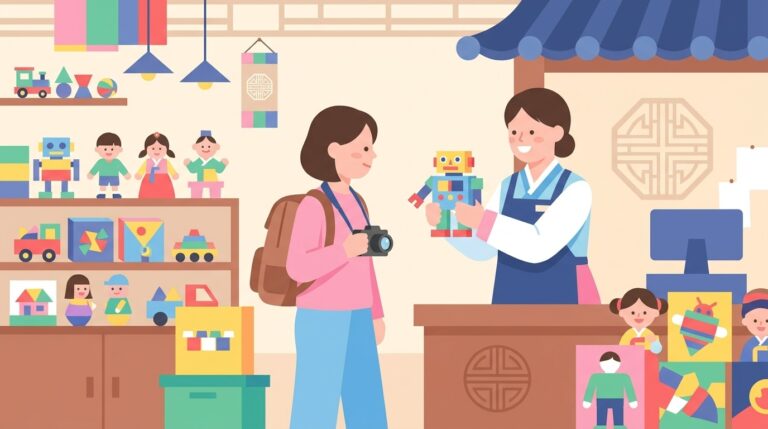
Hello! I am the Lead Editor of Daily Hangul. Have you ever watched a K-Drama where a wealthy, stylish aunt or uncle walks into a toy store, points at a giant robot, and says, I’ll take everything? Welcome to early May in Korea! May 5th is Eorininal (Children’s Day), and the toy aisles in places like Emart or Lotte Mart turn into absolute battlegrounds. Parents and relatives act like secret agents trying to secure that one limited-edition toy. If you have a Korean friend with kids, or young nieces and nephews living here, getting them a gift is a huge cultural plus. But how do you navigate the crowded aisles and ask the clerk for the right thing without panicking? Let’s dive in!
Phase 2: Core Expressions Deep Dive
1. 요즘 제일 잘 나가는 게 뭐예요?
* Pronunciation: yojeum jeil jal naganeun ge mwoyeyo? (yo-jeum / je-il / jal / na-ga-neun / ge / mwo-ye-yo?)
* Meaning: Literal (What is the thing that goes out the best these days?) vs. Real nuance (What is the best-seller right now?)
* K-Culture Moment: Imagine standing in front of a giant wall of character toys. You have absolutely no idea what Catch! Teenieping or Hello Carbot is. You lock eyes with the busy store clerk and drop this lifesaver sentence.
* Editor’s Insight: This is the ultimate shortcut! Instead of politely saying Recommend something, asking What goes out the best makes you sound like a true local who knows how fast trends move in Korea.
* Situation Spectrum:
* Casual (Friends): ✅ (Drop the yo -> mwoya?)
* Semi-formal (Clerks/Colleagues): ✅
* Formal (Boss/Elders): 🚫 (Too casual for a business setting)
* 🤔 Think About It: Why do Koreans often ask what is popular rather than just picking what they personally like? How does this tie into the Nunchi culture of keeping up with social trends?
2. 이거 선물할 건데, 포장되나요?
* Pronunciation: igeo seonmulhal geonde, pojangdoenayo? (i-geo / seon-mul-hal / geon-de, / po-jang-dwe-na-yo?)
* Meaning: Literal (I will gift this, does packaging happen?) vs. Real nuance (I am giving this as a gift, can you wrap it?)
* K-Culture Moment: You finally bought the gift, but giving it in a standard plastic grocery bag? Big no! In K-Dramas, gifts are always presented beautifully. Appearance and presentation matter deeply in Korean gifting culture.
* Editor’s Insight: This is a magic phrase for bakeries, cafes, and toy stores. Keep in mind, some giant marts do not wrap items at the register, but they usually sell pretty gift bags right at the counter!
* Situation Spectrum:
* Casual: ✅ (pojangdwae?)
* Semi-formal: ✅
* Formal: ⚠️ (Say pojang haejusil su innayo? for extra politeness)
* 🤔 Think About It: Why is the passive voice (Does wrapping happen?) used so often in Korean instead of Can YOU wrap this? It naturally softens the request so it does not sound like an order!
3. 영수증은 버려주세요.
* Pronunciation: yeongsujeungeun beoryeojuseyo. (yeong-su-jeung-eun / beo-ryeo-ju-se-yo.)
* Meaning: Literal (As for the receipt, please throw it away.) vs. Real nuance (I do not need the receipt, please toss it.)
* K-Culture Moment: When treating someone or buying a gift, showing the price is considered a bit tacky. You casually tell the cashier to toss the receipt to keep the magic of the gift alive.
* Editor’s Insight: If you do need the receipt for a potential exchange, say yeongsujeung juseyo (Please give me the receipt). But for gifts, tossing it is the cool, considerate move.
* Situation Spectrum:
* Casual: ⚠️ (Friends don’t usually ring up items)
* Semi-formal: ✅ (To cashiers)
* Formal: 🚫
Phase 3: Textbook vs. Real Korean
Asking for a Recommendation
* 📖 Textbook: 아이들이 좋아하는 장난감을 추천해 주시겠습니까? (Would you please recommend a toy that children like?)
* 🗣️ Real Korean: 요즘 애들한테 뭐가 제일 핫해요? (What is the most hot among kids these days?)
* 💡 Why it is different: Koreans love using the English word hot to describe fast-moving trends. It is efficient and instantly understood across all generations.
Asking for Gift Wrapping
* 📖 Textbook: 이것을 예쁘게 포장해 주십시오. (Please wrap this beautifully.)
* 🗣️ Real Korean: 이거 선물할 건데, 포장되나요? (I am gifting this, can it be wrapped?)
* 💡 Why it is different: Giving the reason (I am gifting this) first builds rapport with the clerk and explains the context naturally.
Bottom Note: As an A2 learner, using words like 핫해요 (hot) or 잘 나가는 거 (best-selling) will instantly make you sound like you have lived in Seoul for years!
Phase 4: Cultural Context — K-Culture Deep Dive
4-1. Non-verbal Nunchi
When giving a Children’s Day gift, always present it with both hands, even to a child! It shows respect and sincerity. Also, watch the parents’ faces (Nunchi). Sometimes, bringing a super loud, noisy drum set is a nightmare for parents living in an apartment building. Asking the parents secretly beforehand is considered top-tier Nunchi!
4-2. The K-Culture Connection: Jokababo
Have you heard of the word 조카바보 (Jokababo)? Joka means nephew or niece, and babo means fool. It describes an aunt or uncle who is an absolute fool for their nieces or nephews! Because of Korea’s low birth rate, one child often receives lavish gifts from their parents, four grandparents, and unmarried aunts and uncles. This is called the Eight Pocket phenomenon. Toy shopping on May 4th is not just an errand; it is a competitive sport to show your love!
Phase 5: Real-life Roleplay Scenario
Setting: May 4th, 7:00 PM. The toy section at a giant Lotte Mart in Seoul. It is packed with stressed parents. You need a gift for your Korean manager’s 6-year-old daughter.
Characters:
* YOU: A foreigner working in Korea, trying to impress your manager.
* Clerk (Ajumma): A veteran toy section employee wearing an apron, who knows absolutely everything about kids’ trends.
Clerk: 찾으시는 거 있으세요?
(chajeusineun geo isseuseyo?)
[Are you looking for something?]
(Stage Direction: She is quickly organizing tall boxes of pink fairy wands.)
YOU: 아, 네. 여섯 살 여자아이 선물 찾고 있어요.
(a, ne. yeoseot sal yeojaai seonmul chatgo isseoyo.)
[Ah, yes. I am looking for a gift for a 6-year-old girl.]
Clerk: 캐치티니핑은 어때요? 요즘 제일 잘 나가요.
(kaechitiniping-eun eottaeyo? yojeum jeil jal nagayo.)
[How about Catch Teenieping? It goes out the best these days.]
YOU: 티…니핑이요?
(ti…niping-iyo?)
[Tee…neeping?]
🔀 Your Turn! How should you respond to her recommendation?
* A) 아니요, 다른 거 주세요. (No, give me something else.)
* B) 아~ 요즘 제일 잘 나가는 게 그거예요? 그럼 그걸로 할게요! (Ah~ that is the best-seller right now? Then I’ll take that!)
* C) 너무 비싸요. (It’s too expensive.)
✅ Best Choice: B! Trust the veteran clerk. She knows the trend. Acknowledging her expertise with That is the best-seller? builds a friendly vibe. Option A is a bit blunt, and C might be true, but you haven’t even checked the price tag yet!
YOU: 그럼 그걸로 할게요! 포장되나요?
(geureom geugeollo halgeyo! pojangdoenayo?)
[Then I’ll take that! Can it be wrapped?]
Clerk: 포장은 저기 계산대에서 하시면 돼요.
(pojangeun jeogi gyesandaeeseo hasimyeon dwaeyo.)
[You can do the wrapping over there at the checkout counter.]
YOU: 아, 감사합니다!
(a, gamsahamnida!)
[Ah, thank you!]
Phase 6: 10-Second Shadowing Drill
😊 아~ / 요즘 / 제~일 잘 나가는 게 / 그거예요?
(a~ / yojeum / je~il jal naganeun ge / geugeoyeyo?)
(Speak brightly, with a slight nod of realization on the Ah~)
Phase 7: K-Culture Mini Dictionary
1. 어린이날
* Romanization: eorininal
* English: Children’s Day
* Context: May 5th in Korea. A national public holiday where kids receive gifts, go to amusement parks, and eat out with family.
2. 조카바보
* Romanization: jokababo
* English: A fool for one’s nephew/niece
* Context: A loving slang term for adults who spend a lot of money and time spoiling their siblings’ kids.
3. 품절
* Romanization: pumjeol
* English: Sold out
* Context: The scariest word you can see in a toy store on May 4th. If the trendiest toy is pumjeol, you have to run to another store!
4. 득템
* Romanization: deuktem
* English: Getting a great item / A great catch
* Context: A gaming slang that crossed into real life. Finding the last popular toy on the shelf is a true deuktem!
Phase 8: Traveler Survival Kit
If you are traveling in Korea and find yourself shopping at a mart, keep these phrases handy!
🆘 Survival Phrase #1
* 🇰🇷 이거 얼마예요? (igeo eolmayeyo?)
* 🗣️ Pronunciation: ee-geo / eol-ma-ye-yo?
* 📍 Where to use: Any market or store without clear price tags.
* 💡 Pro Tip: If you cannot understand the fast numbers they say back, hold out your phone calculator! It is a universally understood language in Korea.🆘 Survival Phrase #2
* 🇰🇷 쇼핑백 하나 주세요. (syopingbaek hana juseyo.)
* 🗣️ Pronunciation: syo-ping-baek / ha-na / ju-se-yo.
* 📍 Where to use: At the register.
* 💡 Pro Tip: Korean stores charge 50 to 100 won for bags due to environmental laws, so they will not give you one automatically. You must ask!
📌 Editor’s Travel Note
* Packing your bags: Did you know? In Korean giant marts, cashiers just scan the items. You have to take your cart to a self-packing station (자율포장대) to pack your own boxes or bags.
* Payment: Korea is a cashless society! A credit card is your best friend, even for a 1,000 won item at a convenience store.
Phase 9: Critical Thinking Corner — One Step Deeper
🧠 Think Deeper: Language & Power
Notice how we use 주세요 (juseyo – please give) so often in Korean? 포장해 주세요 (Please wrap it), 영수증 버려 주세요 (Please throw away the receipt). While English relies heavily on modal verbs like Could you… or Would you mind…, Korean relies on adding honorific verb endings to show respect to workers. Even though the customer is paying, politeness to the service worker is deeply embedded in the grammar itself. The relationship between speaker and listener is defined every time a sentence ends.
💬 Your Turn: How do you politely ask a cashier for a favor in your culture? Do you use a specific tone or just add please? Tell us in the comments!
Phase 10: FAQ & Avoiding Misunderstandings
FAQ: Can I just give cash to the kid instead of a toy?
Editor’s Answer: For older kids (middle and high schoolers), cash is definitely king! But for a 6-year-old on Children’s Day, a physical toy is highly expected. Save the cash envelopes for traditional holidays like Lunar New Year (Seollal) or Chuseok.
❌ Mistake 1: Touching or messing up display toys that are inside the box.
✅ Fix: Only play with the unboxed sample (샘플) toys. Korean clerks and parents take the physical condition of the box very seriously when it comes to gifts. A dented box means it is un-giftable!
❌ Mistake 2: Assuming gift wrapping is always free everywhere.
✅ Fix: Department stores will usually wrap items beautifully for free, but giant discount marts might just sell you a pretty paper bag at the counter. Do not be offended; it is just standard store policy!
Phase 11: Summary & Action Items
One-Liner Summary: To survive the chaos of Children’s Day shopping, just ask the clerk: 요즘 제일 잘 나가는 게 뭐예요? (What’s the best-seller?)
Action Mission:
* 🥉 Bronze (Solo): Stand in front of your mirror, pretend you are holding a big gift box, and ask 포장되나요? three times!
* 🥈 Silver (Online): Find a picture of a Korean toy online and post it on a language learning forum with the caption: 이거 어린이날 선물이에요!
* 🥇 Gold (Real World): Next time you buy anything at a Korean store or cafe, boldly ask: 쇼핑백 하나 주세요 (Please give me a shopping bag).
K-Culture Mission: Go to YouTube and search for 조카바보 (Jokababo) to see funny, heartwarming vlogs of Koreans buying crazy gifts for their little nieces and nephews!
Phase 12: Quiz — Interactive Challenge
1. Situational Judgment:
You are at the register and you do not want the 6-year-old’s parents to know the robot cost 100,000 won. What do you secretly say to the cashier?
* A) 쇼핑백 하나 주세요. (Please give me a shopping bag.)
* B) 영수증은 버려주세요. (Please throw away the receipt.)
* C) 너무 비싸요. (It is too expensive.)
2. Fill in the Blank:
To sound like a local when asking for a popular recommendation, you say: 요즘 제일 (_____) 게 뭐예요?
* Hint: It means going out well.
3. True or False – K-Culture Edition:
It is perfectly fine to hand a toy to a child using only one hand since they are much younger than you.
(Answers: 1. B, 2. 잘 나가는 (jal naganeun), 3. False! Giving a gift with both hands shows deep care and is a great cultural habit, even when giving something to a small child!)






