

How to Make New Year Wishes in Korean Like a Local
Phase 1: Empathy
Hello! This is your Daily Hangul Editor, your veteran tutor and local culture navigator.
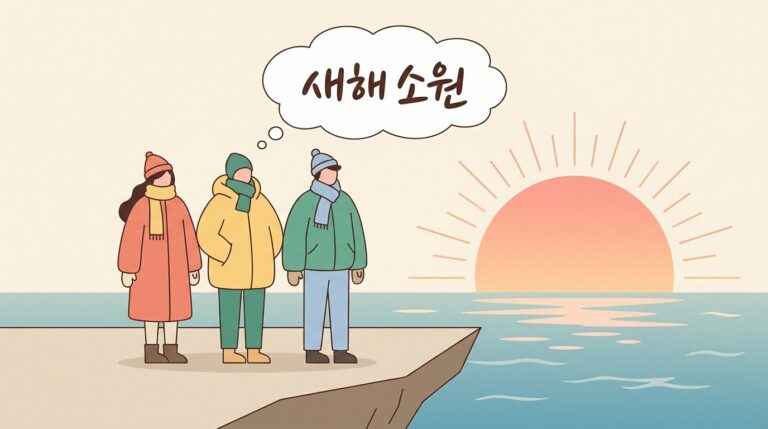
Imagine this: You are standing in the freezing cold at Bosingak Pavilion in Seoul, or maybe at Jeongdongjin Beach watching the first sunrise of the year. The crowd is cheering, and your Korean friends close their eyes, whispering something to themselves. You want to make a wish for the New Year, share your future plans, and join in the festive spirit. But the dictionary translation of I wish feels a bit… robotic. If you simply say I want, it lacks that heartfelt New Year magic.
Today, we are going to dive into the art of making wishes and setting goals in Korean, perfectly tailored for the B1 intermediate level. By the end of this post, you won’t just be translating words; you will understand the deep cultural heartbeat behind Korean New Year resolutions. This guide is built entirely from the real experiences of students just like you who wanted to sound less like a textbook and more like a true local.
Phase 2: Core Expressions Deep Dive
1. 새해 복 많이 받으세요
- Pronunciation: Saehae bok mani badeuseyo (say-hae-bog ma-ni ba-deu-se-yo)
- Meaning: Literal (Please receive a lot of New Year’s luck) vs. Real nuance (Happy New Year!)
- K-Culture Moment: At midnight on January 1st, or during the Lunar New Year holiday (Seollal), this is the universal greeting. You will hear it from your favorite K-Pop idols during live streams, see it on KakaoTalk banners, and hear it during family gatherings in K-Dramas.
- Editor’s Insight: Think of 복 (bok) as a tangible bundle of blessings. You are not just wishing someone a happy time; you are literally hoping they catch a lot of good fortune coming their way.
- Situation Spectrum:
- Friends (Casual): ✅ 새해 복 많이 받아!
- Colleagues (Semi-formal): ✅ 새해 복 많이 받으세요.
- Boss/Elders (Formal): ✅ 새해 복 많이 받으십시오.
- 🤔 Think About It: Why do Koreans tell others to receive luck rather than just saying have a happy year? It reflects a culture of wishing prosperity upon others as a gift. Does your native language have a similar concept of gifting luck?
2. 올해는 명사/동사면 좋겠어요
- Pronunciation: Olhaeneun [noun/verb]-(eu)myeon jokesseoyo (ol-hae-neun … myeon jo-ket-seo-yo)
- Meaning: Literal (It would be good if [X] happens this year) vs. Real nuance (I hope/wish that [X] happens this year)
- K-Culture Moment: This is exactly what you say when blowing out candles on a cake, or looking at the full moon. It is a gentle, hopeful way to express a wish without sounding demanding.
- Editor’s Insight: Using (으)면 좋겠어요 sounds incredibly soft and polite. It is like saying It would be lovely if… rather than I want this right now!
- Situation Spectrum:
- Friends (Casual): ✅ 올해는 여행 많이 가면 좋겠어.
- Colleagues (Semi-formal): ✅ 올해는 프로젝트가 성공하면 좋겠어요.
- Boss/Elders (Formal): ⚠️ (Better to use 건강하시기를 바랍니다 for elders’ health)
- 🤔 Think About It: Korean indirectness shines here. By phrasing a wish as a conditional (If this happens, it would be good), it softens the desire. Why is being indirect often seen as polite in Korean society?
3. 올해는 꼭 ~할 거예요
- Pronunciation: Olhaeneun kkok ~hal geoyeyo (ol-hae-neun ggok …-hal geo-ye-yo)
- Meaning: Literal (This year, I will surely do [X]) vs. Real nuance (My New Year’s resolution is to [X])
- K-Culture Moment: The classic scene where a K-Drama protagonist ties a headband, writes a study schedule, and declares their ultimate goal for the year, like passing an exam or finally confessing their feelings.
- Editor’s Insight: The magic word here is 꼭 (kkok). It means surely or without fail. It turns a simple future tense into a firm, fiery resolution.
- Situation Spectrum:
- Friends (Casual): ✅ 올해는 꼭 다이어트 성공할 거야!
- Colleagues (Semi-formal): ✅ 올해는 꼭 영어를 배울 거예요.
- Boss/Elders (Formal): 🚫 (Too personal for formal business contexts unless directly asked).
- 🤔 Think About It: Koreans love to show determination and effort. Adding 꼭 shows you are taking your goal seriously.
Phase 3: Textbook vs. Real Korean
Situation 1: Wishing for Wealth and Health
* 📖 Textbook Korean: 새해에는 건강하시고 돈을 많이 버시기를 바랍니다. (Very formal and stiff)
* 🗣️ Real Korean: 올해는 아프지 말고 적게 일하고 많이 버세요! (Don’t get sick, work less, and earn a lot!)
* 💡 Why is it different?: Work less, earn more is a modern, humorous blessing among younger generations reflecting the strong desire for work-life balance.
Situation 2: Announcing a Diet or Study Goal
* 📖 Textbook Korean: 저는 올해 매일 운동을 할 것입니다.
* 🗣️ Real Korean: 올해는 진짜 갓생 산다. 오운완 필수! (This year, I’m truly living a God-saeng. O-un-wan is a must!)
* 💡 Why is it different?: Slang like 갓생 (God-saeng: living a productive, exemplary life) and 오운완 (O-un-wan: Workout of the day completed) dominate social media culture in Korea.
Phase 4: Cultural Context — K-Culture Deep Dive
Non-verbal Cues: The Art of Sebae (세배)
When making New Year’s wishes to family elders during Lunar New Year, words are not enough. You must perform a deep, respectful bow called Sebae. You bow first, stay silent, wait for their blessing (Deokdam), and then say your wishes. Also, remember to receive your Sebae-don (New Year’s money) with two hands! Do not stare directly into their eyes while receiving it; a humble, thankful nod is perfect.
K-Travel Connection: The Sunrise Pilgrimage
In Korea, December 31st is chaotic at train stations. Everyone is heading to the East Coast, specifically places like Jeongdongjin or Homigot, to watch the first sunrise of the year. People believe that making a wish while watching the first sun (첫 해) grants it. If you travel to Korea during winter, this is a must-do cultural experience. But be warned: the freezing ocean wind is no joke!
Phase 5: Real-Life Roleplay Scenario
Setting: 6:30 AM, January 1st. Jeongdongjin Beach. The wind is freezing, but the beach is packed with people holding hot packs. You and your Korean friend are waiting for the sun to rise.
Characters:
* YOU: An expat experiencing your first Korean New Year sunrise.
* Min-su: (28, your close Korean friend, shivering but incredibly excited).
Min-su: 아, 진짜 춥다! 근데 하늘 보니까 해가 곧 뜰 것 같아!
(A, jinjja chupda! Geunde haneul bonikka haega got tteul geot gata!)
[Ah, it’s so cold! But looking at the sky, I think the sun will rise soon!]
(Stage Direction: Min-su rubs his hands together and points at the horizon)
YOU: 그러게요! 저기 좀 밝아지는 것 같아요.
(Geureogeyo! Jeogi jom balkajineun geot gatayo.)
[I know, right! It looks like it’s getting brighter over there.]
Min-su: 올해 소원은 생각했어? 나는 꼭 이직할 거야.
(Olhae sowoneun saenggakaesseo? Naneun kkok ijikal geoya.)
[Did you think of your wish for this year? I am definitely going to change jobs.]
🔀 Your Turn! How should you respond?
A) 저는 소원이 없어요. (I don’t have a wish.)
B) 오, 좋은 직장 찾으면 좋겠어요! 저는 올해 꼭 한국어 시험에 합격할 거예요. (Oh, I hope you find a good job! I will definitely pass my Korean exam this year.)
C) 왜 이직해요? 지금 회사 좋아요. (Why change jobs? Your current company is good.)✅ Best Choice: B — Acknowledges his wish politely using (으)면 좋겠어요 and shares your firm resolution using 꼭 할 거예요. It keeps the festive, supportive mood alive!
⚠️ Choice A Analysis: Too blunt and kills the mood. Even if you don’t have a grand wish, making up a small goal (like eating good food) is great for the conversation!
Min-su: 오, 진짜? 합격할 수 있을 거야! 내가 응원할게.
(O, jinjja? Hapgyeokal su isseul geoya! Naega eung-wonhalge.)
[Oh, really? You’ll be able to pass! I’ll cheer for you.]
YOU: 고마워요. 우리 올해는 진짜 갓생 살아봐요!
(Gomawoyo. Uri olhaeneun jinjja gat-saeng sarabwayo!)
[Thank you. Let’s really live a ‘God-saeng’ this year!]
(Stage Direction: You both high-five as the bright sun finally peaks over the ocean waves)
Phase 6: 10-Second Shadowing Drill
😊 올해는 꼭 / 한국어를 / 마스터할 거예요!
(ol-hae-neun ggok / han-gu-geo-reul / ma-seu-teo-hal geo-ye-yo!)
[Brightly, with strong determination: This year, I will definitely master Korean!]
Phase 7: K-Culture Mini Dictionary
1. 보신각 (Bosingak)
* Romanization: Bosingak
* English: Bosingak Pavilion (Bell)
* Context: The massive bell in Seoul that is rung 33 times at midnight on New Year’s Eve. It is the Korean equivalent of the Times Square ball drop!
2. 해돋이 (Haedoji)
* Romanization: Haedoji
* English: Sunrise viewing
* Context: The act of watching the sunrise, especially the very first one of the year to make wishes.
3. 떡국 (Tteokguk)
* Romanization: Tteokguk
* English: Sliced rice cake soup
* Context: The traditional dish eaten on New Year’s. Koreans joke that you only get one year older if you finish your bowl of Tteokguk.
4. 덕담 (Deokdam)
* Romanization: Deokdam
* English: Words of blessing
* Context: Warm words and well-wishes exchanged during the New Year, usually given by elders to younger people.
Phase 8: Traveler Survival Kit
If you are traveling in Korea during the New Year, you will definitely need these phrases to navigate the holiday!
🆘 Survival Expression #1
* 🇰🇷 해돋이 명소가 어디예요? (haedoji myeongsoga eodiyeyo?)
* 🗣️ English Pronunciation: hae-do-ji myeong-so-ga eo-di-ye-yo?
* 📍 Where to use: Asking hotel staff or locals for the best spot to see the sunrise.
* 💡 Pro Tip: 명소 (myeongso) means a famous spot. You can attach it to anything: 야경 명소 (night view spot), 맛집 명소 (famous food spot).
🆘 Survival Expression #2
* 🇰🇷 떡국 하나 주세요. (tteokguk hana juseyo)
* 🗣️ English Pronunciation: ddeok-guk ha-na ju-se-yo
* 📍 Where to use: Ordering at a restaurant in January.
* 💡 Pro Tip: If you don’t eat beef, ask if they have 멸치 국물 (myeolchi gungmul – anchovy broth) based Tteokguk!
🆘 Survival Expression #3
* 🇰🇷 기차표 매진됐나요? (gichapyo maejindwaennayo?)
* 🗣️ English Pronunciation: gi-cha-pyo mae-jin-dwaen-na-yo?
* 📍 Where to use: At the train station trying to get to the East Coast.
📌 Editor’s Travel Note
* Useful Apps: The KTX (Korail Talk) app is essential! Train tickets to the East Coast on Dec 31st sell out a month in advance. Book early!
* Weather Prep: Korean beaches in winter are brutally cold. Buy 핫팩 (hot packs) from any convenience store before you head out to wait for the sunrise.
Phase 9: Critical Thinking — One Step Deeper
Food & Identity: The Soup That Ages You
In many cultures, your age simply changes on your personal birthday. But in traditional Korean culture, everyone turns a year older together on January 1st (or Lunar New Year), and the ritual that solidifies this shared aging process is eating Tteokguk (Rice Cake Soup). It is a shared communal experience of growing older and wiser together. The white rice cakes symbolize a bright, clean start, while the long shape of the rice cake before it is sliced represents longevity. This unique connection between food and age shows how heavily Korean culture emphasizes collective identity and togetherness over individualism.
💬 Your Turn: In your native culture, do you have a specific food that brings good luck for the New Year? Share it in the comments below!
Phase 10: FAQ & Avoiding Misunderstandings
- Q: Can I just translate Make a wish directly into 소원을 만드세요?
- A: No! In Korean, you do not make (만들다) a wish. You pray/beg for a wish. The correct natural verb is 소원을 빌다 (sowoneul bilda).
-
Q: Can I ask What is your New Year’s resolution? to someone I just met?
- A: It is generally okay and actually makes a great icebreaker in January! Just make sure to stick to polite language: 새해 목표가 뭐예요? (What is your New Year goal?)
❌ Common Mistake #1: Using 꼭 (kkok) with negative feelings. 꼭 is strictly for strong positive resolutions or promises. Don’t say 올해는 꼭 아플 거예요 (I will definitely get sick). That sounds like a terrifying curse!
✅ Do this instead: Use it only for goals: 올해는 꼭 한국에 갈 거예요! (I will definitely go to Korea this year!)❌ Common Mistake #2: Forgetting honorifics with elders. Never say 새해 복 많이 받아 to someone older than you unless they specifically told you to drop the formalities.
✅ Do this instead: Always stick to the full polite form: 새해 복 많이 받으세요.
Phase 11: Summary & Action Items
One-Liner Summary: From wishing others 새해 복 많이 받으세요 to setting your own goals with 꼭 ~할 거예요, you are now fully equipped to ring in the Korean New Year like a local!
Action Mission 3 Steps:
* 🥉 Bronze (Solo): Stand in front of your mirror and practice 올해는 꼭 한국어 마스터할 거예요! 3 times with confidence.
* 🥈 Silver (Online): Post your New Year’s resolution in Korean in our Daily Hangul community comments using (으)면 좋겠어요.
* 🥇 Gold (Real Life): Send a KakaoTalk message to a Korean friend saying 새해 복 많이 받으세요! 올해는 꼭 같이 밥 먹어요!
K-Culture Mission:
Go to YouTube and search for K-Pop idols New Year Greetings (새해 인사). Listen carefully—how many times can you catch them saying 새해 복 많이 받으세요?
Phase 12: Quiz — Interactive Challenge
1. Situational Judgment: You are watching the sunrise with your Korean co-workers. You want to express your wish to get a promotion this year. Which is the most natural to say?
* A) 저는 승진을 원해요.
* B) 올해는 꼭 승진하면 좋겠어요.
* C) 승진을 주세요.
2. Fill in the Blank:
My resolution is to diet this year!
올해는 ( ) 다이어트 성공( ) 거예요!
3. True or False — K-Culture Edition:
In Korea, you must eat Kimchi Jjigae on New Year’s Day to turn a year older. (T/F)
(Answers: 1. B – A sounds translated and C means literally give me a promotion. / 2. 꼭, 할 / 3. False, it is Tteokguk!)
Frequently Asked Questions (FAQ)
Q: What does "새해 복 많이 받으세요" mean in Korean and how do you pronounce it?
A: In Korean, "새해 복 많이 받으세요" is pronounced [Saehae bok mani badeuseyo (say-hae-bog ma-ni ba-deu-se-yo] and means: Literal (Please receive a lot of New Year's luck) vs. Real nuance (Happy New Year!)
Q: What does "올해는 명사/동사면 좋겠어요" mean in Korean and how do you pronounce it?
A: In Korean, "올해는 명사/동사면 좋겠어요" is pronounced [Olhaeneun [noun/verb] and means: Literal (It would be good if [X] happens this year) vs. Real nuance (I hope/wish that [X] happens this year)
Q: What does "올해는 꼭 ~할 거예요" mean in Korean and how do you pronounce it?
A: In Korean, "올해는 꼭 ~할 거예요" is pronounced [Olhaeneun kkok ~hal geoyeyo (ol-hae-neun ggok ...-hal geo-ye-yo] and means: Literal (This year, I will surely do [X]) vs. Real nuance (My New Year's resolution is to [X])







