

Hello! It’s your Daily Hangul Editor.
Imagine this: You are walking down the vibrant streets of Hongdae in Seoul on a Friday night. The streets are alive with indie bands, acoustic singers, and massive crowds singing along. Or maybe you’re watching a K-Drama like Hospital Playlist, where the doctors gather after work to jam in their basement band.
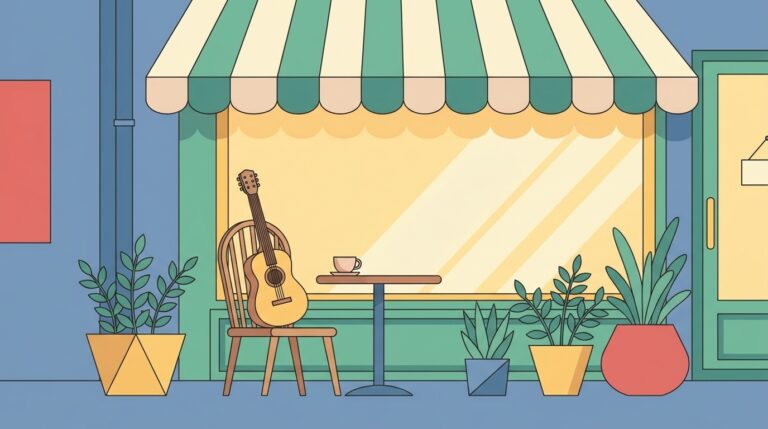
Music is a huge part of Korean culture! But what happens when your Korean friend points to a guitar in a cafe and asks, “Do you play?”
If you directly translate “I play the guitar” from English, you might accidentally say something that makes your Korean friends giggle. Don’t worry! As your veteran tutor, I’m here to show you exactly how to talk about your musical hobbies like a true local.
This post is based on real questions from my beginner students. Let’s tune up our Korean skills!
Phase 2: Deep Dive into Core Expressions
Here are the top 3 expressions you need to know when talking about instruments.
1. 악기 연주할 줄 알아요?
- Pronunciation: ak-gi yeon-ju-hal jul a-ra-yo?
- Meaning: Can you play an instrument? (Literal: Do you know how to perform an instrument?)
- K-Culture Moment: You are at an after-work dinner (회식), and someone spots your guitar calluses or a piano keychain on your bag. They lean in and ask this to break the ice.
- Editor’s Insight: Instead of asking “Can you?” (할 수 있어요?), Koreans prefer asking “Do you know how to?” (할 줄 알아요?) when talking about acquired skills. It sounds much more natural!
- Situation Spectrum:
- Casual with friends: ✅ (Drop the ‘yo’: 악기 연주할 줄 알아?)
- Co-workers: ✅
- Formal/Elders: ⚠️ (Use 연주하실 줄 아세요? for older people)
- 🤔 Think About It: Why does Korean differentiate between “being physically able to” (할 수 있다) and “knowing the skill of” (할 줄 알다)? How does your language handle this?
2. 피아노/기타 칠 줄 알아요.
- Pronunciation: pi-a-no / gi-ta chil jul a-ra-yo.
- Meaning: I can play the piano/guitar. (Literal: I know how to hit the piano/guitar.)
- K-Culture Moment: Someone hands you a guitar at a party. You accept it humbly with this phrase before blowing their minds with a K-Pop cover.
- Editor’s Insight: This is the most important verb to remember! To “play” a percussion or string/keyboard instrument, we use 치다 (to hit/strike). Do not use the verb for “play” (놀다) – that means to hang out or play like a child!
- Situation Spectrum:
- Casual with friends: ✅
- Co-workers: ✅
- Formal/Elders: ⚠️
- 🤔 Think About It: We “hit” (치다) the piano, “blow” (불다) the flute, and “pull” (켜다) the violin. Korean verbs are very visual and physical. Which instrument’s verb surprises you the most?
3. 취미로 밴드 하고 있어요.
- Pronunciation: chwi-mi-ro baen-deu ha-go i-sseo-yo.
- Meaning: I’m in a band as a hobby.
- K-Culture Moment: In K-Dramas, having a secret hobby like a band is a classic trope to show a character’s hidden charm. Saying this will definitely make you look cool!
- Editor’s Insight: “취미로” (as a hobby) is a great way to stay humble. In Korea, humility is a virtue. Even if you are a pro, adding “just as a hobby” makes you sound approachable and polite.
- Situation Spectrum:
- Casual with friends: ✅
- Co-workers: ✅
- Formal/Elders: ✅
Phase 3: Textbook vs. Real Korean
Let’s compare what you learned in textbooks with what you’ll actually hear on the streets of Seoul.
[Asking About Hobbies]
* 📖 Textbook Korean: 취미가 무엇입니까? (chwi-mi-ga mu-eo-sim-ni-kka? – What is your hobby?)
* 🗣️ Real Korean: 쉴 때 보통 뭐 해요? (swil ttae bo-tong mwo hae-yo? – What do you usually do when you rest?)
* 💡 Why so different?: The textbook version sounds like a job interview. Asking “what do you do in your free time” feels much warmer and personal.
[Reacting to a Great Performance]
* 📖 Textbook Korean: 연주를 아주 잘하시네요. (yeon-ju-reul a-ju jal-ha-si-ne-yo. – You perform very well.)
* 🗣️ Real Korean: 와, 대박! 진짜 잘 친다! (wa, dae-bak! jin-jja jal chin-da! – Wow, awesome! You play so well!)
* 💡 Why so different?: Spontaneous awe requires natural, casual exclamations. “대박” (Awesome/Jackpot) is the ultimate compliment among friends.
Bottom Note: At the A2 level, you don’t need heavy slang. Just switching from “취미가 무엇입니까?” to “주말에 뭐 해요?” (What do you do on weekends?) will make you sound 10x more fluent!
Phase 4: Cultural Context — K-Culture Deep Dive
4-1. The Non-Verbal Magic
When someone is playing an instrument in Korea, don’t just sit still! Koreans love active participation. The best non-verbal compliment is swaying lightly and doing 떼창 (tte-chang – singing along) if you know the lyrics. If someone compliments your playing, don’t just say “Thank you.” Wave your hands and say “아니에요” (a-ni-e-yo – No, not at all) to show the essential Korean virtue of humility.
4-2. K-Culture Link: The Hongdae Busking Vibe & K-Drama Tropes
If you visit the Hongdae area in Seoul, you’ll see dozens of street performers (buskers) every night. It’s a massive part of youth culture. Also, think of K-Dramas like Hospital Playlist. Why do the main characters, who are busy doctors, form a band? In Korea, playing an instrument isn’t just a solitary act; it’s a way to build 소속감 (so-sok-gam – a sense of belonging). Bonding over music and having a “Band Club” (밴드부) in school or a “Hobby Club” (동호회) as adults is a beloved social activity.
Critical View: Dramas make it look like everyone is a genius musician who perfectly plays together without practicing. In reality, hobby clubs spend more time eating fried chicken and drinking beer after a 30-minute practice session!
Phase 5: Real-life Roleplay Scenario
Setting: Friday evening, 7 PM. You are at a cozy vintage cafe near Hongdae with acoustic guitars hanging on the wall. You are sipping an iced Americano with your Korean coworker.
Characters:
* YOU: An expat who loves music and just started learning Korean.
* Minsu (30): Your friendly coworker who loves indie bands.
Dialogue:
Minsu: 00씨, 주말에 보통 뭐 해요? ☕
(00-ssi, ju-ma-re bo-tong mwo hae-yo?)
[00, what do you usually do on weekends?]
(🎭 Stage Direction: Minsu takes a sip of his coffee and looks at you curiously)
YOU: 저는 집에서 쉬거나 피아노 쳐요.
(jeo-neun ji-be-seo swi-geo-na pi-a-no chyeo-yo.)
[I rest at home or play the piano.]
Minsu: 오! 진짜요? 피아노 칠 줄 알아요?
(o! jin-jja-yo? pi-a-no chil jul a-ra-yo?)
[Oh! Really? You know how to play the piano?]
YOU: 네, 아주 조금 칠 줄 알아요. 어릴 때 배웠어요.
(ne, a-ju jo-geum chil jul a-ra-yo. eo-ril ttae bae-wo-sseo-yo.)
[Yes, I can play just a little. I learned when I was young.]
Minsu: 와, 멋있다! 저기 피아노 있는데, 한 번 쳐봐요! 🎹
(wa, meo-sit-da! jeo-gi pi-a-no in-neun-de, han beon chyeo-bwa-yo!)
[Wow, cool! There’s a piano over there, you should play something!]
🔀 Your Turn! How should you respond?
– A) “네, 좋아요! 제가 칠게요!” (Yes, great! I will play!)
– B) “아유, 아니에요. 진짜 조금밖에 못 쳐요.” (Oh, no. I really can only play a little bit.)
– C) “싫어요. 안 할 거예요.” (I hate it. I won’t do it.)✅ Best Choice: B — Why? Modesty is key in Korea! Even if you are Mozart, it’s polite to deny it once or twice. If they insist, then you can say “그럼 조금만 쳐볼게요” (Then I’ll just play a little).
⚠️ Choice C Analysis: Too direct and harsh. It might kill the warm mood!
K-Culture Bonus Roleplay
You walk into Nakwon Instrument Arcade (낙원상가) to buy a guitar.
Owner: 뭐 찾으시는 거 있어요?
(mwo cha-jeu-si-neun geo i-sseo-yo? – Are you looking for anything?)
YOU: 기타 보러 왔어요. 이거 한 번 쳐봐도 돼요?
(gi-ta bo-reo wa-sseo-yo. i-geo han beon chyeo-bwa-do dwae-yo? – I came to look at guitars. Can I try playing this one?)
Owner: 그럼요! 편하게 쳐보세요.
(geu-reom-yo! pyeon-ha-ge chyeo-bo-se-yo. – Of course! Feel free to play it.)
Phase 6: 10-Second Shadowing Drill
Practice this sentence focusing on intonation and pauses. Imagine someone just handed you a guitar!
😊 Shyly but proudly:
저는 / 기타를 / 조~금 / 칠 줄 알아요.
(jeo-neun / gi-ta-reul / jo~geum / chil jul a-ra-yo.)
Tip: Drag out the “조~금” (jo~geum) to emphasize that it’s “just a liiiiiittle” bit. It sounds very cute and natural!
Phase 7: K-Culture Mini Dictionary
Here are 4 words you must know to navigate the Korean music hobby scene.
1. 버스킹
* Romanization: beo-seu-king
* English: Busking / Street performance
* Context: Derived from English, but used extensively in Korea. Hongdae is the absolute mecca of ‘beo-seu-king’.
2. 동호회
* Romanization: dong-ho-hoe
* English: Hobby club
* Context: Koreans love joining clubs to share hobbies. There are tons of amateur band or acoustic guitar ‘dong-ho-hoe’ where members practice and then go out for drinks (회식).
3. 떼창
* Romanization: tte-chang
* English: Sing-along crowd
* Context: ‘Tte’ means a group/herd, and ‘chang’ means singing. Korean audiences are famous globally for singing the entire song loudly together with the artist.
4. 합주
* Romanization: hap-ju
* English: Ensemble practice / Jam session
* Context: When band members gather in a rented studio space to practice together. “오늘 합주 있어요” (I have a jam session today).
Phase 8: Traveler’s Survival Kit
If you are visiting Korea and want to check out the music scene (or buy some gear), you need these phrases!
🆘 Survival Phrase #1: Can I play this?
– 🇰🇷 “이거 쳐봐도 돼요?” (i-geo han beon chyeo-bwa-do dwae-yo?)
– 📍 Where to use: Guitar shops in Nakwon Arcade, or cafes with a public piano.
– 💡 Pro Tip: Never just grab an instrument. Always ask for permission using “~해도 돼요?” (May I…?).🆘 Survival Phrase #2: Do you have…?
– 🇰🇷 “기타 줄 있나요?” (gi-ta jul in-na-yo? – Do you have guitar strings?)
– 📍 Where to use: Music stores.
– 💡 Pro Tip: Replace “기타 줄” with any item you need (피크 – picks, 케이블 – cables).🆘 Survival Phrase #3: Please tune this.
– 🇰🇷 “튜닝해 주실 수 있나요?” (tyu-ning-hae ju-sil su in-na-yo?)
– 📍 Where to use: When you buy a new guitar or need help at a shop.📌 Editor’s Travel Note
– The Holy Grail: If you love instruments, you MUST visit Nakwon Instrument Arcade (낙원상가) in Jongno, Seoul. It’s an entire indoor mall filled purely with musical instruments!
– Busking spots: Exit 3 of Hongik University Station (Yeonnam-dong park) or the main Hongdae street. Bring cash if you want to tip the buskers, as tipping culture doesn’t exist in restaurants, but it does for street artists!
Phase 9: Critical Thinking — A Step Deeper
🧠 Think Deeper: Social Bonding Through Solitary Hobbies
Playing an instrument can be a very solitary activity. However, in Korea, even playing the acoustic guitar is heavily tied to community. The booming culture of ‘동호회’ (Hobby Clubs) shows that Koreans use hobbies as a vehicle for ‘정’ (jeong – deep emotional connection) and belonging. It’s less about becoming a maestro and more about the shared experience of practicing, messing up, and laughing over a bowl of spicy rice cakes afterward.💬 Your Turn: Does your culture view playing an instrument as a solitary pursuit or a group activity? Let me know in the comments!
Phase 10: FAQ & Avoiding Misunderstandings
- “Can I just play the piano if I see one in a cafe or subway station?”
- Maybe, but proceed with caution! Subway station pianos (like the ones at Sinchon station) are for the public. Cafe pianos might just be interior decor. Always ask: “이거 쳐봐도 돼요?” first!
- “Why do we say ‘hit’ (치다) for the piano?”
- Korean categorizes instrument verbs by the physical action required to make the sound. You physically strike the keys (치다), you blow into a flute (불다), and you pull a bow across strings (켜다).
❌ Common Mistake #1: Using 놀다 (to play) for instruments.
– Example: 피아노를 놀아요. (I play piano – INCORRECT!)
– Why it’s wrong: ‘놀다’ means playing like a child in a playground, or hanging out with friends.
✅ Do this instead: Use 치다! -> 피아노를 쳐요.
Phase 11: Summary & Action Items
One-Liner Summary: Remember to use “치다” (to hit) instead of “놀다” (to play) for pianos and guitars, and always stay humble when someone praises your skills!
Action Mission:
* 🥉 Bronze (Solo): Say “저는 피아노(or 기타) 칠 줄 알아요” 3 times in front of the mirror with a modest smile.
* 🥈 Silver (Online): Leave a comment below in Korean telling us what instrument you play!
* 🥇 Gold (Real World): Next time you meet a Korean friend, ask them: “주말에 보통 뭐 해요? 악기 연주할 줄 알아요?”
K-Culture Mission:
Go to YouTube and search “홍대 버스킹” (Hongdae Busking) or watch a clip from the drama Hospital Playlist. Notice how the audience interacts and sings along (떼창)!
Phase 12: Interactive Quiz
Let’s test what you’ve learned today!
1. Fill in the blank:
Your friend points to a guitar. You want to say “I know how to play the guitar.”
“저는 기타를 [ ] 줄 알아요.”
A) 놀
B) 칠
C) 할
2. True or False — K-Culture Edition:
If a Korean person says “Wow, you are so good at playing!” you should immediately say “Yes, I know, I am the best!”
3. Situational Judgment:
You want to try playing a display guitar at Nakwon Arcade. What is the most polite thing to say?
A) 이거 쳐봐도 돼요?
B) 저 피아노 칠 줄 알아요.
C) 튜닝해 주세요.
Answers:
1. B) 칠 – We ‘hit’ (치다) string and keyboard instruments!
2. False – Humility is key. Saying “아니에요, 조금밖에 못 쳐요” (No, I can only play a little) will win you more hearts.
3. A) 이거 쳐봐도 돼요? – It means “Can I try playing this?” B is “I know how to play piano” and C is “Please tune this.”
Frequently Asked Questions (FAQ)
Q: What does "악기 연주할 줄 알아요?" mean in Korean and how do you pronounce it?
A: In Korean, "악기 연주할 줄 알아요?" is pronounced [ak-gi yeon-ju-hal jul a-ra-yo?] and means: Can you play an instrument? (Literal: Do you know how to perform an instrument?)
Q: What does "피아노/기타 칠 줄 알아요." mean in Korean and how do you pronounce it?
A: In Korean, "피아노/기타 칠 줄 알아요." is pronounced [pi-a-no / gi-ta chil jul a-ra-yo.] and means: I can play the piano/guitar. (Literal: I know how to hit the piano/guitar.)
Q: What does "취미로 밴드 하고 있어요." mean in Korean and how do you pronounce it?
A: In Korean, "취미로 밴드 하고 있어요." is pronounced [chwi-mi-ro baen-deu ha-go i-sseo-yo.] and means: I'm in a band as a hobby.







