

Phase 1: Empathy (The K-Culture Cold Open)
Hello! I am your Senior Editor at Daily Hangul.
Picture this: You are watching a K-Drama. The main character gets into a huge fight with their parents, packs a small bag, and runs away… straight to a Jjimjilbang (Korean bathhouse). They are sitting on the warm floor with a towel folded like sheep horns on their head, cracking a boiled egg on their friend’s forehead. Have you seen this scene?
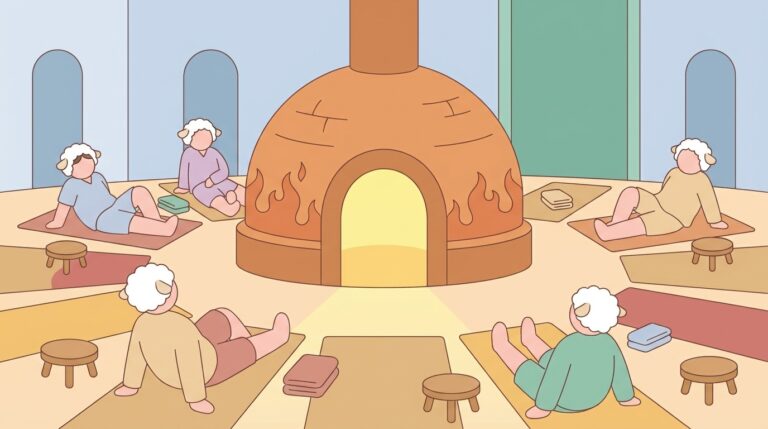
Now, imagine you visit a Jjimjilbang yourself. You bravely step into the 불가마 (Bulgama)—a dome-shaped sauna heated to over 90 degrees Celsius. You feel like you are melting. But right next to you, a Korean uncle closes his eyes, lets out a deep sigh, and says, “Ah, this is so cool and refreshing!”
Wait… what? You are sweating buckets, and he says it is refreshing? If you do not understand this uniquely Korean concept of ‘cooling heat,’ you might think your translation app is broken! Today, we are going to dive into the fiery, sweaty, and surprisingly relaxing world of Korean sauna culture. Let’s unlock the secret language of the Bulgama together.
Phase 2: Core Expressions Deep Dive
1. 아, 시원하다 (Ah, that’s refreshing!)
- Pronunciation: a, siwonhada [Sounds like: ah, shee-won-ha-da]
- Meaning: Literal translation is “Ah, it is cool.” The real nuance is “Ah, this is so relieving/refreshing.”
- K-Culture Moment: You will hear this not only when drinking cold water in summer but also when Koreans step into a boiling hot Bulgama, eat spicy soup, or get a deep tissue massage.
- Editor’s Insight: This expression is not just about temperature; it is about the feeling of releasing tension. When the intense heat melts away your muscle pain and stress, Koreans feel a deep sense of relief, which translates to ‘siwonhada’.
- Situation Spectrum:
- Casual (friends): ✅ (아, 시원해!)
- Semi-formal (colleagues): ✅ (아, 시원하네요.)
- Formal (elders): ✅ (아, 시원합니다.)
- 🤔 Think About It: Why do you think Korean language links physical heat/pain with the feeling of being ‘refreshed’? Does your culture have a similar way of finding comfort in extreme sensations?
2. 몸 좀 지지자 (Let’s soothe our muscles with heat)
- Pronunciation: mom jom jijija [Sounds like: mom johm jee-jee-jah]
- Meaning: Literal translation is “Let’s grill/fry our bodies.” The real nuance is “Let’s warm up and relax our stiff muscles on a hot surface.”
- K-Culture Moment: When the weather gets cold, or after a long week of working at a desk, a Korean friend might stretch their back and say this before dragging you to the heated floor of a Jjimjilbang.
- Editor’s Insight: The verb 지지다 (jijida) is traditionally used for pan-frying food (like pancakes). But Koreans love the ondol (heated floor) culture so much that we use this word for ‘pressing’ our tired bodies against a very hot surface to heal.
- Situation Spectrum:
- Casual (friends): ✅
- Semi-formal (colleagues): ⚠️ (Use ‘몸 좀 녹이시죠’ instead)
- Formal (elders): 🚫 (Too casual)
- 🤔 Think About It: Koreans love their heated floors (Ondol). How does your country deal with winter chills or muscle aches?
3. 땀 좀 쫙 빼자 (Let’s sweat it all out)
- Pronunciation: ttam jom jjak ppaeja [Sounds like: ttam johm jjwack ppae-jah]
- Meaning: Literal translation is “Let’s extract some sweat completely.” The real nuance is “Let’s have a good, detoxifying sweat.”
- K-Culture Moment: Right before walking into the highest temperature Bulgama room, someone will say this as a battle cry. It is about endurance and feeling purified afterward.
- Editor’s Insight: The word 쫙 (jjak) is an emphasizing sound that means “completely” or “in one swift motion.” It adds that satisfying, dramatic flair to the sentence.
- Situation Spectrum:
- Casual (friends): ✅
- Semi-formal (colleagues): ✅ (땀 좀 빼고 올게요)
- Formal (elders): ⚠️
- 🤔 Think About It: Sweating is often seen as unhygienic in some cultures, but as a cleansing ritual in others. How is sweating viewed in your home country?
Phase 3: Textbook vs. Real Korean
[Suggesting to go to the sauna]
* 📖 Textbook Korean: 우리 같이 사우나에 갑시다. (Let’s go to the sauna together.)
* 🗣️ Real Korean: 주말에 찜질방 가서 몸 좀 지지자! (Let’s go to the Jjimjilbang this weekend and melt our bodies!)
* 💡 Why the difference?: Koreans rarely say “Let’s go to the sauna” in a dry, formal way. We focus on the action—the jijida (healing heat) experience.
[Reacting to the extreme heat]
* 📖 Textbook Korean: 온도가 정말 높네요. (The temperature is really high.)
* 🗣️ Real Korean: 와, 땀 장난 아니다. 아으 시원해! (Wow, the sweat is no joke. Ah, so refreshing!)
* 💡 Why the difference?: “장난 아니다” (It’s no joke) is the ultimate everyday slang to express that something is intense or amazing.
Phase 4: Cultural Context — K-Culture Deep Dive
4-1. Non-verbal Communication
When saying “아, 시원하다” (Ah, siwonhada) in a sauna, you cannot just say it with a straight face. You must pair it with a deep, dramatic sigh: “으아~” (Eu-ah~). Tilt your head back slightly, close your eyes, and maybe lightly tap your shoulders or thighs with your fists. This shows you are truly feeling the Korean Nunchi of the room—blending in perfectly with the relaxing locals.
4-2. K-Drama Connection: The Safe Haven
Why do K-Drama characters always run to the Jjimjilbang when they are heartbroken, broke, or fighting with their families? Because for about 10 to 15 dollars, you get 24-hour access to warmth, safety, entertainment, and food!
Have you ever noticed them wearing towels on their heads? That is the famous 양머리 (Yangmeori – Sheep Head). It actually started as a cute trend and became a huge pop-culture phenomenon thanks to dramas in the 2000s.
Critical Viewpoint: While dramas show characters sleeping soundly on the floor, in reality, Jjimjilbangs can be quite noisy with snoring uncles and crying babies. It is not always the peaceful hotel alternative dramas make it out to be!
Phase 5: Real-Life Roleplay Scenario
Setting: Saturday afternoon, inside an 85°C Bulgama room at a mega Jjimjilbang in Seoul. The air is incredibly dry and hot. You are sitting on a straw mat with your Korean friend.
Characters:
* YOU: An adventurous foreigner trying the Bulgama for the first time.
* Min-su (30s): Your Korean friend who convinced you this would be “fun.”
Dialogue:
Min-su: 와, 여기 온도 딱 좋다. 그치?
(Wa, yeogi ondo ttak jota. Geuchi?)
[Wow, the temperature here is perfect. Right?]
YOU: (Wiping sweat) 온도가 85도인데 딱 좋다고요?
(Ondoga palsibo-do-inde ttak jotagoyo?)
[It’s 85 degrees and you say it’s perfect?]
Min-su: 에이, 이 정도는 돼야 땀 좀 쫙 빼지. 으아~ 시원하다!
(Ei, i jeongdoneun dwaeya ttam jom jjak ppaeji. Eua~ siwonhada!)
[Come on, it has to be at least this hot to sweat it all out. Ah~ so refreshing!]
YOU: 시원하다고요? 저 지금 녹고 있는 것 같아요…
(Siwonhadagoyo? Jeo jigeum nokgo inneun geot gatayo…)
[Refreshing? I feel like I’m melting right now…]
Min-su: (Laughs) 조금만 더 참아봐. 5분만 더 지지자. 괜찮아?
(Jogeumman deo chamabwa. Obunman deo jijija. Gwaenchana?)
[Just hold on a little longer. Let’s soothe our bodies for 5 more minutes. Are you okay?]
🔀 Your Turn! How will you respond?
– A) 네, 괜찮아요. 더 있을 수 있어요. (Yes, I’m fine. I can stay longer.)
– B) 안 되겠어요. 저 먼저 나갈게요! 식혜 사주세요! (I can’t do this. I’m going out first! Buy me Sikhye!)
– C) 불이야! 살려주세요! (Fire! Help me!)✅ Best Choice: B — Why? It is honest, safe, and asking for 식혜 (Sikhye – sweet rice beverage) is the most brilliant, culturally accurate way to end a sauna session. Min-su will definitely laugh and buy you one.
⚠️ Choice C Analysis: Funny in your head, but do not yell “Fire” in a crowded sauna! You might cause a panic.
Phase 6: 10-Second Shadowing Drill
Let’s practice the ultimate Jjimjilbang sigh of relief. Remember to act a little tired but deeply satisfied.
😌 으아~ / 땀을 쫙 빼니까 / 진~~~짜 / 시원하다!
(Eua~ / ttameul jjak ppaenikka / jin~~~jja / siwonhada!)
[Ah~ / because I sweat it all out / it is real~~~ly / refreshing!]
Phase 7: K-Culture Mini Dictionary
1. 찜질방
* Romanization: Jjimjilbang
* English: Korean bathhouse/sauna
* Context: A 24-hour facility featuring hot baths, saunas, sleeping areas, and snack bars. The ultimate Korean relaxation zone.
2. 불가마
* Romanization: Bulgama
* English: Fire kiln / Super-hot sauna
* Context: A dome-like sauna usually made of stone or clay. Temperatures range from 70°C to over 100°C.
3. 식혜와 구운 계란
* Romanization: Sikhye-wa guun gyeran
* English: Sweet rice punch and baked eggs
* Context: The holy grail of Jjimjilbang food. The cold, sweet drink perfectly balances the hot sauna, and the brown baked eggs are a protein-packed snack.
4. 양머리
* Romanization: Yangmeori
* English: Sheep head towel
* Context: Folding a standard towel into a cap with two buns on the side. Everyone looks cute wearing it, and it keeps your hair safe from the extreme heat.
Phase 8: Traveler’s Survival Kit
Are you visiting a Jjimjilbang soon? Save these phrases!
🆘 Survival Phrases for the Jjimjilbang
– 🇰🇷 “식혜 하나랑 계란 세 개 주세요.” (Sikhye hanarang gyeran se gae juseyo.)
– 🗣️ English: One Sikhye and three eggs, please.
– 📍 Where to use: At the snack bar (매점 – maejeom).
- 🇰🇷 “너무 뜨거워요.” (Neomu tteugeowoyo.)
- 🗣️ English: It is too hot.
- 📍 Where to use: When the Bulgama is burning your skin.
📌 Editor’s Travel Note
– Payment inside: You usually do not need your wallet! When you enter, you get a locker key on a wristband. You use this wristband to “tap” and pay for food, massage chairs, and games. You pay the total bill when you leave.
– Barefoot zone: Do not wear socks or slippers inside the lounging area unless provided.
Phase 9: Think Deeper — “One Step Further”
Wellness and Identity: The Philosophy of Heat
Why do Koreans love enduring blistering heat in a Bulgama and eating boiling hot stews even in the middle of summer (이열치열 – fighting heat with heat)? It is deeply connected to the Korean concept of Han (pent-up sorrow/stress) and the desire for catharsis. Sweating profusely in a 90°C room is seen as a physical way to flush out not just bodily toxins, but emotional heavy burdens. That is why the pain of the heat suddenly transforms into the feeling of Siwonhada (refreshment/relief). It is a form of active, aggressive relaxation.
💬 Your Turn: Does your culture have a tradition where enduring physical discomfort (like extreme heat, cold plunges, or intense spices) is considered healing? Tell us in the comments!
Phase 10: FAQ & Common Mistakes
Q: Do I have to be completely naked in the Jjimjilbang?
A: No! This is a very common misunderstanding. A Jjimjilbang has two zones. The bath/shower area is strictly gender-separated and you must be naked. However, the sauna/lounge area (where the Bulgama is) is a co-ed public space. You MUST wear the t-shirt and shorts uniform provided at the front desk!
Q: Can I use “아, 시원하다” (Ah, siwonhada) for cold weather?
A: Yes, you can! It literally means “cool.” If a cool breeze blows in autumn, you can say “시원하다.” Just remember it has a double meaning depending on the context (temperature vs. physical relief).
❌ Common Mistake: Using ‘뜨겁다’ (It’s hot) and ‘덥다’ (It’s hot) interchangeably.
✅ How to fix it:
– 덥다 (deopda): Used for the weather or air temperature making you sweat. (e.g., Summer is hot.)
– 뜨겁다 (tteugeopda): Used for objects you touch or very intense, localized heat. (e.g., This soup is hot. The floor of the Bulgama is hot!)
Phase 11: Summary & Action Items
One-Liner Summary: In Korea, surviving the extreme heat of the Bulgama and sweating it out is the ultimate way to feel truly “refreshing” (시원하다)!
Action Mission 3 Steps:
* 🥉 Bronze (Solo): Stand in your bathroom after a hot shower, stretch your arms, and practice sighing: “으아~ 시원하다!”
* 🥈 Silver (Online): Go to YouTube, search for “Jjimjilbang vlog,” and leave a comment using “땀 좀 쫙 빼자!”
* 🥇 Gold (Real Life): Visit a Korean spa (if there is one in your city or when visiting Korea), wear the Yangmeori, and order Sikhye in Korean!
Special K-Culture Mission:
Search online for “How to fold a Korean Yangmeori (sheep head towel)” and try making one with your bathroom towel right now!
Phase 12: Interactive Quiz
1. Situational Judgment:
You are inside the Bulgama. Your back is resting against the incredibly hot stone wall, and your muscle tension is melting away. What is the most culturally appropriate thing to say?
* A) 아이고, 춥다! (Oh, it’s cold!)
* B) 아~ 시원하다! (Ah~ so refreshing!)
* C) 사우나에 갑시다! (Let’s go to the sauna!)
2. True or False — K-Culture Edition:
You must bring cash into the Bulgama room to buy boiled eggs and Sikhye. (T / F)
3. Fill in the Blank:
Korean friend: “이번 주말에 피곤한데 찜질방 가서 몸 좀 _______?”
(Hint: Let’s soothe our muscles on a hot surface)
Click here to see the answers!
1. B (Even though it is hot, the relief feels ‘refreshing’ to Koreans!)
2. False (You use your electronic locker key bracelet to pay for everything inside!)
3. 지지자 (jijija)
Frequently Asked Questions (FAQ)
Q: What does "아, 시원하다 (Ah, that's refreshing!)" mean in Korean and how do you pronounce it?
A: In Korean, "아, 시원하다 (Ah, that's refreshing!)" is pronounced [a, siwonhada [Sounds like: ah, shee-won-ha-da] and means: Literal translation is "Ah, it is cool." The real nuance is "Ah, this is so relieving/refreshing."
Q: What does "몸 좀 지지자 (Let's soothe our muscles with heat)" mean in Korean and how do you pronounce it?
A: In Korean, "몸 좀 지지자 (Let's soothe our muscles with heat)" is pronounced [mom jom jijija [Sounds like: mom johm jee-jee-jah] and means: Literal translation is "Let's grill/fry our bodies." The real nuance is "Let's warm up and relax our stiff muscles on a hot surface."
Q: What does "땀 좀 쫙 빼자 (Let's sweat it all out)" mean in Korean and how do you pronounce it?
A: In Korean, "땀 좀 쫙 빼자 (Let's sweat it all out)" is pronounced [ttam jom jjak ppaeja [Sounds like: ttam johm jjwack ppae-jah] and means: Literal translation is "Let's extract some sweat completely." The real nuance is "Let's have a good, detoxifying sweat."







