

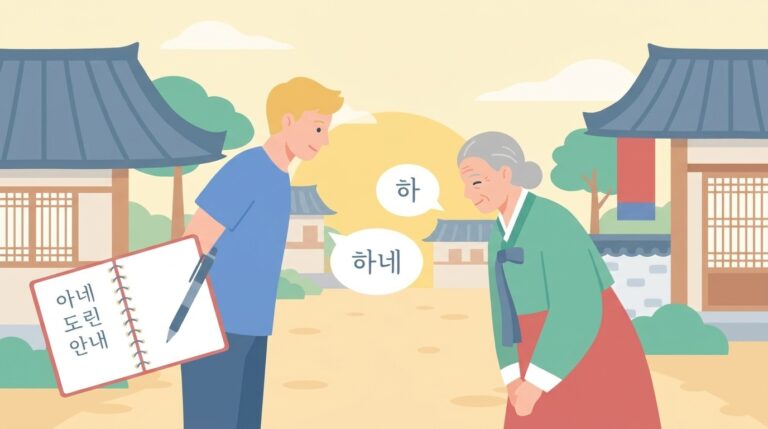
Phase 1: Empathy
Hello there! I am the Lead Editor of Daily Hangul, and your personal guide to mastering the real, living Korean language.
Imagine this K-Drama scene: The wealthy Chairman is sitting in his grand office. His loyal secretary walks in. If the secretary were talking to a friend, they might say, ‘밥 먹었어?’ (Did you eat?). But to the Chairman? The entire vocabulary shifts. The words for ‘eat’ and ‘meal’ completely mutate into something you probably never saw in your beginner textbooks.
Welcome to the ‘Final Boss’ of Korean honorifics: Extreme Honorific Vocabulary (극존칭 어휘).
When you reach the B2 (Intermediate) level, simply attaching ‘yo’ (요) or ‘seumnida’ (습니다) at the end of your sentences is no longer enough to sound perfectly polite. In Korea, when speaking to elders, senior clients, or your partner’s grandparents, using the wrong noun can accidentally sound like a police interrogation. But don’t worry! This guide is based on real struggles my foreign students have faced. By the end of this post, you’ll know exactly how to navigate these tricky words and secure that ‘Insider’ (인싸) status.
Phase 2: Core Expression Deep Dive
Let’s break down the most essential vocabulary transformations you need to survive formal Korean settings.
1. 이름 (Name) -> 성함 (Name – Extreme Honorific)
- Pronunciation: seongham (sung-hahm)
- Meaning: Name (Literal & Real Nuance: Honorable Name)
- K-Culture Moment: You walk into a luxury hotel in Seoul or a corporate office for a meeting. The polite receptionist will never ask for your ‘ireum’ (이름). They will always ask, ‘성함이 어떻게 되세요?’ (What is your honorable name?).
- Editor’s Insight: Using ‘이름’ (ireum) to ask an elder or a customer for their name feels abrupt and slightly rude, almost like asking ‘Who are you?’ instead of ‘May I have your name?’. ‘성함’ (seongham) instantly wraps your sentence in silk.
- Situation Spectrum:
- Casual (Friends): 🚫
- Semi-formal (Coworkers): ⚠️
- Formal (Elders/Clients): ✅
- 🤔 Think About It: Notice how Koreans ask ‘How does your name become?’ (어떻게 되세요?) instead of ‘What is your name?’ (뭐예요?). Why do you think Korean culture prefers indirect questions when showing respect?
2. 나이 (Age) -> 연세 (Age – Extreme Honorific)
- Pronunciation: yeonse (yuhn-seh)
- Meaning: Age (Real Nuance: Years of life lived)
- K-Culture Moment: In K-Dramas, when a young doctor speaks to an elderly patient, they gently ask, ‘할아버지, 연세가 어떻게 되세요?’ (Grandfather, what is your age?).
- Editor’s Insight: Age dictates the entire hierarchy of the Korean language. While it is common to ask a new acquaintance their age, using ‘나이’ (nai) to someone with grey hair is a huge faux pas. ‘연세’ acknowledges the weight and wisdom of their years.
- Situation Spectrum:
- Casual (Friends): 🚫
- Semi-formal (Coworkers): 🚫 (Too formal for young coworkers)
- Formal (Grandparents/Elders over 60): ✅
- 🤔 Think About It: In many Western cultures, asking an older person their age is rude. In Korea, it is necessary to establish the correct level of respect. How does your culture view age-related questions?
3. 밥 먹다 (To eat a meal) -> 진지 드시다 (To eat a meal – Extreme Honorific)
- Pronunciation: jinji deusida (jeen-jee deu-shee-dah)
- Meaning: To consume an honorable meal.
- K-Culture Moment: The classic ‘meeting the in-laws’ scene. The nervous protagonist bows deeply and asks the intimidating father-in-law, ‘진지 드셨습니까?’ (Have you had your meal?).
- Editor’s Insight: ‘밥’ (bab) is just food. ‘진지’ (jinji) is a meal worthy of utmost respect. Note that ‘진지’ is quite old-school. Today, it is mostly reserved for grandparents or elderly relatives. For your boss, you would use ‘식사’ (siksa – dining) instead.
- Situation Spectrum:
- Casual (Friends): 🚫
- Semi-formal (Boss/Manager): ⚠️ (Use 식사 siksa instead)
- Formal (Grandparents/Elderly in-laws): ✅
- 🤔 Think About It: Asking ‘Did you eat?’ is the ultimate Korean greeting, rooted in a history where food was scarce. Does your native language have greetings that don’t literally mean ‘Hello’?
Phase 3: Textbook vs Real Korean
Let’s see how these words actually play out in everyday situations.
[Asking a Customer’s Name]
* 📖 Textbook Korean: 이름이 뭐예요? (ireumi mwoyeyo? – What is your name?)
* 🗣️ Real Korean: 성함이 어떻게 되세요? (seonghami eotteoge doeseyo? – How does your name become?)
* 💡 Why the difference?: Directness is often perceived as aggressive in Korean business culture. ‘How does it become’ provides a polite, indirect cushion.
[Asking an Elder’s Age]
* 📖 Textbook Korean: 몇 살이에요? (myeot sarieyo? – How old are you?)
* 🗣️ Real Korean: 연세가 어떻게 되세요? (yeonsega eotteoge doeseyo?)
* 💡 Why the difference?: ‘살’ (sal) is used for children and peers. ‘연세’ shows reverence for the elder’s life journey.
[Telling Your Boss to Eat]
* 📖 Textbook Korean: 밥 먹으세요. (bam meogeuseyo – Eat your rice.)
* 🗣️ Real Korean: 식사하셨어요? (siksahasyeosseoyo? – Have you dined?)
* 💡 Why the difference?: Commanding a boss to eat, even politely, is awkward. Asking if they have dined is the socially smooth way to show care.
Phase 4: Cultural Context — K-Culture Deep Dive
4-1. The Unspoken Rules (Non-verbal Elements)
Words are only 50% of Korean respect. If you use ‘성함’ (seongham) but hand over a document with one hand while making intense eye contact, the respect is broken. When using extreme honorifics:
* Always use two hands when offering or receiving something.
* Lower your gaze slightly. Staring directly into an elder’s eyes while asking ‘연세가 어떻게 되세요?’ can seem confrontational.
* Your ‘Nunchi’ (눈치 – ability to read the room) should tell you: if the person has grey hair or holds a high rank, automatically switch to these vocabulary words.
4-2. K-Drama Connection: The ‘Meeting the Parents’ Trope
If you have watched K-Dramas like Crash Landing on You or Queen of Tears, you know the tension of meeting the older generation. The younger character will physically shrink, bow 90 degrees, and carefully calculate every noun and verb. They won’t say ‘My house’ (우리 집 uri jip); they will refer to the elder’s house as ‘댁’ (daek). Understanding these vocabulary shifts adds a whole new layer of enjoyment to your drama watching—you can literally hear the power dynamics shift through their word choices!
Phase 5: Real-Life Roleplay Scenario
Setting: A traditional Hanjeongsik (Korean table d’hote) restaurant in Jongno. Traditional music plays softly. You are sitting on floor cushions.
Characters:
* YOU: An expat living in Korea. You’ve been invited to meet your Korean partner’s grandfather for the first time.
* Grandfather (할아버지): 75 years old. Traditional, strict-looking, but has a warm heart.
* Minji: Your supportive Korean partner.
Dialogue:
Minji: 할아버지, 제 남자친구/여자친구예요. 인사해.
(harabeoji, je namjachingu/yeojachinguyeyo. insahae.)
[Grandpa, this is my boyfriend/girlfriend. Say hello.]
YOU: 처음 뵙겠습니다. 만나서 반갑습니다.
(cheoeum boepgetseumnida. mannaseo bangapseumnida.)
[How do you do. Nice to meet you.]
(🎭 Stage Direction: You bow deeply from the waist)
Grandfather: 그래, 반가워요. 한국말을 아주 잘하네. 나이가 어떻게 돼요?
(geurae, bangawoyo. hangungmareul aju jalhane. naiga eotteoge dwaeyo?)
[Yes, nice to meet you. You speak Korean very well. How old are you?]
YOU: 저는 올해 스물여덟 살입니다.
(jeoneun olhae seumulyeodeol sarimnida.)
[I am 28 years old this year.]
Grandfather: 젊네. 한국 음식은 입에 맞아요?
(jeomne. hanguk eumsigeun ibe majayo?)
[You’re young. Does Korean food suit your taste?]
YOU: 네, 아주 좋아합니다. 특히 불고기를 좋아해요.
(ne, aju joahamnida. teuki bulgogireul joahaeyo.)
[Yes, I like it very much. I especially like Bulgogi.]
Minji: 오빠/자기야, 할아버지께 밥 드셨는지 여쭤봐.
(oppa/jagiya, harabeojikke bap deusyeonneunji yeojjwobwa.)
[Honey, ask Grandpa if he has eaten.]
🔀 Your Turn! How should you ask the Grandfather if he ate?
A) 할아버지, 밥 먹었어요? (harabeoji, bam meogeosseoyo?)
B) 할아버지, 진지 드셨어요? (harabeoji, jinji deusyeosseoyo?)
C) 할아버지, 식사하셨어요? (harabeoji, siksahasyeosseoyo?)✅ Best Choice: B — Because he is an elderly family member, ‘진지 드셨어요?’ is the absolute best way to show deep traditional respect. It will impress him instantly!
⚠️ Choice C Analysis: ‘식사하셨어요’ is also polite and acceptable, but usually used for bosses or middle-aged people. ‘진지’ is the ultimate ‘Grandparent’ word.
❌ Choice A Analysis: NEVER use ‘밥 먹었어요’ to your partner’s grandfather. He might jokingly (or seriously) tell you to study your manners!
YOU: 할아버지, 오시느라 힘드셨죠? 진지 드셨어요?
(harabeoji, osineura himdeusyeotjyo? jinji deusyeosseoyo?)
[Grandpa, was it hard coming all the way here? Have you had your meal?]
Grandfather: 허허! 진지라는 말도 알아? 아주 훌륭하네. 안 먹었지, 어서 먹자!
(heoheo! jinjiraneun maldo ara? aju hullyunghane. an meogeotji, eoseo meokja!)
[Haha! You even know the word Jinji? Very excellent. I haven’t eaten, let’s eat!]
Bonus K-Travel Roleplay:
You are lost in a traditional market and see an elderly shop owner.
YOU: 어르신, 죄송하지만 지하철역이 어디 있는지 아세요?
(eoreusin, joesonghajiman jihacheollyeogi eodi inneunji aseyo? – Elder, excuse me, but do you know where the subway station is?)
Owner: 저쪽으로 쭉 가면 돼!
(jeojjogeuro jjuk gamyeon dwae! – Just go straight that way!)
YOU: 감사합니다! 많이 파세요!
(gamsahamnida! mani paseyo! – Thank you! Sell a lot! – Classic polite market parting greeting)
Phase 6: 10-Second Shadowing Drill
Practice saying this out loud to get the melody right. Follow the emotion tags and pauses!
😊 밝고 예의 바르게 (Bright and polite)
할아버지, / 진지 / 드셨어요?
(harabeoji, / jinji / deusyeosseoyo?)
🥺 조심스럽게 (Carefully and softly)
성함이 / 어떻게 / 되세요?
(seonghami / eotteoge / doeseyo?)
Phase 7: K-Culture Mini Dictionary
Here are 4 cultural keywords you must know to master polite Korean situations:
1. 눈치
* Romanization: nunchi
* English: Social situational awareness / Reading the room
* Context: The quintessential Korean social skill. It’s the ability to quickly assess the hierarchy and mood of a room and adjust your vocabulary accordingly.
2. 어르신
* Romanization: eoreusin
* English: Respected elder
* Context: A safe, highly polite term to address an elderly person whose name or title you do not know (e.g., an elderly stranger on the street).
3. 상견례
* Romanization: sanggyeollye
* English: Formal meeting between the families of a bride and groom
* Context: The ultimate test of extreme honorifics. At this event, a single wrong word choice can cause serious family drama!
4. 식사 예절
* Romanization: siksa yejeol
* English: Dining etiquette
* Context: It goes beyond words. You do not pick up your spoon until the eldest person at the table picks up theirs.
Phase 8: Traveler Survival Kit
Even if you aren’t marrying into a Korean family, you will interact with older folks during your travels. Here is your survival kit.
🆘 Survival Expression #1
* 🇰🇷 ‘어르신, 길 좀 여쭐게요.’ (eoreusin, gil jom yeojjulgeyo.)
* 🗣️ English: Elder, let me ask you for directions.
* 📍 Where to use: Asking elderly locals for directions.
* 💡 Pro Tip: ‘여쭈다’ (yeojjuda) is the extreme honorific version of ‘물어보다’ (to ask). It instantly makes you look incredibly well-educated.🆘 Survival Expression #2
* 🇰🇷 ‘성함이 어떻게 되세요?’ (seonghami eotteoge doeseyo?)
* 🗣️ English: May I have your name?
* 📍 Where to use: Making reservations, filling out forms at a clinic, or dealing with business partners.📌 Editor’s Travel Note
* When visiting traditional markets like Gwangjang Market, the elderly vendors might speak to you in ‘Banmal’ (casual speech). Don’t be offended! In market culture, it’s a sign of grandmotherly affection (정 – jeong).
* However, YOU should always reply in polite form (‘yo’ or ‘seumnida’).
Phase 9: Critical Thinking Corner — ‘A Step Deeper’
Language & Power in Korea
🧠 Think Deeper:
Korean honorifics aren’t just about ‘being polite.’ They are an intricate map of social architecture. By completely changing nouns and verbs based on the listener’s age and status, the language constantly reinforces a vertical social structure. However, it’s not simply about dominance; it’s heavily rooted in Confucian care and respect. When you use words like ‘연세’ (Yeonse) or ‘진지’ (Jinji), you are actively taking on the role of the humble caretaker, honoring the hardships the older generation endured.💬 Your Turn: Does your native language have ways to show extreme respect to elders, or do you treat everyone with the same level of casual friendliness? Let us know in the comments!
Phase 10: FAQ & Avoiding Misunderstandings
Let’s clear up some common confusions B2 learners face:
- Q: Can I use ‘진지 드셨어요?’ to my company boss?
- A: NO. It sounds too archaic and intimate, like you are talking to a grandfather. For your boss, use ‘식사하셨어요?’ (Did you dine?).
- Q: If I’m writing a fan letter to an older K-Pop idol, should I use ‘연세’?
- A: NO! Idols, even older ones, rely on a youthful image. Using ‘연세’ will make them feel like a senior citizen. Stick to standard polite Korean.
❌ Common Mistake #1: Trying to use honorifics on yourself.
✅ Do this instead: Never say ‘제 성함은…’ (My honorable name is…). Honorifics are only for the OTHER person. Say ‘제 이름은…’ (My name is…).❌ Common Mistake #2: Asking an elder ‘몇 살이에요?’ (How old are you?).
✅ Do this instead: Always use ‘연세가 어떻게 되세요?’ for anyone who looks over 60.
Phase 11: Summary & Action Items
One-Liner Summary: To master extreme Korean honorifics, remember that respect isn’t just an ending particle; it changes the very core vocabulary you use for Name (성함), Age (연세), and Meals (진지).
Action Mission:
* 🥉 Bronze (Solo): Stand in front of the mirror and politely ask your reflection for its name using ‘성함이 어떻게 되세요?’ three times.
* 🥈 Silver (Online): Go to a language exchange app and ask an older Korean language partner, ‘식사하셨어요?’ instead of ‘밥 먹었어요?’.
* 🥇 Gold (Real World): Next time you visit a traditional Korean restaurant, politely say goodbye to the elderly owner by bowing and saying ‘안녕히 계세요, 어르신!’ (Goodbye, respected elder!).
🎬 K-Culture Mission: Watch a historical K-Drama (Sageuk) or a family drama this weekend. Pay close attention to scenes with grandparents. Every time you hear ‘진지’ (Jinji) instead of ‘밥’ (Bab), take a screenshot or write it down!
Phase 12: Quiz — Interactive Challenge
Test your extreme honorifics knowledge!
1. Situational Judgment: You are checking into a hotel in Busan. The front desk staff wants to ask for your name. What will they most likely say?
* A) 이름 좀 알려주세요.
* B) 성함이 어떻게 되세요?
* C) 댁이 어디세요?
2. Fill in the Blank:
할아버지, 올해 [ _______ ]가 어떻게 되세요? (Grandpa, how old are you this year?)
* A) 나이
* B) 연세
* C) 살
3. True or False — K-Culture Edition:
In Korea, it is strictly forbidden to ask someone’s age when you first meet them, as it is considered extremely rude. (T/F)
Click to see the answers!
- B – The staff will use the extreme honorific ‘성함’ (Seongham) for a customer.
- B – ‘연세’ (Yeonse) is the correct extreme honorific for an elder’s age.
- False – In fact, Koreans often ask your age shortly after meeting you to establish the social hierarchy and know which level of honorific language to use!
Thank you for studying with Daily Hangul. Stay tuned for our next deep dive into the fascinating world of the Korean language! What topic should we cover next? Drop a comment below!
Frequently Asked Questions (FAQ)
Q: What does "이름 (Name) -> 성함 (Name - Extreme Honorific)" mean in Korean and how do you pronounce it?
A: In Korean, "이름 (Name) -> 성함 (Name - Extreme Honorific)" is pronounced [seongham (sung-hahm] and means: Name (Literal & Real Nuance: Honorable Name)
Q: What does "나이 (Age) -> 연세 (Age - Extreme Honorific)" mean in Korean and how do you pronounce it?
A: In Korean, "나이 (Age) -> 연세 (Age - Extreme Honorific)" is pronounced [yeonse (yuhn-seh] and means: Age (Real Nuance: Years of life lived)
Q: What does "밥 먹다 (To eat a meal) -> 진지 드시다 (To eat a meal - Extreme Honorific)" mean in Korean and how do you pronounce it?
A: In Korean, "밥 먹다 (To eat a meal) -> 진지 드시다 (To eat a meal - Extreme Honorific)" is pronounced [jinji deusida (jeen-jee deu-shee-dah] and means: To consume an honorable meal.







