

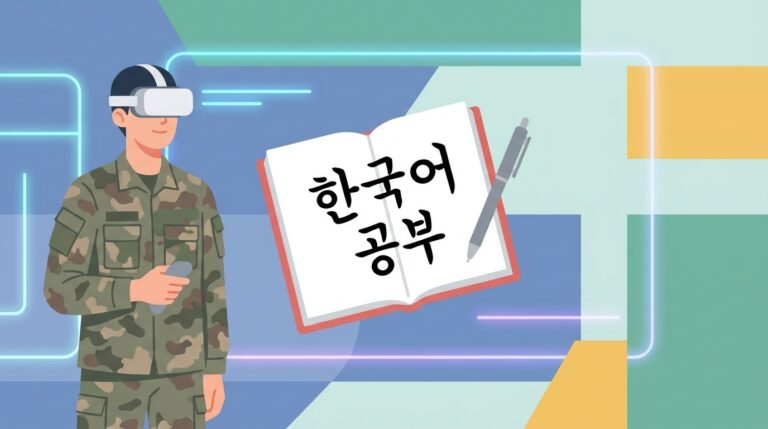
Phase 1: Empathy & K-Culture Cold Open
Hello! I am your Daily Hangul editor.
Picture this: You are walking down the vibrant streets of Hongdae on a random Tuesday afternoon. Among the trendy college students and tourists, you suddenly spot a group of guys walking around in full camouflage military uniforms, eating pork belly, or casually holding iced Americanos. Are we at war? Did a military base suddenly relocate to a trendy cafe district?
Not at all! If you have lived in Korea or watched enough slice-of-life K-Dramas, you might already know this phenomenon. These are 예비군 (yeobigun)—military reservists.
In South Korea, after men complete their mandatory active-duty military service (which you often see K-Pop idols tearfully depart for and proudly return from), they do not just hang up their uniforms forever. For several years, they must attend annual reserve training. Historically, this training was notorious for being boring, outdated, and terribly underpaid. It was a common K-Drama trope to see male characters sighing heavily when their draft notice for reserve training arrived in the mail.
However, things are changing fast. Welcome to the era of scientific modernization of reserve forces (예비군 훈련의 과학화) and realistic compensation (보상 현실화). VR shooting simulators are replacing dusty firing ranges, and the compensation is finally starting to look like actual money rather than just bus fare.
As an advanced C2 Korean learner, discussing sociopolitical and cultural shifts like this will instantly elevate you from a ‘foreigner who speaks good Korean’ to an ‘insider who truly understands Korean society’. Let us dive into the advanced vocabulary and cultural nuances behind this modern Korean military shift!
Phase 2: Core Expressions Deep Dive
Here are the top advanced expressions native Koreans use when talking about the modernization of reserve training.
1. 훈련이 완전 빡세졌어. (The training got intensely hard.)
- Pronunciation: hullyeoni wanjeon ppaksejyeosseo. [Sound-alike: Hool-lyeon-ee wan-jeon ppak-seh-jyeot-so.]
- Meaning: Literal: The training became entirely hard. / Real nuance: The training is no joke anymore; it requires serious physical and mental effort.
- K-Culture Moment: A returning K-Pop idol doing a live stream with fans after his reserve duty, wiping sweat off his brow and saying, ‘Wow, VR shooting is no joke nowadays. wanjeon ppaksejyeosseo.’
- Editor’s Insight: 빡세다 (ppakseda) is a highly common slang term meaning ‘tough, intense, or physically demanding.’ Since reserve training used to be considered a ‘rest day’ where guys just slacked off, the introduction of Miles gear (laser engagement systems) and strict evaluations has made them realize they actually have to sweat now.
- Situation Spectrum:
- Close friends (Casual): ✅
- Co-workers (Semi-formal): ⚠️ (Only if you are close and speaking casually)
- Boss/Elders (Formal): 🚫 (Use ‘훈련이 많이 힘들어졌습니다’ instead)
- Think About It: Why does Korean have so many slang words related to physical hardship and hierarchy (like 빡세다)? How does the shared experience of mandatory conscription shape the everyday vocabulary of Korean men?
2. 마일즈 장비 도입돼서 실감 나. (With the Miles gear introduced, it feels so real.)
- Pronunciation: mailljeu jangbi doipdwaeseo silgam na. [Sound-alike: Mile-jeu jang-bee do-ip-dweh-so shil-gam na.]
- Meaning: Literal: Miles equipment is introduced, so realistic feeling comes out. / Real nuance: The training is super immersive now because of the new tactical laser gear.
- K-Culture Moment: Co-workers chatting at the water cooler on Monday morning. One guy rubs his shoulders, complaining about the tactical training, but admits the tech was actually pretty cool, like playing a real-life video game.
- Editor’s Insight: 실감 나다 (silgam nada) means ‘to feel real’ or ‘to hit close to home.’ It is a fantastic C2 level expression you can use not just for military gear, but for VR games, realistic K-Drama acting, or even when realizing you finally arrived in Korea.
- Situation Spectrum:
- Close friends (Casual): ✅
- Co-workers (Semi-formal): ✅
- Boss/Elders (Formal): ⚠️ (Change to ‘실감이 납니다’)
- Think About It: South Korea is an IT powerhouse. Do you think the rapid gamification and digitization of military training reflect the country’s broader obsession with technology and efficiency?
3. 드디어 보상비가 현실화되네. (Finally, the compensation is becoming realistic.)
- Pronunciation: deudieo bosangbiga hyeonsilhwadoene. [Sound-alike: Deu-dee-oh bo-sang-bee-gah hyun-shil-hwa-dweh-neh.]
- Meaning: Literal: Finally compensation fee is becoming realistic. / Real nuance: They are finally paying us a fair, acceptable amount for our time.
- K-Culture Moment: Watching the 8 PM evening news where the anchor discusses the government’s budget increase for military reservists.
- Editor’s Insight: 현실화 (hyeonsilhwa) literally means ‘realization’ or ‘actualization,’ but in political and economic contexts, it means adjusting outdated policies/prices to match current reality (e.g., inflation or fair wage). This word instantly makes you sound like a highly educated native speaker.
- Situation Spectrum:
- Close friends (Casual): ✅
- Co-workers (Semi-formal): ✅
- Boss/Elders (Formal): ✅ (Change to ‘현실화되네요’)
- Think About It: Compensation used to be so low that guys joked it barely covered a bowl of jjajangmyeon. Discussing ‘현실화’ touches on the modern Korean youth’s demand for fairness (공정성) and proper compensation for their sacrifices.
Phase 3: Textbook vs. Real Korean
Let us look at how the textbook teaches you versus how Koreans actually complain or brag about their reserve training over a pint of beer.
[Talking about the difficulty of the training]
* Textbook Korean: 훈련이 많이 어려워졌습니다. (The training has become very difficult.)
* Real Korean: 와, 요즘 예비군 장난 아니야. 완전 빡세. (Wow, reserve duty is no joke these days. It is super intense.)
* Why the difference?: ‘장난 아니야’ (literally: it is not a joke) is the ultimate native reaction to anything extreme, whether it is delicious K-Food, a beautiful K-Pop idol, or a grueling workout.
[Talking about the increased pay]
* Textbook Korean: 훈련 수당이 인상되었습니다. (The training allowance has been increased.)
* Real Korean: 이제야 좀 밥값은 하네. (It finally covers the cost of a meal at least.)
* Why the difference?: Koreans often measure small amounts of money against the price of basic necessities like ‘밥값’ (food cost) or ‘커피값’ (coffee cost). It reflects a cynical yet practical approach to small financial gains.
Bottom Note: At the C2 level, you should master replacing academic verbs (인상되다) with idiomatic lifestyle expressions (밥값은 하다) depending on your audience.
Phase 4: Cultural Context — K-Culture Deep Dive
4-1. Non-verbal Element: The Reservist Swagger (예비군 스웩)
There is a very specific physical transformation that happens when a Korean man puts on his reserve uniform. While active-duty soldiers walk with crisp, disciplined movements, reservists are famous for their exaggerated sluggishness, slouching, and hands shoved deep into their pockets. If you talk about reserve training, dropping your shoulders and sighing heavily before speaking will earn you massive laughs from Korean friends. It is a shared physical comedy trait.
4-2. K-Culture Connection: The Drama ‘D.P.’ vs Reality
If you watched the hit K-Drama D.P., you saw the dark, heavy side of Korean active-duty military. However, reserve training (예비군) is the complete opposite vibe. It is often portrayed in media as a comedic relief moment.
Furthermore, in the K-Pop fandom world, when an idol goes to reserve duty, fans affectionately call it ‘예비군 출퇴근’ (commuting to the reserve). Since modernization now allows for early discharge (조기퇴소) for top-performing squads (using those high-tech laser systems), you will often see fans cheering on Twitter: ‘Our oppa is a sharpshooter! He got early discharge today!’
Phase 5: Real-life Roleplay Scenario
Setting: Friday evening, 7 PM. A bustling Korean BBQ restaurant near Gangnam Station. The air is thick with the savory smell of grilled pork belly. You are sitting with your Korean co-workers. Minsu, who took two days off this week for his reserve training, just joined the table. He is still carrying his camo military backpack.
Characters:
– YOU: A foreign professional working in Korea. You have excellent Korean skills and know exactly how to push Minsu’s buttons.
– Minsu (32): Your friendly, slightly dramatic Korean colleague.
Dialogue:
Minsu: 아, 온몸이 쑤시네. 예비군 다녀왔더니 죽겠다.
(a, onmomi ssusine. yeobigun danyeowatdeoni jukgetda.)
[Translation] Ah, my whole body aches. I went to reserve training and it is killing me.
YOU: 에이, 예비군 가서 그냥 쉬다 오신 거 아니에요?
(ei, yeobigun gaseo geunyang swida osin geo anieyo?)
[Translation] Hey~ didn’t you just go there and rest?
Minsu: 무슨 소리야! 요즘 예비군 완전 빡세졌어. 마일즈 장비 차고 산 뛰어다녔다고!
(museun soriya! yojeum yeobigun wanjeon ppaksejyeosseo. mailljeu jangbi chago san ttwieodanyeotdago!)
[Translation] What are you talking about! Reserve training got so intense lately. I was running around the mountain wearing Miles gear!
YOU: 오, 과학화 훈련? 그럼 성적 좋으면 조기퇴소도 시켜줘요?
(o, gwahakhwa hullyeon? geureom seongjeok joeumyeon jogitoesodo sikyeojwoyo?)
[Translation] Oh, the modernized scientific training? Do they let you leave early if your score is good?
Minsu: 당연하지! 우리 분대가 1등해서 제일 먼저 퇴소했어.
(dangyeonhaji! uri bundega il-deunghaeseo jeil meonjeo toesohaesseo.)
[Translation] Of course! Our squad took 1st place, so we were the first to get discharged.
(Stage Direction: Minsu proudly flexes his arm while pouring a glass of Soju)
YOU: 오~ 역시! 근데 보상비는 좀 올랐어요?
(o~ yeoksi! geunde bosangbineun jom ollasseoyo?)
[Translation] Oh~ as expected! But did the compensation fee go up a bit?
Minsu: 어, 드디어 보상비가 좀 현실화됐더라. 그래서 오늘 고기는 내가 쏜다!
(eo, deudieo bosangbiga jom hyeonsilhwadwaetdeora. geuraeseo oneul gogineun naega ssonda!)
[Translation] Yeah, the compensation finally became a bit realistic. So the meat is on me today!
Decision Point: Your Turn! How should you reply?
– A) 네, 감사합니다. 고기 많이 먹겠습니다. (Formal, textbook, a bit stiff)
– B) 헐, 대박! 역시 민수 대리님 짬바 장난 아니네요! 잘 먹겠습니다! (Enthusiastic, uses slang effectively)
– C) 예비군 수당으로 소고기 사주세요! (A bit too demanding, might ruin the mood)
Best Choice: B.
Why? You acknowledge his generosity while casually using the military-derived slang ‘짬바’ (vibe of experience), praising his veteran skills. It is the perfect C2 level mix of wit and cultural understanding!
Phase 6: 10-Second Shadowing Drill
Read this out loud. Pay attention to the pauses (/) and the emotional tags!
😤 (Defensively) 요즘 예비군은요, / 옛날이랑 다르게 / 완~~~전 빡세졌어요!
(yojeum yeobiguneunyo, / yennalirang dareuge / wan~~~jeon ppaksejyeosseoyo!)
😊 (Excitedly) 보상비가 / 드디어 현실화돼서 / 기분이 좋습니다!
(bosangbiga / deudieo hyeonsilhwadwaeseo / gibuni joseumnida!)
Phase 7: K-Culture Mini Dictionary
Here are some essential keywords related to Korean military and everyday society.
1. 군필 (Gunpil)
– English: A person who has completed their mandatory military service.
– Context: Highly valued in Korean society. You will often see ‘군필자 우대’ (Preference for those who completed military service) on part-time job postings, implying they are responsible and disciplined.
2. 조기퇴소 (Jogitoeso)
– English: Early discharge / Leaving early.
– Context: The ultimate reward in reserve training. If your team performs well in the VR/scientific simulations, you get to go home hours earlier than others. This sparks fierce competitiveness among normally lazy reservists.
3. 짬바 (Jjamba)
– English: Vibe/Aura of experience.
– Context: A compound word from ‘짬에서 나오는 바이브’ (Vibe coming from military food/time served). It started as military slang but is now widely used in K-Pop (e.g., praising a veteran idol’s stage presence) and corporate life.
4. 쏜다 (Ssonda)
– English: To treat someone (to food/drinks).
– Context: Literally means ‘to shoot’ (a gun), but idiomatically means ‘I will pay for this!’ Very fitting for a post-military training BBQ.
Phase 8: Traveler’s Survival Kit
While you might not attend reserve training as a traveler, you will definitely encounter military culture, especially if you visit places near the DMZ, take the subway on a Friday (when soldiers get leave), or interact with young Korean men.
Survival Expression #1: Military Discounts
– 🇰🇷 “혹시 군인 할인 되나요?” (hoksi gunin harin doenayo?)
– 🗣️ English Pronunciation: Hok-shi goo-nin ha-rin dweh-na-yo?
– 📍 Where to use: Theme parks (Everland/Lotte World), movie theaters, restaurants.
– 💡 Pro Tip: If you are traveling with a Korean friend who is currently serving, always ask this! Many places offer huge discounts for active-duty soldiers to honor their service.
Survival Expression #2: Respectful Acknowledgment
– 🇰🇷 “고생 많으십니다.” (gosaeng maneusimnida.)
– 🗣️ English Pronunciation: Go-saeng ma-neu-shim-ni-da.
– 📍 Where to use: Seeing soldiers carrying heavy bags on a train, or greeting a friend who just finished training.
– 💡 Pro Tip: This means ‘You are working hard/suffering a lot.’ It is the most respectful and heartwarming thing you can say to someone doing their national duty.
Editor’s Travel Note
– South Korea is technically still at war (armistice). Do not be alarmed if you hear loud sirens on the 15th of certain months; it is just a nationwide civil defense drill (민방위 훈련).
– Taking photos of military bases or restricted coastal fences is strictly prohibited and heavily fined. Watch out for signs with a camera crossed out!
Phase 9: Critical Thinking Corner — A Step Deeper
Language & Power: How Military Culture Bleeds into Corporate Korea
The mandatory conscription system does not just train soldiers; it shapes the very fabric of Korean organizational culture. Expressions you learn in business Korean—such as strict reporting lines (보고 체계), saying ‘다/나/까’ (formal sentence endings), and the emphasis on seniority (기수 문화)—all stem from military experiences.
As reserve training modernizes with VR and scientific methods, the corporate world is also shifting from strict top-down hierarchies to horizontal, skill-based evaluations. The demand for ‘현실화’ (realistic compensation) in the military directly mirrors the younger MZ generation’s demand for transparent bonuses and fair pay in the workplace.
Think Deeper:
Does your home country have mandatory military service? How do you think an entire demographic sharing an intense, disciplined experience in their early 20s affects the language and work culture of a nation?
Your Turn: Have you noticed any ‘military-like’ strictness in Korean culture (like school clubs or workplaces)? Share your observations in the comments!
Phase 10: FAQ & Avoiding Misunderstandings
Q: Can I joke about someone’s military service being ‘easy’ now?
A: Be careful! While older generations often tease younger guys saying ‘요즘 군대는 캠프지’ (The military is a summer camp nowadays), it is highly offensive coming from a foreigner or someone who has not served. Always stick to acknowledging their hard work (고생하셨습니다).
Q: If I meet a Korean guy, is it polite to ask if he finished his military service?
A: Yes, it is actually a very common icebreaker among men! You can ask, ‘군대 다녀오셨어요?’ (Have you been to the military?). Just do not press for traumatic details.
Common Mistakes to Avoid:
❌ Common Mistake: Translating ‘I shot a gun’ directly as ‘나는 총을 쏘았다’ in casual conversation.
✅ Do This Instead: Koreans usually drop the ‘I’ (나는) and use the verb ‘사격하다’ (to do shooting practice) in military contexts. Say, ‘VR 사격 해봤어?’ (Have you tried VR shooting?)
Phase 11: Summary & Action Items
One-Liner Summary:
Korean reserve training (예비군) has evolved from a boring obligation to an intense, high-tech experience (빡세진 과학화 훈련) with increasingly fair pay (보상 현실화)!
Action Mission:
– 🥉 Bronze (Solo): Look in the mirror and practice sighing like a tired reservist while saying, ‘아, 훈련 완전 빡세.’
– 🥈 Silver (Online): Find a YouTube vlog of a Korean guy doing a ‘예비군 브이로그’ (Reserve vlog) and leave a comment: ‘요즘 훈련 정말 과학화되었네요! 고생하셨습니다.’
– 🥇 Gold (Real World): If a Korean male friend complains about being tired, playfully ask him, ‘혹시 오늘 예비군 다녀오셨어요?’ (Did you happen to go to reserve training today?)
K-Culture Mission:
Search for ‘Idol 예비군’ on Twitter or Google Images. Notice how they mix their flawless K-Pop visuals with the gritty reality of the camouflage uniform. Notice the specific ‘Reservist Swagger’ they adopt!
Phase 12: Interactive Quiz Challenge
Test your C2 Korean intuition!
1. Situational Judgment:
Your colleague comes back from reserve training and complains that the new VR laser training made him run all day. What is the most natural, native-like response?
A) 정말 불쌍하네요. (You are so pitiful.)
B) 와, 요즘 예비군 완전 빡세네요! (Wow, reserve duty is super intense these days!)
C) 군인은 국가를 지켜야 합니다. (Soldiers must protect the country.)
2. Fill in the Blank:
Finally, the government raised the allowance for reservists to a reasonable amount.
“드디어 예비군 훈련 보상비가 ( ______ ) 되었네요.”
3. True or False — K-Culture Edition:
In Korea, ‘짬바’ is a term exclusively used inside actual military bases and never by civilians or K-Pop fans. (T/F)
(Answers: 1. B, 2. 현실화, 3. False – It is widely used in everyday life to mean ‘vibe of experience’.)
Frequently Asked Questions (FAQ)
Q: What does "훈련이 완전 빡세졌어. (The training got intensely hard.)" mean in Korean and how do you pronounce it?
A: In Korean, "훈련이 완전 빡세졌어. (The training got intensely hard.)" is pronounced [hullyeoni wanjeon ppaksejyeosseo. [Sound-alike: Hool-lyeon-ee wan-jeon ppak-seh-jyeot-so.] and means: Literal: The training became entirely hard. / Real nuance: The training is no joke anymore; it requires serious physical and mental effort.
Q: What does "마일즈 장비 도입돼서 실감 나. (With the Miles gear introduced, it feels so real.)" mean in Korean and how do you pronounce it?
A: In Korean, "마일즈 장비 도입돼서 실감 나. (With the Miles gear introduced, it feels so real.)" is pronounced [mailljeu jangbi doipdwaeseo silgam na. [Sound-alike: Mile-jeu jang-bee do-ip-dweh-so shil-gam na.] and means: Literal: Miles equipment is introduced, so realistic feeling comes out. / Real nuance: The training is super immersive now because of the new tactical laser gear.
Q: What does "드디어 보상비가 현실화되네. (Finally, the compensation is becoming realistic.)" mean in Korean and how do you pronounce it?
A: In Korean, "드디어 보상비가 현실화되네. (Finally, the compensation is becoming realistic.)" is pronounced [deudieo bosangbiga hyeonsilhwadoene. [Sound-alike: Deu-dee-oh bo-sang-bee-gah hyun-shil-hwa-dweh-neh.] and means: Literal: Finally compensation fee is becoming realistic. / Real nuance: They are finally paying us a fair, acceptable amount for our time.







