

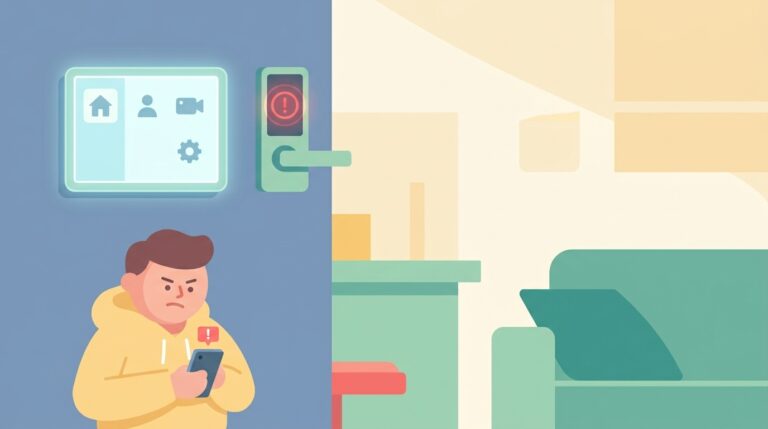
Phase 1: Empathy & Immersion\n\nHello! This is your editor from Daily Hangul. \n\nImagine this: You’ve just checked into a gorgeous, ultra-modern Airbnb in Gangnam. Everything is smart. The door lock sings a little melody when you enter, the ‘Wallpad’ controls the lights, the heating, and even calls the elevator for you. You feel like you’re in the year 2050. But suddenly, in the middle of the night, the lights start flickering, and the smart speaker starts blaring K-Pop on its own. \n\nYou remember that K-Drama thriller you watched last week where the villain hacked into the protagonist’s apartment. Your heart drops. Did your smart home just get hacked? \n\nWelcome to the hyper-connected reality of South Korea! Korea is a global leader in the Internet of Things (IoT). Our apartments, cafes, and even public trash cans are connected to the internet. But with ultimate convenience comes the ultimate modern headache: IoT security vulnerabilities and hacking. \n\nIf you live or travel in Korea, you’ll rely heavily on apps and smart devices. Knowing how to explain that your device is acting weird, or that your data might have been compromised, isn’t just advanced vocabulary—it’s essential digital survival. Today, we are going to dive deep into C1-level expressions that Koreans use when their digital life goes haywire. Don’t worry, you won’t sound like a robotic textbook; you’ll sound like a Pangyo IT professional!\n\n—\n\n### Phase 2: Core Expressions Deep Dive\n\nLet’s look at the absolute must-know expressions for when your digital security fails.\n\n### 1. 털리다\n* Pronunciation: teollida [Sounds like: ‘Tull’ like ‘ull’ in hull + lee + da]\n* Meaning: Literal: To be dusted off / to be shaken off. Real nuance: To be robbed, hacked, or entirely compromised.\n* K-Culture Moment: You’ll hear this constantly in Korean news or among friends. When a major food delivery app gets hacked and passwords are leaked, netizens will say, ‘Ah, my data got dusted again.’ It feels visceral, like someone turned your pockets inside out.\n* Editor’s Insight: This word is incredibly versatile. We use it for getting hacked, getting scolded severely by a boss (영혼까지 털렸어 – my soul was dusted), or losing all your money in a game.\n* Situation Spectrum:\n * Casual friends: ✅\n * Co-workers: ⚠️ (Okay with close peers)\n * Boss/Formal: 🚫 (Use ‘유출되다’ – to be leaked instead)\n* 🤔 Think About It: Why do Koreans use such a physical, violent verb for digital data? It reflects how deeply connected our physical and digital lives are. Losing your KakaoTalk account feels just as violating as someone picking your pocket!\n\n### 2. 보안이 뚫리다\n* Pronunciation: boani ttullida [Sounds like: bo-ahn-ee ttul-lee-da. Tip: For ‘tt’, tense up your tongue right behind your teeth before releasing!]\n* Meaning: Literal: The security is pierced/punctured. Real nuance: A security breach has occurred.\n* K-Culture Moment: In every Korean cyber-thriller drama, the frantic hacker typing furiously will suddenly slam the desk and shout, ‘보안망이 뚫렸습니다!’ (The security network has been breached!).\n* Editor’s Insight: Instead of saying ‘failed’ or ‘hacked’, Koreans visualize security as a physical wall or net. When it fails, a hole has been punched through it.\n* Situation Spectrum:\n * Casual friends: ✅\n * Co-workers: ✅\n * Boss/Formal: ✅ (Widely accepted in professional settings)\n* 🤔 Think About It: Can you think of how your native language visualizes cybersecurity? Is it a wall, a lock, or something else?\n\n### 3. 원격으로 조종당하다\n* Pronunciation: wongeogeuro jojongdanghada [won-gyuk-eu-ro jo-jong-dang-ha-da. ‘eu’ sounds like the disgusted grunt you make when stepping in gum.]\n* Meaning: To be remotely controlled (against your will).\n* K-Culture Moment: The terrifying moment in a K-Thriller when the smart car’s steering wheel turns on its own, or the Wallpad unlocks the front door. \n* Editor’s Insight: Pay attention to the suffix -당하다 (danghada). While ‘-받다 (batda)’ means to passively receive something neutral or good, ‘-당하다’ specifically implies you are suffering an action against your will. It adds a layer of victimization and helplessness.\n* Situation Spectrum:\n * Casual friends: ✅\n * Co-workers: ✅\n * Boss/Formal: ✅\n\n—\n\n### Phase 3: Textbook vs Real Korean\n\nLet’s see how these concepts evolve from the textbook to the streets of Seoul.\n\n[Situation 1: Your password was leaked online]\n* 📖 Textbook: 내 비밀번호가 유출되었습니다. (My password has been leaked.)\n* 🗣️ Real Korean: 아, 내 비번 싹 다 털렸어! (Ah, all my passwords got entirely dusted!)\n* 💡 Why the difference?: Koreans love efficiency. ‘비밀번호’ becomes the abbreviation ‘비번 (bibeon)’, and ‘싹 다’ adds an emotional flair of total frustration.\n\n[Situation 2: The smart home app is unresponsive due to a server crash]\n* 📖 Textbook: 기기가 시스템 오류로 작동하지 않습니다. (The device is not operating due to a system error.)\n* 🗣️ Real Korean: 어? 앱 완전히 먹통 됐는데? (Huh? The app went completely deaf/blind?)\n* 💡 Why the difference?: ‘먹통 (meoktong)’ originally meant an inkwell used by carpenters, but it evolved to mean someone who doesn’t understand anything, and now refers to frozen electronics.\n\n[Situation 3: Telling a friend to be careful of phishing]\n* 📖 Textbook: 스미싱 사기를 조심하십시오. (Please be careful of smishing scams.)\n* 🗣️ Real Korean: 야, 이상한 링크 절대 누르지 마. 해킹당해! (Hey, never click weird links. You’ll get hacked!)\n* 💡 Why the difference?: Direct commands with clear consequences (‘해킹당해’) are preferred in casual speech over formal warnings.\n\n> Bottom Note: For C1 learners, understanding the formal words like ‘유출되다 (leak)’ is essential for watching the news or working in an office, but mastering ‘털리다’ and ‘먹통’ will instantly make you sound like a local.\n\n—\n\n### Phase 4: Cultural Context — K-Culture Deep Dive\n\n#### 4-1. Non-verbal Nuances\nWhen discussing a security breach or hacked device at work, maintain a serious demeanor. Don’t smile nervously. In Korea’s fast-paced corporate culture, a breached system (보안이 뚫린 것) is an absolute emergency. Show a bit of ‘눈치 (nunchi – reading the room)’ by lowering your voice slightly to indicate the gravity of the situation.\n\n#### 4-2. The ‘Wallpad’ (월패드) Phenomenon in K-Culture\nIf you watch modern K-Dramas, you’ll notice a tablet screen near the front door of every apartment. This is the Wallpad. It’s the brain of the Korean smart home, controlling the boiler (ondol), lights, CCTV, and door locks. \n\nIn real life, a few years ago, Korea faced a massive Wallpad hacking scandal where hackers accessed the inner cameras of hundreds of apartments. Since then, it’s become a common trope in thrillers for hackers to manipulate the Wallpad to terrorize the protagonist. While the extreme scenarios in dramas are fictionalized, the anxiety around IoT security is deeply embedded in modern Korean society.\n\n—\n\n### Phase 5: Interactive Roleplay Scenario\n\nSetting: It’s 2:00 PM on a Tuesday in a sleek IT startup office in Pangyo (Korea’s Silicon Valley). The IoT-connected air purifiers and smart blinds have been acting crazy all morning, going on and off by themselves. You are an expatriate tech lead. You are standing by the coffee machine with Min-su, your senior developer.\n\nCharacters:\n* YOU: Expatriate tech lead. Perceptive and professional.\n* Min-su: (34, Male) Your Korean coworker. Competent, but currently very stressed out.\n\nMin-su: 하아… 오늘 사무실 기기들이 왜 이러죠? 귀신이라도 들렸나?\n(Haa… oneul samusil gigideuri wae ireojyo? Gwisinirado deullyeonna?)\n[Sigh… why are the office devices acting like this today? Are they possessed by a ghost?]\n(Stage Direction: Min-su aggressively pushes the button on the coffee machine, but it doesn’t dispense anything.)\n\nYOU: 글쎄요. 앱이 또 먹통이 된 거 아닐까요?\n(Geulsseyo. Aebi tto meoktongi doen geo anilkkayo?)\n[I’m not sure. Maybe the app went frozen/dead again?]\n\nMin-su: 방금 관리팀에서 연락 왔는데, 외부망에서 접속 시도가 있었대요.\n(Banggeum gwanritimeseo yeollak wanneunde, oebumangeseo jeopsok sidoga isseotdaeyo.)\n[The management team just contacted me, they said there was an access attempt from an external network.]\n\nYOU: 네? 그럼 사내 보안이 뚫린 건가요?\n(Ne? Geureom sanae boani ttullin geongayo?)\n[What? Then has our internal security been breached?]\n\nMin-su: 아직 확실하진 않은데, 누군가 원격으로 조종하고 있는 것 같아요.\n(Ajik hwaksilhajin anneunde, nugun-ga wongeogeuro jojonghago inneun geot gatayo.)\n[It’s not certain yet, but it seems like someone is controlling it remotely.]\n\n> 🔀 Your Turn! How should you respond to Min-su?\n> – A) 아싸! 그럼 오늘 조기 퇴근인가요? (Yay! Then do we get off work early today?)\n> – B) 빨리 서버 연결부터 끊어야 하는 거 아니에요? (Shouldn’t we disconnect the server connection first?)\n> – C) 헐, 대박. 제 개인정보 다 털린 거 아니에요? (Whoa, jackpot. Isn’t all my personal info hacked/dusted?)\n>\n> ✅ Best Choice: B — In a professional IT emergency, focusing on the solution with a polite but urgent tone is best.\n> ⚠️ Choice C Analysis: While highly natural in casual speech, saying ‘헐, 대박’ and ‘털리다’ in a corporate security crisis might sound a bit too casual or panicked for a tech lead, though it perfectly captures the inner feelings of everyone in the room!\n\n—\n\n### Phase 6: 10-Second Shadowing Drill\n\nPractice this sentence to sound incredibly natural when your device freezes up because of a suspected glitch or hack. Pay attention to the pauses and intonation!\n\n😤 아, 짜증 나! / 내 계정 / 완전히 털린 것 같아! (a, jjajeung na! / nae gyejeong / wanjeonhi teollin geot gata!)\nEmotion: Frustrated and annoyed. Emphasize the ‘완전히 (completely)’!\n\n—\n\n### Phase 7: K-Culture Mini Dictionary (IoT Edition)\n\n1. 도어락 (do-eo-rak)\n* English: Smart Door Lock\n* Context: Almost no one uses physical keys in Korea anymore. Everyone uses a keypad door lock. A dead battery on a door lock is a common everyday crisis.\n\n2. 월패드 (wol-pae-deu)\n* English: Wallpad\n* Context: The wall-mounted smart tablet in Korean apartments that controls the entire IoT ecosystem of the house.\n\n3. 비번 (bi-beon)\n* English: Password (Abbreviation)\n* Context: Short for 비밀번호 (bi-mil-beon-ho). When Koreans sign up for websites, they often face complex password rules, making ‘비번 찾기 (Find password)’ a daily struggle.\n\n4. 먹통 (meok-tong)\n* English: Unresponsive / Frozen\n* Context: Used to describe digital devices or servers that suddenly stop working. If KakaoTalk goes down, the entire country says ‘카톡 먹통 사태 (KakaoTalk blackout crisis)’.\n\n—\n\n### Phase 8: Traveler’s Survival Kit\n\nEven if you’re just visiting Korea, you’ll be surrounded by IoT. You’ll order food from a tablet on the table (T-order), enter your smart hotel room with an app, and store luggage in smart lockers. What if the network drops or a system glitches?\n\n> 🆘 Survival Phrases for Digital Glitches\n> – 🇰🇷 ‘QR 코드가 인식이 안 돼요.’ (QR kodeuga insigi an dwaeyo.)\n> – 🗣️ English: The QR code isn’t being recognized.\n> – 📍 Where to use: Kiosks, Smart Lockers, Restaurants.\n> – 💡 Pro Tip: If the machine is unresponsive, you can just say ‘이거 먹통이에요 (igeo meoktong-ieyo – this is frozen).’ The staff will instantly understand and reset it!\n\n> 📌 Editor’s Travel Note\n> – Public Wi-Fi: Korea has incredible free public Wi-Fi, but remember that open networks are prime spots for data snooping (털리다!). Use a VPN if you’re checking your bank app at a cafe.\n> – Cashless Society: Korea is nearly completely cashless. If your payment app glitches or your card gets blocked for security reasons, it can be a hassle. Always carry a small amount of emergency cash (around 30,000 KRW) or a physical backup card.\n\n—\n\n### Phase 9: Critical Thinking — ‘A Step Deeper’\n\nMedia vs Reality: The ‘Ppalli-ppalli’ Dilemma\n\n> 🧠 Think Deeper:\n> South Korea’s digital infrastructure is famously fast, driven by the cultural mindset of Ppalli-ppalli (빨리빨리 – hurry, hurry). This desire for absolute convenience led to the hyper-integration of IoT in everyday life. You can turn on your apartment’s heating while riding the subway home! However, this rapid digitization often outpaced cybersecurity measures, leading to massive data leaks and the Wallpad hacking scandals. The language reflects this: words like ‘털리다’ (dusted) show a sense of helpless resignation among citizens who feel that giving up some privacy is the unavoidable tax for hyper-convenience.\n>\n> 💬 Your Turn: Does your culture value digital convenience over privacy, or vice versa? Have you ever felt like your data was ‘dusted’? Share in the comments!\n\n—\n\n### Phase 10: FAQ & Avoiding Common Mistakes\n\nQ: Can I use ‘털리다’ when talking to the police or a bank teller about a hacked account?\nNo! ‘털리다’ is slang. If you are reporting a serious crime to authorities or speaking formally, you must use ‘해킹당했습니다’ (I was hacked) or ‘개인정보가 유출되었습니다’ (My personal info was leaked).\n\nQ: If a food delivery app isn’t working, can I call the restaurant and say ‘보안이 뚫렸어요’?\nNo, ‘보안이 뚫리다’ means a specific security breach. If the app just isn’t loading, say ‘앱이 먹통이에요’ (The app is unresponsive) or ‘서버가 다운됐어요’ (The server is down).\n\n> ❌ Common Mistake #1: Trying to directly translate ‘My device has a virus.’ \n> ✅ Do this instead: Koreans rarely say ‘바이러스 걸렸어요’ for smart devices or IoT (mostly just for PCs). For phones or IoT, they prefer ‘해킹당한 것 같아요’ (I think it got hacked) or ‘오류가 났어요’ (There’s an error).\n\n—\n\n### Phase 11: Summary & Action Items\n\nOne-Liner Summary: When your Korean smart life glitches or gets hacked, remember: data gets dusted (털리다), security gets pierced (뚫리다), and devices go deaf and blind (먹통)!\n\n🔥 Action Mission 3 Steps:\n* 🥉 Bronze (Solo): Look at your smartphone or laptop right now and declare to it: ‘보안이 뚫리면 안 돼!’ (You shouldn’t get your security breached!)\n* 🥈 Silver (Online): Change one of your old passwords today, and write down ‘비번 변경 완료’ (Password change complete) in your planner or study notes.\n* 🥇 Gold (Real World): Next time you watch a Korean thriller or tech drama, listen carefully for the words ‘해킹 (Hacking)’, ‘유출 (Leak)’, or ‘털리다’. You WILL hear them!\n\n—\n\n### Phase 12: Interactive Quiz Challenge\n\nTest your C1 Korean digital survival skills!\n\n1. Situational Judgment: Your Korean friend looks at their phone, sighs deeply, and says their social media account was used to send spam messages. What is the most natural, empathetic Korean response?\n* A) 정말 시스템 오류군요. (That is truly a system error.)\n* B) 헐, 계정 털린 거 아니야? 빨리 비번 바꿔! (Whoa, isn’t your account hacked/dusted? Change the password quickly!)\n* C) 보안망이 뚫렸습니다. (The security network has been breached.)\n\n2. True or False (K-Culture Edition): \nIn Korea, it is common to leave your laptop unattended at a cafe to go to the restroom, because the physical security is high, even though digital hacking (phishing/smishing) is a common concern.\n* True / False\n\n(Answers: 1. B – ‘A’ is robotic, ‘C’ is too formal for a friend. 2. True – Koreans will steal your digital data via phishing, but no one will touch your Macbook at Starbucks!)“
Frequently Asked Questions (FAQ)
Q: What does "-당하다" mean in Korean and how do you pronounce it?
A: In Korean, "-당하다" is pronounced [danghada] and means: . While '-받다 (batda)' means to passively receive something neutral or good, '-당하다' specifically implies you are suffering an action against your will. It adds a layer of victimization and helplessness.\n*
Q: What does "'개인정보가 유출되었습니다'" mean in Korean and how do you pronounce it?
A: In Korean, "'개인정보가 유출되었습니다'" is pronounced [My personal info was leaked] and means: .\n\n







