

Phase 1: The K-Drama Mask Mystery
Hello! I am your Daily Hangul Editor, your local Korean friend and veteran tutor.
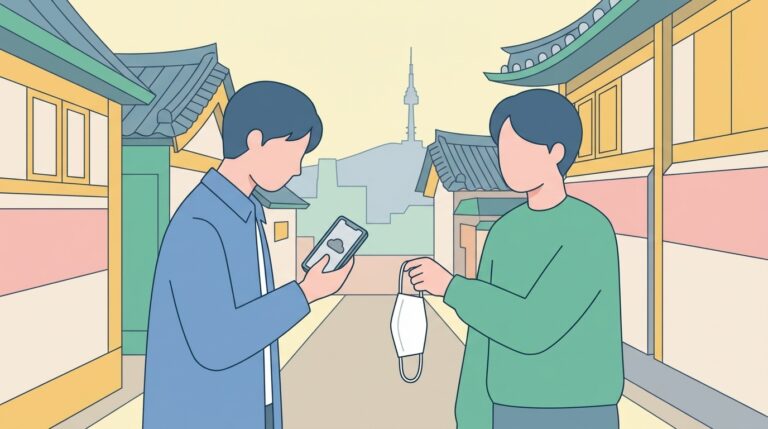
Picture this: You are watching your favorite K-Drama. The handsome male lead is waiting outside the heroine’s house. The music swells, they make eye contact, and he slowly reaches into his pocket. A ring? A love letter? No… he pulls out a white paper mask and gently puts it on her face.
Wait, what? Is she sick? Did she forget to put on makeup?
Not quite! Welcome to the Korean spring (and sometimes winter, and fall). The culprit behind this unromantic-yet-deeply-caring gesture is 미세먼지 (mise-meonji), or Fine Dust. In Korea, checking the fine dust level is as natural as checking the weather. If you want to survive the grey-sky days in Seoul and show locals you truly understand their daily lives, you need to know how to talk about it.
Today, we are learning how to say “Put on a mask” and navigate Korea’s fine dust culture like a true insider.
Phase 2: Core Expressions Deep Dive
1. 미세먼지 (Fine Dust)
- Pronunciation: mi-se-meon-ji [mee-seh-mawn-jee]
- Meaning: Fine dust / Micro-dust
- K-Culture Moment: You wake up in your Seoul hotel, look out the window, and the N Seoul Tower is completely hidden in a grey haze. Your Korean friend immediately texts you: “미세먼지 조심해!” (Be careful of the fine dust!)
- Editor’s Insight: This word is a combination of ‘미세’ (micro/fine) and ‘먼지’ (dust). It is a daily buzzword in Korea. You will see it on the news, on your phone weather app, and even in cosmetic commercials (cleansing foams that wash away ‘mise-meonji’!).
- Situation Spectrum:
- Friends (Casual): ✅
- Co-workers (Semi-formal): ✅
- Boss/Elders (Formal): ✅
- 🤔 Think About It: Why do you think air quality has become such a massive part of the Korean beauty and skincare industry?
2. 마스크 쓰세요 (Please wear a mask)
- Pronunciation: ma-seu-keu sseu-se-yo [mah-soo-koo soo-seh-yo]
- Meaning: Please put on a mask / Wear a mask.
- K-Culture Moment: A mother yelling this to her child running out the door for school, or a concerned K-Pop idol posting this on Weverse to their fans on a bad air day.
- Editor’s Insight: In English, we use “wear” for everything. Clothes, hats, shoes. In Korean, the verb changes depending on the body part! For things you put on your head or face (hats, glasses, masks), we use the verb 쓰다 (sseuda). Adding ‘~세요’ (~seyo) makes it a polite request.
- Situation Spectrum:
- Friends (Casual): ⚠️ (Too polite. Use “마스크 써” instead)
- Co-workers (Semi-formal): ✅
- Boss/Elders (Formal): ✅
- 🤔 Think About It: In Korea, telling someone to “dress warmly” or “wear a mask” is considered a form of affection. How do people show casual affection in your culture?
3. 공기가 안 좋아요 (The air is bad)
- Pronunciation: gong-gi-ga an jo-a-yo [gong-gee-gah ahn jo-ah-yo]
- Meaning: The air quality is not good today.
- K-Culture Moment: You walk into a Korean café. Everyone is taking off their masks and sighing. The barista looks outside and says this while wiping the counter.
- Editor’s Insight: ‘공기’ (gonggi) means air, and ‘안 좋아요’ (an joayo) means ‘is not good’. This is the ultimate small-talk starter in Korea on a hazy day, perfectly replacing the British “Terrible weather today, isn’t it?”
- Situation Spectrum:
- Friends (Casual): ⚠️ (Say “공기 안 좋아”)
- Co-workers (Semi-formal): ✅
- Boss/Elders (Formal): ✅
Phase 3: Textbook vs. Real Korean
Situation 1: Advising someone to wear a mask
* 📖 Textbook Korean: 마스크를 착용하십시오. (maseukeureul chagyonghasipsio)
* 🗣️ Real Korean: 마스크 꼭 쓰세요~ (maseukeu kkok sseuseyo~)
* 💡 Why is it different?: “착용하다” is a formal, Sino-Korean word used in public broadcasts or airplane announcements. Real people use the simpler verb “쓰다” and add “꼭” (make sure to) for extra care.
Situation 2: Reacting to terrible air quality
* 📖 Textbook Korean: 대기 오염이 심각합니다. (daegi oyeomi simgakhamnida)
* 🗣️ Real Korean: 오늘 미세먼지 장난 아니에요. (oneul misemeonji jangnan anieyo)
* 💡 Why is it different?: “장난 아니에요” literally means “It’s no joke.” Koreans use this phrase to describe anything extreme—whether the food is amazingly delicious or the dust is terribly thick!
Bottom Note: For A1 beginners, sticking to “미세먼지 많아요” (There is a lot of fine dust) is perfectly fine and sounds very natural!
Phase 4: Cultural Context — K-Culture Deep Dive
4-1. The Non-verbal Language of Masks
Handing someone a mask in Korea is a sign of ‘눈치’ (Nunchi) and care. If you are meeting a Korean friend on a bad dust day, pulling out a spare individually wrapped KF94 mask and handing it to them with two hands will instantly upgrade you to ‘Best Friend’ status.
4-2. K-Food Connection: The Pork Belly Myth
So, the sky is grey and you can barely see the sun. What do Koreans do? They go out to eat 삼겹살 (Samgyeopsal – Pork Belly)!
There is a long-standing, playful myth in Korea that eating greasy pork belly helps “wash the dust down your throat.” Scientifically? Highly debatable. Culturally? Absolutely essential. Any excuse to gather around a hot grill, listen to the meat sizzle, and share a meal with friends is a good one. If the dust is bad, suggest going to a BBQ place. Your Korean colleagues will love it.
Phase 5: Real-Life Roleplay Scenario
Setting: 8:00 AM on a Tuesday. Inside a bright GS25 Convenience Store. The sky outside is a hazy yellow.
Characters:
* YOU: A traveler whose throat is feeling a bit scratchy.
* Cashier: A friendly part-time college student.
Cashier: 어서 오세요!
(eoseo oseyo!)
[Welcome!]
YOU: 안녕하세요. 저기…
(annyeonghaseyo. jeogi…)
[Hello. Excuse me…]
Cashier: 네, 찾으시는 거 있으세요?
(ne, chajeusineun geo isseuseyo?)
[Yes, are you looking for something?]
YOU: 마스크 있어요?
(maseukeu isseoyo?)
[Do you have masks?]
Cashier: 네, 이쪽이에요. 오늘 미세먼지 장난 아니죠?
(ne, ijjogieyo. oneul misemeonji jangnan anijo?)
[Yes, over here. The fine dust is no joke today, right?]
🔀 Your Turn! How do you reply?
* A) 네, 미세먼지 좋아요. (Yes, fine dust is good.)
* B) 네, 마스크 안 써요. (Yes, I don’t wear a mask.)
* C) 네, 공기가 안 좋아요. (Yes, the air is not good.)
✅ Best Choice: C — You are agreeing and using the perfect small talk phrase!
⚠️ Analysis: Choice A is grammatically correct but means you ENJOY the pollution! Choice B means you refuse to wear masks.
Phase 6: 10-Second Shadowing Drill
Speak out loud! Follow the breaks (/) and the emotion tags.
😢 오-늘 / 공-기-가 / 안 좋-아-요.
(o-neul / gong-gi-ga / an jo-a-yo.)
[The air is not good today.]
😊 나-갈 때 / 마-스-크 / 꼭! 쓰-세-요!
(na-gal ttae / ma-seu-keu / kkok! sseu-se-yo!)
[When you go out, make sure to wear a mask!]
Phase 7: K-Culture Mini Dictionary
1. 미세먼지
* Romanization: mise-meonji
* English: Fine dust
* Context: The microscopic dust particles in the air, usually worse in Spring.
2. KF94
* Romanization: ke-i-e-peu gu-sa
* English: Korean Filter 94
* Context: The standard Korean mask that blocks 94% of particles. The go-to mask for fine dust.
3. 삼겹살
* Romanization: samgyeopsal
* English: Pork Belly
* Context: The ultimate Korean soul food, believed by many locals to clear dust from your throat.
4. 눈치
* Romanization: nunchi
* English: Emotional intelligence / Reading the room
* Context: Offering a mask to a coughing friend is a great example of good Nunchi.
Phase 8: Traveler Survival Kit
Here are the top phrases you need when navigating pharmacies or convenience stores in Korea!
🆘 Survival Phrases
* 🇰🇷 “마스크 있어요?” (maseukeu isseoyo?)
* 🗣️ [mah-soo-koo ee-saw-yo?]
* 📍 Use at: Convenience stores, Pharmacies (약국).
* 💡 Pro Tip: When buying a mask, look for the “KF94” label. Regular cloth masks won’t stop the micro-dust!
📌 Editor’s Travel Note
* Useful App: Download the app “미세미세” (MiseMise). It uses cute (and sometimes terrifying) emojis to show the current dust levels in your exact location.
* Health Tip: If you wear contact lenses, you might want to switch to glasses on bad dust days. Your eyes will thank you!
Phase 9: Critical Thinking — “A Step Deeper”
🧠 Think Deeper: Food & Identity
Why do Koreans eat pork belly on dusty days? Beyond the myth of “washing the throat,” this reveals a beautiful aspect of Korean identity: dealing with hardship through community and food. When the environment outside is hostile and grey, Koreans gather around a warm fire, share food from the same grill, and comfort each other. The food itself isn’t the cure; the act of eating together is the medicine.
💬 Your Turn: Does your culture have a specific food people eat when the weather is terrible or they feel slightly under the weather? Share it in the comments!
Phase 10: FAQ & Avoiding Misunderstandings
Q: Can I tell an older person “마스크 써” (maseukeu sseo)?
* A: NO! Dropping the “요” (yo) makes it informal (banmal). Telling an elder what to do in banmal is very rude. Always say “마스크 쓰세요” (maseukeu sseuseyo).
Q: Can I use the verb 입다 (ipda) for masks? Like ‘마스크 입으세요’?
* A: No. “입다” is strictly for things you wear on your main body (shirts, pants). For heads and faces, you must use “쓰다” (sseuda).
❌ Common Mistake #1: Translating “fine dust” directly as “좋은 먼지” (Good dust). In English, ‘fine’ means good, but here it means micro! Always use ‘미세먼지’ (mise-meonji).
Phase 11: Summary & Action Items
One-Liner Summary: When the Korean sky turns grey, remember to say “미세먼지” (Fine dust) and show you care with “마스크 쓰세요” (Please wear a mask).
Action Mission 3 Steps:
* 🥉 Bronze (Solo): Stand in front of a mirror and say “마스크 쓰세요” 3 times while pretending to hand out a mask.
* 🥈 Silver (Online): Look up the weather in Seoul right now. Is the air quality good or bad?
* 🥇 Gold (Real Life): Next time you watch a K-Drama and see someone hand out a mask, shout “미세먼지!” at the TV.
K-Culture Mission: Download a Korean weather app or check Naver Weather. Look for the little dust cloud icon. What does the Korean word next to it say?
Did you know about the pork belly myth before? Let me know your thoughts in the comments below!
Phase 12: Interactive Quiz
1. Fill in the Blank:
You want to tell your coworker that the air is not good today.
오늘 _______가 안 좋아요.
A) 날씨 (Weather)
B) 공기 (Air)
C) 마스크 (Mask)
2. True or False — K-Culture Edition:
“Koreans traditionally believe eating spicy tteokbokki washes the fine dust out of your throat.”
3. Situational Judgment:
You walk into a pharmacy to buy a mask. Which phrase is correct?
A) 마스크 입어요? (maseukeu ibeoyo?)
B) 마스크 있어요? (maseukeu isseoyo?)
(Answers: 1: B, 2: False – it’s Pork Belly!, 3: B)
Frequently Asked Questions (FAQ)
Q: What does "미세먼지 (Fine Dust)" mean in Korean and how do you pronounce it?
A: In Korean, "미세먼지 (Fine Dust)" is pronounced [mi-se-meon-ji [mee-seh-mawn-jee] and means: Fine dust / Micro-dust
Q: What does "마스크 쓰세요 (Please wear a mask)" mean in Korean and how do you pronounce it?
A: In Korean, "마스크 쓰세요 (Please wear a mask)" is pronounced [ma-seu-keu sseu-se-yo [mah-soo-koo soo-seh-yo] and means: Please put on a mask / Wear a mask.
Q: What does "공기가 안 좋아요 (The air is bad)" mean in Korean and how do you pronounce it?
A: In Korean, "공기가 안 좋아요 (The air is bad)" is pronounced [gong-gi-ga an jo-a-yo [gong-gee-gah ahn jo-ah-yo] and means: The air quality is not good today.







