

Phase 1: The Ultimate Boss Fight of Korean Romance
Hello! I am your Daily Hangul Editor. If you have watched over 200 K-Dramas like I have, you know exactly what happens when the music suddenly turns dramatic, the camera pans across a luxurious traditional restaurant, and two families sit across from each other in absolute silence. Welcome to the Sanggyeollye (상견례)—the official meeting between the bride and groom’s families.
While K-Dramas love to use this setting for maximum drama (cue the infamous water-splashing-in-the-face trope), the reality of a Korean family meeting is a delicate dance of hyper-politeness, strategic seating, and Nunchi (눈치). At the C2 level, you already know how to order food and chat with friends. But surviving the Sanggyeollye requires mastering the highest level of Korean honorifics and understanding the unspoken rules of hierarchy. If you or someone you know is preparing for a Korean wedding, knowing these nuances won’t just prevent awkward silences—it will instantly earn you the coveted ‘perfect son/daughter-in-law’ title. Let us dive into the art of the Korean formal family meeting.
Phase 2: Deep Dive into Core Expressions
At a Sanggyeollye, casual politeness (해요체) is not enough. You must elevate your speech to formal honorifics (하십시오체) to show utmost respect.
1. 오시느라 불편함은 없으셨는지요?
- Pronunciation: Oshineura bulpyeonhameun eopseusyeon-neunjiyo? (Oh-shee-neu-ra bool-pyeon-ham-eun up-seu-shyeon-neun-jee-yo?)
- Meaning: Literal: Were there no inconveniences while you were coming here? / Real nuance: Thank you so much for making the trip here; I hope the journey was pleasant.
- K-Culture Moment: This is the absolute standard icebreaker. Before anyone touches the menu or discusses the couple, the host family (or the couple) must acknowledge the effort the other family made to travel to the venue.
- Editor’s Insight: The beauty of this phrase lies in the ending ‘~는지요?’. It sounds much softer, more elegant, and more considerate than a direct ‘~습니까?’. It is like wrapping your question in a velvet cushion.
- Situation Spectrum:
- Friends (Casual): 🚫
- Co-workers (Semi-formal): ⚠️
- In-laws/Elders (Formal): ✅
- 🤔 Think About It: Why do Koreans apologize for or inquire about the ‘inconvenience’ of a journey before saying hello? How does this reflect the Korean virtue of Bae-ryeo (배려, consideration)?
2. 두 분 인상이 너무 좋으십니다.
- Pronunciation: Du bun insang-i neomu joeusimnida. (Doo boon in-sang-ee neo-moo jo-eu-shim-nee-da.)
- Meaning: Literal: The impressions of you two are very good. / Real nuance: You both have such warm and wonderful faces.
- K-Culture Moment: When the tension is high, complimenting the parents’ ‘Insang’ (impression/facial energy) is the safest and most appreciated compliment in Korean culture.
- Editor’s Insight: Notice we do not say ‘You are handsome/beautiful’ to elders in this setting, as it can sound patronizing. Praising their Insang implies they look wise, kind, and have lived a good life.
- Situation Spectrum:
- Friends (Casual): 🚫
- Co-workers (Semi-formal): ⚠️
- In-laws/Elders (Formal): ✅
- 🤔 Think About It: What does ‘good impression’ mean in your culture? In Korea, a ‘good impression’ often means looking gentle, generous, and trustworthy.
3. 과찬이십니다. 다 어르신들께서 예쁘게 봐주신 덕분입니다.
- Pronunciation: Gwachanisimnida. Da eoreusindeulkkeoseo yeppeuge bwajusin deokbunimnida. (Gwa-chan-ee-shim-nee-da. Da uh-reu-shin-deul-kke-seo ye-ppeu-ge bwa-joo-shin deok-boon-im-nee-da.)
- Meaning: Literal: That is an overcompliment. It is all thanks to the elders looking at us prettily. / Real nuance: I am truly flattered. Thank you for viewing me so kindly.
- K-Culture Moment: When your future mother-in-law praises your Korean skills or your career, simply saying ‘Thank you’ can seem slightly arrogant in traditional settings. You must deflect the praise and credit their generosity.
- Editor’s Insight: ‘예쁘게 보다’ (to look at prettily) does not mean physical beauty. It means ‘to look upon someone with affection and forgiveness for their flaws.’ It is the ultimate phrase of humility.
- Situation Spectrum:
- Friends (Casual): 🚫
- Co-workers (Semi-formal): ⚠️
- In-laws/Elders (Formal): ✅
Phase 3: Textbook vs. Real Korean
[Breaking the Ice]
* 📖 Textbook Korean: 만나서 반갑습니다. 날씨가 참 좋습니다. (Nice to meet you. The weather is very good.)
* 🗣️ Real Korean: 귀한 걸음 해주셔서 감사합니다. 오시는 길은 안 막히셨는지요? (Thank you for your precious steps. Was the traffic not congested on your way here?)
* 💡 Why the difference?: Textbook phrases sound like a business meeting. Real Korean focuses on honoring the physical effort the guests made to attend the meeting.
[Addressing the Future In-laws]
* 📖 Textbook Korean: 지민 씨의 아버님, 어머님 (Jimin’s father, mother)
* 🗣️ Real Korean: 사돈어른 (Sadoneoreun – used by parents to parents) or 예비 장인어른/장모님 (Future Father/Mother-in-law – used by the groom), 예비 시아버님/시어머님 (used by the bride).
* 💡 Why the difference?: Korean relationship titles are highly specific. Using the correct title establishes the exact boundaries and respect required for this new family merger.
Phase 4: Cultural Context — K-Culture Deep Dive
4-1. Non-verbal Element: The Rule of Sangseok (상석)
Language is only half the battle. If you sit in the wrong chair, you have already failed! In Korea, Sangseok (the seat of honor) is always the seat furthest from the door, usually facing the best view or the wall. The father of the bride/groom sits at the absolute Sangseok, followed by the mothers, and the couple sits closest to the door. Why closest to the door? Because the youngest or the hosts are expected to handle requests like calling the waiter or receiving the bill.
4-2. K-Food Connection: The Hanjeongsik Pace
Sanggyeollye usually takes place at a high-end Hanjeongsik (Korean traditional course meal) restaurant. Why? Because grilling Samgyeopsal is too noisy, and eating soup can be messy. The individual plating of a Hanjeongsik prevents the awkwardness of deciding who gets the last piece of meat. Pro-tip: Never lift your spoon before the eldest fathers at the table lift theirs. And when drinking water or tea, slightly turn your head away from the elders—a subtle non-verbal sign of immense respect.
Phase 5: Real-Life Roleplay Scenario
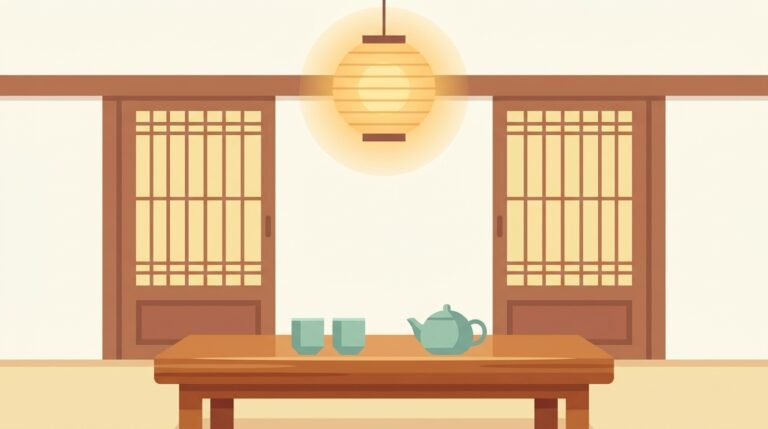
Setting: Saturday afternoon, 1:00 PM. A quiet, private room in a luxurious Hanjeongsik restaurant in Bukchon, Seoul. The sliding wooden doors are closed. You (the foreign bride/groom) are sitting next to your Korean fiancé, Minho. Across from you are Minho’s parents. The tension is palpable, but there are polite smiles all around.
Characters:
– YOU: A foreign professional working in Seoul, nervous but well-prepared.
– Minho: Your Korean fiancé, trying to keep the mood light.
– Mr. Kim: Minho’s father, traditional but warm-hearted.
– Mrs. Kim: Minho’s mother, observant and elegant.
Dialogue:
Mr. Kim: 허허, 차가 많이 막혔을 텐데 오느라 고생했어요.
(Heoheo, chaga mani makyeosseul tende oneura gosaenghaesseoyo.)
[Translation] Haha, the traffic must have been heavy, you worked hard coming all this way.
(🎭 Stage Direction: Mr. Kim pours tea for your parents, then looks at you warmly.)
YOU: 아닙니다, 아버님. 오시는 길은 불편하지 않으셨는지요?
(Animnida, abeonim. Osineun gireun bulpyeonhaji aneuseyonneunjiyo?)
[Translation] Not at all, Father. Were there any inconveniences on your way here?
Mrs. Kim: 우리는 괜찮았어요. 그나저나 [당신 이름] 씨 부모님께서 참 인상이 좋으시네요.
(Urineun gwaenchannasseoyo. Geunajeona [Your Name]-ssi bumonimkkeseo cham insangi joeusineyo.)
[Translation] We were fine. By the way, [Your Name]’s parents have such wonderful impressions.
YOU: 감사합니다, 어머님. 저희 부모님께서도 두 분을 뵙게 되어 무척 영광이라고 하셨습니다.
(Gamsahamnida, eomeonim. Jeohui bumonimkkeseodo du buneul boepge doe-eo mucheok yeonggwang-irago hasyeotseumnida.)
[Translation] Thank you, Mother. My parents also said they are truly honored to meet you both.
Mr. Kim: 한국말을 어찌 이리 유창하게 잘할까? 민호가 복이 많네.
(Hangungmareul eojji iri yuchanghage jalhalkka? Minhoga bogi manne.)
[Translation] How do you speak Korean so fluently? Minho is very lucky (has a lot of blessings).
🔀 Your Turn! How should you respond?
– A) 네, 저는 한국어 공부를 5년 동안 열심히 했습니다! (Yes, I studied Korean hard for 5 years!)
– B) 아유, 아닙니다. 아직 많이 부족합니다. 예쁘게 봐주셔서 감사합니다. (Oh, not at all. I am still lacking a lot. Thank you for looking upon me kindly.)
– C) 맞아요! 민호 씨는 저를 만나서 진짜 럭키가이죠. (That’s right! Minho is truly a lucky guy to have met me.)✅ Best Choice: B — Reason: In a C2 advanced formal setting, extreme humility is expected. Acknowledging your own hard work (A) or joking about your superiority (C) will shatter the respectful atmosphere. Deflecting praise and showing gratitude (B) is the golden rule of Sanggyeollye.
Phase 6: 10-Second Shadowing Drill
Practice the rhythm and extreme politeness of this essential phrase. Pay attention to the pauses!
🥺 다 / 어르신들께서 / 예~~~쁘게 봐주신 / 덕분입니다.
(Da / eoreusindeul-kkeseo / ye~~~ppeuge bwajusin / deokbunimnida.)
Emphasize the ‘ye~~~’ softly to show genuine gratitude and humility.
Phase 7: K-Culture Mini Dictionary
1. 눈치
* Romanization: nunchi
* English: Emotional intelligence / reading the room
* Context: The core social sense in Korea. At a Sanggyeollye, using your Nunchi means knowing when to pour tea, when to laugh, and when to redirect an uncomfortable topic.
2. 상견례
* Romanization: sanggyeollye
* English: Formal meeting between the families of the bride and groom
* Context: Often the final hurdle before finalizing a marriage. It is less about the couple and more about the union of two families’ backgrounds and values.
3. 사돈
* Romanization: sadon
* English: In-laws (specifically the relationship between the two sets of parents)
* Context: A highly respectful title. Your parents will call your fiancé’s parents ‘Sadon-eoreun’. It signifies an alliance of deep respect.
4. 상석
* Romanization: sangseok
* English: The seat of honor
* Context: Placed furthest from the entrance. Offering the Sangseok to the elders is the most basic yet critical demonstration of etiquette.
Phase 8: Traveler Survival Kit
Even if you are not getting married, visiting a high-end traditional restaurant requires specific vocabulary.
🆘 Survival Phrases for High-End Reservations
– 🇰🇷 상견례 예약한 [이름]입니다. 방으로 안내해 주시겠어요? (Sanggyeollye yeyakhan [Name]imnida. Bangeuro annaehae jusigesseoyo?)
– 🗣️ Pronunciation Guide: Sang-gyeol-rye ye-yak-han [Name]-im-nee-da. Bang-eu-ro an-nae-hae joo-shee-get-seo-yo?
– 📍 Where to use: Fine dining restaurants, hotel lobbies.
– 💡 Pro Tip: Private rooms are called ‘Room’ (룸) or ‘Bang’ (방). Always confirm your room reservation for sensitive meetings!📌 Editor’s Travel Note
– Transportation: For a Sanggyeollye, families often take a premium taxi (Kakao T Black or Venti) to ensure they arrive unruffled and on time.
– Payment: The groom’s side or the couple usually pays for the meal in advance or quietly slips out to pay before the dessert arrives. Never argue over the bill in front of the parents at a Sanggyeollye!
Phase 9: Critical Thinking Corner — “One Step Deeper”
Language & Power: The Architecture of Respect
In Western cultures, marriage is often viewed as the union of two independent individuals. Therefore, family meetings are usually casual, aimed at simply ‘getting to know each other.’ However, the Korean language structurally reflects the Confucian ideal that marriage is the binding of two entire families. The shift from standard polite Korean (해요체) to extreme formal honorifics (하십시오체), and the immediate adoption of heavy titles like Sadon or Abeonim (Father), acts as a verbal contract. You are not just making friends; you are accepting a permanent, hierarchical position within a new familial ecosystem. By lowering yourself verbally (Jeohui, Bujokhan), you are elevating the new family, signaling that you value social harmony over individual pride.
💬 Your Turn: How do families meet before a wedding in your culture? Is there a strict seating arrangement or specific language required? Share your cultural traditions in the comments!
Phase 10: FAQ & Avoiding Misunderstandings
- Can we discuss how much the wedding will cost at this meeting?
NO. This is the biggest taboo. The Sanggyeollye is about exchanging pleasantries, discussing the couples’ childhoods, and complimenting each other. Financial matters, housing, and wedding costs must be negotiated privately by the couple beforehand. Bringing up money here is considered incredibly rude. -
Can I drink alcohol during the meeting?
Maybe. Usually, a light traditional liquor (like Baekseju) is shared to break the ice. If the father-in-law offers you a drink, you must accept it with two hands, turn your head away to drink, and never leave your glass empty.
❌ Common Mistake #1: Calling your partner’s parents by their first name.
✅ Do this instead: Always use the titles 아버님 (Abeonim – Father) and 어머님 (Eomeonim – Mother). Using a first name, even with Mr./Mrs., is an absolute disaster in Korea.
Phase 11: Summary & Action Items
- One-Liner Summary: Surviving the Sanggyeollye requires mastering the ‘seat of honor’, extreme humility in your speech, and praising the other family’s ‘Insang’.
-
Action Mission:
- 🥉 Bronze (Solo): Stand in front of a mirror, bow slightly, and practice saying “오시느라 불편함은 없으셨는지요?” three times smoothly.
- 🥈 Silver (Online): Write a comment below sharing how you would politely refuse a compliment in your native language.
- 🥇 Gold (Real World): Next time you meet a Korean elder or senior colleague, try using “과찬이십니다” (You flatter me) instead of just “감사합니다” when they praise you.
- K-Culture Mission: Watch episode 1 of any family-centric K-Drama (like Father is Strange or My Golden Life) and spot the scene where they fight over the Sangseok (seat of honor) at a restaurant!
Phase 12: Quiz — Interactive Challenge
1. Situational Judgment:
The groom’s mother says to you, “You look so beautiful today, and your Korean is perfect!” What is the most appropriate C2-level response?
– A) 네, 저는 원래 똑똑합니다. (Yes, I am naturally smart.)
– B) 감사합니다! 오늘 화장에 신경 좀 썼어요. (Thank you! I paid attention to my makeup today.)
– C) 과찬이십니다. 다 어르신께서 예쁘게 봐주신 덕분입니다. (You flatter me. It is all thanks to you looking at me kindly.)
(Answer: C. A is arrogant, B is too casual and misses the point of traditional humility).
2. True or False — K-Culture Edition:
At a Sanggyeollye, the person paying the bill should loudly announce, “I will pay for this!” to show generosity. (T/F)
(Answer: False. The bill is usually settled quietly outside the room by the couple or the host before the meal ends, avoiding any awkward financial discussions in front of the elders.)
Frequently Asked Questions (FAQ)
Q: What does "오시느라 불편함은 없으셨는지요?" mean in Korean and how do you pronounce it?
A: In Korean, "오시느라 불편함은 없으셨는지요?" is pronounced [Oshineura bulpyeonhameun eopseusyeon-neunjiyo? (Oh-shee-neu-ra bool-pyeon-ham-eun up-seu-shyeon-neun-jee-yo?] and means: Literal: Were there no inconveniences while you were coming here? / Real nuance: Thank you so much for making the trip here; I hope the journey was pleasant.
Q: What does "두 분 인상이 너무 좋으십니다." mean in Korean and how do you pronounce it?
A: In Korean, "두 분 인상이 너무 좋으십니다." is pronounced [Du bun insang-i neomu joeusimnida. (Doo boon in-sang-ee neo-moo jo-eu-shim-nee-da.] and means: Literal: The impressions of you two are very good. / Real nuance: You both have such warm and wonderful faces.
Q: What does "과찬이십니다. 다 어르신들께서 예쁘게 봐주신 덕분입니다." mean in Korean and how do you pronounce it?
A: In Korean, "과찬이십니다. 다 어르신들께서 예쁘게 봐주신 덕분입니다." is pronounced [Gwachanisimnida. Da eoreusindeulkkeoseo yeppeuge bwajusin deokbunimnida. (Gwa-chan-ee-shim-nee-da. Da uh-reu-shin-deul-kke-seo ye-ppeu-ge bwa-joo-shin deok-boon-im-nee-da.] and means: Literal: That is an overcompliment. It is all thanks to the elders looking at us prettily. / Real nuance: I am truly flattered. Thank you for viewing me so kindly.






