

Phase 1: Empathy (The Cold Open)
Hello! I am your Daily Hangul Editor.
We have all seen it in K-Dramas: The protagonist overworked themselves in the rain, and suddenly they collapse. The next scene? They are lying in bed with a carefully folded wet towel on their forehead, while the handsome male lead or caring female lead blows on a hot spoonful of Juk (Korean porridge).
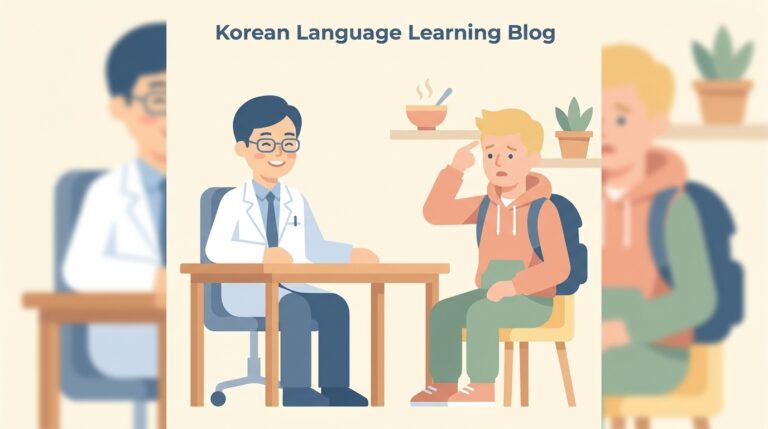
But let us face reality. When you are visiting or living in Korea and you wake up with a pounding headache and a fever, there is usually no drama protagonist to cook you porridge. You have to navigate the fast-paced streets of Seoul, find a clinic, and explain to a doctor exactly what is wrong.
Getting sick in a foreign country is one of the most stressful experiences. Your brain is foggy, and suddenly, all the Korean vocabulary you memorized vanishes. If you just say “I am sick,” the doctor will ask for details, and the medical consultation might turn into a confusing game of charades.
Do not worry. Today, I am going to teach you exactly how to explain your symptoms like a local. This guide is based on real struggles from my foreign students who had to brave the Korean medical system. By the end of this, you will know exactly what to say to get the right medicine and get back to enjoying your K-Life!
Phase 2: Core Expressions Deep Dive
1. 어젯밤부터 열이 나요.
- Pronunciation: (eojetbambuteo yeori nayo.) [Sound-alike: uh-jet-bam-boo-tuh yuh-ree nah-yo]
- Meaning: Literal: Fever comes out since last night. / Real nuance: I have had a fever since last night.
- K-Culture Moment: If you call your Korean boss or professor to ask for a sick day, this is the exact phrase you use. In Korea, simply saying “I have a cold” might not sound serious enough to miss work. But mentioning a fever? That gets immediate sympathy.
- Editor’s Insight: Notice how Koreans say “fever comes out” (열이 나요) instead of “I have a fever” (열이 있어요). In Korean, illnesses and symptoms are often treated as things that happen to you or emerge, rather than things you possess.
- Situation Spectrum:
- Friends (Casual): ✅ (Say: 어젯밤부터 열이 나 – eojetbambuteo yeori na)
- Coworkers (Semi-formal): ✅
- Doctors/Elders (Formal): ✅
- 🤔 Think About It: Why do Koreans emphasize when a symptom started rather than just the symptom itself? It shows the listener (especially doctors) the progression of the illness, which fits perfectly into Korea’s highly efficient, problem-solving culture.
2. 온몸이 쑤시고 몸살 기운이 있어요.
- Pronunciation: (onmomi ssusigo momsal giuni isseoyo.) [Sound-alike: ohn-mom-ee soo-she-go mom-sal gee-oon-ee ee-suh-yo]
- Meaning: Literal: My whole body aches and I have the energy of a momsal. / Real nuance: My body aches all over and I feel like I’m coming down with the flu.
- K-Culture Moment: Momsal is a uniquely Korean cultural illness. It is severe body aches and exhaustion often brought on by extreme stress or overworking. If a K-Pop idol misses a schedule due to “poor condition,” fans immediately worry they have momsal.
- Editor’s Insight: This is the magic password at a Korean pharmacy or clinic. It perfectly describes that heavy, achy, chills-all-over feeling before a bad cold or flu hits fully.
- Situation Spectrum:
- Friends (Casual): ✅
- Coworkers (Semi-formal): ✅
- Doctors/Elders (Formal): ✅
- 🤔 Think About It: Is there an exact translation for momsal in your language? The fact that Koreans have a specific word for “sickness caused by overworking” tells you a lot about the intense work culture here.
3. 목이 붓고 기침이 나요.
- Pronunciation: (mogi butgo gichimi nayo.) [Sound-alike: moh-gee boot-go gee-cheem-ee nah-yo]
- Meaning: Literal: Throat is swollen and cough comes out. / Real nuance: I have a sore throat and a cough.
- K-Culture Moment: In winter, you will see many Koreans wearing masks not just for fine dust, but because they have a sore throat and want to protect others. Mentioning your throat is swollen will often prompt a Korean friend to buy you warm Yuja-cha (Citron tea).
- Editor’s Insight: Instead of saying “my throat hurts” (목이 아파요), saying it is “swollen” (붓다) is much more descriptive for doctors.
- Situation Spectrum:
- Friends (Casual): ✅
- Coworkers (Semi-formal): ✅
- Doctors/Elders (Formal): ✅
Phase 3: Textbook vs. Real Korean
[Describing When the Fever Started]
* 📖 Textbook Korean: 저는 어제 밤에 온도가 높았습니다. (jeoneun eoje bame ondoganopasseumnida.)
* 🗣️ Real Korean: 어젯밤부터 열이 났어요. (eojetbambuteo yeori nasseoyo.)
* 💡 Why the difference?: Koreans rarely use the scientific word “온도” (temperature) for body heat in daily conversation. We use “열” (fever/heat).
[Describing Muscle Aches]
* 📖 Textbook Korean: 저는 근육통이 있습니다. (jeoneun geunyuktongi isseumnida.)
* 🗣️ Real Korean: 몸살 기운이 있어요. (momsal giuni isseoyo.)
* 💡 Why the difference?: “근육통” sounds like you went to the gym and lifted too heavy. “몸살” accurately conveys sickness from illness or fatigue.
[Asking for Medicine]
* 📖 Textbook Korean: 약을 주시겠습니까? (yageul jusigesseumnida?)
* 🗣️ Real Korean: 처방전 부탁드립니다. (cheobangjeon butakdeurimnida.) – At the clinic
* 💡 Why the difference?: In Korea, doctors do not give you medicine directly. They give you a “처방전” (prescription), which you take to the pharmacy next door.
Phase 4: Cultural Context — K-Culture Deep Dive
4-1. Non-Verbal Elements
When speaking to a Korean doctor, look at them directly but maintain a polite posture. Use your hands to point to the areas that hurt (throat, head, stomach). Because Korean clinics are incredibly fast-paced, doctors rely on your quick verbal descriptions and your physical gestures. Use your Nunchi (reading the room) – be concise and clear. The doctor might only have 3 minutes for you!
4-2. The K-Food Connection: Sickness and Juk
If you tell a Korean friend “어젯밤부터 열이 나요,” the first thing they will ask is, “밥은 먹었어요?” (Did you eat?). In Korea, food is medicine. When you are sick, eating regular rice can be too heavy for your stomach, so Koreans eat Juk (죽 – rice porridge).
The most popular franchise is Bonjuk (본죽), which you might have seen sponsored in countless K-Dramas! If you have a fever, the most highly recommended flavor is Jeonbokjuk (전복죽 – Abalone porridge) because it is believed to restore your energy and stamina. Understanding this food culture means you understand Korean affection. When Koreans want to show they care for a sick friend, they do not just say “Get well soon,” they send a mobile gift card for Abalone porridge.
Phase 5: Real-Life Roleplay Scenario
Setting: Monday morning, 9:30 AM. An Internal Medicine clinic (내과 – Naegwa) in Myeongdong. The waiting room is full of people coughing quietly. You finally hear your name called and walk into the doctor’s office.
Characters:
* YOU: An expat who barely slept last night due to chills and a fever.
* Doctor (의사 선생님): A sharp, efficient, but kind Korean doctor who speaks very fast.
Dialogue:
의사 선생님: 어디가 불편해서 오셨어요?
(eodiga bulpyeonhaeseo osyeosseoyo?)
[Where is it uncomfortable? / What brings you in today?]
YOU: 선생님, 저 감기에 걸린 것 같아요. 어젯밤부터 열이 나요.
(seonsaengnim, jeo gamgie geollin geot gatayo. eojetbambuteo yeori nayo.)
[Doctor, I think I caught a cold. I’ve had a fever since last night.]
(🎭 Stage Direction: You gesture towards your forehead looking exhausted)
의사 선생님: 열이요? 체온 한번 재볼게요. (Beep) 음, 38도네요. 다른 증상은요?
(yeoriyo? cheon hambeon jaebolgeyo. eum, 38doneyo. dareun jeungsangeunyo?)
[Fever? Let me check your temperature. Hmm, it’s 38 degrees. Any other symptoms?]
YOU: 온몸이 쑤시고, 몸살 기운이 심해요.
(onmomi ssusigo, momsal giuni simhaeyo.)
[My whole body aches, and the body aches are severe.]
의사 선생님: 기침이나 콧물은 안 나고요?
(gichimina konmureun an nagoyo?)
[No cough or runny nose?]
YOU: 네, 기침은 안 나는데 목이 조금 부었어요.
(ne, gichimeun an naneunde mogi jogeum bueosseoyo.)
[Yes, I don’t have a cough, but my throat is a little swollen.]
의사 선생님: 아 하세요. (Checking throat) 네, 편도가 좀 부었네요. 주사 하나 맞고 가실래요?
(a haseyo. ne, pyeondoga jom bueonneyo. jusa hana matgo gasillaeyo?)
[Say Ah. Yes, your tonsils are a bit swollen. Do you want to get a shot before you go?]
🔀 Your Turn! How should you respond?
* A) 아니요, 주사는 무서워요! (No, shots are scary!)
* B) 네, 주사 맞을게요. 빨리 낫고 싶어요. (Yes, I’ll get the shot. I want to get better quickly.)
* C) 주사요? 대박! (A shot? Awesome!)✅ Best Choice: B — In Korea, doctors frequently offer a quick IV drip or a vitamin/antibiotic injection (주사) for colds to help you recover at “Korean speed” (Bali-bali). It’s very common and highly effective!
⚠️ Choice C Analysis: “대박” is slang and highly inappropriate to say to a doctor in a medical setting.
의사 선생님: 네, 처방전 드릴 테니까 1층 약국에서 약 타가세요. 밥 잘 챙겨 드시고요!
(ne, cheobangjeon deuril tenikka 1cheung yakgugeseo yak tagaseyo. bap jal chaenggyeo deusigoyo!)
[Okay, I’ll give you a prescription, so pick up your medicine at the pharmacy on the 1st floor. Make sure to eat well!]
Phase 6: 10-Second Shadowing Drill
Practice saying these lines with the right emotion and pacing! The slashes ( / ) show you where to pause naturally.
- 🥺 Tired & Polite: 선생님, / 어젯밤부터 / 열이 나요.
(seonsaengnim, / eojetbambuteo / yeori nayo.) - 🤒 Exhausted: 온몸이 쑤시고 / 몸살 기운이 / 심해요.
(onmomi ssusigo / momsal giuni / simhaeyo.) - 😷 Descriptive: 기침은 안 나는데 / 목이 조금 부었어요.
(gichimeun an naneunde / mogi jogeum bueosseoyo.)
Phase 7: K-Culture Mini Dictionary
Here are 4 cultural keywords you must know when getting sick in Korea.
1. 내과 (Naegwa)
* Romanization: naegwa
* English: Internal Medicine Clinic
* Context: In many countries, you go to a General Practitioner (GP) for a cold. In Korea, you look for a Naegwa. They handle colds, fevers, stomach aches, and general illnesses.
2. 약국 (Yakguk)
* Romanization: yakguk
* English: Pharmacy
* Context: Always marked with a big “약” (Yak) sign. Unlike Western drugstores (like CVS or Boots), you can’t just buy strong meds off the shelf. You must hand your prescription to the pharmacist.
3. 처방전 (Cheobangjeon)
* Romanization: cheobangjeon
* English: Prescription
* Context: The doctor prints two copies. You give one to the pharmacist. Korean medicine often comes pre-sorted into tiny paper or plastic packets for Morning, Afternoon, and Night!
4. 눈치 (Nunchi)
* Romanization: nunchi
* English: Situational awareness / Reading the room
* Context: Using your nunchi at the clinic means having your ID card (Alien Registration Card) ready, explaining your symptoms quickly, and stepping out so the next patient can enter.
Phase 8: Traveler Survival Kit
If you are traveling in Korea and don’t have Korean health insurance, going to a clinic might seem daunting (though it is still surprisingly affordable!). If you just want to grab something quickly, head to a pharmacy.
🆘 Survival Phrases for the Pharmacy
* 🇰🇷 “근처에 약국 어디 있어요?” (geuncheoe yakguk eodi isseoyo?)
* 🗣️ English pronunciation: geun-chuh-eh yak-gook uh-dee ee-suh-yo?
* 📍 Where to use: Asking hotel staff or people on the street.
* 💡 Pro Tip: Look for the glowing green or red cross signs, or just a big “약” (Yak).🆘 Survival Phrases for Symptoms
* 🇰🇷 “진통제 주세요.” (jintongje juseyo.) – Painkiller please.
* 🇰🇷 “감기약 주세요.” (gamgiyak juseyo.) – Cold medicine please.
* 🇰🇷 “해열제 주세요.” (haeyeolje juseyo.) – Fever reducer please.📌 Editor’s Travel Note
* App Recommendation: If your symptoms are complex, use the Papago app to translate your symptoms exactly, and show the screen to the pharmacist.
* Convenience Stores: If it is midnight and pharmacies are closed, go to any CU, GS25, or 7-Eleven. Tell the cashier “감기약 있어요?” (Do you have cold medicine?) or look for “타이레놀” (Tylenol) behind the counter.
Phase 9: Critical Thinking — “A Step Deeper”
Language and Power: Why Do We Call Doctors “Teachers”?
🧠 Think Deeper:
In English, you refer to a medical professional simply as “Doctor.” But in Korean, you must attach the title “선생님” (Seonsaengnim), which literally translates to “Teacher.” You say, “의사 선생님” (Doctor Teacher). This reflects Korea’s Confucian roots, where knowledge, education, and healing are highly revered. The title “선생님” is a sign of ultimate respect given to those who possess specialized knowledge and guide others. If you just call them “의사!” (Doctor!), it is considered extremely rude.💬 Your Turn: In your culture, do medical professionals have a special title that reflects their social standing? Let us know in the comments!
Phase 10: FAQ & Avoiding Misunderstandings
Q: “Can I just ask the pharmacy for antibiotics for my fever?”
* No. In Korea, antibiotics (항생제 – hangsaengje) strictly require a doctor’s prescription. You cannot buy them over the counter at a Yakguk. You must visit a clinic first.
Q: “Is it okay to ask for sick leave if I only have a minor cold?”
* Maybe. Korean work culture is intense. Minor sniffles usually won’t excuse you from work. That is why emphasizing “열이 나요” (I have a fever) or “몸살” (severe body aches) is crucial to justify resting at home.
❌ Common Mistake #1: Saying “저는 열을 가지고 있어요” (I possess a fever).
✅ Do This Instead: Koreans use the verb “나다” (to come out / emerge). Always say “열이 나요” (Fever comes out).❌ Common Mistake #2: Taking all the pills from the pharmacy packet at once without asking.
✅ Do This Instead: The pharmacist will say “식후 30분에 드세요” (Take 30 minutes after meals). The pills are usually bundled together in single-dose packets. You take one whole packet at a time!
Phase 11: Summary & Action Items
One-Liner Summary: When you are sick in Korea, quickly find a Naegwa (Clinic) and explain your symptoms clearly using “어젯밤부터 열이 나요” to get the right care.
Action Mission 3 Steps:
* 🥉 Bronze (Solo): Stand in front of the mirror, gesture to your forehead, and say “어젯밤부터 열이 나요” three times.
* 🥈 Silver (Online): Go to your language exchange app (like HelloTalk) and post: “한국에서 아플 때 가는 병원은 내과예요!” (The hospital you go to when you’re sick in Korea is Naegwa!)
* 🥇 Gold (Real Life): Next time you pass by a clinic in Korea, look at the sign. Does it say “내과”? Memorize the character “약” on pharmacy windows.
K-Culture Mission:
Search online for “Bonjuk menu” (본죽 메뉴). Look at the different types of porridge available. Which one would you want to eat if you had a momsal? (I highly recommend the Beef and Mushroom porridge!)
Phase 12: Quiz — Interactive Challenge
1. Situational Judgment:
You wake up in your Seoul hotel room at 2:00 AM with a slight fever and a headache. Pharmacies are closed. What is your best option?
* A) Wait until 9:00 AM for the clinic to open.
* B) Go to a 24-hour convenience store (GS25, CU) and buy basic medicine like Tylenol.
* C) Go to the hospital emergency room immediately.
Answer: B. Convenience stores carry emergency basic medicines (안전상비의약품) like painkillers, cold medicine, and digestive pills! C is too expensive and unnecessary for a slight fever.
2. Fill in the Blank:
You are at the clinic.
YOU: 선생님, ________ 기운이 심해서 온몸이 쑤셔요. (I have severe body aches/flu-like fatigue…)
* A) 눈치 (Nunchi)
* B) 몸살 (Momsal)
* C) 회식 (Hoesik)
Answer: B. Momsal is the perfect word to describe severe body aches from fatigue or cold.
3. True or False — K-Culture Edition:
“In Korea, the pharmacist will usually hand you an entire bottle of pills for your prescription.”
Answer: False! Korean pharmacists use amazing automated machines that sort your exact prescribed pills into tiny, single-dose paper or plastic packets. You just rip one open after each meal!
Hope you never have to use these phrases, but if you do, you are now fully prepared! Stay healthy!
Frequently Asked Questions (FAQ)
Q: What does "어젯밤부터 열이 나요." mean in Korean and how do you pronounce it?
A: In Korean, "어젯밤부터 열이 나요." is pronounced [eojetbambuteo yeori nayo.] and means: Literal: Fever comes out since last night. / Real nuance: I have had a fever since last night.
Q: What does "온몸이 쑤시고 몸살 기운이 있어요." mean in Korean and how do you pronounce it?
A: In Korean, "온몸이 쑤시고 몸살 기운이 있어요." is pronounced [onmomi ssusigo momsal giuni isseoyo.] and means: Literal: My whole body aches and I have the energy of a momsal. / Real nuance: My body aches all over and I feel like I'm coming down with the flu.
Q: What does "목이 붓고 기침이 나요." mean in Korean and how do you pronounce it?
A: In Korean, "목이 붓고 기침이 나요." is pronounced [mogi butgo gichimi nayo.] and means: Literal: Throat is swollen and cough comes out. / Real nuance: I have a sore throat and a cough.







