

Phase 1: Empathy & K-Culture Cold Open
Hello! I am the lead editor of Daily Hangul.
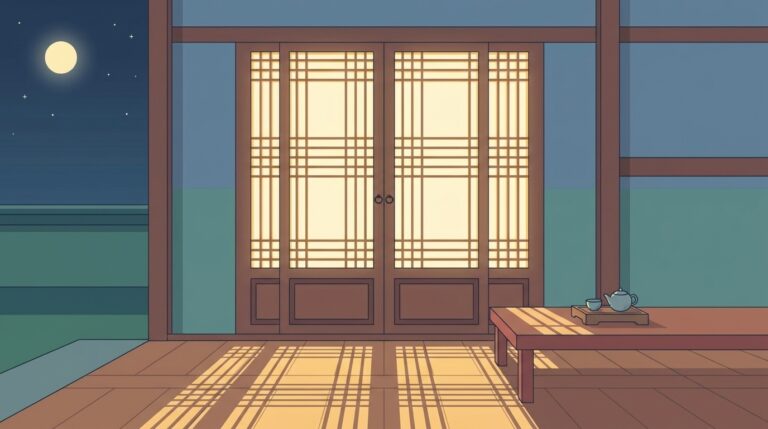
Have you ever watched a historical K-Drama (Sageuk) like The Red Sleeve or Mr. Sunshine? There is always that one breathtakingly tense scene: a soft, warm light glows from inside a room, projecting the silhouette of the protagonist onto a paper door. Sometimes it is the shadow of an assassin, and sometimes it is two lovers, separated only by a thin layer of translucent paper, whispering their deepest secrets.
That magical paper is called Changhoji (창호지), and the beautiful wooden lattice holding it together is called Munsal (문살).
As a C1 level learner, you already know words like 예쁘다 (pretty) or 아름답다 (beautiful). But if you visit a traditional Hanok cafe or stay in a Bukchon Hanok guesthouse and just say “방이 예뻐요” (The room is pretty), it feels a bit… flat, doesn’t it? Today, we are going to dive into the highly sophisticated, poetic vocabulary that Koreans use to describe traditional beauty. By the end of this module, you will sound not just fluent, but deeply cultured.
This guide is crafted from the real experiences of my advanced students who wanted to sound like true Korean aesthetes. Let’s step into the quiet elegance of the Hanok.
Phase 2: Core Expressions Deep Dive
1. 은은하다 (eun-eun-hada)
- Pronunciation: eun-eun-hada [The ‘eu’ sounds like the disgusted sound you make when stepping in gum, smoothly elongated.]
- Meaning: (Literal) Faint, subtle / (Real nuance) Delicately beautiful, soft, not overpowering.
- K-Culture Moment: You are at a trendy Hanok cafe in Ikseon-dong. The sunlight is softly filtering through the Changhoji paper door, creating a warm, moody glow. You take a sip of traditional tea, and the scent is deeply soothing but not too strong. That is the essence of eun-eun-hada.
- Editor’s Insight: This word is the ultimate compliment in traditional Korean aesthetics. It means something doesn’t need to scream for attention to be beautiful. It is often used for light, scent, color, and even a person’s gentle smile.
- Situation Spectrum:
- Casual friends: ✅
- Coworkers (Semi-formal): ✅
- Boss/Elders (Formal): ✅ (Highly praised!)
- 🤔 Think About It: Why does Korean culture value things that are eun-eun-hada (subtle) rather than perfectly clear or shockingly bright? How does this reflect the traditional Korean mindset of blending in with nature rather than conquering it?
2. 정갈하다 (jeong-gal-hada)
- Pronunciation: jeong-gal-hada [jung-gahl-hah-dah]
- Meaning: (Literal) Neat, clean / (Real nuance) Aesthetically pristine, flawlessly neat with a sense of spiritual or moral purity.
- K-Culture Moment: Think of the perfectly intersecting wooden lines of the Munsal. Or imagine the perfectly plated side dishes (banchan) at a high-end traditional Korean restaurant. It is not just wiped clean with a cloth; it looks thoughtfully organized and deeply respected.
- Editor’s Insight: If you tell a Korean elder, “집이 참 정갈하네요” (Your home is very jeong-gal-ha-neyo), they will be incredibly impressed. It acknowledges their refined taste and meticulous care, not just their cleaning skills.
- Situation Spectrum:
- Casual friends: ⚠️ (A bit too poetic for a messy dorm room)
- Coworkers (Semi-formal): ✅
- Boss/Elders (Formal): ✅ (The perfect compliment)
- 🤔 Think About It: In your native language, is there a distinction between “hygienically clean” and “aesthetically/spiritually neat”?
3. 고즈넉하다 (go-jeu-neok-hada)
- Pronunciation: go-jeu-neok-hada [go-juh-nuck-hah-dah]
- Meaning: (Literal) Quiet / (Real nuance) Peacefully tranquil, possessing a serene, historical, or profound silence.
- K-Culture Moment: You are walking through the back alleys of Jeonju Hanok Village at 7 AM before the tourists arrive. The air is crisp, the curved tiled roofs (Giwa) look majestic, and there is a deep, comforting silence.
- Editor’s Insight: Do not use this for a quiet library. This word requires atmosphere. It is strictly reserved for places or times that hold a beautiful, atmospheric stillness, usually tied to nature or traditional architecture.
- Situation Spectrum:
- Casual friends: ✅
- Coworkers (Semi-formal): ✅
- Boss/Elders (Formal): ✅
- 🤔 Think About It: Urban life in Seoul is incredibly fast-paced (Palli-palli culture). Why do you think modern Koreans seek out go-jeu-neok-han (tranquil) Hanok cafes on their weekends?
Phase 3: Textbook vs. Real Korean
[Describing the lighting in a Hanok cafe]
* 📖 Textbook Korean: 조명이 안 밝아요. (The lighting is not bright.)
* 🗣️ Real Korean: 빛이 창호지를 통해서 은은하게 들어오네요. (The light comes in so softly through the Changhoji.)
* 💡 Why the difference?: C1 speakers don’t just state facts; they describe the mood. Koreans appreciate indirect, filtered light as a poetic element.
[Praising the neat wooden patterns of the door]
* 📖 Textbook Korean: 문살이 깨끗해요. (The door lattice is clean.)
* 🗣️ Real Korean: 문살 무늬가 참 정갈하네요. (The pattern of the door lattice is so pristine and elegant.)
* 💡 Why the difference?: 깨끗하다 means free of dirt. 정갈하다 implies human devotion and artistic neatness, elevating the compliment.
[Expressing the vibe of the traditional house]
* 📖 Textbook Korean: 여기는 아주 조용합니다. (It is very quiet here.)
* 🗣️ Real Korean: 분위기가 정말 고즈넉해서 힐링이 되네요. (The atmosphere is so tranquil; it’s really healing.)
* 💡 Why the difference?: “힐링” (Healing) is a massive buzzword in Korea. Combining a traditional aesthetic word (고즈넉하다) with a modern slang concept (힐링) makes you sound like a true Seoulite.
Phase 4: Cultural Context — K-Culture Deep Dive
4-1. Non-verbal Element: The Nunchi of the Paper Door
Unlike heavy wooden doors or thick Western walls that completely block the outside world, Hanok’s Changhoji doors are breathing walls. They let in the wind, the sound of rain, and the silhouettes of people outside. Because the soundproofing is practically zero, living in a Hanok historically required extreme Nunchi (눈치). You had to lower your voice, walk softly, and be hyper-aware of others’ presence. When describing these spaces, your tone of voice should naturally soften. You don’t yell “정갈하다!”; you murmur it gently.
4-2. K-Drama Connection: The Silhouette Confession
If you’ve watched historical K-Dramas, you know the classic trope. The male lead stands outside the female lead’s room. He doesn’t open the door. He simply stands there, his shadow cast upon the Changhoji illuminated by a candle inside. He confesses his love, or says his final goodbye, through the paper. This represents the Korean concept of Jeong (정) and respect for boundaries. The paper acts as a medium that separates them physically but connects them emotionally. Understanding this makes the word eun-eun-hada (subtle, delicate) much more powerful!
Phase 5: Real-Life Roleplay Scenario
Scenario A: The Hanok Stay Check-in
- Setting: 3:00 PM on a crisp autumn Friday. You have just arrived at a premium, highly-rated Hanok guesthouse in Bukchon Hanok Village. The wooden floors shine, and the paper doors slide open with a soft shhk sound.
- Characters:
- YOU: An international professional who appreciates culture and architecture.
- Madame Lee (55): The elegant owner of the guesthouse who takes immense pride in maintaining the house.
Madame Lee: 어서 오세요. 오시느라 고생 많으셨죠? 방으로 안내해 드릴게요.
(eoseo oseyo. osineura gosaeng maneusyeotjyo? bangeuro annaehae deurilgeyo.)
[Welcome. You must be tired from the journey, right? I will guide you to your room.]
(Stage Direction: She gracefully slides open the Changhoji door, revealing a minimalist room with a beautiful tea set.)
YOU: 우와, 방이 정말 예쁘네요!
(uwa, bangi jeongmal yeppeuneyo!)
[Wow, the room is really pretty!]
Madame Lee: 감사합니다. 한옥이라서 조금 불편하실 수도 있지만, 마음은 편하실 거예요.
(gamsahamnida. hanogiraseo jogeum bulpyeonhasil sudo itjiman, maeumeun pyeonhasil geoeyo.)
[Thank you. Since it’s a Hanok, it might be a bit inconvenient, but your mind will feel at ease.]
YOU: 전혀요. 특히 저 문살이랑 창호지가 너무 마음에 들어요. 밖에서 들어오는 빛이 참…
(jeonhyeoyo. teukhi jeo munsarirang changhojiga neomu maeume deureoyo. bakkeseo deureooneun bichi cham…)
[Not at all. I especially love that lattice and paper door. The light coming in from outside is so…]
🔀 Your Turn! How will you finish this sentence?
* A) 빛이 참 밝고 좋네요! (Bright and good!)
* B) 빛이 참 은은해서 고즈넉하네요. (Subtle, so it feels deeply tranquil.)
* C) 빛이 참 대박이네요! (Awesome/Epic!)✅ Best Choice: B — Combining eun-eun-hada and go-jeu-neok-hada shows an incredibly high level of cultural fluency. Madame Lee might just offer you her most expensive traditional tea for free!
⚠️ Choice A & C Analysis: ‘Bright’ misses the point of Hanok lighting, which is meant to be soft. ‘Daebak’ is way too casual for an elegant 55-year-old host in a traditional setting.
Scenario B: The Instagram Cafe Hunt
- Setting: A trendy Hanok cafe in Anguk-dong. You are with your Korean friend, Minji.
- Minji: 여기 사진 진짜 잘 나온다. 그치?
(yeogi sajin jinjja jal naonda. geuchi?)
[Photos turn out really well here. Right?] - YOU: 응, 조명이 엄청 은은해. 그리고 디저트 플레이팅도 완전 정갈하다!
(eung, jomyeongi eomcheong euneunhae. geurigo dijeoteu peulleitingdo wanjeon jeonggalhada!)
[Yeah, the lighting is super soft. And the dessert plating is totally pristine!] - Minji: 오~ 너 한국어 진짜 고급스럽게 한다!
(o~ neo hangugeo jinjja gogeupseureopge handa!)
[Oh~ You speak Korean so luxuriously!]
Phase 6: 10-Second Shadowing Drill
Try reading these sentences out loud, paying attention to the intonation slashes (/) and the emotion tags!
- 😌 (Deeply relaxed) 창호지를 통해 / 들어오는 빛이 / 참~ 은은하네요.
(changhojireul tonghae / deureooneun bichi / cham~ euneunhaneyo.) - ✨ (Impressed) 문살 무늬가 / 어쩜 이렇게 / 정갈할까요?
(munsal munuiga / eojjeom ireoke / jeonggalhalkkayo?) - 🍵 (Peaceful) 분위기가 / 너무 고즈넉해서 / 힐링돼요.
(bunwigiga / neomu gojeuneokaeseo / hillingdwaeyo.)
Phase 7: K-Culture Mini Dictionary
1. 창호지 (Changhoji)
* English: Traditional Korean paper used for doors and windows.
* Context: Made from mulberry bark, it breathes, controls humidity, and filters harsh sunlight into a soft glow. It is the skin of the Hanok.
2. 문살 (Munsal)
* English: The wooden lattice/framework of traditional doors.
* Context: Beyond structural support, Munsal patterns (like grids or floral designs) are considered high art and cast beautiful geometric shadows into the room.
3. 여백의 미 (Yeobaek-ui mi)
* English: The beauty of empty space.
* Context: A core philosophy in Korean traditional art and architecture. Hanok rooms are usually kept empty (no bulky furniture) to let the space, light, and nature become the decoration.
4. 우풍 (Upung)
* English: Draft (cold air seeping in).
* Context: A practical reality of Hanok living! Because the walls are paper and wood, winter drafts are common. Koreans counter this with Ondol (underfloor heating).
Phase 8: Traveler Survival Kit
If you are visiting a Hanok cafe or staying in a traditional guesthouse, these C1 survival phrases will elevate your experience!
🆘 Survival Phrases for Hanok Travelers
* 🇰🇷 “방음이 조금 걱정되는데, 조심해야 할 점이 있나요?”
* 🗣️ (bangeumi jogeum geokjeongdoeneunde, josimhaeya hal jeomi innayo?)
* 🇺🇸 “I am a bit worried about soundproofing, are there things I should be careful about?” (Shows great respect/Nunchi!)
- 🇰🇷 “외풍(우풍)이 심하지는 않나요?”
- 🗣️ (oepung/upungi simhajineun annayo?)
- 🇺🇸 “Is the winter draft very strong?” (Essential for winter travel!)
🇰🇷 “신발은 마루 밑에 벗어두면 되나요?”
- 🗣️ (sinbareun maru mite beoseodumyeon doenayo?)
- 🇺🇸 “Should I take off my shoes under the wooden porch (Maru)?”
📌 Editor’s Travel Note:
* Hanok Etiquette: Never poke a hole in the Changhoji! In historical dramas, you might see spies poking holes with wet fingers to peek inside, but doing this to a cafe or guesthouse door will result in a hefty repair fine.
* Footwear: Hanok structures require you to take off your shoes constantly. Wear shoes that are easy to slip on and off!
Phase 9: Critical Thinking Corner — “One Step Deeper”
Language & Architecture: The Philosophy of Coexistence
When we look at Western castles made of thick stone, the goal is clear: defense and separation from the harsh outside world. But a Korean Hanok uses paper (Changhoji) for doors. Why? Traditional Koreans believed humans should not conquer nature, but live harmoniously within it. The paper allows the sound of rain, the chirping of insects, and the subtle light to enter the living space. The vocabulary we learned today—eun-eun-hada (subtle) and go-jeu-neok-hada (peaceful)—reflects this very philosophy. We don’t praise the Hanok for being “strong” or “bright”; we praise it for being “subtle” and “tranquil.”
💬 Your Turn: Does your culture’s traditional architecture focus more on protecting you from nature, or connecting you with it? How does your language reflect that? Let me know in the comments!
Phase 10: FAQ & Common Mistakes
- Q: Can I use eun-eun-hada to describe a person?
- A: Yes! If you say someone has an eun-eun-han charm (은은한 매력이 있어요), it means they aren’t flashy or loud, but they have a deep, quiet charisma that grows on you over time.
- Q: Are Hanoks really made entirely of paper and wood?
- A: Traditionally, yes, along with clay and stone. Modern Hanoks (especially cafes) often install secret double-layered glass behind the Changhoji to handle the harsh Korean winters and summers!
❌ Common Mistake: Confusing 정갈하다 (jeong-gal-hada) with 그냥 깨끗하다 (just clean).
✅ How to fix: Use 깨끗하다 when you wash your hands or do the laundry. Use 정갈하다 when describing traditional food plating, Hanok architecture, or someone’s remarkably neat handwriting. It requires an element of aesthetic appreciation.
Phase 11: Summary & Action Items
- One-Liner Summary: To praise traditional Korean beauty, move beyond “pretty” and embrace the subtle, pristine elegance of eun-eun-hada and jeong-gal-hada.
-
Action Mission 3 Steps:
- 🥉 Bronze (Solo): Look at a photo of a Hanok and say “분위기가 고즈넉하네요” out loud 3 times.
- 🥈 Silver (Online): Find an aesthetic Hanok Cafe on Instagram (search #한옥카페) and leave a comment: “창호지 빛이 참 은은하네요!”
- 🥇 Gold (Real Life): Next time you visit a Korean restaurant or cafe with traditional decor, tell the staff: “가게가 참 정갈하고 예뻐요.”
- K-Culture Mission: Watch an episode of a historical K-Drama tonight. Try to spot a scene where two characters are talking through a Changhoji door. Notice how their voices drop to a whisper!
Phase 12: Quiz — Interactive Challenge
1. Situational Judgment: You are served a beautifully arranged traditional Korean meal (Hanjeongsik). Which phrase makes you sound like a sophisticated C1 speaker?
* A) 와! 음식이 너무 시끄러워요!
* B) 와! 세팅이 참 정갈하네요.
* C) 와! 반찬이 고즈넉해요.
(Answer: B. ‘A’ means the food is noisy. ‘C’ means the side dishes are historically tranquil, which is a very weird thing to say about food!)
2. Fill in the Blank:
“The light shining through the paper door is so soft and beautiful.”
=> 창호지를 통해 들어오는 빛이 참 ( _______ ) 하네요.
(Answer: 은은 / eun-eun)
3. True or False – K-Culture Edition:
It is considered fun and acceptable for tourists to poke small holes in the Hanok paper doors, just like kids do in K-Dramas.
(Answer: FALSE. Please do not do this! It is expensive to replace the Changhoji!)
Great job today! Next time you see a wooden lattice door, I hope you feel the deep, quiet beauty of Korea. See you in the next module!
Frequently Asked Questions (FAQ)
Q: What does "은은하다 (eun-eun-hada)" mean in Korean and how do you pronounce it?
A: In Korean, "은은하다 (eun-eun-hada)" is pronounced [eun-eun-hada [The 'eu' sounds like the disgusted sound you make when stepping in gum, smoothly elongated.] and means: (Literal) Faint, subtle / (Real nuance) Delicately beautiful, soft, not overpowering.
Q: What does "정갈하다 (jeong-gal-hada)" mean in Korean and how do you pronounce it?
A: In Korean, "정갈하다 (jeong-gal-hada)" is pronounced [jeong-gal-hada [jung-gahl-hah-dah] and means: (Literal) Neat, clean / (Real nuance) Aesthetically pristine, flawlessly neat with a sense of spiritual or moral purity.
Q: What does "고즈넉하다 (go-jeu-neok-hada)" mean in Korean and how do you pronounce it?
A: In Korean, "고즈넉하다 (go-jeu-neok-hada)" is pronounced [go-jeu-neok-hada [go-juh-nuck-hah-dah] and means: (Literal) Quiet / (Real nuance) Peacefully tranquil, possessing a serene, historical, or profound silence.







