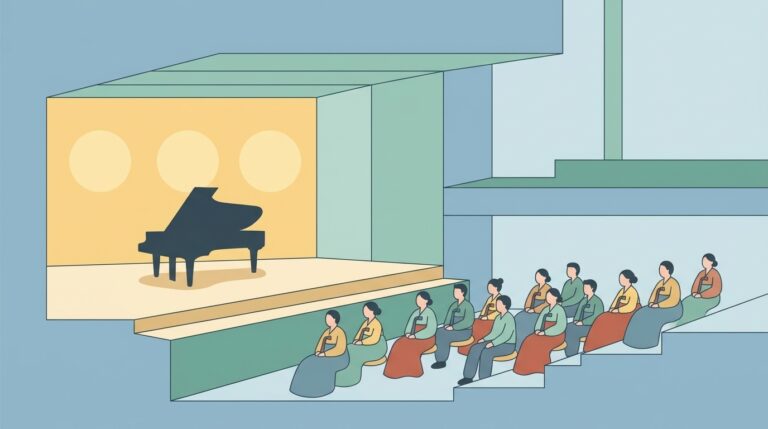
Phase 1: Empathy (Immersive Open)
Hello! I’m the lead editor of Daily Hangul, your premium tutor and local culture navigator.
Picture this: You are watching a sophisticated K-Drama. The chaebol heir takes their date to a magnificent classical concert at the Seoul Arts Center (예술의전당). The orchestra plays beautifully, the music swells, and as the final note rings out, the audience erupts into thunderous applause. The main characters exchange a knowing glance, whispering something elegant about the performance.
Now, imagine you are actually there. You’ve managed to score a ticket to see world-renowned pianist Yunchan Lim or Seong-jin Cho in Seoul. The lights dim. But wait—when exactly do you clap? How do you tell your Korean companion that the music deeply moved you without sounding like a robotic textbook? And what is this intense, silent Nunchi (눈치) battle happening in the audience right now?
As an advanced (C1) Korean learner, you already know your basic greetings. But navigating a high-art event like a classical concert in Korea requires a delicate blend of formal language, cultural awareness, and a sprinkle of native-like idioms. This guide is based on real experiences of my students who transitioned from tourists to true cultural insiders. Let’s tune our Korean to the perfect pitch!
Phase 2: Core Expressions Deep Dive
Here are the top advanced expressions you need to sound like a seasoned Korean concertgoer.
1. 오늘 연주, 정말 소름 돋았어요. (oneul yeonju, jeongmal soreum dodasseoyo)
- Pronunciation: [oneul yeonju, jeongmal so-reum do-da-sseo-yo] / ‘so-reum’ sounds like ‘so room’
- Meaning: (Literal) Today’s performance really raised goosebumps. / (Real Nuance) Today’s performance was breathtakingly amazing.
- K-Culture Moment: You’ll hear this constantly in Korean audition shows or when someone listens to an incredible live vocal. In a classical setting during intermission, saying this with wide eyes immediately shows your deep appreciation.
- Editor’s Insight: This is a fantastic C1 phrase. Instead of a boring “좋았어요 (It was good),” “소름 돋다” conveys a visceral, emotional reaction to art.
- Situation Spectrum:
- Friends (Casual): ✅ (소름 돋았어!)
- Colleagues (Semi-formal): ✅ (소름 돋았어요.)
- Formal/Elders (Formal): ⚠️ (Slightly too colloquial for very formal elders, stick to “감동적이었습니다”)
- 🤔 Think About It: Why do Koreans often use physical shock reactions (like goosebumps, or “미쳤다 – crazy”) to express extreme positive emotions? Does your language have a similar physical metaphor for good music?
2. 악장 사이에는 박수를 치지 않는 게 매너예요. (akjang saieneun baksureul chiji anneun ge maeneoyeyo)
- Pronunciation: [ak-jang sa-i-e-neun bak-su-reul chi-ji an-neun ge mae-neo-ye-yo]
- Meaning: (Literal) It is manners not to clap between movements. / (Real Nuance) Please hold your applause until the very end of the piece.
- K-Culture Moment: You bring a friend to a symphony. They almost clap after the lively first movement. You gently lean in and whisper this to save them from the collective glaring of 2,000 Korean classical fans.
- Editor’s Insight: “매너예요 (It’s etiquette/manners)” is a soft, non-confrontational way to correct someone’s behavior in Korea, blending the English loanword ‘manner’ with Korean politeness.
- Situation Spectrum:
- Friends (Casual): ✅ (매너야)
- Colleagues (Semi-formal): ✅ (매너예요)
- Formal/Elders (Formal): 🚫 (Too direct. Better to say: “모든 악장이 끝나고 박수를 칩니다”)
- 🤔 Think About It: Notice the indirectness here. Instead of saying “Don’t clap,” you say “Not clapping is the etiquette.” How does this reflect the Korean cultural preference for preserving the other person’s face (체면 – chaemyeon)?
3. 귀 호강 제대로 했어요. (gwi hogang jedaero haesseoyo)
- Pronunciation: [gwi ho-gang je-dae-ro hae-sseo-yo]
- Meaning: (Literal) My ears properly experienced luxury. / (Real Nuance) It was an absolute treat for my ears. The music was divine.
- K-Culture Moment: Leaving the concert hall, grabbing a glass of wine, and reviewing the night. This is a very trendy, sophisticated idiom that shows you are highly fluent.
- Editor’s Insight: ‘호강’ means living in luxury or enjoying a great privilege. Koreans use ‘눈 호강’ (eyes luxury – seeing something beautiful) and ‘귀 호강’ (ears luxury – hearing great music).
- Situation Spectrum:
- Friends (Casual): ✅
- Colleagues (Semi-formal): ✅
- Formal/Elders (Formal): ⚠️ (A bit informal, though generally acceptable if spoken politely)
- 🤔 Think About It: The concept of ‘호강’ implies you received something you are almost unworthy of, showing a humble appreciation.
Phase 3: Textbook vs. Real Korean
Let’s upgrade your vocabulary from textbook robotic to natively elegant.
[Expressing Praise for a Performance]
* 📖 Textbook Korean: 연주가 매우 아름다웠습니다. (The performance was very beautiful.)
* 🗣️ Real Korean: 와, 오늘 폼 미쳤다 / 귀 호강 제대로 했어요. (Wow, form is crazy / My ears got thoroughly spoiled.)
* 💡 Why is it different?: Younger Korean generations, even high-culture consumers, use internet-derived slang like “폼 미쳤다” (their form/skill is crazy) to express raw, unpretentious awe.
[Asking to Pass in a Narrow Row]
* 📖 Textbook Korean: 비켜주십시오. (Please step aside.)
* 🗣️ Real Korean: (Bowing slightly) 잠시만 지나갈게요. 죄송합니다. (I’ll just pass by for a moment. Sorry.)
* 💡 Why is it different?: Concert hall rows in Korea can be tight. “비켜주십시오” sounds like a police order. “지나갈게요 (I will pass)” shifts the focus to your action, sounding much more polite.
Bottom Note: For C1 learners, using “귀 호강” or “소름 돋았어요” is the sweet spot—it shows high fluency and cultural integration without sounding disrespectful.
Phase 4: Cultural Context — K-Culture Deep Dive
4-1. Non-Verbal Elements: The Concert Hall Nunchi (눈치)
Korean audiences are known globally for being incredibly attentive and perfectly silent during classical performances. This requires a high level of Nunchi. If you have to cough between movements, you will see Koreans burying their faces into thick padded jackets (패딩) to muffle the sound. Eye contact is kept to a minimum during the music; the collective focus on the stage is almost sacred.
4-2. The K-Popification of K-Classical
If you attend a classical concert in Korea today, you might notice something fascinating. The fandom culture of K-Pop has deeply influenced the classical world. Pianists like Seong-jin Cho or Yunchan Lim have “fandoms” (팬덤). Getting tickets for their shows is called 피켓팅 (Blood Ticketing), just like a BTS concert. While they don’t use lightsticks (응원봉), the sheer dedication, the line for buying merchandise (프로그램북/굿즈), and the explosive “Bravo!” shouts at the end mirror idol concerts. It’s a unique blend of high art and passionate Korean fandom dynamics!
Phase 5: Real-Life Roleplay Scenario
Setting: 8:00 PM, Friday. Intermission at the Seoul Arts Center Concert Hall. You are standing in the stylish lobby holding a program book. You are here with Min-su, your Korean business partner who invited you.
Characters:
– YOU: A foreign expat working in Seoul, a classical music enthusiast.
– Min-su (35): Your Korean business partner. Cultured, polite, but friendly.
Dialogue:
Min-su: 전반부 연주 어땠어요? 저는 완전 기대 이상이었어요.
(jeonbanbu yeonju eottaesseoyo? jeoneun wanjeon gidae isang-ieosseoyo.)
[How was the first half’s performance? For me, it completely exceeded expectations.]
YOU: 진짜 훌륭하네요. 오케스트라 사운드가 압도적이었어요.
(jinjja hullyunghaneyo. okeseuteura saundeuga apdojeogieosseoyo.)
[It’s truly magnificent. The orchestra’s sound was overwhelming.]
Min-su: 맞아요. 특히 지휘자 열정이 대단하더라고요.
(majayo. teukhi jihwija yeoljeong-i daedanhadeoragoyo.)
[Right. Especially the conductor’s passion was incredible.]
YOU: 네, 1악장 끝났을 때 저도 모르게 박수 칠 뻔했어요.
(ne, 1akjang kkeunnasseul ttae jeodo moreuge baksu chil ppeonhaesseoyo.)
[Yes, when the 1st movement ended, I almost clapped without realizing it.]
Min-su: 하하, 사실 저도요. 아, 2부 시작 종이 울리네요. 들어갈까요?
(haha, sasil jeodoyo. a, 2bu sijak jong-i ullineyo. deureogalkkayo?)
[Haha, actually me too. Oh, the bell for the second half is ringing. Shall we go in?]
(🎭 Stage Direction: You both walk back to your row. Someone is sitting near the aisle.)
YOU: (To the person in the aisle seat) 죄송합니다. 잠시만 지나갈게요.
(joesonghamnida. jamsiman jinagalgeyo.)
[I’m sorry. I’ll just pass by for a moment.]
Min-su: (Sitting down) 이번 피아노 협주곡이 오늘 하이라이트예요.
(ibeon piano hyeopjugogi oneul haillaiteuyeyo.)
[This piano concerto is today’s highlight.]
🔀 Your Turn! How should you respond as the music finishes later?
– A) “연주가 참 좋았습니다.” (Very textbook, polite but a bit dry)
– B) “와… 진짜 귀 호강 제대로 했어요. 소름 돋았어요!” (Cultured, expressive, high fluency)
– C) “대박! 폼 미쳤다!” (Too slangy for a business partner at a classical concert)✅ Best Choice: B — Reason: At C1 level, you want to show sophisticated emotional vocabulary. “귀 호강” and “소름 돋았어요” show you truly felt the music, building a deeper bond with your Korean partner.
⚠️ Choice C Analysis: While “대박” is great for a K-pop concert with friends, using it with a business partner at the Seoul Arts Center breaks the elegant atmosphere.
Phase 6: 10-Second Shadowing Drill
Practice your intonation and pacing! Read aloud, pausing at the slashes.
🥺 Deeply moved: 와… / 오늘 연주 / 진짜 소름 돋았어요. / 귀 호강 / 제대로 했네요!
(wa… / oneul yeonju / jinjja soreum dodasseoyo. / gwi hogang / jedaero haenneyo!)
Phase 7: K-Culture Mini Dictionary
1. 눈치 (nunchi)
* Pronunciation: nun-chi
* English: Situational awareness / Reading the room
* Context: The quintessential Korean social sense. In a concert, it’s the nunchi that keeps 2,000 people from coughing until the maestro completely lowers their baton.
2. 피켓팅 (Piketting)
* Pronunciation: pi-ket-ting
* English: Blood ticketing (피 blood + 티켓팅 ticketing)
* Context: The brutal, highly competitive process of buying tickets online. Used for idols and star classical musicians alike.
3. 예술의전당 (Seoul Arts Center)
* Pronunciation: ye-sul-ui jeon-dang
* English: The Hall of Arts
* Context: Korea’s premier cultural complex in Seocho-dong, Seoul. The ultimate stage for classical musicians.
4. 귀 호강 (Gwi hogang)
* Pronunciation: gwi ho-gang
* English: Luxury for the ears
* Context: Used when listening to a flawless live performance, an amazing singer, or a beautiful symphony.
Phase 8: Traveler’s Survival Kit
Even in a high-class concert hall, you need practical survival skills! Here are the top phrases to navigate the venue.
🆘 Survival Phrase #1: Finding the Box Office
– 🇰🇷 “예매표 찾는 곳이 어디예요?” (yemaepyo channeun gosi eodiyeyo?)
– 🗣️ English guide: Where is the place to pick up reserved tickets?
– 📍 Where to use: In the crowded lobby of the concert hall.
– 💡 Pro Tip: Look for signs that say “티켓 수령” (Ticket Pick-up).🆘 Survival Phrase #2: Getting a Program
– 🇰🇷 “프로그램북 하나 주세요. 얼마예요?” (peurogeuraembuk hana juseyo. eolmayeyo?)
– 🗣️ English guide: One program book, please. How much is it?
– 📍 Where to use: At the merchandise (굿즈) counter.📌 Editor’s Travel Note
– Concert Hall Apps: Check “Interpark Ticket” (인터파크 티켓) or “Melon Ticket” for bookings.
– Coat Check: Most Korean concert halls offer a free “물품보관소” (Cloakroom) so you don’t have to rustle your heavy winter coats (패딩) during the performance!
Phase 9: Critical Thinking Corner — “One Step Deeper”
🧠 Think Deeper: Media vs Reality & The Global Era
Let’s analyze the “fandomization” of classical music in Korea. Historically, classical music was seen as an exclusive aristocratic pursuit. However, in modern Korea, the lines between K-Pop idol culture and Classical music have blurred. Fans bring the intense dedication, social media streaming support, and ‘blood ticketing’ energy to classical artists. Some purists argue this disrupts the traditional solemnity of classical music. Yet, others celebrate that Korea has successfully democratized high art, filling massive concert halls with enthusiastic 20-somethings, breathing vibrant new life into a globally aging classical music demographic.
💬 Your Turn: Does your home country have a strict divide between “high art” and “pop culture,” or are they blending? Share your thoughts in the comments!
Phase 10: FAQ & Avoiding Common Mistakes
Q: Can I shout “Bravo” in Korea?
Yes! Shouting “Bravo” (브라보), “Brava” (for females), or “Bravi” (plural) is highly encouraged in Korea, but strictly only after the performance has entirely concluded and the conductor lowers their arms.
Q: Do I tip the usher if they show me to my seat?
No. There is absolutely zero tipping culture in Korea. Trying to tip an usher at the Seoul Arts Center will cause sheer panic and confusion.
❌ Common Mistake #1: Clapping between movements (악장).
✅ How to fix it: Follow the Nunchi rule. Never be the first to clap. Wait until the conductor fully lowers their arms, turns around, and the majority of the audience begins to applaud.❌ Common Mistake #2: Recording the curtain call without checking.
✅ How to fix it: Unlike K-Pop, classical concerts in Korea strictly prohibit all photos/videos, even during curtain calls, unless an announcement specifically states “커튼콜 촬영이 가능합니다” (Curtain call photography is permitted).
Phase 11: Summary & Action Items
One-Liner Summary: Mastering advanced expressions like “소름 돋았어요” and reading the audience’s “Nunchi” will transform you from a classical music tourist to a true Korean cultural insider.
Action Mission 3 Steps:
– 🥉 Bronze (Solo): Stand in front of a mirror and dramatically whisper, “와… 정말 귀 호강 제대로 했어요” three times.
– 🥈 Silver (Online): Find a YouTube video of Yunchan Lim playing, and leave a Korean comment: “연주가 정말 소름 돋네요!”
– 🥇 Gold (Real Life): Attend any live music event in Korea (or even watch a classical broadcast with a Korean friend) and use these expressions to review the performance!
K-Culture Mission:
Go to YouTube and search for “조성진 쇼팽 콩쿠르” (Seong-jin Cho Chopin Competition). Look at the Korean comments. Can you spot anyone using “소름” or “귀 호강”?
What piece of classical music recently gave you goosebumps? Let me know below! 👇
Phase 12: Interactive Quiz
1. Situational Judgment:
The first movement of a Beethoven Symphony has just ended wonderfully. What do you do?
* A) Stand up and yell “Bravo!”
* B) Clap loudly to show respect.
* C) Stay completely silent, cough quietly into your sleeve if necessary, and wait for the second movement.
2. Fill in the Blank:
Wow, that performance gave me goosebumps!
“오늘 연주, 정말 ( _____ ) 돋았어요!”
3. True or False – K-Culture Edition:
It is completely fine to take photos during a classical music concert in Korea as long as the flash is off. (T/F)
🚨 Click here for the answers!
1. C (Remember the Nunchi! Never clap between movements – 악장 사이에는 박수를 치지 않습니다.)
2. 소름 (soreum)
3. False (Taking photos is strictly forbidden inside Korean concert halls, often even during the curtain call, to protect the performers’ rights and audience concentration.)
Frequently Asked Questions (FAQ)
Q: What does "오늘 연주, 정말 소름 돋았어요. (oneul yeonju, jeongmal soreum dodasseoyo)" mean in Korean and how do you pronounce it?
A: In Korean, "오늘 연주, 정말 소름 돋았어요. (oneul yeonju, jeongmal soreum dodasseoyo)" is pronounced [oneul yeonju, jeongmal so-reum do-da-sseo-yo] and means: (Literal) Today's performance really raised goosebumps. / (Real Nuance) Today's performance was breathtakingly amazing.
Q: What does "악장 사이에는 박수를 치지 않는 게 매너예요. (akjang saieneun baksureul chiji anneun ge maeneoyeyo)" mean in Korean and how do you pronounce it?
A: In Korean, "악장 사이에는 박수를 치지 않는 게 매너예요. (akjang saieneun baksureul chiji anneun ge maeneoyeyo)" is pronounced [ak-jang sa-i-e-neun bak-su-reul chi-ji an-neun ge mae-neo-ye-yo] and means: (Literal) It is manners not to clap between movements. / (Real Nuance) Please hold your applause until the very end of the piece.
Q: What does "귀 호강 제대로 했어요. (gwi hogang jedaero haesseoyo)" mean in Korean and how do you pronounce it?
A: In Korean, "귀 호강 제대로 했어요. (gwi hogang jedaero haesseoyo)" is pronounced [gwi ho-gang je-dae-ro hae-sseo-yo] and means: (Literal) My ears properly experienced luxury. / (Real Nuance) It was an absolute treat for my ears. The music was divine.