

Phase 1: Empathy (The Immersive Opening)
Hello there! It’s your Daily Hangul Editor.
Imagine this: You are watching a tense, heart-pounding scene from your favorite Korean medical drama. The monitor is flatlining, the emergency room is in chaos, and the lead doctor shouts, “골든 타임 5분 남았습니다!” (We have 5 minutes of golden time left!) The subtitles simply read, “Time is running out,” but is that all it really means?
In Korea, the concept of 골든 타임 (Golden Time) is deeply ingrained in the culture. It refers to the crucial window of time during an emergency—like cardiac arrest—when a life can still be saved. But it has also bled into everyday life, business, and even relationships to mean “that one critical moment you cannot afford to miss.”
As an expat or a traveler in Korea, what happens if you find yourself in a real-life emergency? The adrenaline kicks in, your mind goes blank, and suddenly the textbook Korean you learned vanishes. You might find yourself wanting to shout “Help!” but no one seems to understand.
Today, we are going completely off the standard curriculum. At the C1 level, you don’t just need to know how to ask for a coffee; you need to know how to command a room, bypass the bystander effect, and potentially save a life in Korean. Let’s dive into the language of urgency, Korean style.
Phase 2: Core Expressions Deep Dive
1. 골든 타임을 놓치면 안 돼요.
- Pronunciation: [gol-deun ta-i-meul no-chi-myeon an dwae-yo.] -> gol-deun sounds like “golden,” no-chi-myeon sounds like “no-chee-myun” (like you’re saying ‘no’ and sneezing ‘chee’).
- Meaning: Literal: We shouldn’t miss the golden time. / Real nuance: We are running out of critical time, act now!
- K-Culture Moment: You will hear this not only in hospital dramas but on the evening news discussing disaster responses, or even in a boardroom when a CEO emphasizes launching a product before a competitor. It implies a sense of shared, urgent responsibility.
- Editor’s Insight: The verb 놓치다 means “to miss” or “to let slip through one’s fingers.” By pairing it with “안 돼요” (should not/cannot), it creates a strong, objective sense of urgency rather than a personal command. It’s a very professional way to express that time is of the essence.
- Situation Spectrum:
- Friends (Casual): ✅
- Colleagues (Semi-formal): ✅
- Boss/Elders (Formal): ✅ (It’s universally applicable due to its objective tone)
- 🤔 Think About It: Why does Korean use an English loanword (Golden Time) for such a critical concept, rather than a traditional Korean word? How does using English terms in high-stakes environments affect the psychological distance of the situation?
2. 거기 파란 옷 입으신 분, 119에 신고해 주세요!
- Pronunciation: [geo-gi pa-ran ot i-beu-sin bun, il-il-gu-e sin-go-hae ju-se-yo!] -> il-il-gu sounds like “eel-eel-goo.”
- Meaning: Literal: The person there wearing blue clothes, please report to 119! / Real nuance: You in the blue shirt, call 911 right now!
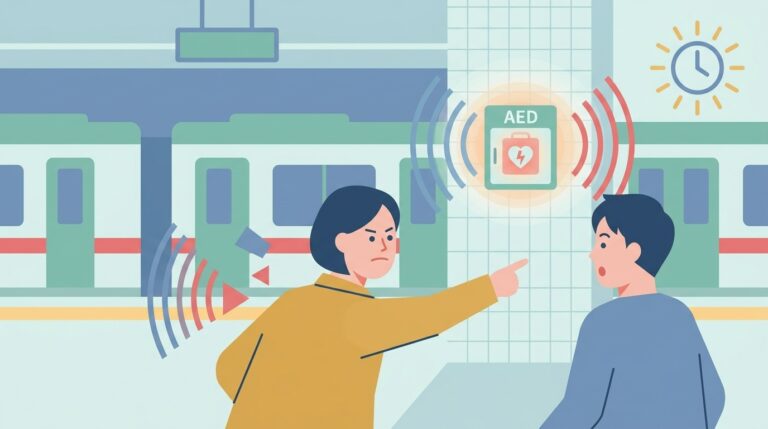
- K-Culture Moment: This is the exact phrase taught in mandatory CPR training across Korean schools, military bases, and corporate orientations. To overcome the “bystander effect” (방관자 효과), Koreans are strictly trained to point at a specific person by describing their clothing or accessories to delegate the task of calling an ambulance.
- Editor’s Insight: Notice that we say 119 (일일구), not 911. Also, instead of the generic “Help,” directly designating someone (파란 옷 입으신 분) is the most culturally and psychologically effective way to get immediate action.
- Situation Spectrum:
- Emergency (Strangers): ✅
- Normal daily life: 🚫 (Pointing and commanding strangers is otherwise highly rude)
- 🤔 Think About It: In normal circumstances, pointing at someone and telling them what to do is a huge cultural taboo in Korea. Why is it that in emergencies, this rule is completely flipped?
3. 제가 심폐소생술 할게요. 자동심장충격기 좀 가져다주세요!
- Pronunciation: [je-ga sim-pye-so-saeng-sul hal-ge-yo. ja-dong-sim-jang-chung-gyeok-gi jom ga-jyeo-da-ju-se-yo!]
- Meaning: Literal: I will do cardiopulmonary resuscitation. Please bring an automated external defibrillator! / Real nuance: I’m starting CPR. Get me an AED!
- K-Culture Moment: Public spaces in Korea, especially subway stations and large buildings, are heavily equipped with AEDs. You will often see them labeled as AED or 자동심장충격기 in bright red boxes.
- Editor’s Insight: 심폐소생술 (CPR) is a mouthful. In real life, many Koreans will simply understand if you yell “CPR 할게요!” However, knowing the Korean term shows a high level of fluency. The addition of 좀 (a little/please) softens the command slightly, a reflex of Korean politeness even in a crisis.
- Situation Spectrum:
- Emergency: ✅
Phase 3: Textbook vs. Real Korean
[Asking for Help in a Crowd]
* 📖 Textbook Korean: “도와주시겠어요?” (Would you please help me?)
* 🗣️ Real Korean: “도와주세요! 사람 살려!” (Help me! Save a person’s life!)
* 💡 Why the difference?: Textbook phrases are meant for customer service or gentle favors. In a life-or-death “Golden Time” scenario, politeness suffixes take too long. You need blunt, loud, and instinctual cries for help.
[Calling the Ambulance]
* 📖 Textbook Korean: “구급차를 불러 주시겠습니까?” (Would you kindly call an ambulance?)
* 🗣️ Real Korean: “119 (일일구) 불러주세요!” (Call 119!)
* 💡 Why the difference?: Efficiency. Syllable count matters in a panic. “일일구” is three quick syllables compared to the clunky formal request.
Phase 4: Cultural Context — K-Culture Deep Dive
4-1. Non-verbal Elements: The Exception to the Rule
Usually, pointing with your index finger at an older Korean person is a massive breach of etiquette. You are taught to use an open hand. However, during the “Golden Time” of CPR, pointing directly and making intense eye contact is mandatory. It overrides all rules of 눈치 (Nunchi) and hierarchy.
4-2. The “Pali-pali” Society and Golden Time
If there is one thing the Korean 빨리빨리 (Pali-pali / Hurry up) culture excels at, it’s emergency response. When you call 119, the response time is astonishingly fast, often arriving within minutes. This societal obsession with speed translates beautifully into saving lives. Furthermore, unlike in many Western countries, calling an ambulance (119) in an emergency is 100% free of charge in Korea. No one hesitates to call for help due to financial fears.
Phase 5: Real-world Roleplay Scenario
Setting: Friday evening, 6:30 PM. Gangnam Subway Station. The platform is packed with commuters rushing home. Suddenly, an elderly man collapses a few meters away from you. The crowd gasps, but people freeze in shock.
Characters:
* YOU: An expat who recently completed a first-aid course.
* Bystander 1 (Man in a black coat): Frozen, holding his briefcase.
* Bystander 2 (Woman in a red scarf): Looking around anxiously.
Dialogue:
YOU: 저기요! 괜찮으세요? 제 말 들리세요?
(jeo-gi-yo! gwaen-cha-neu-se-yo? je mal deul-ri-se-yo?)
[Excuse me! Are you okay? Can you hear me?]
(Stage Direction: You tap the man’s shoulders, but there is no response. He is unconscious.)
YOU: 의식이 없어요! 골든 타임입니다, 빨리 조치해야 돼요!
(ui-si-gi eop-seo-yo! gol-deun ta-i-mim-ni-da, ppal-ri jo-chi-hae-ya dwae-yo!)
[He’s unconscious! It’s the golden time, we need to act fast!]
(Stage Direction: You look up at the paralyzed crowd.)
🔀 Your Turn! How do you delegate tasks to save him?
A) “누구든 119에 전화 좀 해 주시겠어요?” (Could anyone please call 119?)
B) “여기 검은 코트 입으신 남자분, 119에 신고해 주세요! 빨간 목도리 하신 분은 자동심장충격기(AED) 가져다주세요!”
C) “제가 의사는 아니지만 도와드릴게요!”✅ Best Choice: B — Reason: This perfectly utilizes the CPR training principle of designating specific individuals to break the bystander effect.
⚠️ Choice A Analysis: Asking “anyone” often results in “no one” acting, as everyone assumes someone else will do it.
Bystander 1: 아, 네! 지금 바로 일일구 전화할게요!
(a, ne! ji-geum ba-ro il-il-gu jeon-hwa-hal-ge-yo!)
[Ah, yes! I’ll call 119 right now!]
YOU: 저는 바로 심폐소생술 시작하겠습니다.
(jeo-neun ba-ro sim-pye-so-saeng-sul si-ja-ka-get-seum-ni-da.)
[I will start CPR immediately.]
Phase 6: 10-Second Shadowing Drill
Let’s practice the most critical command. Speak with authority and urgency.
😤 거기 / 파란 옷 입으신 분, / 일일구에 / 신고해 주세요!
(geo-gi / pa-ran ot i-beu-sin bun, / il-il-gu-e / sin-go-hae ju-se-yo!)
Phase 7: K-Culture Mini Dictionary
1. 119 (일일구)
* Romanization: il-il-gu
* English: Fire and Ambulance Emergency Number
* Context: The equivalent of 911 in the US or 999 in the UK. They handle fires and medical emergencies (Police is 112).
2. 방관자 효과
* Romanization: bang-gwan-ja hyo-gwa
* English: Bystander Effect
* Context: A psychological phenomenon heavily taught against in Korean first-aid courses. It’s the reason you must point out specific people.
3. 눈치
* Romanization: nunchi
* English: Social sense / Situational awareness
* Context: Normally, Koreans use nunchi to act appropriately in hierarchies. In an emergency, you must abandon standard nunchi to take control.
4. 심폐소생술 (CPR)
* Romanization: sim-pye-so-saeng-sul
* English: Cardiopulmonary Resuscitation
* Context: A crucial medical skill. The phrase literally translates to Heart-Lung-Revive-Technique.
Phase 8: Traveler’s Survival Kit
Even if you aren’t doing CPR, knowing how to handle a medical crisis is crucial.
🆘 Survival Phrase #1
* 🇰🇷 “구급차 좀 불러주세요!” (gu-geup-cha jom bul-reo-ju-se-yo!)
* 🗣️ Pronunciation: [goo-geup-cha jom bool-luh-joo-seh-yo!]
* 📍 Where to use: Anywhere a medical emergency occurs.
* 💡 Pro Tip: If you call 119 yourself, don’t panic if you don’t speak fluent Korean. Say “English please,” and they will connect you to an interpreter service instantly.📌 Editor’s Travel Note
* Ambulance Fees: Public 119 ambulances are entirely free of charge in life-threatening emergencies. Never hesitate to call out of financial concern.
* AED Locations: Almost all subway stations, large apartment complexes, and public institutions have an AED (자동심장충격기) on the wall.
Phase 9: Critical Thinking Corner — “A Step Deeper”
Language & Power (언어와 권력)
Korean is famously known for its complex system of honorifics (존댓말) and strict social hierarchy based on age and status. However, the concept of the “Golden Time” creates a fascinating linguistic paradox. When a life is on the line, the rigid structures of age, corporate rank, and social politeness instantly collapse. A junior employee can—and must—yell commands at a senior manager if they are managing a CPR situation. This momentary suspension of linguistic rules highlights a beautiful truth in Korean society: beneath the strict protocols of etiquette, human life and collective survival hold the ultimate authority.
💬 Your Turn: Does your native language have a similar shift in tone during emergencies? How does politeness change when time is critical? Share your thoughts in the comments!
Phase 10: FAQ & Avoiding Misunderstandings
- Q: Can I use Banmal (casual speech) during an emergency to save time?
- A: Maybe, but try to avoid it. Even in a crisis, adding “~요” at the end of your verbs (도와주세요 instead of 도와줘) is preferred unless you are shouting into the void. However, if you accidentally use Banmal because you are panicking, absolutely no one will hold it against you after the fact.
❌ Common Mistake #1: Shouting “Help me!” in English.
✅ Do this instead: Shout “사람 살려!” (Save a person!) or “도와주세요!” It cuts through the noise and instantly alerts locals that this is a severe crisis, not just a lost tourist.
Phase 11: Summary & Action Items
One-Liner Summary: In a “Golden Time” emergency, abandon subtle politeness and use direct, specific commands to save a life.
Action Mission 3 Steps:
* 🥉 Bronze: Stand in front of your mirror, point firmly, and practice saying, “파란 옷 입으신 분, 119에 신고해 주세요!”
* 🥈 Silver: Search “자동심장충격기” on Naver Maps or Kakao Map to see where the closest AED is in your current or future Korean neighborhood.
* 🥇 Gold: Next time you are in a Korean subway station, physically locate the AED box. It’s usually near the ticket gates!
K-Culture Mission: Watch a medical K-Drama (like Hospital Playlist or Dr. Romantic). Listen closely for the phrase “골든 타임” or “CPR” and see how the characters’ language shifts to urgent, direct commands.
Phase 12: Quiz — Interactive Challenge
1. Situational Judgment: You see someone faint on the street. There are three people watching. What is the MOST culturally effective way to get an ambulance?
* A) “제발 도와주세요!” (Please help!)
* B) “구급차 불러 주실 분 있나요?” (Is there anyone who can call an ambulance?)
* C) “저기 안경 쓰신 분, 119 불러주세요!” (You there with the glasses, call 119!)
2. True or False — K-Culture Edition:
* If you call 119 for an ambulance in Korea, you will be hit with a massive medical bill. (T / F)
(Answers: 1. C – Pointing out a specific trait is the standard way to break the bystander effect in Korea. 2. False – Emergency 119 ambulances are free in Korea!)
Frequently Asked Questions (FAQ)
Q: What does "골든 타임을 놓치면 안 돼요." mean in Korean and how do you pronounce it?
A: In Korean, "골든 타임을 놓치면 안 돼요." is pronounced [gol-deun ta-i-meul no-chi-myeon an dwae-yo.] and means: Literal: We shouldn't miss the golden time. / Real nuance: We are running out of critical time, act now!
Q: What does "거기 파란 옷 입으신 분, 119에 신고해 주세요!" mean in Korean and how do you pronounce it?
A: In Korean, "거기 파란 옷 입으신 분, 119에 신고해 주세요!" is pronounced [geo-gi pa-ran ot i-beu-sin bun, il-il-gu-e sin-go-hae ju-se-yo!] and means: Literal: The person there wearing blue clothes, please report to 119! / Real nuance: You in the blue shirt, call 911 right now!
Q: What does "제가 심폐소생술 할게요. 자동심장충격기 좀 가져다주세요!" mean in Korean and how do you pronounce it?
A: In Korean, "제가 심폐소생술 할게요. 자동심장충격기 좀 가져다주세요!" is pronounced [je-ga sim-pye-so-saeng-sul hal-ge-yo. ja-dong-sim-jang-chung-gyeok-gi jom ga-jyeo-da-ju-se-yo!] and means: Literal: I will do cardiopulmonary resuscitation. Please bring an automated external defibrillator! / Real nuance: I'm starting CPR. Get me an AED!







