

Phase 1: The Boiling Truth About Korean Summers
Hello! This is your Daily Hangul Editor.
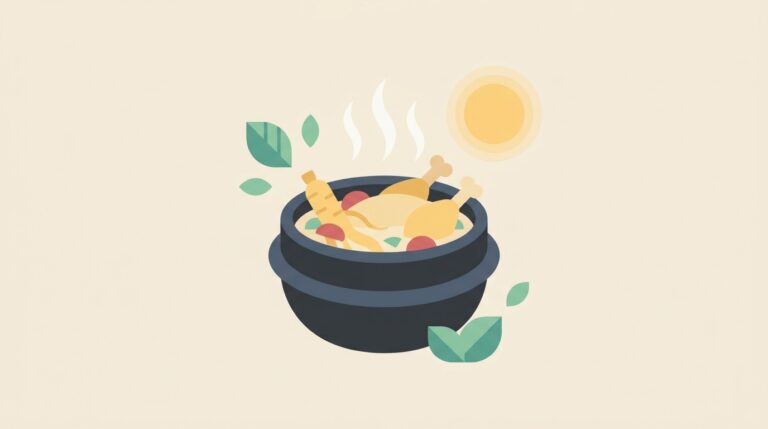
Imagine this: It’s mid-July in Seoul. The humidity is sitting at a suffocating 90%, the asphalt is practically melting, and your shirt is glued to your back. You finally make it to your lunch meeting with your Korean colleagues, dreaming of iced Americanos and freezing cold Naengmyeon (cold noodles). But instead, your team leader enthusiastically leads you into a restaurant with steam billowing out of the kitchen. You sit down, and a furiously boiling stone pot of whole chicken stuffed with ginseng (Samgyetang) is placed in front of you.
While you are questioning your life choices, your senior colleague takes a sip of the boiling broth, wipes the sweat from their forehead, and sighs deeply: “Ah~ Siwonhada!” (Ah, that’s refreshing!)
Refreshing? It’s literally boiling! What is going on here? Welcome to the ultimate C1-level Korean cultural immersion: the survival of 복날 (Boknal). If you understand the mechanics of this seasonal custom and the expressions surrounding it, you won’t just speak Korean; you’ll understand the very soul of Korean resilience.
Everything in this guide comes from real moments of panic my expat students have experienced during the Korean summer. Let’s dive in.
Phase 2: Core Expressions Deep Dive
1. 이열치열 (Fight fire with fire)
- Pronunciation: i-yeol-chi-yeol [ee-yuhl-chee-yuhl]
- Meaning: Literal: Control heat with heat. Real nuance: Overcoming the summer heat by eating hot, nutritious food to balance your body’s internal temperature.
- K-Culture Moment: You’ll see this everywhere from K-Drama dialogues to news anchors announcing the weather. When the hero and his mentor sweat over a spicy stew on a hot day, this four-character idiom (Saja-seongeo) is the unwritten script of their bonding.
- Editor’s Insight: This isn’t just a phrase; it’s a traditional Eastern medicine philosophy. It feels slightly philosophical but is used casually every day in summer.
- Situation Spectrum:
- Casual with friends: ✅
- Semi-formal with colleagues: ✅
- Formal with elders: ✅
- 🤔 Think About It: Why does traditional Korean culture believe that fighting heat with heat is healthier than just cooling down? Does your culture have a counter-intuitive remedy like this?
2. 몸보신하다 (To rejuvenate stamina)
- Pronunciation: mom-bo-sin-ha-da [mohm-boh-sheen-ha-dah]
- Meaning: Literal: To protect and supplement the body. Real nuance: Eating high-quality, nutritious food (usually hot, medicinal soups) to recover energy lost to fatigue or heat.
- K-Culture Moment: In K-Dramas, when a high school student is preparing for the crucial Suneung (college entrance exam), the caring mother will inevitably bring them a steaming bowl of herbal soup, saying, “우리 아들, 몸보신 좀 해” (My son, get some stamina).
- Editor’s Insight: You use this when you feel physically drained (기력이 딸릴 때). It’s the perfect excuse to treat yourself to an expensive meal.
- Situation Spectrum:
- Casual with friends: ✅
- Semi-formal with colleagues: ✅
- Formal with elders: ⚠️ (Saying “몸보신 하십시오” to an elder is polite, but you must use honorifics).
- 🤔 Think About It: Notice how Koreans use food as medicine in everyday conversation. How often do you connect a specific meal to a direct physical cure in your native language?
3. 국물이 시원하다 (The broth is refreshing)
- Pronunciation: gung-muri si-won-ha-da [goong-moo-ree shee-won-ha-dah]
- Meaning: Literal: The broth is cool/cold. Real nuance: The hot broth is deeply satisfying, clearing the throat and stomach, providing a cathartic release of fatigue.
- K-Culture Moment: Picture a seasoned detective in a crime thriller taking a sip of Haejangguk (hangover soup) after an all-nighter. He lets out a loud “Keu-ah~” and says, “진짜 시원하다!” (So refreshing!)
- Editor’s Insight: This is the ultimate test of a true local. If you call a boiling soup “시원하다,” older Koreans will look at you with deep respect. It’s the sensation of a hot bath untangling your tight muscles, but in food form.
- Situation Spectrum:
- Casual with friends: ✅
- Semi-formal with colleagues: ✅
- Formal with elders: ✅
- 🤔 Think About It: What does it say about a language when the word for “cool/refreshing” is used to describe “boiling hot, but internally relieving”?
Phase 3: Textbook vs. Real Korean
[Situation 1: Suggesting a healthy meal for the summer heat]
* 📖 Textbook Korean: 여름이니까 건강에 좋은 음식을 먹으러 갑시다. (Since it’s summer, let’s go eat healthy food.)
* 🗣️ Real Korean: 오늘 중복인데 삼계탕으로 몸보신 좀 할까? (It’s Jungbok today, shall we get some stamina with Samgyetang?)
* 💡 Why the difference?: Koreans constantly reference the specific seasonal calendar (Chobok, Jungbok, Malbok) to justify social gatherings and specific menus.
[Situation 2: Expressing that you are exhausted by the heat]
* 📖 Textbook Korean: 날씨가 너무 더워서 에너지가 없습니다. (The weather is too hot so I have no energy.)
* 🗣️ Real Korean: 아, 날씨 미쳤다. 기력 딸려. (Ah, the weather is crazy. I’m running low on stamina.)
* 💡 Why the difference?: “기력이 딸리다” (energy is draining/lacking) is a highly colloquial, visceral way to express physical exhaustion, often followed by a suggestion to eat meat.
Phase 4: Cultural Context — K-Culture Deep Dive
4-1. The Non-verbal “Nunchi” of the Boiling Pot
When eating Samgyetang or any Boyangsik (health food) with superiors, there is a subtle layer of Nunchi (social tact). When the whole chicken arrives, who gets the drumstick (닭다리 – dakdari)? In Korean culture, the drumstick is the prize piece. If your senior offers it to you, it’s a massive gesture of affection. Accept it with two hands, a slight bow of the head, and say, “감사합니다. 잘 먹겠습니다!”
4-2. The K-Food Connection: A Nation Synchronized
Boknal consists of Chobok (초복 – beginning), Jungbok (중복 – middle), and Malbok (말복 – end), usually spanning July to August. During these three days, the entire nation is synchronized. Delivery apps often crash because millions of people are trying to order fried chicken (the modern alternative to Samgyetang). At famous traditional restaurants like Tosokchon in Seoul, the line wraps around the block, with people standing in 35-degree heat just to eat boiling soup. It’s not just about the food; it’s a communal ritual of surviving the harshest season together.
Phase 5: Interactive Roleplay Scenario
Setting: Mid-July, Jungbok (The second dog day of summer). A famous, crowded Samgyetang restaurant in Jongno. The air conditioning is fighting a losing battle against the steam of a hundred boiling stone pots. You are sweating alongside your senior colleague.
Characters:
– YOU: An expat professional working in Seoul, currently questioning why you aren’t eating ice cream.
– Ji-hoon (38): Your Korean team leader. He believes a man’s worth is measured by his tolerance for spicy and hot foods.
Dialogue:
Ji-hoon: (Wiping sweat with a damp towel) 와, 오늘 진짜 덥네요. 역시 중복이에요.
(Wa, oneul jinjja deomneyo. Yeoksi jungbogiyeyo.)
[Wow, it’s really hot today. As expected of Jungbok.]
YOU: 팀장님, 이렇게 더운데 왜 끓는 삼계탕을 먹는 거예요? 🥵
(Timjangnim, ireoke deounde wae kkeulneun samgyetangeul meongneun geoyeyo?)
[Team leader, why are we eating boiling Samgyetang when it’s this hot?]
Ji-hoon: 에이, 한국의 여름은 이열치열이죠! 땀을 쫙 빼야 시원해져요.
(Ei, hangugui yeoreumeun iyeolchiyeorijyo! Ttameul jjwag ppaeya siwonhaejyeoyo.)
[Hey, Korean summers are about fighting fire with fire! You have to sweat it all out to feel refreshed.]
(🎭 Stage Direction: The waitress places a fiercely boiling pot in front of you. Ji-hoon takes a sip of his broth and lets out a loud “Keu-ah!”)
Ji-hoon: 크아~ 국물 진짜 시원하다! XX씨, 기력 딸릴 텐데 다리 하나 드세요.
(Keu-a~ gungmul jinjja siwonhada! XX-ssi, giryeok ttallil tende dari hana deuseyo.)
[Keu-ah~ the broth is so refreshing! You must be low on stamina, have a chicken leg.]
(🎭 Stage Direction: Ji-hoon uses his chopsticks to place a plump chicken drumstick into your bowl.)
🔀 Your Turn! How do you respond?
– A) “아니요, 저는 가슴살이 더 좋아요.” (No, I prefer chicken breast.)
– B) “진짜요? 대박!” (Really? Awesome!)
– C) “아이고, 감사합니다! 팀장님도 많이 드시고 몸보신 하세요!” (Oh my, thank you! Please eat a lot too and rejuvenate your stamina, Team Leader!)✅ Best Choice: C — Why? It acknowledges the gesture, shows gratitude, and politely wishes them health using the appropriate vocabulary (몸보신) and honorifics.
⚠️ Choice A Analysis: While honest, rejecting a senior’s offering of the best meat can disrupt the harmonious Jeong (affection) they are trying to build. Eat it, or politely pass it back saying “팀장님이 드셔야죠!” (You should eat it, Team Leader!).
Phase 6: 10-Second Shadowing Drill
Master the rhythm and intonation of a true Seoulite suggesting a lunch menu.
😊 오늘 / 초복인데 / 삼계탕으로 / 몸보신 / 어때요?
(oneul / choboginde / samgyetangeuro / mombosin / eottaeyo?)
[It’s Chobok today, how about we get some stamina with Samgyetang?]
Tip: Keep the tone bright and slightly rising at the end on “어때요?”. Emphasize the word “몸보신” (mombosin) to show you care about their health!
Phase 7: K-Culture Mini Dictionary
1. 복날 (Boknal)
* Romanization: bong-nal
* English: The Dog Days of Summer
* Context: The three hottest days based on the lunar calendar (Chobok, Jungbok, Malbok). Culturally, it’s a nationwide excuse to eat healthy, expensive poultry.
2. 보양식 (Boyangsik)
* Romanization: bo-yang-sik
* English: Health/Stamina Food
* Context: Foods believed to restore energy. Includes Samgyetang (ginseng chicken), Jangeo (eel), and Jeonbok (abalone).
3. 이열치열 (Iyeolchiyeol)
* Romanization: i-yeol-chi-yeol
* English: Fight fire with fire
* Context: The Eastern medicine philosophy that consuming hot foods during summer draws the heat out and balances your core body temperature.
4. 단골 (Dangol)
* Romanization: dan-gol
* English: Regular customer / Go-to spot
* Context: On Boknal, everyone flocks to their dangol Samgyetang restaurant. Building a dangol relationship means the owner might give you extra side dishes (Service/서비스)!
Phase 8: Traveler Survival Kit
Navigating famous health food restaurants in the sweltering heat requires quick, efficient Korean.
🆘 Survival Expressions for Restaurants
– 🇰🇷 “여기 대기 명단 있나요?” (yeogi daegi myeongdan innayo?)
– 🗣️ Pronunciation: [yuh-gee dae-gee myung-dan een-nah-yo?]
– 📍 Use when: You arrive at a packed Samgyetang spot and need to know if there’s a waiting list.
– 💡 Pro Tip: Look for a tablet near the door! Most famous spots in Seoul use an app like “CatchTable” where you input your phone number to queue.
- 🇰🇷 “국물 좀 더 주실 수 있나요?” (gungmul jom deo jusil su innayo?)
- 🗣️ Pronunciation: [goong-mool johm duh joo-shil soo een-nah-yo?]
- 📍 Use when: You’ve slurped all your delicious herbal broth and want a refill.
📌 Editor’s Travel Note
– Takeout (포장 – Pojang): If the line is 2 hours long on Chobok, ask “포장 되나요?” (Is takeout available?). They often pack the broth and raw ingredients separately for you to boil at your Airbnb!
– No Tipping: Never tip your server, even if the service was exceptional. In Korea, tipping is awkward and might cause confusion.
Phase 9: Critical Thinking — “One Step Deeper”
🧠 Think Deeper: Food & Identity (음식과 정체성)
Why do Koreans endure the blistering heat to eat boiling soup together? In traditional agrarian Korean society, summer was the season of grueling physical labor in the rice paddies. High-protein foods like chicken were rare luxuries. Sharing a precious, boiling pot of Samgyetang wasn’t just about nutrition; it was a communal ritual of survival. By sweating together and sharing the nourishment, communities forged Jeong (정 – deep emotional bond). Even today, in the air-conditioned corporate jungles of Seoul, taking your team out for Boyangsik on Boknal is a modern continuation of this ancient ritual of saying, “We will survive this hardship together.”
💬 Your Turn: Does your culture have a specific food that people only eat on a certain day or season to build community? Share it in the comments!
Phase 10: FAQ & Avoiding Misunderstandings
Q: Can I eat cold food on Boknal?
Yes! While the traditionalists stick to Samgyetang, younger generations often flock to Naengmyeon (cold buckwheat noodles) or Bingsu (shaved ice). However, taking an elder out for cold food on Boknal might earn you a gentle lecture on internal body temperature.
Q: Should I eat the ginseng and dates inside the chicken?
There is a widespread Korean myth that the jujube (date) absorbs all the toxins from the chicken, so you shouldn’t eat it. Scientifically, it’s fine, but culturally, many Koreans leave the dates and ginseng at the bottom of the bowl.
❌ Common Mistake: Saying “차갑다” (Cold) when you mean the hot soup is refreshing.
✅ Do This Instead: Remember, “차갑다” refers strictly to physical temperature (like ice water). To express that satisfying, relieving feeling of a hot soup, always use “시원하다” (Siwonhada).
Phase 11: Summary & Action Items
💡 One-Liner Summary: On Boknal, combat the summer fatigue (기력이 딸리다) by fighting fire with fire (이열치열) and eating boiling stamina food (몸보신) until you sigh, “시원하다!”
🚀 Action Mission 3-Step:
– 🥉 Bronze (Solo): Look at your next meal and say aloud: “몸보신하자!” (Let’s get some stamina!)
– 🥈 Silver (Online): Find a Korean recipe video for Samgyetang on YouTube and comment, “국물이 진짜 시원해 보여요!” (The broth looks so refreshing!)
– 🥇 Gold (Real World): Visit a Korean restaurant, order a hot soup, and when you take the first sip, dramatically say “크~ 시원하다!” to impress the staff.
🇰🇷 K-Culture Mission:
Search “Korean Boknal 2024 dates” online. On the next Chobok, Jungbok, or Malbok, order some Korean fried chicken or Samgyetang. Post a picture on social media with the hashtag #이열치열.
Phase 12: Quiz — Interactive Challenge
1. Situational Judgment:
You are eating a boiling hot Kimchi Stew with your Korean father-in-law in August. You take a sip, feel a wave of deep relief in your stomach, and want to impress him. What do you say?
– A) 와, 너무 뜨거워요! (Wow, it’s so hot!)
– B) 으~ 너무 차가워요! (Ugh~ it’s so cold!)
– C) 크~ 국물이 정말 시원하네요! (Keu~ the broth is truly refreshing!)
(Answer: C. Saying A is too obvious, and B is physically incorrect. C shows profound cultural fluency!)
2. True or False — K-Culture Edition:
“It is highly recommended to leave a 15% tip at famous Samgyetang restaurants to ensure good service on Boknal.”
(Answer: False. Tipping is not a part of Korean culture and will only cause confusion at the register!)
3. Fill in the Blank:
Today is really hot, but I’m going to eat hot spicy noodles because in Korea, we believe in ________ (fighting heat with heat).
(Answer: 이열치열 / Iyeolchiyeol)
Frequently Asked Questions (FAQ)
Q: What does "이열치열 (Fight fire with fire)" mean in Korean and how do you pronounce it?
A: In Korean, "이열치열 (Fight fire with fire)" is pronounced [i-yeol-chi-yeol [ee-yuhl-chee-yuhl] and means: Literal: Control heat with heat. Real nuance: Overcoming the summer heat by eating hot, nutritious food to balance your body's internal temperature.
Q: What does "몸보신하다 (To rejuvenate stamina)" mean in Korean and how do you pronounce it?
A: In Korean, "몸보신하다 (To rejuvenate stamina)" is pronounced [mom-bo-sin-ha-da [mohm-boh-sheen-ha-dah] and means: Literal: To protect and supplement the body. Real nuance: Eating high-quality, nutritious food (usually hot, medicinal soups) to recover energy lost to fatigue or heat.
Q: What does "국물이 시원하다 (The broth is refreshing)" mean in Korean and how do you pronounce it?
A: In Korean, "국물이 시원하다 (The broth is refreshing)" is pronounced [gung-muri si-won-ha-da [goong-moo-ree shee-won-ha-dah] and means: Literal: The broth is cool/cold. Real nuance: The hot broth is deeply satisfying, clearing the throat and stomach, providing a cathartic release of fatigue.







