

Phase 1: Empathy (The K-Culture Cold Open)
Hello! I am the Lead Editor of Daily Hangul, your personal Korean tutoring brand and local cultural navigator.
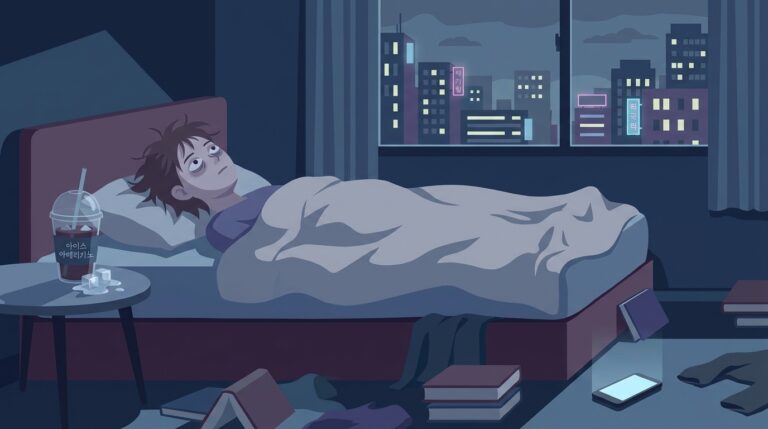
Picture this: You are watching your favorite K-Drama. The lead character is lying in bed, staring blankly at the ceiling. They toss and turn, finally sighing heavily before giving up. Next scene? They are at the office, aggressively tearing open a red ginseng stick (홍삼) or clutching an oversized Iced Americano like a lifeline.
Does this feel relatable? In Korea’s fast-paced society, sleep deprivation and insomnia are practically a cultural phenomenon. Whether it’s due to studying late, working overtime, or just the stress of adapting to a new country, struggling to sleep is a universal pain point. But when you want to express this exhaustion to your Korean friends or colleagues, the textbook phrase “저는 피곤합니다” (I am tired) just doesn’t capture the soul-crushing reality of a sleepless night.
In this guide, I’m going to teach you how to talk about sleep—and the lack of it—like a true local. Knowing these B2-level expressions won’t just help you communicate your health status; it will instantly make Koreans feel a sense of camaraderie with you. After all, nothing bonds people faster than complaining about being tired! Let’s dive in.
Phase 2: Core Expressions Deep Dive
Here are the three most essential expressions to master when your sleep schedule goes off the rails.
1. 잠을 설쳤어요 (I tossed and turned / I didn’t sleep well)
- Pronunciation: [jameul seolchyeosseoyo] + ‘eul’ sounds like the disgusted ‘ugh’ sound you make when stepping in gum, combined with an ‘L’. ‘seol’ sounds like ‘soul’ but shorter.
- Meaning: Literal: “I half-did my sleep.” | Real nuance: “I kept waking up, tossed and turned, and didn’t get any deep rest.”
- K-Culture Moment: You walk into the office looking exhausted. Your coworker asks if you’re okay. You let out a deep sigh and use this phrase. Instantly, they nod in sympathy and offer you a coffee.
- Editor’s Insight: The verb ‘설치다’ means to do something incompletely or restlessly. It perfectly captures that frustrating feeling of being half-awake all night. It sounds much more natural and native-like than simply saying “잠을 못 잤어요” (I couldn’t sleep).
- Situation Spectrum:
- Casual (Friends): ✅ (잠 설쳤어)
- Semi-formal (Coworkers): ✅ (잠을 설쳤어요)
- Formal (Boss/Elders): ⚠️ (밤새 잠을 좀 설쳤습니다 – Use with polite tone)
- 🤔 Think About It: Korean has many verbs that describe the quality of an action, not just the action itself. How does your native language differentiate between “not sleeping” and “sleeping poorly”?
2. 뜬눈으로 밤을 새웠어요 (I stayed up all night with my eyes wide open)
- Pronunciation: [tteunnuneuro bameul saewosseoyo] + ‘tteun’ has a strong double ‘tt’ sound, like the ‘t’ in ‘stop’.
- Meaning: Literal: “I stayed up the night with open eyes.” | Real nuance: “I had severe insomnia and literally didn’t sleep a wink.”
- K-Culture Moment: K-Pop fans use this a lot when they pull an all-nighter waiting for a music video drop or fighting for concert tickets (티켓팅).
- Editor’s Insight: This expression is a bit dramatic but incredibly common. It emphasizes the suffering of insomnia. If you use this, Koreans will immediately understand the severity of your sleep deprivation.
- Situation Spectrum:
- Casual (Friends): ✅ (뜬눈으로 밤샜어)
- Semi-formal (Coworkers): ✅ (뜬눈으로 밤을 새웠어요)
- Formal (Boss/Elders): ⚠️ (Can sound a bit too dramatic for a strictly professional setting)
- 🤔 Think About It: Why do we say “with open eyes” (뜬눈으로) instead of just “I didn’t sleep”? It adds a layer of visual storytelling to everyday conversation.
3. 꿀잠 잤어요 (I slept like a log / I had a sweet sleep)
- Pronunciation: [kkuljam jasseoyo] + ‘kkul’ means honey, use a tense double ‘kk’ like ‘skill’.
- Meaning: Literal: “I slept a honey sleep.” | Real nuance: “I slept incredibly well and feel fully refreshed.”
- K-Culture Moment: After you finally cure your insomnia, you text your friend this phrase in the morning. Idols also frequently post on social media saying “팬여러분, 꿀잠 자세요~” (Fans, have a honey sleep~).
- Editor’s Insight: Adding ‘꿀’ (honey) as a prefix makes anything better. 꿀팁 (honey tip = great advice), 꿀잼 (honey fun = super fun). It’s a slightly slangy but universally accepted term for a fantastic night’s rest.
- Situation Spectrum:
- Casual (Friends): ✅ (꿀잠 잤어?)
- Semi-formal (Coworkers): ⚠️ (Fine for close coworkers, but a bit too casual for distant ones)
- Formal (Boss/Elders): 🚫 (Stick to “안녕히 주무셨습니까?”)
- 🤔 Think About It: Using food metaphors (like honey) to describe abstract concepts like sleep or fun is a huge part of modern Korean slang. What food represents “the best” in your culture?
Phase 3: Textbook vs. Real Korean
[Situation 1: Explaining your fatigue]
* 📖 Textbook Korean: 저는 오늘 매우 피곤합니다. (I am very tired today.)
* 🗣️ Real Korean: 아, 피곤해 죽겠어요. / 오늘 진짜 수면 부족이에요. (Ah, I’m so tired I could die. / I’m seriously sleep-deprived today.)
* 💡 Why the difference?: Koreans love dramatic exaggeration. Adding “~어/아 죽겠다” (to death) emphasizes the extreme state of your emotion or physical condition.
[Situation 2: Wishing someone a good night]
* 📖 Textbook Korean: 안녕히 주무세요. (Sleep peacefully. – Used for elders)
* 🗣️ Real Korean: 잘 자! / 꿀잠 자~ (Sleep well! / Have a honey sleep~ – Used for friends/partners)
* 💡 Why the difference?: Textbook Korean focuses heavily on honorifics. While “안녕히 주무세요” is correct for older people, using it with friends creates a bizarre, uncomfortable distance.
Bottom Note: At the B2 level, try incorporating “피곤해 죽겠어요” into your daily chats. It shows you understand Korean conversational rhythm, but remember to keep it out of formal emails!
Phase 4: Cultural Context — K-Culture Deep Dive
4-1. Non-verbal Cues: The Art of Suffering Silently (but Visibly)
When complaining about sleep deprivation in Korea, non-verbal cues are vital. You shouldn’t just say you’re tired; you must perform it slightly. A subtle rub of the back of your neck, a heavy sigh (한숨), or staring blankly at your computer monitor communicates your state to the collective group. This ties into 눈치 (Nunchi): your coworkers will “read the room” and likely go easy on you, perhaps offering a caffeinated beverage.
4-2. The “Ppalli-Ppalli” Culture vs. The Sleep Economy
If there’s one thing K-Dramas get absolutely right about modern Korean life, it’s the late-night culture. Korea’s 24/7 delivery apps, late-night dining (야식, Yasik), and intense work/study culture (야근, Yageun) are enemies of good sleep.
Ironically, because everyone is so sleep-deprived, the Health & Well-being market in Korea is booming. If you complain about insomnia, you won’t just get sympathy; you’ll get unsolicited recommendations for tart cherry juice, warm chamomile tea from a specific cafe, or sleep-inducing lavender mists.
Critical Viewpoint: While K-Dramas often romanticize the CEO working until 3 AM with a perfect complexion, the reality of Korean sleep deprivation is a serious societal issue. The language reflects this—which is why there are so many nuanced ways to say “I’m exhausted.”
Phase 5: Real-Life Roleplay Scenario
Scenario A: The Breakroom Intervention
- Setting: 9:30 AM at the company breakroom. The espresso machine is aggressively grinding beans. You are staring blankly into space, holding an empty mug.
- Characters:
- YOU: An expat professional who has been suffering from insomnia for three days.
- Minji (30s): Your friendly Korean coworker who is practically a walking pharmacy.
Minji: OO씨, 안색이 안 좋아요. 어디 아파요? 😥
(OO-ssi, ansaegi an joayo. Eodi apayo?)
[OO, your complexion doesn’t look good. Are you sick?]
YOU: 아… 아니요. 아픈 건 아닌데, 요즘 불면증이 좀 있어서요.
(A… aniyo. Apeun geon aninde, yojeum bulmyeonjeung-i jom isseoseoyo.)
[Ah… no. I’m not sick, but I have a bit of insomnia lately.]
Minji: 헉, 진짜요? 어제도 잠을 설쳤어요?
(Heok, jinjjayo? Eojedo jameul seolchyeosseoyo?)
[Gasp, really? Did you toss and turn yesterday too?]
YOU: 네, 새벽 4시까지 뜬눈으로 밤을 새웠어요. 피곤해 죽겠어요.
(Ne, saebyeok nesikkaji tteunnuneuro bameul saewosseoyo. Pigonhae jukgesseoyo.)
[Yes, I stayed up all night with my eyes open until 4 AM. I’m so tired I could die.]
Minji: 어떡해… 커피 마시지 말고 이거 한번 먹어볼래요? 홍삼인데 피로 회복에 좋아요!
(Eotteokhae… keopi masiji malgo igeo hanbeon meogeobollaeyo? Hongsaminde piro hoeboge joayo!)
[Oh no… Don’t drink coffee, do you want to try this? It’s red ginseng, it’s good for fatigue recovery!]
(🎭 Stage Direction: Minji pulls a red ginseng stick from her pocket like a magician)
🔀 Your Turn! How do you respond?
– A) “아, 냄새가 이상해서 안 먹을래요.” (Ah, the smell is weird, I won’t eat it.)
– B) “우와, 감사합니다! 잘 먹고 오늘 밤엔 꼭 꿀잠 잘게요!” (Wow, thank you! I’ll have it and definitely get a honey sleep tonight!)
– C) “홍삼이 수면 부족에 과학적으로 효과가 있나요?” (Is red ginseng scientifically effective for sleep deprivation?)✅ Best Choice: B — You show gratitude, accept the thoughtful gesture, and use the word ‘꿀잠’ to keep the mood light and friendly.
⚠️ Choice C Analysis: While you might be genuinely curious, questioning the science of a coworker’s kind offering can come off as slightly rude or challenging (눈치 없음) in Korean culture.
Scenario B: Bonus K-Culture Roleplay — The Pharmacy (약국)
(You decide to get some mild help and visit a local pharmacy.)
Pharmacist: 어떻게 오셨어요?
(Eotteoke osyeosseoyo?) [How can I help you? / What brings you here?]
YOU: 제가 요즘 잠을 잘 못 자서요. 수면 유도제 같은 거 있나요?
(Jega yojeum jameul jal mot jaseoyo. Sumyeon yudoje gateun geo innayo?)
[I haven’t been able to sleep well lately. Do you have anything like a sleep inducer?]
Pharmacist: 네, 처방전 없이 살 수 있는 약 드릴게요. 주무시기 30분 전에 드세요.
(Ne, cheobangjeon eopsi sal su inneun yak deurilgeyo. Jumusigi samsip-bun jeone deuseyo.)
[Yes, I’ll give you over-the-counter medicine. Take it 30 minutes before you go to sleep.]
Phase 6: 10-Second Shadowing Drill
Read this out loud to practice the natural rhythm. Pay attention to the pauses / and the emotion tags!
😩 하아… / 요즘 / 너무 피곤해요.
(Haa… / yojeum / neomu pigonhaeyo.)😣 어제도 / 계속 / 잠을 설쳐서 /
(Eojedo / gyesok / jameul seolchyeoseo /)😵💫 거의 / 뜬눈으로 / 밤을 새웠거든요.
(Geoui / tteunnuneuro / bameul saewotgeodeunyo.)🥺 오늘 밤에는 / 제발 / 꿀잠 자고 싶어요!
(Oneul bameneun / jebal / kkuljam jago sipeoyo!)
Phase 7: K-Culture Mini Dictionary
1. 눈치 (Nunchi)
* Romanization: nunchi
* English: Situational awareness / emotional intelligence.
* Context: The Korean art of reading the room. If your boss is still working, you might lack the “nunchi” to go home early, leading to our next word…
2. 야근 (Yageun)
* Romanization: yageun
* English: Night overtime work.
* Context: A major culprit for sleep deprivation in Korea. “오늘 또 야근이에요” (I have overtime again today) is a universal tragedy.
3. 얼죽아 (Eoljuga)
* Romanization: eoljuga
* English: “Iced Americano even if I freeze to death.”
* Context: An acronym for 얼어 죽어도 아이스 아메리카노. Koreans love their iced coffee year-round, often using it to combat the lack of sleep.
4. 야식 (Yasik)
* Romanization: yasik
* English: Late-night snack.
* Context: Eating spicy chicken or ramyeon at 11 PM. Delicious, but scientifically proven to cause you to 잠을 설치다 (toss and turn) due to digestion issues.
Phase 8: Traveler’s Survival Kit
If you’re traveling in Korea and jet lag or the bustling city noise keeps you awake, you’ll need these phrases to survive.
🆘 Survival Phrases for Better Sleep
– 🇰🇷 “수면 유도제 있어요?” (Sumyeon yudoje isseoyo?) – Do you have sleep-inducing pills? (Milder than prescription sleeping pills / 수면제)
– 🇰🇷 “카페인 없는 차 있나요?” (Kapein eomneun cha innayo?) – Do you have caffeine-free tea?
– 🇰🇷 “조용한 방으로 바꿀 수 있을까요?” (Joyonghan bangeuro bakkul su isseulkkayo?) – Can I change to a quieter room? (For hotels)📍 Where to use: Pharmacies (약국), Cafes, Hotel Front Desks.
📌 Editor’s Travel Note
– Pharmacy Culture: In Korea, you cannot buy sleeping pills (수면제) without a doctor’s prescription. However, you can buy mild sleep aids (수면 유도제) over the counter at any local pharmacy (약국).
– Cafe Culture: If you want to sleep well, be careful in cafes! Decaf (디카페인) is becoming more common in Seoul, but smaller, independent cafes might not offer it.
Phase 9: Critical Thinking Corner — “Going Deeper”
🧠 Think Deeper: Media vs Reality (The Glamour of the Night vs. The Toll on Health)
When you watch K-Dramas or K-Pop vlogs, Seoul is portrayed as a glittering, sleepless metropolis. Characters eat late-night spicy food, drink soju until dawn, and then magically show up at work looking flawless. However, the reality of this 24-hour culture takes a heavy toll on the actual health and well-being of the population. Korea ranks among the most sleep-deprived nations in the OECD. This discrepancy has given rise to the “Sleeponomics” (슬리포노믹스) industry, where people spend millions of won on premium mattresses, ASMR apps, and sleep clinics. The language we learned today—뜬눈으로 밤을 새우다, 잠을 설치다—are not just phrases; they are symptoms of a highly competitive society that is finally beginning to realize the value of rest.
💬 Your Turn: Does your culture glorify “hustle culture” and lack of sleep, or is prioritizing rest strictly enforced? How do you express “I’m completely exhausted” in your native language? Let us know in the comments!
Phase 10: FAQ & Avoiding Common Mistakes
Q: Can I use “피곤해 죽겠어요” (I’m so tired I could die) to my boss?
No. While it has the polite ‘요’ ending, the phrase itself is a complaint. Complaining directly to a boss is considered unprofessional. Stick to “오늘 컨디션이 조금 안 좋습니다” (My condition is not very good today).
Q: What’s the difference between 졸리다 and 피곤하다?
* 졸리다 (Jollida): Sleepy. Your eyelids are heavy, you need to close your eyes. (Solution: Sleep)
* 피곤하다 (Pigonhada): Fatigued / Tired. Your body lacks energy, maybe from stress or working out. (Solution: Rest or vitamins)
❌ Common Mistake #1: Saying “저는 불면증입니다” (I am insomnia).
✅ Do this instead: Say “저는 불면증이 있어요” (I have insomnia). In Korean, you have an illness or condition, you are not the condition.
Phase 11: Summary & Action Items
One-Liner Summary: To sound like a native when you’re sleep-deprived, ditch the textbook “I’m tired” and use 잠을 설쳤어요 (tossed and turned) or wish your friends a 꿀잠 (honey sleep).
Your Action Missions:
– 🥉 Bronze (Solo): Stand in front of the mirror, let out a realistic, exhausted sigh, and say “아… 잠을 설쳤어” three times.
– 🥈 Silver (Online): Post a picture of your morning coffee on social media with the caption: “어제 뜬눈으로 밤을 새웠어요. ☕️ 수면 부족…”
– 🥇 Gold (Real World): Next time a Korean friend asks how you are, use one of today’s expressions to describe your sleep quality.
🌙 K-Culture Mission:
Tonight, search YouTube for “Korean Sleep ASMR” or “수면 유도 음악” (Sleep-inducing music) and read the Korean comments. You will see countless people using the exact words you learned today, commiserating over their shared insomnia.
Phase 12: Interactive Quiz
Test your B2 knowledge before you go to sleep!
1. Situational Judgment: Your close friend texts you: “내일 중요한 시험이라 너무 떨려.” (I’m so nervous because I have an important exam tomorrow.) What is the BEST reply to wish them a good night?
– A) 안녕히 주무십시오.
– B) 뜬눈으로 밤을 새워라!
– C) 걱정하지 말고 꿀잠 자!
2. Fill in the Blank:
어제 커피를 너무 많이 마셔서 밤새 잠을 ________.
(I drank too much coffee yesterday, so I _______ all night.)
– A) 설쳤어요
– B) 잤어요
– C) 일어났어요
3. True or False — K-Culture Edition:
If you have mild insomnia in Korea, you can buy sleeping pills (수면제) at the convenience store at 2 AM.
(Check your answers by highlighting the invisible text below!)
Click to reveal answers!
1. C (Use ‘꿀잠 자’ for a close friend. ‘안녕히 주무십시오’ is way too formal, and B is cursing them with insomnia!)
2. A (설쳤어요 – tossed and turned / slept poorly).
3. False (You cannot buy strong sleeping pills without a prescription, and even mild sleep aids/수면 유도제 must be bought at a pharmacy, not a convenience store.)
Good luck, and tonight, I sincerely hope you all 꿀잠 주무세요! (Have a honey sleep!)
Frequently Asked Questions (FAQ)
Q: What does "잠을 설쳤어요 (I tossed and turned / I didn't sleep well)" mean in Korean and how do you pronounce it?
A: In Korean, "잠을 설쳤어요 (I tossed and turned / I didn't sleep well)" is pronounced [jameul seolchyeosseoyo] and means: Literal: "I half-did my sleep." | Real nuance: "I kept waking up, tossed and turned, and didn't get any deep rest."
Q: What does "뜬눈으로 밤을 새웠어요 (I stayed up all night with my eyes wide open)" mean in Korean and how do you pronounce it?
A: In Korean, "뜬눈으로 밤을 새웠어요 (I stayed up all night with my eyes wide open)" is pronounced [tteunnuneuro bameul saewosseoyo] and means: Literal: "I stayed up the night with open eyes." | Real nuance: "I had severe insomnia and literally didn't sleep a wink."
Q: What does "꿀잠 잤어요 (I slept like a log / I had a sweet sleep)" mean in Korean and how do you pronounce it?
A: In Korean, "꿀잠 잤어요 (I slept like a log / I had a sweet sleep)" is pronounced [kkuljam jasseoyo] and means: Literal: "I slept a honey sleep." | Real nuance: "I slept incredibly well and feel fully refreshed."







