

People Watching at Korean Festivals: The Ultimate Guide to Sounding Like a Local
Phase 1: Welcome to the Festival!
Hello! I’m your Daily Hangul Editor, your personal K-Culture navigator and Korean tutor.
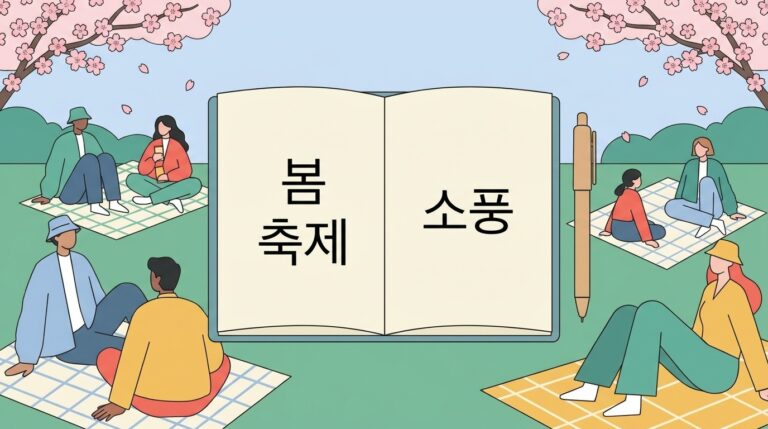
Imagine this: It’s a breezy Friday evening in April. You are at the famous Yeouido Spring Flower Festival. The cherry blossoms are blowing in the wind, street food stalls are sizzling, and buskers are singing indie K-Pop songs. You are sitting on a picnic mat with your Korean friends, sipping on a cold drink.
What do you do when you’re just sitting and chilling? You do 사람 구경 (saram gugyeong), which literally means ‘people watching’!
In textbooks, you learn how to ask for directions or order food. But what happens when you see someone wearing a fabulous outfit, or when a massive crowd suddenly pushes past you? If you only know textbook Korean, you might sound like a news anchor! Today, we are going to learn the natural, witty expressions Koreans actually use when taking in the festival sights.
Phase 2: Core Expressions Deep Dive
Here are the top 3 expressions you need for your next people-watching session.
1. 사람 진짜 많다!
- Pronunciation: saram jinjja manta! [sah-rahm jeen-jah mahn-tah]
- Sound-alike guide: ‘manta’ sounds like ‘manta’ in Manta ray.
- Meaning: Literal: People really many! / Real nuance: Whoa, there are so many people!
- K-Culture Moment: You’ll hear this exactly 5 seconds after stepping out of the subway station at a major festival. Everyone mutters this to themselves or their friends as they navigate the sea of people.
- Editor’s Insight: Notice how it ends in ‘~다 (~da)’? This is called the ‘plain form’ or ‘exclamatory form’. Koreans use it when they are talking to themselves or expressing spontaneous surprise.
- Situation Spectrum:
- Casual (Friends): ✅
- Semi-formal (Co-workers): ✅ (If said like a general observation)
- Formal (Boss/Elders): ⚠️ (Better to say “사람이 정말 많네요”)
- 🤔 Think About It: Why does Korean have a specific verb form just for talking to yourself or expressing sudden realization? Does your language have a way to distinguish between ‘talking to someone’ and ‘thinking out loud’?
2. 저 사람 봐봐.
- Pronunciation: jeo saram bwabwa. [juh sah-rahm bwah-bwah]
- Sound-alike guide: ‘bwa’ sounds like a quick ‘bwa’ sound, repeated twice.
- Meaning: Literal: Look at that person. / Real nuance: Check that person out.
- K-Culture Moment: Your friend taps your shoulder while you’re eating your street food, pointing with their chin toward someone doing an amazing dance cover in the park.
- Editor’s Insight: ‘봐 (bwa)’ comes from ‘보다 (to look)’. Repeating it as ‘봐봐 (bwabwa)’ softens the command. It feels like “take a quick look!” rather than a strict “LOOK.”
- Situation Spectrum:
- Casual (Friends): ✅
- Semi-formal (Co-workers): ⚠️
- Formal (Boss/Elders): 🚫
- 🤔 Think About It: Repeating a word in Korean often makes it sound softer and friendlier. Can you think of other Korean words that are repeated like this?
3. 옷 진짜 잘 입는다.
- Pronunciation: ot jinjja jal imneunda. [oat jeen-jah jahl eem-neun-dah]
- Sound-alike guide: ‘ot’ sounds like ‘oat’ (like oatmeal).
- Meaning: Literal: Clothes really well wear. / Real nuance: They have great style. / They dress really well.
- K-Culture Moment: Korea is known for its fashion. When you go to a festival in Hongdae or Seongsu, you will see people dressed like they belong on a runway. This is the ultimate compliment you can give (or observe) about someone’s style.
- Editor’s Insight: We don’t usually say “스타일 좋다 (good style)” as much as we say “옷 잘 입는다 (wears clothes well).” It’s an action-oriented way to praise someone’s fashion sense.
- Situation Spectrum:
- Casual (Friends): ✅
- Semi-formal (Co-workers): ✅
- Formal (Boss/Elders): 🚫
Phase 3: Textbook vs. Real Korean
Let’s see how textbook Korean transforms in the wild!
[Situation 1: Reacting to a massive crowd]
* 📖 Textbook Korean: 사람이 아주 많습니다. (There are very many people.)
* 🗣️ Real Korean: 와, 사람 대박 많아. (Wow, crazy amount of people.)
* 💡 Why is it different?: ‘대박 (daebak)’ originally meant ‘jackpot’, but now it’s used as an intensifier like ‘totally’ or ‘freaking’ in everyday casual speech.
[Situation 2: Pointing something out to a friend]
* 📖 Textbook Korean: 저기를 보세요. (Please look over there.)
* 🗣️ Real Korean: 헐, 저기 봐봐. (Gasp, look over there.)
* 💡 Why is it different?: ‘헐 (heol)’ is the ultimate Korean reaction sound for surprise, shock, or realization. It immediately grabs your friend’s attention!
Bottom Note: Since you are at an A2 level, using ‘대박 (daebak)’ and ‘헐 (heol)’ will instantly make you sound more like a local. Just remember to only use them with friends!
Phase 4: Cultural Context — K-Culture Deep Dive
4-1. The Non-verbal Nunchi of People Watching
When doing saram gugyeong in Korea, you need 눈치 (Nunchi)—the subtle art of reading the room. If you want to point someone out to your friend, do not point with your index finger. Pointing at people is considered very rude in Korea. Instead, Koreans use the ‘chin point’ (subtly lifting the chin toward the direction) or just describe the person using eye movements.
4-2. The K-Drama Connection: The Accidental Stare
Have you ever noticed in K-Dramas how the main characters often lock eyes in a crowded festival? In reality, staring intensely at someone in Korea can make them uncomfortable, and sometimes people might ask, “왜 쳐다보세요? (Why are you staring?)” Keep your people-watching casual and discreet, just like a local enjoying the vibe!
Phase 5: Real-World Roleplay Scenario
Scenario A: Chicken, Beer, and Vibes
* Setting: Friday 7 PM, Hangang Park during the Summer Night Market. People are sitting on picnic mats, eating, and chatting.
* Characters:
* YOU: An exchange student enjoying your first Korean festival.
* Minsoo (24): Your Korean language exchange partner, very energetic.
Minsoo: 와, 오늘 날씨 최고다! 맥주 마시기 딱 좋은 날씨네.
(wa, oneul nalssi choegoda! maekju masigi ttak joeun nalssine.)
[Wow, the weather is the best today! Perfect weather for drinking beer.]
(🎭 Stage Direction: Minsoo hands you a paper cup of beer.)
YOU: 고마워! 근데 주말이라 그런지…
(gomawo! geunde jumarira geureonji…)
[Thanks! But maybe because it’s the weekend…]
Minsoo: 응? 왜?
(eung? wae?)
[Huh? Why?]
YOU: 사람 진짜 많다!
(saram jinjja manta!)
[There are so many people!]
Minsoo: 내 말이! 아, 맞다. 저기 무대 봐봐. 버스킹 시작하려나 봐.
(nae mari! a, matda. jeogi mudae bwabwa. beoseuking sijakaryeona bwa.)
[That’s what I’m saying! Oh, right. Look at the stage over there. I think busking is about to start.]
YOU: 오, 노래 부르는 사람 옷 진짜 잘 입는다.
(o, norae bureuneun saram ot jinjja jal imneunda.)
[Oh, the person singing dresses really well.]
🔀 Your Turn! Minsoo asks if you want to go closer to the stage. How do you reply?
– A) “아니요. 저는 걷기 싫습니다.” (No, I do not want to walk – Too robotic!)
– B) “우리 그냥 여기서 볼까?” (Shall we just watch from here?)
– C) “저기 가자! 대박!” (Let’s go there! Awesome!)✅ Best Choice: B or C! If you want to keep relaxing, B is a very natural and polite way to suggest staying put. If you want to go, C is fun and energetic!
Scenario B: The Food Truck Line (Bonus)
You are waiting in a long line for a famous churros food truck.
* You: 헐, 줄 너무 길다. (heol, jul neomu gilda – Gasp, the line is too long.)
* Friend: 다른 거 먹을까? (dareun geo meogeulkka? – Shall we eat something else?)
* You: 아니야, 그냥 기다리자! (aniya, geunyang gidarija! – No, let’s just wait!)
Phase 6: 10-Second Shadowing Drill
Practice this sentence to sound incredibly natural when you’re surprised by a crowd!
😲 와, / 사람 / 대~~~박 / 많아! (wa, / saram / dae~~~bak / mana!)
* Pause slightly after ‘와’ and ‘사람’.
* Stretch the ‘대’ in ‘대박’ to emphasize just how huge the crowd is!
Phase 7: K-Culture Mini Dictionary
1. 눈치
* Romanization: nunchi
* English: Social sense / Reading the room
* Context: The quintessential Korean social skill. When people-watching, using ‘nunchi’ means observing without making others uncomfortable.
2. 핫플
* Romanization: hatpeul
* English: Hot place / Trendy spot
* Context: Short for ‘Hot Place’. Festivals, popular cafes, and pop-up stores are all ‘hatpeul’. If there are many people, it’s definitely a hatpeul!
3. 버스킹
* Romanization: beoseuking
* English: Busking (Street performance)
* Context: A massive part of Korean festival culture, especially in places like Hongdae or Han River parks.
4. 돗자리
* Romanization: dotjari
* English: Picnic mat
* Context: You can’t enjoy a Korean park festival without a ‘dotjari’. You can buy them at any nearby convenience store for about 5,000 won!
Phase 8: Traveler Survival Kit
When there are thousands of people at a festival, you need survival Korean to navigate the crowd safely!
🆘 Survival Phrases for Crowded Places
🇰🇷 1. 잠시만요! (jam-si-man-yo!)
– 🗣️ Meaning: Excuse me / Just a moment (passing through).
– 📍 Use it when: You need to push through a dense crowd. Say this loudly but politely, and the sea of people will part for you!🇰🇷 2. 여기 자리 있어요? (yeogi jari isseoyo?)
– 🗣️ Meaning: Is this seat taken?
– 📍 Use it when: You spot an empty spot on a bench or at a food court table during the festival.🇰🇷 3. 사진 좀 찍어주시겠어요? (sajin jom jjigeojusigesseoyo?)
– 🗣️ Meaning: Could you please take a picture for us?
– 📍 Use it when: You find the perfect photo zone.📌 Editor’s Travel Note
– Finding your friends: If you lose your friends in a festival crowd, sending a KakaoTalk location pin is standard practice!
– Trash disposal: Festival food generates trash. In Korea, you must separate recycling (plastic, paper, food waste). Watch where the locals throw their things!
Phase 9: Critical Thinking Corner — “One Step Deeper”
🧠 Think Deeper: Media vs Reality in Korean Fashion
When you do saram gugyeong at a Korean festival, you might notice that many young people look perfectly styled, almost like they stepped out of a K-Drama. Korea has a highly trend-sensitive culture, where blending in with current fashion trends is a way of showing social belonging. However, this also creates pressure (called nunchi) to constantly keep up with fast-changing trends. Do you think dressing trendy is a form of self-expression, or a result of social pressure?💬 Your Turn: How is street fashion perceived in your culture? Do people care a lot about trends when going to festivals? Let us know in the comments!
Phase 10: FAQ & Mistake Prevention
Q1: Can I take pictures of people with cool outfits?
A: NO! Korea has very strict portrait rights (초상권 – chosang-gwon). Taking photos of strangers without permission, even in public festival spaces, is highly frowned upon and can be illegal. If you want a picture of their outfit, you must ask: “옷이 너무 멋진데, 사진 한 장 찍어도 될까요? (Your clothes are so cool, may I take a picture?)”
Q2: Is it rude to say “사람 진짜 많다!” out loud?
A: Not at all! Since it’s in the ‘plain form’, it’s treated as a personal observation. It’s totally fine to say it even if strangers hear you.
❌ Common Mistake #1: Pointing at someone and saying “저 사람! (That person!)” loudly.
✅ Do this instead: Use subtle eye contact or a chin nod, and quietly say “저기 봐봐 (Look over there).”
Phase 11: Summary & Action Items
- One-Liner Summary: Use “사람 진짜 많다” and “저기 봐봐” to naturally react to the lively crowds and sights at Korean festivals!
-
Action Mission:
- 🥉 Bronze (Solo): Say “와, 사람 대박 많아!” out loud 3 times pretending you are at a crowded concert.
- 🥈 Silver (Online): Find a YouTube vlog of a Korean festival and comment: “축제에 사람 진짜 많네요!”
- 🥇 Gold (Real Life): The next time you are in a crowded spot (even in your home country!), use the plain form and mutter to yourself: “사람 진짜 많다.”
- K-Culture Mission: Watch an episode of a K-Drama where the characters go to a festival, Han river, or a busy street. Count how many times they say some variation of “사람 많다” or use the word “대박”!
Phase 12: Quiz — Interactive Challenge
1. You are walking through a huge crowd at a night market and need to get past some people. What should you say?
A) 저기 봐봐! (Look over there!)
B) 헐! (Gasp!)
C) 잠시만요! (Excuse me / passing through!)
2. True or False: It is completely fine to take photos of random strangers at a Korean festival if their outfit is nice.
(T / F)
3. Fill in the blank: Wow, that person dresses so well! -> 옷 진짜 잘 (______).
A) 먹는다 (eats)
B) 입는다 (wears)
C) 잔다 (sleeps)
👀 Click here for Answers!
1. C (Saying “잠시만요” is the polite way to ask people to make room for you to pass.)
2. False (Due to strict portrait rights, you should never photograph strangers without permission!)
3. B (옷 잘 입는다 means they wear clothes well, aka they have great style!)
Loved this lesson? Drop a comment below with your favorite festival experience, and don’t forget to practice your ‘nunchi’! 😊
Frequently Asked Questions (FAQ)
Q: What does "사람 진짜 많다!" mean in Korean and how do you pronounce it?
A: In Korean, "사람 진짜 많다!" is pronounced [saram jinjja manta! [sah-rahm jeen-jah mahn-tah] and means: Literal: People really many! / Real nuance: Whoa, there are so many people!
Q: What does "저 사람 봐봐." mean in Korean and how do you pronounce it?
A: In Korean, "저 사람 봐봐." is pronounced [jeo saram bwabwa. [juh sah-rahm bwah-bwah] and means: Literal: Look at that person. / Real nuance: Check that person out.
Q: What does "옷 진짜 잘 입는다." mean in Korean and how do you pronounce it?
A: In Korean, "옷 진짜 잘 입는다." is pronounced [ot jinjja jal imneunda. [oat jeen-jah jahl eem-neun-dah] and means: Literal: Clothes really well wear. / Real nuance: They have great style. / They dress really well.







