

Phase 1: Empathy (Welcome to the Real Korea!)
Hello! I’m your Daily Hangul Editor.
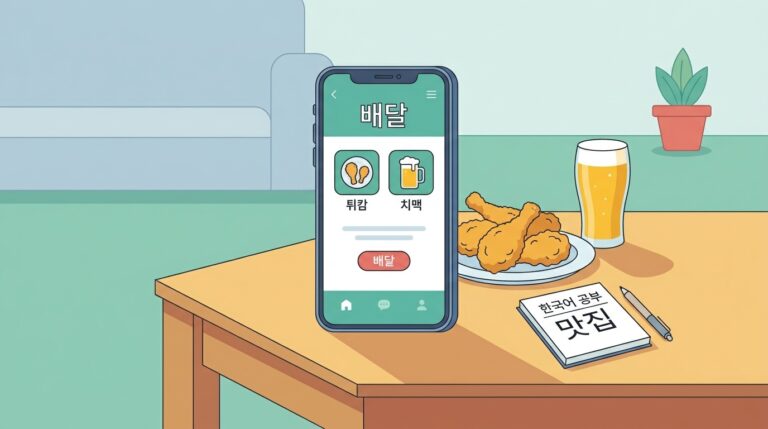
Picture this: It’s 11 PM on a Friday. You’re watching your favorite K-Drama, and suddenly, the main characters start eating incredibly crispy fried chicken and drinking cold beer. Your stomach rumbles. You want it. You need it.
You download a Korean delivery app, but it’s a maze of Hangul. Or maybe you want to ask the hotel front desk to order for you, but you don’t know what to say. What if I told you that knowing just a few phrases could not only get your food faster but also score you some free extra food?
Today, we’re diving into the legendary Korean Delivery Culture (배달 문화). This guide is based on real struggles from my foreign students who just wanted some midnight late-night snacks! Let’s make sure you never go hungry in Korea.
Phase 2: Deep Dive into Key Expressions
1. 리뷰 이벤트 참여할게요
- Pronunciation: [ribyu ibenteu chamyeohalgeyo] (ri-byu sounds like ‘review’ with a B / cham-yeo sounds like ‘charm’ + ‘yo’ / hal-ge-yo sounds like ‘hal-gay-yo’)
- Meaning: I will participate in the review event. (Real nuance: “I promise to leave a good review, so please give me the free side dish!”)
- K-Culture Moment: When ordering on apps like Baemin or Yogiyo, restaurants offer freebies (cheese balls, extra drinks) if you promise to leave a 5-star review. You type this in the “Requests to Owner” box.
- Editor’s Insight: This is the ultimate insider secret! Koreans love getting “Service” (free stuff). If you don’t write this, you’re missing out on the full Korean delivery experience.
- Situation Spectrum:
- Delivery App Memo (Casual/Written): ✅
- Talking to a friend (Casual): ✅
- Formal Business Meeting: 🚫
- 🤔 Think About It: Why do you think Korean restaurants give away free food just for a review? How does this reflect the highly competitive but generous nature of Korean small businesses?
2. 문 앞에 두고 벨 눌러주세요
- Pronunciation: [mun ape dugo bel nulleojuseyo] (mun sounds like ‘moon’ / bel sounds like ‘bell’ / nul-leo sounds like ‘null-uh’)
- Meaning: Please leave it in front of the door and ring the bell.
- K-Culture Moment: You’ll see this as an automatic checkbox in delivery apps. Since COVID-19, non-face-to-face (비대면) delivery has become the standard in Korea.
- Editor’s Insight: This phrase is a lifesaver if you are shy about speaking Korean to the delivery rider or if you are in your pajamas!
- Situation Spectrum:
- Delivery App Memo (Polite request): ✅
- Talking to the rider on the phone (Polite): ✅
- Friends (Casual): 🚫
- 🤔 Think About It: Korea is incredibly safe. People can leave packages and food outside doors for hours without them getting stolen. Does your home country have a similar trust-based culture?
3. 최소 주문 금액
- Pronunciation: [choeso jumun geumaek] (choe-so sounds like ‘chwe-so’ / ju-mun sounds like ‘joo-moon’ / geum-aek sounds like ‘geum-ack’)
- Meaning: Minimum order amount.
- K-Culture Moment: You try to order just one iced Americano, but the app blocks you! Why? Because every restaurant has a minimum amount you must spend before they will deliver.
- Editor’s Insight: This isn’t a phrase you speak, but a crucial vocabulary word you MUST read on the app. If you see this, you might need to add an extra cake to your cart!
- Situation Spectrum:
- Reading Apps (Information): ✅
- Spoken Conversation: ⚠️ (Only used when explaining why you can’t order yet)
- 🤔 Think About It: Delivery in Korea used to be 100% free with no minimums. As delivery apps grew, this changed. How has technology changed the way we eat?
Phase 3: Textbook vs Real Korean
[When suggesting to order food]
* 📖 Textbook Korean: 음식을 배달해 주세요. (Please deliver the food.)
* 🗣️ Real Korean: 배민으로 시키자! (Let’s order via Baemin!)
* 💡 Why is it different?: Koreans rarely say “deliver food” casually. They use the verb 시키다 (to order) and often just say the name of the popular app, Baemin (배달의민족).
[When asking for extra side dishes like radish or kimchi]
* 📖 Textbook Korean: 반찬을 많이 주세요. (Please give me a lot of side dishes.)
* 🗣️ Real Korean: 단무지 넉넉히 부탁드려요~ (Please give plenty of pickled radish~)
* 💡 Why is it different?: Using “부탁드려요” (I request) is much softer and more polite than “주세요” (Give me). Adding a tilde (~) in text softens the tone!
Bottom Note: At the A2 level, remember that sounding natural is more about polite friendliness rather than perfect grammar. Always add “부탁드려요” when writing notes to the restaurant!
Phase 4: Cultural Context — K-Culture Deep Dive
4-1. Non-verbal Elements
When you actually open the door to receive food directly, you don’t need a long conversation. A simple, quick bow (a slight head nod) and a bright “감사합니다” (Thank you) or “수고하세요” (Keep up the good work) is perfect. Avoid prolonged eye contact; a quick smile and nod show perfect Nunchi (social tact).
4-2. K-Food Connection: The “Bali-Bali” App Culture
The Korean delivery culture is fueled by the “Pali-Pali” (빨리빨리 – Hurry, hurry) mindset. In K-Dramas, you might see people ordering food to a park by the Han River. This isn’t movie magic; it’s real!
However, there is a catch. The apps are designed for Korean residents (requiring Korean phone numbers and local credit cards). For tourists, it can be frustrating. But don’t worry! Understanding the menu terms and knowing how to ask a Korean friend or hotel staff to order for you (using the phrases above) will give you the ultimate K-Food experience.
Phase 5: Real-life Roleplay Scenario
Setting: Friday night, 8 PM. You are hanging out at your Korean friend Min-su’s apartment. You both just finished watching an intense episode of a K-Drama and you are starving.
Characters:
– YOU: A foreign resident/traveler who really wants to experience authentic Korean delivery.
– Min-su (30): Your friendly Korean friend who is a master of delivery apps.
Dialogue:
Min-su: 배고프죠? 우리 뭐 좀 시켜 먹을까요? 📱
(Romanization) Baegopeujo? Uri mwo jom sikyeo meogeulkkayo?
(English) You’re hungry, right? Shall we order something to eat?
(🎭 Stage Direction: Min-su grabs his smartphone and opens the Baemin app.)
YOU: 네! 한국에 오면 꼭 배달 음식을 먹어보고 싶었어요.
(Romanization) Ne! Hanguge omyeon kkok baedal eumsigeul meogeobogo sipeosseoyo.
(English) Yes! I really wanted to try delivery food when I came to Korea.
Min-su: 금요일 밤엔 당연히 치맥이죠! 🍗🍺
(Romanization) Geumyoil bamen dangyeonhi chimaegijo!
(English) On a Friday night, it’s definitely Chimaek (Chicken and Beer)!
YOU: 오, 좋아요! 제가 전화로 주문해 볼까요?
(Romanization) O, joayo! Jaega jeonhwaro jumunhae bolkkayo?
(English) Oh, great! Should I try ordering over the phone?
Min-su: 하하, 아니요. 요즘은 다 배달 앱으로 시켜요.
(Romanization) Haha, aniyo. Yojeumeun da baedal aebeuro sikyeoyo.
(English) Haha, no. These days, everyone orders through delivery apps.
YOU: 아, 그렇군요. 최소 주문 금액이 있네요?
(Romanization) Ah, geureokunyo. Choeso jumun geumaegi inneyo?
(English) Ah, I see. There is a minimum order amount?
Min-su: 맞아요. 치킨 한 마리면 충분해요. 아, 사장님께 메시지 남겨야겠다.
(Romanization) Majayo. Chikin han marimyeon chungbunhaeyo. Ah, sajangnimkke mesiji namgyeoyagetda.
(English) That’s right. One whole chicken is enough. Ah, I need to leave a message for the owner.
YOU: 메시지요? 뭐라고 써요?
(Romanization) Mesijiyo? Mworago sseoyo?
(English) A message? What are you writing?
Min-su: “리뷰 이벤트 참여할게요! 치즈볼 부탁드려요~” 이렇게요.
(Romanization) “Ribyu ibenteu chamyeohalgeyo! Chijeubol butakdeuryeoyo~” ireokeyo.
(English) “I will participate in the review event! Please give us cheese balls~” like this.
🔀 Your Turn! How do you respond to the idea of free cheese balls?
– A) “우와, 공짜 치즈볼! 대박이에요!” (Wow, free cheese balls! That’s awesome!)
– B) “사장님이 싫어하지 않을까요?” (Wouldn’t the owner dislike that?)
– C) “저는 리뷰 안 쓸래요.” (I won’t write a review.)✅ Best Choice: A — Reason: Reacting with “대박” (Daebak – awesome) is the perfect casual way to show excitement with a friend!
⚠️ Choice B Analysis: You don’t need to worry! The owners offer these events purposely to gain good ratings, which helps their business grow.
YOU: 우와, 공짜 치즈볼! 대박이에요!
(Romanization) Uwa, gongjja chijeubol! Daebagieyo!
(English) Wow, free cheese balls! That’s awesome!
Min-su: 그쵸? 배달 오면 “문 앞에 두고 벨 눌러주세요”라고 했으니까, 벨 울리면 가져오면 돼요.
(Romanization) Geuchyo? Baedal omyeon “mun ape dugo bel nulleojuseyo”rago haesseunikka, bel ullimyeon gajyeoomyeon dwaeyo.
(English) Right? I set it to “Please leave it at the door and ring the bell,” so when the bell rings, we just bring it in.
Bonus Roleplay: The Hotel Front Desk
You don’t have a Korean number, but you want chicken. You go to the hotel reception.
YOU: 실례합니다. 혹시 치킨 배달 주문해 주실 수 있나요?
(Sillyehamnida. Hoksi chikin baedal jumunhae jusil su innayo? – Excuse me. Could you possibly order chicken delivery for me?)
Staff: 네, 가능합니다. 방 번호가 어떻게 되시죠?
(Ne, ganeunghamnida. Bang beonhoga eotteoke doesijo? – Yes, it’s possible. What is your room number?)
YOU: 704호입니다. 현금으로 낼게요.
(704 ho-imnida. Hyeongeumeuro naelgeyo. – It’s room 704. I will pay in cash.)
Phase 6: 10-Second Shadowing Drill
Listen to the rhythm, pause at the slashes (/), and match the emotion!
🥺 (Cute & Polite) 사장님 / 리뷰 이벤트 / 참여할게요! / 치즈볼 / 부탁드려요~
(sajangnim / ribyu ibenteu / chamyeohalgeyo! / chijeubol / butakdeuryeoyo~)
😊 (Friendly & Clear) 문 앞에 / 두고 / 벨 / 눌러주세요!
(mun ape / dugo / bel / nulleojuseyo!)
Phase 7: K-Culture Mini Dictionary
1. 배달의민족 (배민)
* Romanization: Baedalui Minjok (Baemin)
* English: Nation of Delivery (The #1 Delivery App)
* Context: It’s practically synonymous with delivery. Koreans don’t say “order delivery,” they say “Let’s do Baemin.”
2. 서비스
* Romanization: seobiseu
* English: Service (Freebies / On the house)
* Context: In Korea, “service” doesn’t mean waitstaff serving you; it means complimentary food given to make the customer happy.
3. 치맥
* Romanization: chimaek
* English: Chicken and Beer
* Context: A portmanteau of Chicken (치킨) and Maekju (맥주 – Beer). The ultimate late-night delivery combo.
4. 배달비
* Romanization: baedalbi
* English: Delivery Fee
* Context: Usually ranges from 2,000 to 5,000 KRW. Many people order together to split this fee!
Phase 8: Traveler Survival Kit
Since tourists often struggle with Korean delivery apps (due to identity verification rules), these phrases will help you get delivery by asking others!
🆘 Survival Phrase #1
– 🇰🇷 “여기 배달 되나요?” (yeogi baedal doenayo?)
– 🗣️ English Pronunciation: yeo-gi bae-dal doe-na-yo?
– 📍 Where to use: Asking a restaurant if they do direct delivery.🆘 Survival Phrase #2
– 🇰🇷 “대신 배달 좀 시켜주실 수 있나요?” (daesin baedal jom sikyeojusil su innayo?)
– 🗣️ English Pronunciation: dae-sin bae-dal jom shi-kyeo-ju-shil soo in-na-yo?
– 📍 Where to use: Asking a hotel receptionist or a Korean friend to order for you.🆘 Survival Phrase #3
– 🇰🇷 “만나서 현금 결제 할게요.” (mannaseo hyeongeum gyeolje halgeyo.)
– 🗣️ English Pronunciation: man-na-seo hyun-geum gyul-je hal-ge-yo.
– 📍 Where to use: Telling someone you will pay the rider in cash when they arrive.📌 Editor’s Travel Note
– Useful Apps: If you are a tourist without a Korean card, use the app “Shuttle Delivery” or “Creatrip”! They accept foreign credit cards and offer English interfaces.
– Tipping: 🛑 Do NOT tip the delivery driver. There is absolutely no tipping culture in Korea. The delivery fee (배달비) covers everything.
Phase 9: Critical Thinking Corner — “One Step Deeper”
🧠 Think Deeper: Food & Identity (The Culture of Sharing)
Have you noticed that Korean delivery menus are huge? Instead of ordering individual meals, Koreans usually order a massive plate of Bossam (boiled pork), Jjimdak (braised chicken), or Fried Chicken to place in the center of the table. In Korean culture, food is strongly tied to “Jeong” (정 – affection and deep connection). Eating from the same shared dishes isn’t just about efficiency; it’s a social ritual that bounds people together as a “family” (식구 – literally ‘mouths that eat together’).
💬 Your Turn: Does your culture prefer individual plates, or do you share large meals like in Korea? How does food bring people together in your country? Let me know in the comments!
Phase 10: FAQ & Avoiding Common Mistakes
Q: Can I order food to a park?
Yes! Famous parks like the Han River Park have designated “Delivery Zones” (배달존). Just tell the rider “여의도 한강공원 배달존 2번입니다” (Yeouido Han River Park Delivery Zone 2).
Q: I don’t speak Korean well. Will the rider call me?
Usually, no. If you select “문 앞에 두고 벨 눌러주세요” (Leave at door and ring bell), they will just drop it off. However, if they can’t find your building password, they might call.
❌ Common Mistake #1: Not writing down your apartment’s front door password!
✅ Do this instead: In the delivery memo, always write: “공동현관 비밀번호: 1234” (Main entrance password: 1234). Otherwise, your food gets cold outside!
Phase 11: Summary & Action Items
One-Liner Summary: Mastering delivery phrases like “리뷰 이벤트 참여할게요” (I’ll do the review event) unlocks the true magic of Korean late-night food culture!
Action Mission:
– 🥉 Bronze (Solo): Stand in front of your mirror and practice saying “리뷰 이벤트 참여할게요” three times.
– 🥈 Silver (Online): Go to YouTube, search for “한국 배달 브이로그” (Korean delivery vlog), and listen for the word “배달” (Baedal).
– 🥇 Gold (Real-world): If you are in Korea, ask your hotel front desk or a friend to help you order Chimaek tonight using the phrases you learned!
🎬 K-Culture Mission: Watch any episode of Hospital Playlist or Crash Landing on You. Can you spot the scenes where they order delivery chicken? Watch how they set up the table and share!
Phase 12: Interactive Quiz
1. Situational Judgment: You want the delivery rider to leave the food at your door because you are in your pajamas. What should you select on the app?
A) 많이 파세요 (Sell a lot)
B) 문 앞에 두고 벨 눌러주세요 (Leave at door and ring bell)
C) 리뷰 이벤트 참여할게요 (I’ll do the review event)
2. True or False – K-Culture Edition:
“When the delivery rider arrives, you should give them a $2 tip for being fast.”
(T / F)
3. Fill in the Blank:
Korean late-night culture isn’t complete without Chicken and Beer, also known as ____ (치맥).
(Answers: 1: B / 2: False – No tipping in Korea! / 3: Chimaek)
Frequently Asked Questions (FAQ)
Q: What does "리뷰 이벤트 참여할게요" mean in Korean and how do you pronounce it?
A: In Korean, "리뷰 이벤트 참여할게요" is pronounced [ribyu ibenteu chamyeohalgeyo] and means: I will participate in the review event. (Real nuance: "I promise to leave a good review, so please give me the free side dish!")
Q: What does "문 앞에 두고 벨 눌러주세요" mean in Korean and how do you pronounce it?
A: In Korean, "문 앞에 두고 벨 눌러주세요" is pronounced [mun ape dugo bel nulleojuseyo] and means: Please leave it in front of the door and ring the bell.
Q: What does "최소 주문 금액" mean in Korean and how do you pronounce it?
A: In Korean, "최소 주문 금액" is pronounced [choeso jumun geumaek] and means: Minimum order amount.







