Phase 1: Empathy (Immersive Opening)
Hello! I am your Daily Hangul Editor.
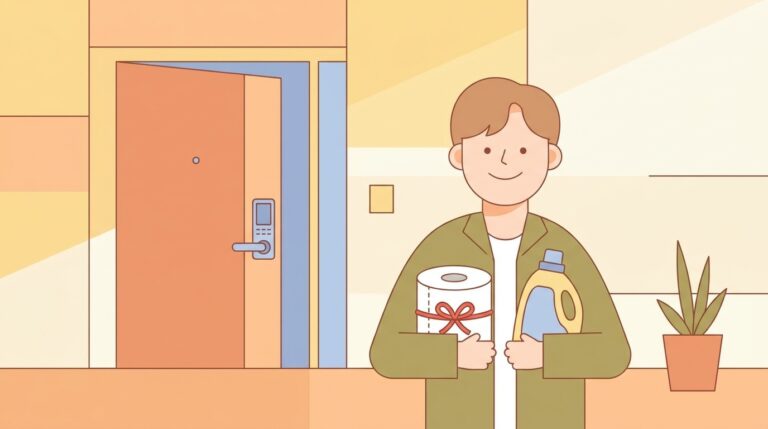
Picture this: You are watching a K-Drama. The main character finally moves into a new apartment, and their friends come over to celebrate. But wait… what are they holding? Huge, colorful packs of toilet paper rolls and big bottles of laundry detergent!
If you’re from a Western culture, bringing toilet paper to a party might seem like a joke or even an insult. But in Korea, this is the ultimate symbol of love and good fortune! This special housewarming party is called 집들이 (Jipdeuri).
If you get invited to a Korean friend’s new home, knowing what to bring and what to say will completely change the atmosphere. You won’t just be “the foreign friend”—you will instantly become a true K-Culture insider! Let’s learn the easiest (A1-level), most essential phrases for your first Korean housewarming experience.
Phase 2: Core Expressions Deep Dive
1. 초대해 주셔서 감사합니다.
- Pronunciation: chodaehae jusyeoseo gamsahamnida.
[Sound-alike guide: cho-dae-hae / joo-shuh-suh (the ‘uh’ sounds like the disgusted sound ‘ugh’ without the ‘g’) / gam-sa-ham-ni-da]- Meaning: Thank you for inviting me.
- K-Culture Moment: You are standing at the doorway, holding your toilet paper gift. Your Korean friend opens the door with a big smile. You bow slightly and say this. It sets the perfect polite tone!
- Editor’s Insight: At the A1 level, this might look a bit long, but it’s a magical phrase. Just memorize it like a song! It shows you respect their effort in inviting you.
- Situation Spectrum:
- Casual Friends: ✅ (Even close friends appreciate polite gratitude initially)
- Coworkers (Semi-formal): ✅
- Boss/Elders (Formal): ✅
- 🤔 Think About It: In Korean culture, acknowledging someone’s effort (like cleaning the house and preparing food for guests) is very important. How do you say “thank you for having me” in your country?
2. 이거 작은 선물이에요.
- Pronunciation: igeo jageun seonmurieyo.
[Sound-alike guide: ee-guh / ja-geun / sun-mool-ee-eh-yo]- Meaning: (Literal) This is a small gift. / (Real nuance) I prepared a little something for you.
- K-Culture Moment: In K-Dramas, someone could hand over a $500 bottle of wine or a massive gift box and still say, “It’s a small gift.” It’s the Korean way of being humble.
- Editor’s Insight: Even if you bought the most expensive, luxurious toilet paper in Seoul, you must say it is “small.” It means “it is small compared to my appreciation for you.”
- Situation Spectrum:
- Casual Friends: ✅
- Coworkers (Semi-formal): ✅
- Boss/Elders (Formal): ✅
- 🤔 Think About It: Why do Koreans downplay their gifts? Does your culture prefer to highlight how great a gift is, or do you also act humble about it?
3. 집이 정말 좋아요!
- Pronunciation: jibi jeongmal joayo!
[Sound-alike guide: jee-bee / jung-mal / jo-ah-yo!]- Meaning: The house is really nice!
- K-Culture Moment: Your friend gives you the “room tour.” Whether it’s a tiny studio apartment (원룸) in Hongdae or a huge family apartment, your job is to react with big, bright eyes and say this phrase!
- Editor’s Insight: Koreans love “리액션” (Reactions). Saying this phrase with a big “우와!” (Wow!) will make the host incredibly proud.
- Situation Spectrum:
- Casual Friends: ✅
- Coworkers (Semi-formal): ✅
- Boss/Elders (Formal): ✅ (Add “우와” only for friends, though!)
- 🤔 Think About It: Complimenting someone’s personal space builds quick intimacy. What is the first thing you compliment when visiting a friend’s house?
Phase 3: Textbook vs. Real Korean
[Situation 1: Handing over the housewarming gift]
* 📖 Textbook Korean: 이것은 저의 선물입니다. (This is my gift. – Very robotic!)
* 🗣️ Real Korean: 휴지 사 왔어요! (I bought toilet paper! / hyuji sa wasseoyo!)
* 💡 Why the difference?: Close friends just casually state what they brought. It’s direct, warm, and natural!
[Situation 2: Complimenting the house]
* 📖 Textbook Korean: 당신의 집이 훌륭합니다. (Your house is excellent.)
* 🗣️ Real Korean: 우와, 집 진짜 좋다! (Wow, house is really good! / uwa, jip jinjja jota!)
* 💡 Why the difference?: Koreans rarely use “당신” (you) in real life. Also, dropping the subject and using “진짜” (really/truly) makes it sound 100x more authentic.
Phase 4: Cultural Context — K-Culture Deep Dive
4-1. Non-verbal Communication
When giving your gift, use two hands! Even if it’s just a light pack of toilet paper, holding it with both hands shows respect. And the most critical non-verbal rule in a Korean home: Take off your shoes at the entrance! Do not step into the living room with your outdoor shoes.
4-2. K-Culture Connection: K-Drama & Variety Shows
If you watch the popular K-Variety show “I Live Alone” (나 혼자 산다), you’ll see celebrities hosting Jipdeuri all the time.
Why toilet paper and detergent?
– Toilet Paper (휴지): Unrolls smoothly. It means “May your life/business unroll smoothly and easily!”
– Laundry Detergent (세제): Makes a lot of bubbles. It means “May your wealth bubble up and multiply!”
Critical View: While dramas show young people bringing toilet paper, nowadays many young Koreans prefer more aesthetic gifts like candles, wine, or nice hand soap. However, toilet paper remains the unbreakable classic!
Phase 5: Real-Life Roleplay Scenario
Setting: Friday night, 7 PM. You are standing in front of an apartment door in Seoul. You are holding a big pack of toilet paper. Your friendly Korean coworker, Min-su, just moved in and invited you.
Characters:
– YOU: A foreign learner excited for your first Jipdeuri.
– Min-su (32): Your cheerful Korean friend.
Dialogue:
Min-su: 어서 와요! (eoseo wayo!)
[Welcome!]
(🎭 Stage Direction: Min-su opens the door with a big smile)
YOU: 초대해 주셔서 감사합니다! (chodaehae jusyeoseo gamsahamnida!)
[Thank you for inviting me!]
Min-su: 뭘 이런 걸 다 사 왔어요~ (mwol ireon geol da sa wasseoyo~)
[Oh, you didn’t have to bring anything!]
(Note: This is standard Korean politeness. Min-su is happy!)
YOU: 이거 작은 선물이에요. 휴지 샀어요. (igeo jageun seonmurieyo. hyuji sasseoyo.)
[It’s a small gift. I bought toilet paper.]
Min-su: 우와, 센스 최고! 고마워요. 들어와요. (uwa, senseu choego! gomawoyo. deurowayo.)
[Wow, great sense! Thank you. Come in.]
🔀 Your Turn! What do you do next?
– A) Walk straight into the living room wearing your cool sneakers.
– B) Take off your shoes, leave them at the entrance, and step inside.
– C) Ask Min-su to clean your shoes.✅ Best Choice: B — NEVER wear shoes inside a Korean home! Taking them off is absolute law.
(Continuing the Roleplay… You took off your shoes)
YOU: 우와, 집이 정말 좋아요! (uwa, jibi jeongmal joayo!)
[Wow, the house is really nice!]
Min-su: 하하, 좀 작죠? (haha, jom jakjyo?)
[Haha, it’s a bit small, right?]
YOU: 아니요, 너무 예뻐요! (aniyo, neomu yeppeoyo!)
[No, it’s so pretty!]
Min-su: 다행이네요. 배고프죠? 피자 시켰어요! (dahaengineyo. baegopeujyo? pija sikyeosseoyo!)
[That’s a relief. You’re hungry, right? I ordered pizza!]
YOU: 오, 너무 좋아요! 잘 먹겠습니다! (o, neomu joayo! jal meokgetseumnida!)
[Oh, I love it! Thank you for the food!]
Bonus Scenario: Buying the gift at a convenience store
If you forgot to buy a gift, just run into a CU or GS25 convenience store!
YOU: 안녕하세요, 휴지 어디 있어요? (annyeonghaseyo, hyuji eodi isseoyo? / Hello, where is the toilet paper?)
Clerk: 저기 뒤에 있어요. (jeogi dwie isseoyo. / It’s right back there.)
YOU: 이거 얼마예요? (igeo eolmayeyo? / How much is this?)
Phase 6: 10-Second Shadowing Drill
Speak out loud! Let’s practice handing over your gift. Pay attention to the pauses (/) and the emotion tags.
😊 이거 / 작은 / 선물이에요~ (ee-guh / ja-geun / sun-mool-ee-eh-yo~)
🤩 우와 / 집이 / 정~~~말 좋아요! (oo-wa / jee-bee / jung~~~mal / jo-ah-yo!)
Phase 7: K-Culture Mini Dictionary
1. 집들이
* Romanization: jipdeuri
* English: Housewarming party
* Context: The party held after moving to a new home. Usually involves showing the house and eating delivery food together.
2. 두루마리 휴지
* Romanization: durumari hyuji
* English: Roll of toilet paper
* Context: The #1 traditional Jipdeuri gift in Korea. Symbolizes everything working out smoothly.
3. 눈치
* Romanization: nunchi
* English: Social sense / Reading the room
* Context: Important at Jipdeuri! You need ‘nunchi’ to know when the host is tired so you can politely go home.
4. 세제
* Romanization: seje
* English: Detergent
* Context: Another classic gift. The bubbles symbolize wealth multiplying.
Phase 8: Traveler Survival Kit
If you are traveling in Korea and need to buy something at a convenience store or mart on your way to a friend’s house, keep these survival phrases handy!
🆘 Survival Phrases TOP 3
– 🇰🇷 “휴지 어디 있어요?” (hyuji eodi isseoyo?)
– 🗣️ Pronunciation: hyu-jee uh-dee iss-uh-yo?
– 📍 Where to use: Mart, Convenience Store
– 🇰🇷 “이거 얼마예요?” (igeo eolmayeyo? – How much is this?)
– 🇰🇷 “봉투 주세요.” (bongtu juseyo. – Please give me a bag.)💡 Pro Tip: In Korea, you usually have to pay extra (around 50-100 won) for a plastic or paper bag. Just say “bongtu juseyo” to buy one!
📌 Editor’s Travel Note:
– Map Apps: Use KakaoMap or Naver Map to find your friend’s house. Google Maps doesn’t work well for walking directions in Korea!
– Card over Cash: Convenience stores perfectly accept credit cards. You don’t need cash to buy your toilet paper gift.
Phase 9: Critical Thinking — “One Step Deeper”
🧠 Think Deeper: Language & Power (The Culture of Modesty)
In Korean culture, the phrase “이거 작은 선물이에요” (This is a small gift) isn’t about the literal size or price of the gift. It reflects a society that highly values modesty and humility. Showing off wealth or effort directly can make others uncomfortable. By lowering the value of your own gift verbally, you are elevating the receiver’s status. It’s a beautiful way to show respect!
💬 Your Turn: In your culture, do people act humble about the gifts they give? Or do they proudly say, “I got you the best thing ever!”? Share your thoughts in the comments!
Phase 10: FAQ & Mistake Prevention
Q: Can I use “초대해 주셔서 감사합니다” to my boss?
A: Yes! It is formal and polite. It is the perfect phrase for elders and bosses.
Q: Do I have to buy toilet paper for Jipdeuri?
A: Not anymore! While toilet paper is the fun, traditional choice, modern Koreans (especially in their 20s-30s) love receiving wine, nice candles, diffusers, or pretty cups.
❌ Common Mistake #1: Leaving your shoes on.
✅ Do this instead: The moment you open the door, look down. If there is a slight step up into the house, take your shoes off right there!❌ Common Mistake #2: Refusing food because you are “trying to be polite.”
✅ Do this instead: In the past, Koreans refused food three times. Today? Just accept it happily and say “잘 먹겠습니다!” (I will eat well!).
Phase 11: Summary & Action Items
One-Liner Summary: Bring toilet paper for luck, take off your shoes, and humbly say “이거 작은 선물이에요” (This is a small gift) to win their hearts!
Action Mission 3 Steps:
– 🥉 Bronze (Solo): Stand in front of your mirror and practice saying “집이 정말 좋아요!” with a big smile.
– 🥈 Silver (Online): Comment below: What gift would you bring to a Jipdeuri?
– 🥇 Gold (Real Life): If you visit a Korean mart, try asking “휴지 어디 있어요?” to the staff!
K-Culture Mission:
Next time you watch a K-Drama, watch the scenes where characters enter a house. Look closely at the entrance—did they take off their shoes? Did they bring a giant pack of toilet paper?
Phase 12: Quiz — Interactive Challenge
1. Situational Judgment:
You just entered your Korean friend’s new apartment. What is the BEST first sentence?
A) “화장실 어디 있어요?” (Where is the bathroom?)
B) “초대해 주셔서 감사합니다.” (Thank you for inviting me.)
C) “이것은 휴지입니다.” (This is toilet paper.)
(Answer: B! It’s polite and sets a great mood. C is too robotic!)
2. True or False – K-Culture Edition:
Giving toilet paper at a Korean housewarming party means you think their house is dirty. (T/F)
(Answer: False! It means you wish everything in their life to unroll smoothly.)
3. Fill in the Blank:
When handing over your gift, you want to be humble.
“이거 _________ 선물이에요.” (This is a small gift.)
(Answer: 작은 / jageun)
Frequently Asked Questions (FAQ)
Q: What does "초대해 주셔서 감사합니다." mean in Korean and how do you pronounce it?
A: In Korean, "초대해 주셔서 감사합니다." is pronounced [chodaehae jusyeoseo gamsahamnida.] and means: Thank you for inviting me.
Q: What does "이거 작은 선물이에요." mean in Korean and how do you pronounce it?
A: In Korean, "이거 작은 선물이에요." is pronounced [igeo jageun seonmurieyo.] and means: (Literal) This is a small gift. / (Real nuance) I prepared a little something for you.
Q: What does "집이 정말 좋아요!" mean in Korean and how do you pronounce it?
A: In Korean, "집이 정말 좋아요!" is pronounced [jibi jeongmal joayo!] and means: The house is really nice!