

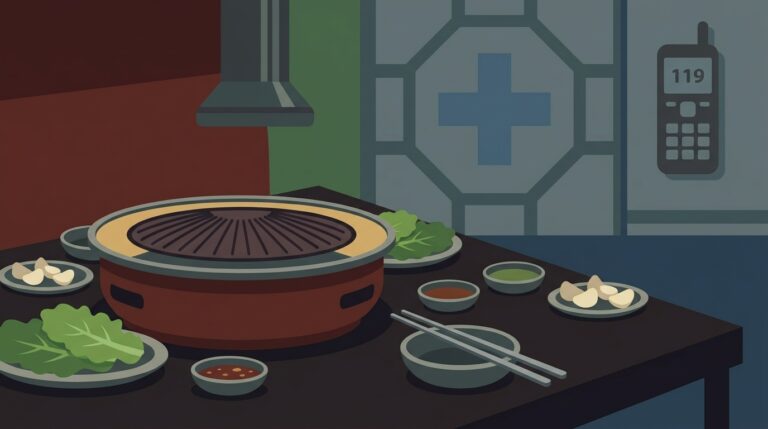
Phase 1: The Empathy Driven Cold Open
Hello! This is your Daily Hangul Editor.
Picture this: You’re watching your favorite K-Drama. The main characters are sitting at a lively, smoke-filled Samgyeopsal (pork belly) restaurant, clinking glasses of Soju. The protagonist wraps a massive Ssam (lettuce wrap) filled with meat, garlic, and rice, and shoves the whole thing into their mouth. We’ve all seen it, right? It’s a classic K-Food moment.
But let’s bring this into reality. You are at that exact restaurant in Seoul with your Korean colleagues. One of them enthusiastically eats a giant Ssam, but suddenly, their face turns red. They stop talking, their hands desperately grasp their throat, and they can’t cough.
Panic sets in. The upbeat K-Pop music in the background fades into a blur. You need to act fast. You know the Heimlich maneuver, but how do you break through the panic and communicate effectively in Korean?
At a C2 (Advanced) level, you aren’t just learning how to order food or discuss social issues—you are learning how to navigate the absolute extremes of human experience in a different language and culture. Today, we are tackling a literal life-or-death situation: Choking Emergencies and the Heimlich Maneuver (하임리히법) in Korea. Let’s dive in.
Phase 2: Core Expressions Deep Dive
When every second counts, your Korean needs to be visceral, sharp, and commanding.
1. “목에 뭐가 걸렸어요! 숨을 못 쉬어요!”
- Pronunciation: [Moge mwoga geollyeosseoyo! Sumeul mot swieoyo!] / Mog-eh sounds like making a slight gulping sound in your throat.
- Meaning: Something is stuck in their throat! They can’t breathe! (Literal: Something got caught in the throat! Can’t breathe breath!)
- K-Culture Moment: In tense medical K-Dramas like Hospital Playlist or Dr. Romantic, this is the frantic shout from a bystander rushing a patient into the ER.
- Editor’s Insight: Forget the clinical term “기도 폐쇄” (airway obstruction) in the heat of the moment. “목에 걸리다” (caught in the throat) is the most instinctual phrase Koreans use. It immediately conveys the urgency without sounding like a medical textbook.
- Situation Spectrum:
- Casual/Friends: ✅ (You might drop the ‘요’ and yell “목에 뭐 걸렸어!”)
- Semi-formal/Colleagues: ✅
- Formal/Elders: ✅ (Urgency overrides strict politeness here)
- 🤔 Think About It: Notice the omission of the subject “He/She”. In high-context Korean, if you are pointing at the choking person, adding “그가” (He) or “이분이” (This person) wastes precious syllables. How does your native language handle subjects during extreme emergencies?
2. “기침 계속 해보세요! (등 두드려 드릴게요!)”
- Pronunciation: [Gichim gyesok haeboseyo! (Deung dudeuryeo deurilgeyo!)]
- Meaning: Keep trying to cough! (I’ll pat your back!)
- K-Culture Moment: Before administering the Heimlich maneuver, standard first aid dictates encouraging the person to cough. This phrase is what a calm, collected protagonist would say while stepping up to help.
- Editor’s Insight: “해보세요” implies “Give it a try / Keep attempting it.” It’s encouraging but authoritative.
- Situation Spectrum:
- Casual/Friends: ✅ (“기침해 봐!”)
- Semi-formal/Colleagues: ✅
- Formal/Elders: ✅
- 🤔 Think About It: Even in an emergency, Koreans naturally append “~보세요” (please try to) rather than just screaming “기침해!” (Cough!) to strangers. The ingrained habit of showing basic respect (존댓말) is incredibly hard to break, even when adrenaline is pumping.
3. “저기 안경 쓰신 분! 빨리 119 좀 불러주세요!”
- Pronunciation: [Jeogi angyeong sseusin bun! Ppal-li il-il-gu jom bulleojuseyo!]
- Meaning: You there in the glasses! Please call 119 quickly!
- K-Culture Moment: In civil defense training (민방위훈련) or first aid courses in Korea, instructors heavily emphasize avoiding the Bystander Effect (방관자 효과). You are taught to specifically point out an individual by their physical feature or clothing.
- Editor’s Insight: Do NOT just yell “누가 119 좀 불러주세요!” (Somebody call 119!). Culturally and psychologically, people might freeze. You must use descriptors: “빨간 옷 입으신 분!” (Person in the red shirt!), “안경 쓰신 분!” (Person wearing glasses!).
- Situation Spectrum:
- Casual/Friends: 🚫 (You’d use their name)
- Semi-formal/Colleagues: ⚠️ (Use their name or title)
- Formal/Strangers: ✅ (Perfect for directing bystanders)
- 🤔 Think About It: We added “좀” (a little/please) in “119 좀 불러주세요.” Even when giving a direct, life-saving command, Korean softens the edge with “좀”. It’s a fascinating linguistic reflex to maintain social harmony, even in chaos.
Phase 3: Textbook vs. Real Korean
Let’s look at how survival Korean differs from the classroom.
[Describing the Emergency]
* 📖 Textbook: 환자의 기도가 음식물로 인해 폐쇄되었습니다. (The patient’s airway has been obstructed by food.)
* 🗣️ Real Korean: 헉! 목에 뭐 걸렸나 봐요! 숨을 못 쉬어요! (Gasp! Looks like something’s stuck in their throat! They can’t breathe!)
* 💡 Why the difference?: Sino-Korean medical terms (기도, 폐쇄) require cognitive load. Pure Korean verbs (걸리다, 막히다) bypass the brain and hit straight to the gut.
[Calling for Help]
* 📖 Textbook: 응급 구급차를 호출해 주시겠습니까? (Would you please summon an emergency ambulance?)
* 🗣️ Real Korean: 빨리 일일구(119) 불러주세요!
* 💡 Why the difference?: No one says “구급차” (ambulance) in a panic. Everyone says “119” (il-il-gu), which is the universal emergency medical number in Korea.
[Executing the Heimlich]
* 📖 Textbook: 제가 하임리히 구명법을 실시하겠습니다. (I will execute the Heimlich life-saving technique.)
* 🗣️ Real Korean: 제가 하임리히법 할게요! 뒤에서 안을게요! (I’ll do the Heimlich! I’m going to grab you from behind!)
* 💡 Why the difference?: Efficiency. You must also announce your physical intention (“I will hug/grab you from behind”) to prevent the choking victim from struggling against you out of surprise.
Phase 4: Cultural Context — K-Culture Deep Dive
4-1. Non-Verbal Cues & The Breakdown of “Nunchi”
In Korean society, Nunchi (눈치 – the subtle art of reading the room) governs everything. You generally avoid pointing directly at people, and you certainly don’t grab your boss from behind. However, during a choking emergency, Nunchi must be completely discarded.
When pointing to a stranger to call 119, use your entire hand to gesture towards them, make piercing eye contact, and speak loudly. If you have to perform the Heimlich on a superior, do not hesitate or apologize first. Action supersedes hierarchy here.
4-2. The “Ssam” Culture & The Danger of “Han-ip-man”
Why do choking incidents often happen at Korean BBQ joints? It’s deeply tied to Ssam (쌈) culture and the concept of Han-ip-man (한입만 – just one bite).
Historically, wrapping food in lettuce or sesame leaves is symbolic of “wrapping up good fortune (복을 쌈 싸 먹다).” Because of this symbolism, biting a Ssam in half is considered bad luck, disrespectful to the person who made it for you, and honestly, it just makes a messy disaster on your plate. You are culturally encouraged to stuff the entire wrap into your mouth at once. Combine this with alcohol during a Hoesik (company dinner), boisterous laughter, and slippery foods like live octopus (산낙지) or chewy rice cakes (떡), and you have a perfect storm for airway obstruction.
Phase 5: Real-Life Roleplay Scenario
Setting: Friday, 8:00 PM. A bustling Samgyeopsal restaurant in Gangnam. It’s incredibly loud. The exhaust pipes are rattling, and K-Pop is blasting.
Characters:
* YOU: An expat who is C2 fluent in Korean and certified in First Aid.
* Min-su (32): Your jovial Korean coworker who loves making comically large Ssam.
* Ji-yoon (28): A junior coworker who gets easily flustered.
Dialogue:
Min-su: 야, 이거 봐라. 상추 두 장, 고기 두 점, 마늘까지! 완벽한 쌈이다! 🥩
(Ya, igeo bwara. Sangchu du jang, gogi du jeom, maneulkkaji! Wanbyeokhan ssamida!)
[Hey, look at this. Two lettuce leaves, two pieces of meat, and garlic! The perfect wrap!]
YOU: 민수 씨, 그거 한입에 다 넣으려고요? 무리 같은데…
(Minsu ssi, geugeo hanibe da neoeuryeogoyo? Muri gateunde…)
[Minsu, are you going to put that all in your mouth at once? Seems like a stretch…]
Min-su: 에이, 쌈은 원래 한입에 먹어야 제맛이지! (Stuffs the entire wrap into his mouth and tries to laugh).
(Ei, ssameun wonlae hanibe meogeoya jemasiji!)
[Hey, a wrap only tastes right if you eat it in one bite!]
(🎭 Stage Direction: Min-su’s eyes widen. He coughs once, then stops. He grabs his throat. His face starts turning red. He cannot make a sound.)
Ji-yoon: 어? 선배님, 왜 그러세요? 장난치지 마세요~
(Eo? Seonbaenim, wae geureoseyo? Jangnanchiji maseyo~)
[Huh? Senior, what’s wrong? Stop joking around~]
YOU: 장난 아니에요! 민수 씨, 목에 걸렸어요? 숨막혀요? 고개 끄덕여보세요!
(Jangnan anieyo! Minsu ssi, moge geollyeosseoyo? Summakyeoyo? Gogae kkeudeogyeoboseyo!)
[It’s not a joke! Minsu, is it stuck in your throat? Are you choking? Nod your head!]
(🎭 Stage Direction: Min-su nods frantically. You stand up behind him, making a fist above his navel.)
YOU: 지윤 씨! 가만히 있지 말고…
(Jiyoon ssi! Gamanhi itji malgo…)
[Jiyoon! Don’t just stand there…]
🔀 Your Turn! How should you instruct Ji-yoon?
* A) “도와주세요! 어떡하죠?”
* B) “지윤 씨! 당장 119에 전화해서 여기 강남역 삼겹살집이라고 말해요!”
* C) “식당 사장님 좀 불러주실래요?”✅ Best Choice: B — Reason: It is a direct, undeniable command that breaks her out of panic, specifies the emergency number (119), and gives her the crucial information to relay (location).
⚠️ Choice A & C Analysis: ‘A’ induces more panic. ‘C’ wastes time. The restaurant owner cannot do more than a paramedic.
YOU: 제가 하임리히법 할게요! 민수 씨, 하나 둘 셋 하면 강하게 밀어 올릴게요!
(Jega haimnihibeop halgeyo! Minsu ssi, hana dul set hamyeon ganghage mireo ollilgeyo!)
[I’ll do the Heimlich! Minsu, on the count of three, I’m going to thrust upward strongly!]
Phase 6: 10-Second Shadowing Drill
Let’s practice the exact rhythm and intonation. You need to sound loud, clear, and commanding.
- 😤 단호하고 명확하게 (Firm and Clear):
저기 / 안경 쓰신 분! / 빨리 / 일일구에 / 신고해 주세요!
(Jeogi / angyeong sseusin bun! / Ppal-li / il-il-gue / singohae juseyo!) -
😟 다급하게 (Urgent):
목에 / 뭐가 걸렸어요! / 숨을 / 못 쉬어요!
(Moge / mwoga geollyeosseoyo! / Sumeul / mot swieoyo!)
Phase 7: K-Culture Mini Dictionary
| 한국어 | Romanization | 영어 | 맥락 설명 (Context) |
|---|---|---|---|
| 하임리히법 | haimnihibeop | Heimlich maneuver | Direct phonetic translation, highly recognized in Korea. |
| 일일구 | il-il-gu | 119 (Emergency Number) | Korea’s equivalent to 911. For medical and fire emergencies. |
| 한입만 | han-ip-man | Just one bite | A cultural eating habit or a plea to take one massive bite of food. |
| 쌈 | ssam | Wrapped food | Meat and condiments wrapped in leafy greens. A major choking hazard if made too large. |
| 방관자 효과 | banggwanja hyogwa | Bystander Effect | The psychological phenomenon where people assume someone else will help. |
Phase 8: Traveler Survival Kit
Even if you aren’t living in Korea, knowing how to handle medical emergencies during your trip is vital.
🆘 Survival Expressions #1: Emergency Dispatch
* 🇰🇷 “구급차 좀 보내주세요. 여기 [장소] 예요.”
* 🗣️ English Guide: [Gugeupcha jom bonaejuseyo. Yeogi (Location)-yeyo.]
* 📍 Where to use: On the phone with 119.
* 💡 Pro Tip: If you don’t know your exact address, find the nearest telephone pole (전봇대). Every utility pole in Korea has a unique ID number. Read that number to the 119 operator, and they can pinpoint your exact GPS location instantly!📌 Editor’s Travel Note
* 119 vs 112: 119 is for Fire & Ambulance. 112 is for Police. If someone is choking, dial 119.
* Language Barrier: The 119 dispatch center in Korea offers a three-way translation service (English, Chinese, Japanese, etc.). Just say “English please” if you panic.
* AEDs: Automated External Defibrillators are ubiquitous in Korea (subway stations, large buildings, apartments). Look for the sign “자동심장충격기” or simply “AED”.
Phase 9: Critical Thinking Corner — “One Step Deeper”
🧠 Think Deeper: Food & Identity (음식과 정체성)
Why do Koreans insist on eating a giant Ssam in one bite, even when it poses a choking risk?
In Korean culinary tradition, wrapping a Ssam is metaphorically wrapping Bok (복 – good fortune or blessings). To bite the wrap in half is to cut your fortune in half. Furthermore, sharing a meal (식구 – literally “mouths that eat together”) is the ultimate expression of community. Making a beautifully large Ssam and offering it to someone else is an act of affection. The loud, boisterous Hoesik (company dinner) environment where everyone is eating these massive wraps and drinking Soju is meant to break down the rigid hierarchical walls of the Korean corporate office.
Thus, the act that leads to the choking hazard is, ironically, one of the deepest expressions of Korean love, community, and fortune. Understanding this dichotomy transforms you from a mere speaker of the language to a true cultural insider.
💬 Your Turn: Does your culture have any eating habits that are deeply meaningful but perhaps a little impractical or risky? Share it in the comments!
Phase 10: FAQ & Avoiding Misunderstandings
Q1: “Can I just drop honorifics (Jeondaetmal) completely in a life-or-death situation?”
* Editor’s Answer: Yes. If someone is dying, no one cares about politeness levels. Yelling “비켜!” (Move!) instead of “비켜주세요” (Please move) to a crowd blocking the medics is entirely acceptable and expected. Survival > Hierarchy.
Q2: “Is there a Good Samaritan Law in Korea? Will I get sued if I break their rib doing the Heimlich?”
* Editor’s Answer: Yes! Korea has the “착한 사마리아인 법” (Good Samaritan Law) under the Emergency Medical Service Act. If you provide first aid in good faith to someone whose life is in danger, and you inadvertently cause injury, you are generally protected from civil and criminal liability.
❌ Common Mistake #1: Saying “111” or “911” out of habit.
✅ Do this instead: Drill “일일구” (119) into your brain. The emergency numbers are different.
Phase 11: Summary & Action Items
- One-Liner Summary: In a choking emergency, ditch the textbook, boldly assign someone to call 119 by pointing out their features, and confidently announce your actions as you perform the Heimlich.
🔥 Action Mission 3-Step:
* 🥉 Bronze (Solo): Stand in front of a mirror and firmly practice pointing and saying: “저기 안경 쓰신 분! 119에 신고해 주세요!”
* 🥈 Silver (Online): Find the nearest AED in your current building or workplace. Look up how to say “Where is the AED?” in Korean and write it in your notes.
* 🥇 Gold (Real World): The next time you are at a Korean BBQ restaurant, observe the Ssam culture. Notice how people eat it in one bite. Quietly identify who you would point to if an emergency happened.
K-Culture Mission: Watch a medical K-Drama (like Doctor Cha or Hospital Playlist) this week. I guarantee you will hear “일일구 불러!” within the first few episodes. Catch it!
Phase 12: Quiz — Interactive Challenge
1. Situational Judgment: A man at the table next to you starts choking on a piece of octopus. He is silent and clutching his throat. You need a bystander in a blue hat to call for an ambulance. What is the most culturally and linguistically effective command?
* A) 파란 모자 쓰신 분! 119 좀 불러주세요!
* B) 실례하지만, 구급차를 호출해 주시겠어요?
* C) 거기 누구라도 911 좀 불러봐요!
2. Fill in the Blank:
(Before doing the Heimlich, you want to encourage the person to keep coughing.)
“_______ 계속 해보세요!”
* A) 식사 (Dining)
* B) 기침 (Cough)
* C) 호흡 (Respiration)
3. True or False — K-Culture Edition:
In Korean culture, it is considered polite to bite a Ssam (lettuce wrap) in half so you can eat it elegantly over two bites. (T/F)
(Answers: 1: A, 2: B, 3: False – You must eat it in one bite “Han-ip-man” to keep the good fortune intact!)
Frequently Asked Questions (FAQ)
Q: What does ""목에 뭐가 걸렸어요! 숨을 못 쉬어요!"" mean in Korean and how do you pronounce it?
A: In Korean, ""목에 뭐가 걸렸어요! 숨을 못 쉬어요!"" is pronounced [Moge mwoga geollyeosseoyo! Sumeul mot swieoyo!] and means: Something is stuck in their throat! They can’t breathe! (Literal: Something got caught in the throat! Can't breathe breath!)
Q: What does ""기침 계속 해보세요! (등 두드려 드릴게요!)"" mean in Korean and how do you pronounce it?
A: In Korean, ""기침 계속 해보세요! (등 두드려 드릴게요!)"" is pronounced [Gichim gyesok haeboseyo! (Deung dudeuryeo deurilgeyo!] and means: Keep trying to cough! (I'll pat your back!)
Q: What does ""저기 안경 쓰신 분! 빨리 119 좀 불러주세요!"" mean in Korean and how do you pronounce it?
A: In Korean, ""저기 안경 쓰신 분! 빨리 119 좀 불러주세요!"" is pronounced [Jeogi angyeong sseusin bun! Ppal-li il-il-gu jom bulleojuseyo!] and means: You there in the glasses! Please call 119 quickly!







