

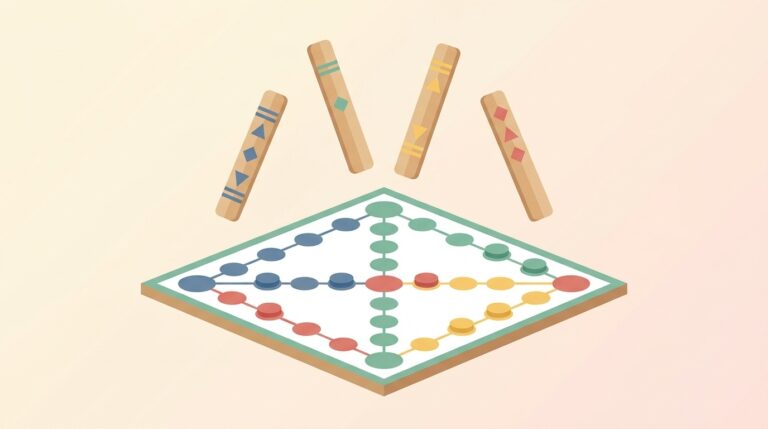
Phase 1: Empathy & Immersion — The Sound of Yut
Hello there! This is your Lead Editor from Daily Hangul.
Imagine this: You are watching a Chuseok (Korean Thanksgiving) special of your favorite K-Pop idol reality show, like Run BTS or Going Seventeen. Suddenly, the idols are dressed in elegant Hanboks, but the atmosphere is anything but serene. They are screaming at the top of their lungs, slamming four wooden sticks onto a mat, and arguing passionately over where to place a tiny button on a piece of paper. Someone yells, “Ah, Nak! Nak!” and collapses in despair, while another screams, “Yut-i-ya!” and does a victory dance.
Welcome to the chaotic, high-stakes world of Yut Nori (윷놀이).
If you think Yut Nori is just a gentle, traditional board game played on major holidays like Seollal (Lunar New Year), you are sorely mistaken. It is a strategic battlefield that tests friendships, ruins family dynamics for the evening, and reveals everyone’s true competitive nature. At an advanced (C1) proficiency level, understanding Yut Nori isn’t just about learning the rules; it’s about grasping the intense, colloquial Korean used in moments of high adrenaline, strategic plotting, and pure, unfiltered Nunchi (눈치).
Let’s dive into the vocabulary and the hidden cultural mechanics of the Yut board. Trust me, knowing these expressions will make you the star of any holiday gathering.
Phase 2: Deep Dive into Yut Nori Jargon
To play Yut, you throw four half-moon-shaped sticks. How they land determines your moves: Do (1 space), Gae (2), Geol (3), Yut (4 + an extra throw), and Mo (5 + an extra throw). But the real language of Yut Nori happens on the board (Malpan).
1. 말을 업다 (Piggybacking your pieces)
- Pronunciation: [ma-reul eop-da] (Sounds like: “ma-reul up-da” — ‘eop’ rhymes with ‘cup’)
- Meaning: Literal: To carry a horse on one’s back. / Real nuance: To stack your game pieces (말, mal) on the same square so they move together as a single unit.
- K-Culture Moment: In a K-Drama holiday scene, the reckless youngest brother will insist on “업어! (Stack ‘em!)” combining three pieces. It’s high risk, high reward. If they reach the end, you win instantly. If they get caught, you lose everything.
- Editor’s Insight: The verb ‘업다’ is the same word used when giving a piggyback ride (어부바). In the game, it implies carrying your comrade. It’s the ultimate “all-in” strategy in Korean board games.
- Situation Spectrum:
- Casual with friends: ✅ “야, 무조건 업어! (Hey, absolutely piggyback them!)”
- Semi-formal (colleagues): ✅ “저희 이거 업고 갈까요? (Shall we piggyback these and go?)”
- Formal (older relatives): ⚠️ Use polite forms, but the strategy remains the same.
- 🤔 Think About It: Why does Korean use the very physical, affectionate verb ‘업다’ (to piggyback) for a board game mechanic? How does this reflect the Korean emphasis on collective fate (공동체 의식)?
2. 잡다 (Catching the opponent)
- Pronunciation: [jap-da] (Sounds like the sharp snap of a trap closing)
- Meaning: Literal: To catch/grab. / Real nuance: To land on the exact square occupied by an opponent’s piece, removing them from the board and sending them back to the start. Plus, you get an extra throw!
- K-Culture Moment: This is the moment relationships break. In variety shows, you’ll see captions like
[분노](Anger) when someone’s heavily piggybacked pieces get caught right before the finish line.- Editor’s Insight: You don’t just gently say, “Oh, I landed on your spot.” You shout “잡았다!” (Gotcha!) with a fist pump. The psychological warfare is half the game.
- Situation Spectrum:
- Casual: ✅ “아싸! 잡았지롱! (Yay! Caught ya, teasingly)”
- Semi-formal: ✅ “오, 제가 잡았네요. (Oh, I guess I caught you.)”
- Formal: ⚠️ Tread lightly. Catching your father-in-law’s piece 3 times in a row requires excellent Nunchi.
- 🤔 Think About It: “잡다” is a very versatile verb in Korean (catching a taxi, getting a job, slaughtering an animal). How does its sharp, decisive sound match the action in the game?
3. 낙 (Foul/Off the board)
- Pronunciation: [nak] (Sounds like a sudden stop, “knock” without the ‘o’ roundness)
- Meaning: Literal: Fall/Drop (from Hanja 落). / Real nuance: When one or more Yut sticks fall off the designated mat. The turn is forfeited.
- K-Culture Moment: Someone winds up like a baseball pitcher, throws the sticks with immense power… and they slide off the blanket. The entire room erupts in pointing and shouting: “낙!!!”
- Editor’s Insight: ‘낙’ is the great equalizer. It punishes those who are too greedy or showy. It’s often accompanied by rules like “낙장불입” (Once played, it cannot be taken back—a phrase borrowed from Go-Stop).
- Situation Spectrum:
- Universal: ✅ You just point at the stick and yell “낙!” regardless of who threw it.
Phase 3: Textbook vs. Real Korean (Game Night Edition)
Let’s see how language shifts when the competitive spirit kicks in.
[Suggesting a risky move]
* 📖 Textbook Korean: 이 말 두 개를 같이 이동하는 것이 좋겠습니다. (It would be good to move these two pieces together.)
* 🗣️ Real Korean: 야, 묻고 더블로 가! 그냥 다 엎어! (Hey, go double or nothing! Just piggyback them all!)
* 💡 Why the difference?: The slang “묻고 더블로 가” (from the movie Tazza) is heavily used in any betting/gaming situation by younger generations to mean “take the risk.”
[When you get an unlucky roll]
* 📖 Textbook Korean: 운이 정말 없네요. (I really have no luck.)
* 🗣️ Real Korean: 아, 개가 뭐야 개가! (Ah, what the heck is a ‘Gae’!)
* 💡 Why the difference?: Throwing a ‘Gae’ (2 spaces) or ‘Do’ (1 space) is frustrating. Using the name of the stick itself as a mild expression of frustration is common, especially since ‘Gae’ literally means ‘dog’.
Bottom Note: At a C1 level, your goal is to match the energy of the room. Using textbook Korean during Yut Nori sounds like a referee, not a player. Embrace the dramatic verbs like ‘업다’ and ‘잡다’.
Phase 4: Cultural Context — The Yut Nori Deep Dive
4-1. The Non-Verbal Art of the Throw
Language is only 50% of Yut Nori. The rest is theatrics. When aiming for a “Yut” or “Mo,” players don’t just drop the sticks. They shake them in their cupped hands, blow on them for luck, and throw them high into the air. However, there is a strict rule of Nunchi here: if you throw them too aggressively and they bounce off the mat, it’s a ‘Nak’ (낙). Also, hovering your hand over the board, hesitating on which piece to move, is a universal sign of a weak strategist. Point decisively!
4-2. The K-Variety Show Trope: The “Baek-Do” Betrayal
If you watch any idol variety show holiday special, there is always one dramatic climax involving 백도 (Baek-do). One of the Yut sticks has a special mark. If only that stick lands flat side up, instead of moving forward 1 space (Do), you must move backward 1 space.
Idols will literally fall to their knees when they are one step away from the finish line, only to roll a Baek-do and move backward, sometimes right into the jaws of an opponent’s piece. The vocabulary around Baek-do is usually filled with dramatic betrayal: “이게 말이 돼?!” (Does this make sense?! / Is this even possible?!).
Phase 5: Interactive Roleplay Scenario
Setting: It’s the Friday evening before the Seollal long weekend. Your company decided to have a team-building session over fried chicken, beer, and a massive game of Yut Nori at the office lounge. The stakes are high: the losing team buys the team coffee for a week.
Characters:
– YOU: The foreign colleague whose Korean is impressive, but whose Yut Nori skills are an unknown variable.
– Team Leader Kim (45): On the opposing team. Very competitive, currently has two pieces “piggybacked” (업었다) near the finish line.
– Min-su (32): Your teammate. The hype-man.
Dialogue:
Min-su: (Shaking the sticks violently) 자, 제발 윷 한 번만!
(ja, jebal yut han beonman!)
[Come on, please just one Yut!]
(🎭 Stage Direction: Min-su throws the sticks high. Three land flat… then the last one wobbles and lands flat too!)
Team Leader Kim: 헉! 윷이다!
(heok! yuchida!)
[Gasp! It’s a Yut!]
Min-su: 아싸!!! 윷이야! 나 한 번 더 던진다!
(assa!!! yutiya! na han beon deo deonjinda!)
[Hell yeah!!! It’s a Yut! I get to throw again!]
(🎭 Stage Direction: Min-su throws again. It’s a ‘Gae’ – 2 spaces.)
Min-su: 아… 개네. OOO(Your Name)씨, 우리 말 어떻게 움직일까요?
(a… gaene. OOO-ssi, uri mal eotteoke umjigilkkayo?)
[Ah… it’s a Gae. OOO, how should we move our pieces?]
(🎭 Stage Direction: You look at the board. You can either move a new piece safely, or use the 4+2 spaces to exactly catch Team Leader Kim’s heavily guarded piggybacked pieces.)
🔀 Your Turn! How do you respond?
– A) “안전하게 새로운 말을 출발시키는 게 어떨까요?” (Polite, but boring strategy)
– B) “팀장님 말 잡으러 가시죠! 다 엎어버려요!” (Aggressive, uses proper slang)
– C) “제가 잡겠습니다. 팀장님 죄송합니다.” (Polite but deadly)✅ Best Choice: B or C.
Why? In Korean gaming culture, going for the “kill” (잡다) is expected and brings the most entertainment. Choice B shows excellent command of colloquial pacing. Choice C is a classic variety-show trope—apologizing politely right before utterly destroying your senior’s game piece. It shows great comedic Nunchi.
Team Leader Kim: (Laughing but sweating) 야, 너무 잔인한 거 아니야? 한 번만 봐줘~
(ya, neomu janinhan geo aniya? han beonman bwajwo~)
[Hey, isn’t that too cruel? Let me off the hook just this once~]
YOU: 승부는 승부니까요! 잡겠습니다!
(seungbuneun seungbunikkayo! japgetseumnida!)
[A game is a game! I’m catching it!]
Phase 6: 10-Second Shadowing Drill
Channel your inner competitive K-variety star! Read this out loud, focusing on the sharp pauses and high energy.
😤 아싸! / 잡았다! / 나 / 한 번 더 / 던질게!
(assa! / jabatda! / na / han beon deo / deonjilge!)
[Hell yeah! / Caught it! / I / am going to throw / one more time!]
Phase 7: K-Culture Mini Dictionary
| 한국어 (Korean) | Romanization | English | Contextual Meaning |
|---|---|---|---|
| 말판 | malpan | Game board | The map where the Yut pieces move. Reading the ‘malpan’ requires deep strategy. |
| 윷가락 | yutgarak | Yut sticks | The 4 wooden sticks. Usually made of birch or chestnut wood. |
| 모 아니면 도 | mo animyeon do | All or nothing | An idiom originating from Yut Nori. Mo (5) is the best, Do (1) is the worst. Used in daily life for high-stakes decisions. |
| 백도 | baek-do | Back-do | The stick marked to make you go backward 1 space. The ultimate plot twist. |
| 깍두기 | kkakdugi | The “Radish” | In games, an extra player (usually a child or someone unskilled) who is allowed to play on a team without their mistakes counting heavily. |
Phase 8: Traveler’s Survival Kit (Game & Gathering Edition)
Even if you aren’t playing Yut Nori, you will likely find yourself in a social gathering playing drinking games, board games, or pool in Korea.
🆘 Survival Expressions for Games
– 🇰🇷 “누구 차례예요?” (nugu charyeyeyo?)
– 🗣️ Meaning: Whose turn is it?
– 📍 Where to use: Board game cafes, PC Bangs, drinking games.
- 🇰🇷 “내기 할까요?” (naegi halkkayo?)
- 🗣️ Meaning: Shall we make a bet? (Usually for who buys coffee/dinner).
🇰🇷 “한 판 더 해요!” (han pan deo haeyo!)
- 🗣️ Meaning: Let’s play one more round!
📌 Editor’s Note on Korean Gatherings
– The Betting Culture (내기 문화): Koreans love making small bets on games. The loser usually pays for the next round of drinks, the ice cream, or the taxi fare. It’s not about gambling; it’s about bonding.
– “Sseuda” (쓰다/쏘다): If you lose the bet, someone might yell, “오늘 OOO가 쏜다!” (OOO is paying/shooting today!). Be prepared to pull out your card!
Phase 9: Critical Thinking Corner — “One Step Deeper”
Language & Power: The Equalizing Mat
🧠 Think Deeper:
Korean society is famously structured around strict age and corporate hierarchies, heavily reflected in its honorific language (존댓말). However, traditional games like Yut Nori serve as a culturally sanctioned “pressure valve.” Around the Yut mat, the rigid hierarchy temporarily blurs. A junior employee can aggressively hunt down the CEO’s pieces, and a daughter-in-law can strategically block her mother-in-law’s progress. While the language might remain structurally polite (adding ‘-요’ or ‘-습니다’), the actions and slang (like ‘다 엎어!’, ‘잡았다!’) are aggressively equal. Yut Nori proves that in Korean culture, collective play is essential for releasing the tension built up by daily social structures.💬 Your Turn: Does your culture have a specific game or event where social rules and hierarchies are temporarily ignored? Share it in the comments!
Phase 10: FAQ & Mistake Prevention
Q: Can I use 반말 (casual language) when playing games with older Korean friends?
A: Maybe. In the heat of the moment, exclamation like “아싸!” or “잡았다!” (technically casual) are universally accepted, even around older people, as they are seen as spontaneous exclamations rather than direct addresses. However, when talking to an older person, you must revert to polite forms: “제가 팀장님 잡았습니다!” (I caught you, Team Leader!).
❌ Common Mistake #1: Throwing the Yut sticks too aggressively.
✅ Do this instead: Throw them high, but keep them contained within the blanket/mat. Repeated “낙” (foul) throws will annoy your teammates because it wastes a turn.❌ Common Mistake #2: Moving the pieces without consulting the team.
✅ Do this instead: Yut Nori is a team sport. Always ask, “어떻게 할까요?” (What should we do?) and debate the strategy (piggybacking vs. running away) before touching the board.
Phase 11: Summary & Action Items
One-Liner Summary: Yut Nori is less about the wooden sticks and more about the psychological warfare of Nunchi, expressed through aggressive verbs like 업다 (piggyback) and 잡다 (catch).
Action Mission 3 Steps:
– 🥉 Bronze: Say “모 아니면 도!” (All or nothing!) to yourself the next time you have to make a tough decision today.
– 🥈 Silver: Leave a comment below using the word “잡았다!” in a creative sentence.
– 🥇 Gold: Next time you play any board game with Korean friends, suggest a “내기” (bet) for coffee and use the vocabulary you learned here.
🎬 K-Culture Mission: Go to YouTube and search “Going Seventeen Yut Nori” or “Run BTS Yut Nori.” Watch just 5 minutes and try to spot the moment someone yells “낙!” or “윷이야!”
Phase 12: Interactive Challenge Quiz
1. Situational Judgment: You are playing Yut Nori with your Korean language exchange partner. They have two pieces resting on the same spot. What is the correct term for this strategy?
– A) 깍두기 (Kkakdugi)
– B) 말을 업다 (Maleul eopda)
– C) 백도 (Baek-do)
💡 Click for Answer
Answer: B. ‘말을 업다’ literally means to give a piggyback ride, representing stacking pieces together.
2. Fill in the Blank: Your friend throws the sticks, and one goes flying under the sofa. You immediately point and shout: “아, ____!!!”
– A) 대박 (Daebak)
– B) 낙 (Nak)
– C) 모 (Mo)
💡 Click for Answer
Answer: B. ‘낙’ (Nak) is the term for a foul when the sticks leave the play area.
3. True or False – K-Culture Edition: When playing Yut Nori with your company boss, you must never ‘catch’ (잡다) their pieces out of respect. (T/F)
💡 Click for Answer
False! The game is the great equalizer. You absolutely should catch their pieces—it shows you are actively participating. Just do it with a polite smile and say, “죄송합니다 팀장님, 제가 잡겠습니다!” (Sorry Team Leader, I’ll be catching you!).
Frequently Asked Questions (FAQ)
Q: What does "말을 업다 (Piggybacking your pieces)" mean in Korean and how do you pronounce it?
A: In Korean, "말을 업다 (Piggybacking your pieces)" is pronounced [ma-reul eop-da] and means: Literal: To carry a horse on one's back. / Real nuance: To stack your game pieces (말, mal) on the same square so they move together as a single unit.
Q: What does "잡다 (Catching the opponent)" mean in Korean and how do you pronounce it?
A: In Korean, "잡다 (Catching the opponent)" is pronounced [jap-da] and means: Literal: To catch/grab. / Real nuance: To land on the exact square occupied by an opponent's piece, removing them from the board and sending them back to the start. Plus, you get an extra throw!
Q: What does "낙 (Foul/Off the board)" mean in Korean and how do you pronounce it?
A: In Korean, "낙 (Foul/Off the board)" is pronounced [nak] and means: Literal: Fall/Drop (from Hanja 落). / Real nuance: When one or more Yut sticks fall off the designated mat. The turn is forfeited.







