

Phase 1: Empathy & The “Why” (Immersion Open)
Hello! I’m the Lead Editor at Daily Hangul.
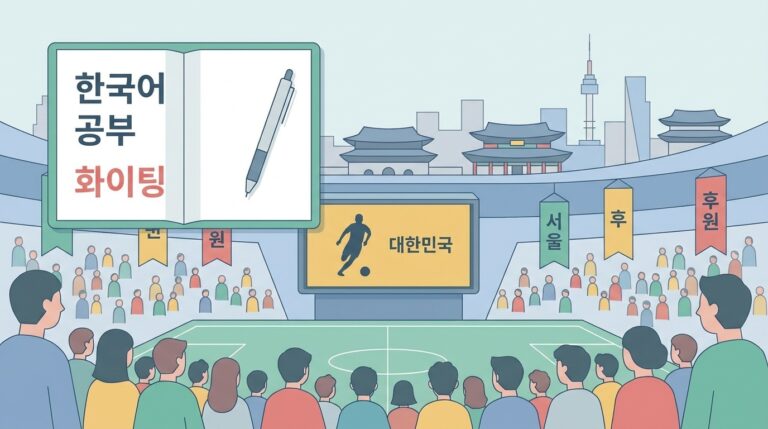
Imagine this: You are watching an English Premier League match. The camera pans across the stadium, and suddenly, you spot vibrant Hangul on a massive LED banner. Or perhaps you are in Times Square, looking up at a colossal billboard celebrating a Korean eSports legend. In these moments, it’s not just a product being sold; it’s ‘Brand Korea’ itself taking center stage.
For advanced (C2) Korean learners, discussing sports is no longer just about saying ‘He kicked the ball well.’ It’s about understanding how South Korea leverages sports marketing to project soft power, enhance its national prestige, and unite its citizens. If you’ve ever watched a Korean sports drama where winning a gold medal feels like a matter of national survival, or wondered why a football player’s apology for losing sounds like a political address, you’ve witnessed this cultural phenomenon.
Today, we are diving deep into the sophisticated vocabulary and sociolinguistic nuances of National Image Enhancement through Sports Marketing. These expressions will not only help you read business articles and news reports flawlessly but will also give you the insider perspective to discuss ‘Brand Korea’ with native professionals.
Phase 2: Core Expressions Deep Dive
1. 국위 선양 (Enhancing National Prestige)
- Pronunciation: [gugwi seonyang] Sounds like: gook-wee sun-yang
- Meaning: Literal: Enhancing the prestige of the nation. Real nuance: Earning global respect for South Korea through exceptional individual or team achievements.
- K-Culture Moment: You will hear this constantly during the Olympics or the World Cup. When athletes return home with medals, news anchors solemnly declare that they have achieved ‘gugwi seonyang.’ It’s a phrase deeply rooted in Korea’s rapid modernization, where individual success on the global stage was seen as lifting the entire nation out of poverty’s shadow.
- Editor’s Insight: This word feels heavy and patriotic. It’s not used for casual victories. It carries a sense of duty, reflecting how Korean athletes are viewed as ambassadors of the state.
- Situation Spectrum:
- Casual with friends: ⚠️ (Sounds too academic/stiff for a casual pub chat)
- Professional / News / Essays: ✅
- Formal business meetings: ✅
- 🤔 Think About It: Why does a sports victory feel like a political achievement in Korea? How does the concept of collective identity (우리 – ‘we’) make an athlete’s success the entire nation’s success?
2. 경제적 파급 효과 (Economic Ripple Effect)
- Pronunciation: [gyeongjejeok pageup hyogwa] Sounds like: gyung-jeh-juk pah-geup hyo-gwa
- Meaning: Literal: Economic ripple effect. Real nuance: The broader, secondary economic benefits generated by a major sporting event or a superstar athlete (e.g., increased tourism, higher export sales of corporate sponsors).
- K-Culture Moment: Whenever a Korean football star signs with a major European club, Korean media immediately publishes infographics detailing the ‘경제적 파급 효과’—calculating everything from jersey sales to the enhanced brand value of their corporate sponsors like Samsung or Hyundai.
- Editor’s Insight: To sound like a true C2 intellectual in a business discussion, drop this phrase. It perfectly captures the intersection of sports, corporate sponsorship, and national marketing.
- Situation Spectrum:
- Casual with friends: 🚫 (Too technical)
- Professional / Semi-formal: ✅
- Formal / Academic: ✅
- 🤔 Think About It: Does your home country meticulously calculate the national economic value of an individual athlete’s overseas success?
3. 위상을 제고하다 (To Elevate Status/Awareness)
- Pronunciation: [wisangeul jegohada] Sounds like: wee-sang-eul je-go-ha-da
- Meaning: To raise or elevate the status, prestige, or awareness of something (usually a nation or a brand).
- K-Culture Moment: In a corporate boardroom, a marketing director pitches sponsoring an international eSports tournament: ‘이 대회를 통해 글로벌 시장에서 우리 기업의 위상을 제고할 수 있습니다’ (Through this tournament, we can elevate our company’s status in the global market).
- Editor’s Insight: ‘제고하다’ (to lift up/raise) is a high-level Hanja word. Swapping the basic ‘높이다’ (to raise) with ‘제고하다’ instantly upgrades your Korean from B2 to C2.
- Situation Spectrum:
- Casual with friends: 🚫
- Office environment: ✅
- Formal presentations: ✅
- 🤔 Think About It: Notice how formal Korean heavily relies on Hanja (Sino-Korean characters) for abstract concepts. How does switching from pure Korean words to Hanja alter the power dynamic in a room?
Phase 3: Textbook vs. Real Korean
Even C2 learners need to know how to code-switch between the boardroom and the sports pub.
[Describing immense national pride]
* 📖 Textbook Korean: 이번 월드컵 덕분에 한국의 국가 이미지가 크게 향상되었습니다. (Thanks to this World Cup, Korea’s national image has greatly improved.)
* 🗣️ Real Korean: 와, 진짜 국뽕 차오르네요! (Wow, I’m totally filled with ‘Gukppong’!)
* 💡 Why it’s different: ‘국뽕’ (Gukppong = Nation + Philopon/meth) is a slang term for intoxicating national pride. While it can sometimes be used sarcastically, younger generations use it playfully to express overwhelming pride when a Korean cultural or sports figure dominates globally.
[Praising a top-tier athlete]
* 📖 Textbook Korean: 그는 세계적으로 인정받는 훌륭한 선수입니다. (He is a globally recognized, excellent player.)
* 🗣️ Real Korean: 우리 흥민이 형, 완전 월클 폼 미쳤다! (Our brother Heung-min, his world-class form is absolute madness!)
* 💡 Why it’s different: ‘월클’ (Wolkeul) is an abbreviation of ‘World Class’. ‘폼 미쳤다’ (form is crazy) is the ultimate modern compliment for someone performing at their absolute peak.
Bottom Note for C2 Learners: Use ‘국위 선양’ in your university essays and corporate reports, but when you are eating fried chicken with your Korean friends watching a match, shouting ‘월클 폼 미쳤다!’ will instantly make you an insider.
Phase 4: Cultural Context — K-Culture Deep Dive
4-1. The Burden of the Representative (국가대표의 무게)
In many Western cultures, an athlete represents themselves first, their club second, and perhaps their country third. In Korea, becoming a ‘국가대표’ (National Team Member) shifts your identity entirely. You are no longer just an athlete; you are the face of the nation. When a Korean athlete loses at the Olympics, they frequently weep and apologize to the citizens (‘국민 여러분께 죄송합니다’). This isn’t just disappointment; it’s a profound cultural reflection of a collective society where the nation’s face (체면) is inextricably tied to the individual’s performance.
4-2. K-Drama & Corporate Sponsorship Connect
Have you noticed how in K-Dramas like Hot Stove League or Twenty-Five Twenty-One, the survival of an athlete or a team almost always hinges on a massive corporate sponsor? This mirrors reality. South Korea’s global sports marketing is largely driven by its ‘Chaebol’ (conglomerates). When a Korean company sponsors a major international sporting event, it is simultaneously selling cars/electronics and marketing the advanced, high-tech image of South Korea itself.
Phase 5: Interactive Roleplay Scenario
Setting: A bustling sports pub in Hongdae. It’s Friday night, 9 PM. The massive screens are broadcasting an international football match where a famous Korean player, sponsored by a Korean tech giant, just scored a magnificent goal. You are drinking beer with your Korean coworkers.
Characters:
– YOU: An expatriate marketing manager working in Seoul for 3 years.
– Min-su (34): Your Korean senior colleague, passionate about sports and business.
Dialogue:
Min-su: 와, 방금 골 봤어요? 진짜 저 선수가 우리나라 국위 선양 다 하네요! ⚽
(Wa, banggeum gol bwasseoyo? Jinjja jeo seonsuga urinara gugwi seonyang da haneyo!)
[Wow, did you see that goal just now? That player is truly single-handedly elevating our national prestige!]
YOU: 맞아요. 저 선수 유니폼에 우리 회사 로고가 딱 박혀있는 걸 보니 저도 모르게 자부심이 생기더라고요.
(Majayo. Jeo seonsu yunipome uri hoesa logoga ttak bakhyeoinneun geol boni jeodo moreuge jabusimi saenggideoragoyo.)
[Right. Seeing our company logo right there on his jersey unconsciously gave me a sense of pride too.]
Min-su: 그쵸? 솔직히 저 선수 한 명이 만들어내는 경제적 파급 효과가 웬만한 대기업 뺨칠 걸요?
(Geuchyo? Soljikhi jeo seonsu han myeongi mandeureonaeneun gyeongjejeok pageup hyogwaga wenmanhan daegieop ppyamchil geollyo?)
[Right? Honestly, the economic ripple effect generated by that single player probably slaps the face of (outperforms) a decent-sized conglomerate.]
YOU: 유럽 현지 언론에서도 극찬이더라고요. 기업들 입장에서는 이만한 스포츠 마케팅이 없죠.
(Yureop hyeonji eolloneseodo geukchanideoragoyo. Gieopdeul ipjangeseoneun imanhan seupocheu maketingi eopjyo.)
[Even the local European media is full of high praise. From the companies’ perspectives, there’s no sports marketing better than this.]
Min-su: 맞아요. 국가 브랜드 위상을 제고하는 데는 스포츠가 최고예요. 아, 나 진짜 오늘 국뽕 너무 차오르는데?
(Majayo. Gukga beuraendeu wisangeul jegohaneun deneun seupocheuga choegoyeyo. A, na jinjja oneul gukppong neomu chaoreuneunde?)
[Exactly. Sports is the best for elevating the national brand status. Ah, I’m seriously overflowing with ‘Gukppong’ today!]
🔀 Your Turn! How will you respond to Min-su?
– A) “저도요! 오늘 진짜 월클 폼 미쳤네요! 맥주 한 잔 더 하실래요?” (Casual & culturally tuned in)
– B) “네, 국위 선양이 대단합니다.” (Too stiff/textbook for a pub setting)
– C) “한국인들은 국가에 너무 집착하는 것 같아요.” (Extremely risky and offensive)✅ Best Choice: A — You smoothly match his excitement by using the modern slang ‘월클 폼’ (World-class form) while proposing another drink, showing high emotional intelligence (눈치) in a social setting.
⚠️ Choice B Analysis: Repeating ‘국위 선양’ after he just dropped a slang like ‘국뽕’ makes you sound like an AI reading a news script.
Phase 6: 10-Second Shadowing Drill
Let’s practice the rhythm and intonation of a professional business opinion. Pay attention to the pauses!
😤 글로벌 스포츠 이벤트는 / 국가의 위상을 / 제고하는 / 핵심 마케팅 전략입니다.
(geullobeol seupocheu ibenteuneun / gukgaui wisangeul / jegohaneun / haeksim maketing jeollyagimnida.)
[Global sporting events are a core marketing strategy for elevating a nation’s status.]
Phase 7: K-Culture Mini Dictionary
1. 국뽕 (Gukppong)
* Romanization: gukppong
* English: Intoxicating national pride / Chauvinism
* Context: A portmanteau of ‘Guk’ (Nation) and ‘Ppong’ (slang for meth). Used to describe an overwhelming, almost addictive feeling of pride in Korea’s global achievements. Can be used positively in fandoms or critically to mock extreme nationalism.
2. 월클 (Wolkeul)
* Romanization: wolkeul
* English: World-class
* Context: The ultimate praise for an athlete, musician, or brand that has broken out of the domestic market and is competing at the highest global level (e.g., Faker, Son Heung-min, BTS).
3. 스포츠 외교 (Seupocheu oegyo)
* Romanization: seupocheu oegyo
* English: Sports Diplomacy
* Context: Using sports to bridge political divides. South Korea frequently uses this concept, famously seen during the 2018 PyeongChang Winter Olympics with the unified Korean team.
4. 길거리 응원 (Gilgeori eungwon)
* Romanization: gilgeori eungwon
* English: Street Cheering
* Context: A massive cultural phenomenon born during the 2002 World Cup. Millions gather in plazas wearing red to watch matches on giant screens, showcasing Korea’s dynamic collective culture.
Phase 8: Traveler Survival Kit (Sports Match Edition)
Are you planning to experience Korea’s electric sports culture firsthand? Here is your survival kit for navigating a stadium.
🆘 Survival Expressions for the Stadium
– 🇰🇷 “원정석이 어디예요?” (wonjeongseogi eodiyeyo?)
– 🗣️ English: Where is the away team seating?
– 📍 Context: Crucial for K-League or baseball matches so you don’t sit in the rival’s section!
- 🇰🇷 “여기 예매 번호요.” (yeogi yemae beonhoyo.)
- 🗣️ English: Here is my reservation number.
- 📍 Context: Showing your ticket at the kiosk or booth.
📌 Editor’s Travel Note
– Chimaek (치맥) Culture: You cannot separate Korean sports from Fried Chicken and Beer. Baseball stadiums even have delivery apps that bring food right to your seat.
– Ticketing: Popular matches (especially eSports or national football games) sell out in seconds. You will need a Korean phone number and an app like ‘Interpark Ticket’ to secure a spot.
Phase 9: Critical Thinking — “One Step Deeper”
Media vs Reality: The Heavy Crown of the ‘National Representative’
🧠 Think Deeper:
South Korea’s brilliant use of sports marketing has undeniably transformed its global image from a war-torn country to an economic and cultural powerhouse. However, this relies heavily on the ‘clean, perfect’ image of its athletes. In the media, these athletes are portrayed as flawless patriots. But in reality, this places immense psychological pressure on young individuals. A single mistake on the field, or a minor personal scandal, is often treated not just as an individual failure, but as an act of tarnishing the ‘national image’ (국가 이미지 훼손). The collective effervescence that unites the country during a victory can quickly turn into collective harsh criticism during a defeat.💬 Your Turn: In your culture, are athletes expected to be perfect moral ambassadors for the country, or are they viewed strictly as individual professionals? Share your thoughts in the comments!
Phase 10: FAQ & Avoiding Common Mistakes
Q: Can I use ‘국뽕’ in a corporate meeting when discussing Korea’s success?
No. 🚫 While ‘국뽕’ is incredibly common online and among friends, it contains a slang word derived from illegal drugs. In any formal or business setting, you must use ‘국위 선양’ or ‘자부심’ (pride) instead.
Q: Is ‘파급 효과’ only used for positive economic effects?
Not necessarily. You can have a ‘부정적 파급 효과’ (negative ripple effect), such as when a corporate sponsor faces a boycott due to a scandal.
❌ Common Mistake #1: Translating ‘I am proud of my country’ directly into ‘나는 내 나라가 자랑스럽다’ in a casual conversation.
✅ Do This Instead: Koreans rarely say ‘내 나라’ (my country). Because of the collective mindset, it is almost always ‘우리나라’ (our country), even if you are referring to Korea as a foreigner speaking Korean.
Phase 11: Summary & Action Items
One-Liner Summary: Mastering vocabulary like ‘국위 선양’ and ‘인지도 제고’ allows you to discuss South Korea’s brilliant sports marketing strategies at the highest intellectual level.
Action Mission:
– 🥉 Bronze: Shadow the Phase 6 sentence three times in front of a mirror, focusing on a confident, professional tone.
– 🥈 Silver: Write a short paragraph in a Korean language community analyzing how your favorite sports team enhances its country’s ‘위상’ (status).
– 🥇 Gold: The next time you watch a sports match with a Korean friend, successfully drop the phrase “진짜 월클 폼 미쳤다!” when a player does something amazing.
K-Culture Mission: Go to YouTube and search for ‘2002 월드컵 길거리 응원’ (2002 World Cup Street Cheering). Observe the scale of the collective pride and imagine how that energy translates into modern corporate sports marketing!
Phase 12: Interactive Quiz
1. Situational Judgment: You are presenting a marketing strategy to a Korean corporate board. You want to suggest sponsoring an athlete to improve the company’s global recognition. Which sentence is most appropriate?
– A) 이 선수를 후원하면 우리 회사의 국뽕이 차오를 것입니다.
– B) 이 선수를 후원하여 우리 브랜드의 글로벌 위상을 제고해야 합니다.
– C) 이 선수는 폼이 미쳤기 때문에 파급 효과가 큽니다.
2. True or False – K-Culture Edition:
In Korea, it is considered perfectly normal for an athlete to issue a formal, tearful public apology to the citizens simply for not winning a medal at the Olympics.
– (True / False)
(Answers: 1. B – ‘위상을 제고하다’ is the perfect C2 business expression. A and C use highly inappropriate slang for a boardroom. / 2. True – The weight of being a ‘National Representative’ in a collective society makes this a frequent occurrence.)
Frequently Asked Questions (FAQ)
Q: What does "국위 선양 (Enhancing National Prestige)" mean in Korean and how do you pronounce it?
A: In Korean, "국위 선양 (Enhancing National Prestige)" is pronounced [gugwi seonyang] and means: Literal: Enhancing the prestige of the nation. Real nuance: Earning global respect for South Korea through exceptional individual or team achievements.
Q: What does "경제적 파급 효과 (Economic Ripple Effect)" mean in Korean and how do you pronounce it?
A: In Korean, "경제적 파급 효과 (Economic Ripple Effect)" is pronounced [gyeongjejeok pageup hyogwa] and means: Literal: Economic ripple effect. Real nuance: The broader, secondary economic benefits generated by a major sporting event or a superstar athlete (e.g., increased tourism, higher export sales of corporate sponsors).
Q: What does "위상을 제고하다 (To Elevate Status/Awareness)" mean in Korean and how do you pronounce it?
A: In Korean, "위상을 제고하다 (To Elevate Status/Awareness)" is pronounced [wisangeul jegohada] and means: To raise or elevate the status, prestige, or awareness of something (usually a nation or a brand).







