

Phase 1: Empathy (Welcome to the World of Jeong)
Hello! It’s your Daily Hangul editor.
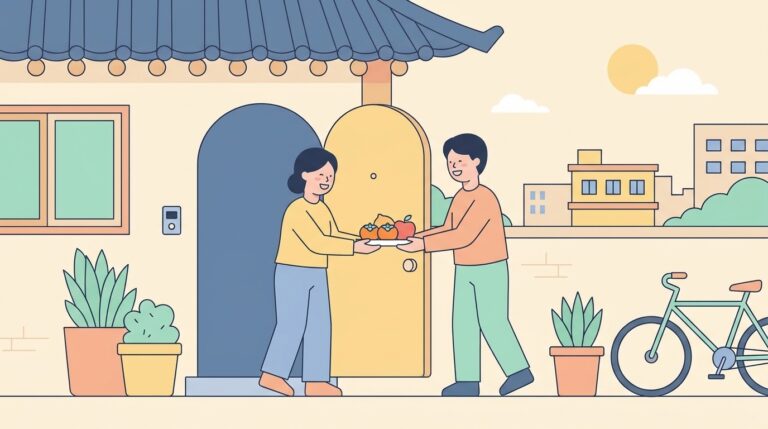
Picture this K-Drama scene: The main character just moved into a new apartment. Suddenly, there’s a knock on the door. It’s the lady from next door, holding a giant plate of sliced watermelon or a warm plate of rice cakes. The protagonist looks confused, accepts the plate, and later realizes… Wait, do I give this plate back empty?
Welcome to the beautiful, sometimes confusing world of 정 (Jeong)—Korea’s unique culture of warmth, affection, and neighborly love.
As a tutor who has helped hundreds of expats settle in Seoul, I constantly get panicked texts like: “My neighbor just gave me Kimchi. What do I do?!” or “An old man just carried my suitcase up the stairs and walked away!”
If you don’t know the language of Jeong, you might feel overwhelmed or even seem rude without meaning to. But once you understand it, you’ll unlock the ultimate ‘Insider’ (인싸) status in Korea. Today, let’s learn how to navigate the heartwarming moments of helping neighbors.
Phase 2: Core Expressions Deep Dive
Here are the top 3 expressions you need when offering or receiving help in a Korean neighborhood.
1. 제가 도와드릴까요?
- Pronunciation: [je-ga do-wa-deu-ril-kka-yo?] Sound-alike: “jay-gah doe-wah-dew-rill-kah-yo?”
- Meaning: Literal: “Shall I help you?” / Real nuance: “Let me give you a hand!”
- K-Culture Moment: You see your neighbor struggling with the recycling bins (분리수거), or a grandmother carrying heavy groceries up the steep hills of Seoul. You step in and say this.
- Editor’s Insight: It sounds incredibly polite and caring. You don’t just say “Do you want help?” You humbly offer your assistance.
- Situation Spectrum:
- Casual (Friends): ⚠️ (Too formal. Say: 내가 도와줄까?)
- Semi-formal (Neighbors): ✅
- Formal (Elders/Boss): ✅
- 🤔 Think About It: Why do Koreans often just start helping (like grabbing your bag) while asking this question? It’s because Jeong is about action, not just words! Does your culture prefer asking first or acting first?
2. 아이고, 감사합니다
- Pronunciation: [a-i-go, gam-sa-ham-ni-da] Sound-alike: “eye-go, gahm-sah-hahm-nee-dah”
- Meaning: Literal: “Alas, thank you.” / Real nuance: “Oh my goodness, thank you so much!”
- K-Culture Moment: You drop your wallet, and someone chases you down to return it. Or the restaurant lady (이모님) gives you a free extra serving of dumplings (서비스).
- Editor’s Insight: The magic word here is 아이고 (Aigo). Adding this before “Thank you” shows pleasant surprise and deep appreciation. It makes you sound like a true local!
- Situation Spectrum:
- Casual: ✅ (아이고 고마워!)
- Semi-formal: ✅
- Formal: ✅
- 🤔 Think About It: “Aigo” is an exclamation that can mean joy, surprise, or sadness. What is a similar “all-purpose” exclamation in your mother tongue?
3. 아유, 괜찮은데~
- Pronunciation: [a-yu, gwaen-cha-neun-de~] Sound-alike: “ah-you, gwen-chah-neun-deh~”
- Meaning: Literal: “Oh, it is okay…” / Real nuance: “Oh, you really shouldn’t have! (But I gladly accept)”
- K-Culture Moment: Your neighbor hands you a box of Jeju tangerines.
- Editor’s Insight: This is the famous Korean “Push-and-Pull” (밀당) of Jeong. In Korea, immediately saying “Give it to me, thanks!” can feel a bit too eager. We softly pretend to decline once out of politeness.
- Situation Spectrum:
- Casual: ✅
- Semi-formal: ✅
- Formal: ⚠️ (To elders, simply say 감사히 잘 먹겠습니다 – I will gratefully eat it well).
- 🤔 Think About It: Is it considered polite in your culture to reject a gift once before accepting it?
Phase 3: Textbook vs. Real Korean
Let’s see how real life differs from your Korean textbook!
[Greeting your neighbor in the elevator]
* 📖 Textbook Korean: 안녕하십니까. (an-nyeong-ha-sim-ni-kka – How do you do?)
* 🗣️ Real Korean: 안녕하세요~ (an-nyeong-ha-se-yo~ – Hello~ + with a slight bow!)
* 💡 Why the difference?: “안녕하십니까” is too stiff, like a soldier! A friendly “안녕하세요” with a soft tone and a smile is the golden rule for neighbors.
[Receiving food from a neighbor]
* 📖 Textbook Korean: 음식을 주셔서 감사합니다. (eum-si-geul ju-syeo-seo gam-sa-ham-ni-da – Thank you for giving me food.)
* 🗣️ Real Korean: 우와, 잘 먹겠습니다! (u-wa, jal meok-get-sseum-ni-da – Wow, I will eat it well!)
* 💡 Why the difference?: Koreans value the action of eating. Promising to “eat it well” is the highest compliment you can give when receiving food.
Bottom Note: For A2 (Beginner) learners, don’t worry about complex grammar. Just remember your reactions! A bright smile and a hearty “잘 먹겠습니다!” will win any neighbor’s heart.
Phase 4: Cultural Context — K-Culture Deep Dive
4-1. Non-Verbal Elements: Two Hands Rule!
When a neighbor hands you something—whether it’s a piece of fruit, a package they picked up for you, or a cup of coffee—always use two hands to receive it. Or, place your left hand lightly on your right forearm as you reach out. It is a sign of respect and Jeong.
4-2. The “Tupperware” (밀폐용기) Rule in K-Dramas 📺
Have you seen the legendary K-Drama Reply 1988 (응답하라 1988)? There’s a hilarious scene where families keep sending dishes back and forth until everyone has a full buffet.
Here is the unspoken rule of Korean neighborhoods: Never return an empty plate or Tupperware!
If your neighbor gives you Kimchi in a container, wash it, and put something inside when you return it. It doesn’t have to be expensive! A few apples, some cookies, or a couple of instant coffee mixes (맥심) are perfect. It’s not about the money; it’s about the continuous flow of Jeong.
Phase 5: Real-Life Roleplay Scenario
Let’s put you in the spotlight!
- Setting: Friday evening, 6 PM. You just moved into a new officetel in Seoul. You are carrying a surprisingly heavy box of books from your car. Your neighbor is holding the elevator open for you.
- Characters:
- YOU: An expat settling into your new Korean home.
- NPC: Minsu (32, your next-door neighbor, friendly and perceptive).
Minsu: (Holding the ‘Open’ button) 천천히 오세요!
(cheon-cheon-hi o-se-yo!)
[Take your time!]
(🎭 Stage Direction: Minsu notices you struggling with the box.)
YOU: (Panting slightly) 아, 감사합니다!
(a, gam-sa-ham-ni-da!)
[Ah, thank you!]
Minsu: 이사 오셨나 봐요? 무거워 보이는데, 제가 좀 도와드릴까요?
(i-sa o-syeon-na bwa-yo? mu-geo-wo bo-i-neun-de, je-ga jom do-wa-deu-ril-kka-yo?)
[Looks like you just moved in? It looks heavy, shall I help you?]
🔀 Your Turn! How do you reply?
– A) “네, 도와주세요.” (Yes, help me.)
– B) “아유, 괜찮습니다! 제가 할 수 있어요.” (Oh, it’s okay! I can do it.)
– C) “대박! 감사합니다!” (Awesome! Thanks!)✅ Best Choice: B.
Reason: Korean ‘Jeong’ requires a tiny bit of push-and-pull. Rejecting politely once shows you don’t want to burden them. Don’t worry, if they really want to help, they will insist!
⚠️ Choice C Analysis: “대박(Daebak)” is too casual for a neighbor you just met.
(Assuming you chose B, Minsu insists!)
Minsu: 에이, 혼자 들기 힘들어 보여요. 이리 주세요.
(e-i, hon-ja deul-gi him-deu-reo bo-yeo-yo. i-ri ju-se-yo.)
[Aw, it looks hard to carry alone. Give it here.]
YOU: 아이고, 정말 감사합니다.
(a-i-go, jeong-mal gam-sa-ham-ni-da.)
[Oh my, thank you so much.]
Minsu: (Smiling) 저는 302호 살아요. 잘 부탁드립니다.
(jeo-neun sam-baek-i-ho sa-ra-yo. jal bu-tak-deu-rim-ni-da.)
[I live in 302. Please look kindly upon me. (Nice to meet you).]
YOU: 저는 303호예요. 앞으로 잘 부탁드립니다!
(jeo-neun sam-baek-sam-ho-ye-yo. a-peu-ro jal bu-tak-deu-rim-ni-da!)
[I’m in 303. Nice to meet you too!]
Minsu: 네, 동네에서 어려운 일 있으면 언제든 말씀하세요.
(ne, dong-ne-e-seo eo-ryeo-un il isseu-myeon eon-je-deun mal-sseum-ha-se-yo.)
[Yes, let me know anytime if you have any trouble in the neighborhood.]
YOU: 네! 다음에 커피 한 잔 대접할게요.
(ne! da-eum-e keo-pi han jan dae-jeop-hal-ge-yo.)
[Yes! I’ll treat you to a cup of coffee next time.]
Phase 6: 10-Second Shadowing Drill
Let’s practice the ultimate reaction when someone helps you. Follow the slashes (/) to pause slightly, and match the emotion!
🥺 아이고~ / 정말 / 감사합니다! / 다음에 / 커피 한 잔 / 대접할게요!
(a-i-go~ / jeong-mal / gam-sa-ham-ni-da! / da-eum-e / keo-pi han jan / dae-jeop-hal-ge-yo!)
(Emotion guide: Start with a surprised, grateful tone on ‘Aigo’, bow slightly on ‘Gamsahamnida’, and smile warmly at the end!)
Phase 7: K-Culture Mini Dictionary
| 한국어 (Korean) | Romanization | English | Context |
|---|---|---|---|
| 정 | Jeong | Affection/Warmth | The invisible bond of empathy and care between people in Korea. |
| 눈치 | Nunchi | Social awareness | The ability to read the room. Having ‘quick nunchi’ means knowing when someone needs help before they ask. |
| 이사떡 | Isatteok | Moving-in rice cakes | A traditional custom of giving red bean rice cakes to neighbors when moving in. (Nowadays, roll cakes or macarons are also popular!) |
| 품앗이 | Pumasi | Mutual help | A traditional farming concept of exchanging labor. Today, it means “If you help me, I help you.” |
| 서비스 | Seobiseu | “Service” (On the house) | When a restaurant or shop gives you something for free out of Jeong. |
Phase 8: Traveler’s Survival Kit 🧳
Even if you’re just visiting Korea for a week, you’ll encounter Jeong. Maybe you are lost, or your suitcase is too heavy at the subway stairs. Here’s how to ask for help!
🆘 Survival Phrases for Travelers
– 🇰🇷 “저기요, 길 좀 물어볼게요.” (jeo-gi-yo, gil jom mu-reo-bol-ge-yo.)
– 🗣️ Meaning: Excuse me, I’d like to ask for directions.
- 🇰🇷 “이것 좀 도와주실 수 있나요?” (i-geot jom do-wa-ju-sil su in-na-yo?)
- 🗣️ Meaning: Could you help me with this?
🇰🇷 “도와주셔서 감사합니다!” (do-wa-ju-syeo-seo gam-sa-ham-ni-da!)
- 🗣️ Meaning: Thank you for helping me!
📌 Editor’s Travel Note
– Don’t tip! If someone helps you with your bags, or a taxi driver loads your trunk, do not give them a tip. Korea has a strict NO-TIP culture. Offering money for Jeong can actually make them uncomfortable. A bright “감사합니다!” and a bow is the best payment.
Phase 9: Critical Thinking — “One Step Deeper”
Food & Identity: Why is sharing food the ultimate sign of Jeong?
In Korea, the word for family is 식구 (Sikgu – 食口), which literally translates to “mouths that eat together.” Historically, Korea was an agricultural society where survival depended on farming together and sharing the harvest. Giving food is not just about feeding someone’s stomach; it’s about sharing a piece of your life and bringing them into your circle. When a Korean neighbor shares Kimchi with you, they are essentially saying, “You are part of our community now.”
💬 Your Turn:
How does your culture express neighborly love? Do you share food, invite people over, or prefer to give each other privacy? Share your thoughts in the comments!
Phase 10: FAQ & Avoiding Mistakes
Q: An older neighbor keeps calling me “학생” (Student) even though I’m working. Should I correct them?
A: No need! Older Koreans often call young-looking people “학생” or “아가씨/총각” (Young lady/man) affectionately. Just smile and accept the Jeong!
Q: My neighbor said, “밥 한번 먹자” (Let’s eat together sometime). Do I need to schedule a date right now?
A: Wait! This is often used as a friendly goodbye, much like “See you around” in English. Say “네, 좋아요!” (Yes, sounds good!) and leave it at that unless they suggest a specific day.
❌ Common Mistake: Throwing away the neighbor’s Tupperware or returning it empty.
✅ How to fix it: Always wash the container and return it with a small token of appreciation inside (fruit, snacks, or even a small pack of tea).
Phase 11: Summary & Action Items
- One-Liner Summary: Korean Jeong is best expressed through polite push-and-pull, sharing food, and heartfelt “Aigo! Thank you!”s.
-
Action Mission:
- 🥉 Bronze: Stand in front of a mirror and practice saying “아이고, 감사합니다!” with a bright smile.
- 🥈 Silver: Leave a comment below using “잘 먹겠습니다!” or “도와드릴까요?”.
- 🥇 Gold: Next time you go to a Korean restaurant or meet a Korean friend, offer to help them with something using “제가 도와드릴까요?”
- K-Culture Mission:
Watch one episode of Reply 1988 or Hospital Playlist this week. Spot the moment when characters share food with each other. Look closely—did they return the plate empty?
Phase 12: Interactive Quiz!
1. You are carrying a heavy suitcase up the subway stairs. A kind Korean grandfather grabs the handle to help. What is the BEST reaction?
– A) “No, stop!”
– B) “아이고, 감사합니다!”
– C) Give him a 10,000 won tip.
(Answer: B! Remember, no tipping in Korea. Just show immense gratitude!)
2. True or False: If a neighbor gives you a box of strawberries, you should immediately open it and start eating it in front of them to show respect.
(Answer: False! You should politely say “아유, 괜찮은데~ 감사합니다!” and accept it with two hands. You don’t need to eat it right away.)
3. Fill in the blank:
When someone offers you a free side dish at a restaurant, you should say “우와, 잘 ( ________ )!”
(Answer: 먹겠습니다 – I will eat well!)
Frequently Asked Questions (FAQ)
Q: What does "제가 도와드릴까요?" mean in Korean and how do you pronounce it?
A: In Korean, "제가 도와드릴까요?" is pronounced [je-ga do-wa-deu-ril-kka-yo?] and means: Literal: "Shall I help you?" / Real nuance: "Let me give you a hand!"
Q: What does "아이고, 감사합니다" mean in Korean and how do you pronounce it?
A: In Korean, "아이고, 감사합니다" is pronounced [a-i-go, gam-sa-ham-ni-da] and means: Literal: "Alas, thank you." / Real nuance: "Oh my goodness, thank you so much!"
Q: What does "아유, 괜찮은데~" mean in Korean and how do you pronounce it?
A: In Korean, "아유, 괜찮은데~" is pronounced [a-yu, gwaen-cha-neun-de~] and means: Literal: "Oh, it is okay..." / Real nuance: "Oh, you really shouldn't have! (But I gladly accept)"







