

Phase 1: Empathy (Welcome to the Virtual World!)
Hello! I’m your Head Editor at Daily Hangul.
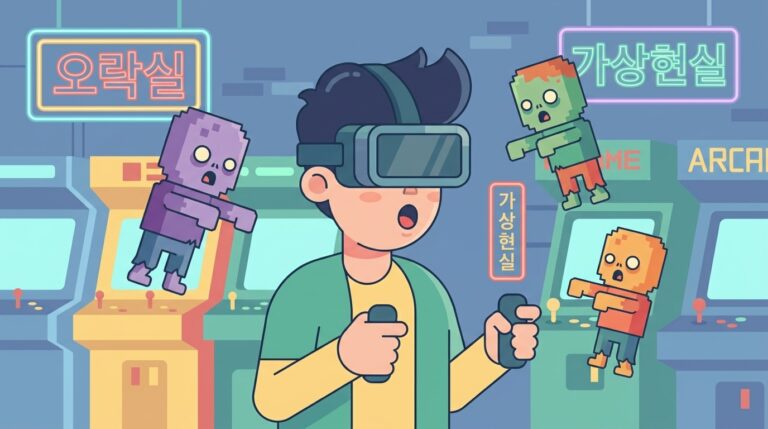
Imagine this: You are hanging out in Hongdae on a Friday night, and your Korean friends drag you into a neon-lit building. The sign says “VR 방탈출” (VR Escape Room). You put on the heavy headset, and suddenly, you are standing on a narrow plank 100 stories in the air, or worse—zombies are running straight at you! 🧟♂️
The staff is saying something to you over the headphones, but between your panicked screaming and the loud game sound effects, you have no idea what’s going on. In K-Dramas, this is usually the scene where the tough guy gets scared and shows his “cute, clumsy” side to his crush. But in reality? You just really need to know how to shoot the laser gun!
If you don’t know the right expressions here, you might end up “dying” in the game before it even starts. Don’t worry! As a tutor who has taken many international students to these VR cafes, I’ve seen all the funny (and slightly embarrassing) moments. Today, I’ll teach you exactly what to say to survive your Korean VR experience like a true insider. Let’s plug in! 🎮
Phase 2: Core Expressions Deep Dive
Here are the most essential survival phrases you’ll need when the VR headset goes on!
1. 이거 무서워요?
- Pronunciation: igeo museowoyo? [ee-guh moo-suh-wo-yo?]
- Meaning: Literal: Is this scary? / Real nuance: How terrifying is this game exactly?
- K-Culture Moment: Before picking a game at the counter, you look at the posters. If you see blood or ghosts, you quickly point and ask the staff this question. If they smile and say “조금요” (A little bit), be warned: it’s probably very scary!
- Editor’s Insight: The word ‘무섭다’ means ‘to be scary.’ Adding ‘이거’ (this) makes it perfectly natural. Use this to protect your heart before committing to a horror room!
- Situation Spectrum:
- Friends (Casual): ✅ (Drop the ‘yo’: 이거 무서워?)
- Staff (Semi-formal): ✅
- Boss/Elder (Formal): 🚫 (You probably won’t play VR zombies with your CEO anyway!)
- 🤔 Think About It: Koreans love “납량특집” (chilling horror specials) during the hot, humid summers. It is believed that getting scared drops your body temperature and helps you cool down. Do you watch horror movies to beat the summer heat in your culture?
2. 어떻게 하는 거예요?
- Pronunciation: eotteoke haneun geoyeyo? [uh-doh-keh ha-neun guh-yeh-yo?]
- Meaning: Literal: How is it doing? / Real nuance: How do I play/use this?
- K-Culture Moment: You have the controllers in your hands, but nothing is happening. You look at the staff member blankly. This is the magic phrase to summon them for a tutorial.
- Editor’s Insight: ‘어떻게’ means ‘how’. Whenever you are confused about a machine, a game, or even a weird Korean side dish, you can use this phrase! It’s polite but sounds very natural and native.
- Situation Spectrum:
- Friends (Casual): ✅ (어떻게 해?)
- Staff (Semi-formal): ✅
- Boss/Elder (Formal): ⚠️ (Use ‘어떻게 하는 겁니까?’ instead)
- 🤔 Think About It: Why do Koreans often add ‘거예요’ (it is the thing of…) at the end of questions? It softens the tone! Asking “어떻게 해요?” is okay, but “어떻게 하는 거예요?” sounds softer, showing curiosity rather than frustration.
3. 힌트 주세요!
- Pronunciation: hinteu juseyo! [hin-teu joo-seh-yo!]
- Meaning: Literal: Hint please! / Real nuance: We are completely stuck, please save us!
- K-Culture Moment: In a Korean Escape Room (방탈출), you usually have a walkie-talkie or an intercom. When you’ve spent 15 minutes staring at a fake bookshelf, it’s time to swallow your pride and yell this into the mic.
- Editor’s Insight: Koreans use the English word “hint” with a Korean pronunciation (힌트). Just add ‘주세요’ (please give), and you can ask for literally anything in Korea!
- Situation Spectrum:
- Friends (Casual): ✅ (힌트 줘!)
- Staff (Semi-formal): ✅
- Boss/Elder (Formal): 🚫
- 🤔 Think About It: Korean escape rooms are famous for being incredibly high-tech and difficult. They reflect the competitive, puzzle-solving nature often trained in the Korean education system. Have you noticed how much Koreans love brain-teaser games?
Phase 3: Textbook vs Real Korean
Let’s upgrade your textbook Korean to real “Hongdae Street” Korean!
[Situation 1: Asking for instructions from the staff]
* 📖 Textbook Korean: 이 기계의 사용법을 알려 주시겠습니까? (Could you please inform me of the usage method for this machine?)
* 🗣️ Real Korean: 저기요, 이거 어떻게 해요? (Excuse me, how do I do this?)
* 💡 Why the difference?: Real conversations in fast-paced environments like cafes prioritize speed and ease over overly formal, written-style vocabulary (사용법).
[Situation 2: Getting completely terrified in the VR game]
* 📖 Textbook Korean: 저는 지금 매우 무섭습니다. (I am very afraid right now.)
* 🗣️ Real Korean: 헐! 대박 무서워요! (Heol! Daebak museowoyo! – Omg! This is crazy scary!)
* 💡 Why the difference?: ‘헐’ (Heol) is a reflex sound of shock, and ‘대박’ (Daebak) is the ultimate slang to emphasize anything extreme (good or bad).
Bottom Note: For an A2(Beginner) level, just mastering “어떻게 해요?” and throwing in a “대박!” will immediately make Koreans think you’ve lived here for months!
Phase 4: Cultural Context — K-Culture Deep Dive
4-1. Non-verbal Cue: The Art of “Nunchi” in Gaming
In Korean group activities, 눈치 (Nunchi)—reading the room—is everything. If you visit an Escape Room with Korean friends, notice how everyone acts. If the group is pretending to be brave, complaining loudly that it’s scary ruins the fun. On the other hand, if a virtual zombie jumps out, a good loud scream actually adds to the atmosphere and shows you are a fun person to play with! Just remember to hand your VR controllers back to the staff using two hands when the game is over. Politeness never takes a break!
4-2. K-Drama Trope: The VR Cafe Date 👩❤️👨
Have you seen this classic K-Drama scene? The male and female leads go on a date to a VR Cafe. The guy tries to act tough, saying “I’m not scared of anything.” But once the headset goes on, he starts screaming, crawling on the floor, and grabbing the air, while the female lead laughs affectionately at him.
Critical Reality Check: Dramas make VR cafes look totally empty and romantic. In reality, they are loud, crowded with teenagers, and your hair/makeup will definitely get messed up from the headset! It’s better to go with close friends than on a first date.
Phase 5: Interactive Roleplay Scenario
Let’s put you in the hot seat.
- Setting: Saturday, 3:00 PM. A bustling VR Cafe in Gangnam. Neon lights, EDM music, and the sound of people screaming in different rooms.
- Characters:
- YOU: An international student trying VR for the first time.
- Minji (25): Your energetic Korean language partner who loves horror games.
- Staff: A busy, polite part-timer.
(Dialogue begins…)
Minji: 좀비 게임 할래? 이거 진짜 재밌대! 🧟♀️
(jombi geim hallae? igeo jinjja jaemitdae!)
[Do you want to play the zombie game? They say it’s really fun!]
(🎭 Stage Direction: Minji points excitedly at a bloody poster.)
YOU: 으… 이거 무서워요?
(eu… igeo museowoyo?)
[Uh… is this scary?]
Minji: 아니야~ 가짜잖아! 저기요, 이거 두 명이요!
(aniya~ gajjajana! jeogiyo, igeo du myeongiyo!)
[No~ It’s fake! Excuse me, two for this one!]
Staff: 네, 이쪽으로 오세요. 헤드셋 써보실게요.
(ne, ijjogeuro oseyo. hedeuset sseobosilgeyo.)
[Yes, come this way. Please put on the headset.]
(🎭 Stage Direction: You put on the headset, but your controllers aren’t doing anything.)
YOU: 저기요, 이거 어떻게 하는 거예요?
(jeogiyo, igeo eotteoke haneun geoyeyo?)
[Excuse me, how do I do this?]
Staff: 아, 여기 버튼을 누르시면 총알이 나갑니다. 시작할게요!
(a, yeogi beoteuneul nureusimyeon chongari nagamnida. sijakalgeyo!)
[Ah, if you press this button, it shoots. I’ll start the game!]
(🎭 Stage Direction: The game starts. A huge virtual zombie jumps right at your face!)
🔀 YOUR TURN! How do you react?
– A) “너무 무섭습니다!” (Neomu museopseumnida!)
– B) “헐! 대박 무서워! 살려주세요!” (Heol! Daebak museowo! Sallyeojuseyo!)
– C) “저기요, 게임을 멈춰주세요.” (Jeogiyo, geimeul meomchwojuseyo.)✅ Best Choice: B — “Heol! This is crazy scary! Save me!”
Why? ‘살려주세요’ (Save me) is dramatically hilarious in games. Koreans use this playfully all the time when gaming. It shows you completely understand the vibe!
⚠️ Choice A & C Analysis: They are way too formal and robotic for an arcade! You sound like a news anchor reporting from a zombie apocalypse.
Phase 6: 10-Second Shadowing Drill
Practice out loud! Pay attention to the pauses (/) and the emotion tags.
- 🥺 (Nervous) 저기요, / 이거 / 무서워요?
(jeogiyo, / igeo / museowoyo?) -
🤔 (Confused) 이거 / 어떻게 / 하는 거예요?
(igeo / eotteoke / haneun geoyeyo?) -
😭 (Desperate) 대박! / 힌트 / 주세요!
(daebak! / hinteu / juseyo!)
Phase 7: K-Culture Mini Dictionary
Here are some keywords to boost your Korean gaming vocabulary!
| 한국어 (Korean) | Romanization | English | Context |
|---|---|---|---|
| 방탈출 | bangtalchul | Escape Room | “Bang” = Room, “Talchul” = Escape. Huge trend in Korea. |
| 쫄보 | jjolbo | Scaredy-cat | Slang for someone easily frightened. Friendly teasing! |
| 헐 | heol | OMG / Whoa | Ultimate reaction sound. Use it when surprised. |
| 대박 | daebak | Awesome / Crazy | Used for anything extreme. Good or bad. |
| 힌트 | hinteu | Hint | Essential for escape rooms when time is running out. |
Phase 8: Traveler Survival Kit
Are you traveling in Korea? You might need to navigate these spaces! Escape Rooms and VR Cafes require instructions, which can be tough for travelers.
🆘 Survival Phrases for K-Arcades
– 🇰🇷 “영어로 된 거 있어요?” (yeongeo-ro doen geo isseoyo?)
– 🗣️ English guide: [young-uh-ro dwen guh iss-uh-yo?]
– 📍 Where to use: Asking if they have English versions of the VR game or Escape room clues.
– 💡 Pro Tip: Many large Escape Rooms in Hongdae have “English-friendly” rooms! Always ask before booking.📌 Editor’s Travel Note
– Useful Apps: Use ‘Naver Map’ and search “방탈출” or “VR 카페”. Google Maps isn’t very reliable for small alleys in Korea.
– Payment: Most Arcades are Card Only (카드 결제).
– Reservations: Popular Escape Rooms require booking weeks in advance via their Korean websites. Ask your hotel concierge to help you book!
Phase 9: Critical Thinking — “One Step Deeper”
🧠 Think Deeper: Media vs Reality (K-Drama Date Spots)
K-Dramas often portray VR Cafes and Arcades as private, romantic places where characters fall in love under soft neon lights. In reality, Korea is a densely populated country, and these entertainment spots are bustling hubs of intense social energy. Koreans go there not just for romance, but to blow off steam from intense studying or long working hours. The loud screaming and laughing you hear isn’t disruptive; it’s a collective, accepted way to release stress in a society that usually demands quiet politeness in public.💬 Your Turn: How do people in your country release stress? Are arcades or escape rooms popular for adults where you live? Let us know in the comments!
Phase 10: FAQ & Avoiding Mistakes
Q: Can I just scream in English when I get scared?
A: Absolutely! But if you yell “엄마야!” (Eom-ma-ya! – Mommy!) when the zombie jumps out, the Korean staff and your friends will love it and think you are deeply immersed in K-culture.
Q: Is it rude to say “대박” to the staff?
A: If you are reacting to the game (“우와, 대박!”), it’s fine. It just means you are having fun. Just don’t use it to describe the staff directly.
❌ Common Mistake #1: Saying “어떻게 해?” (Casual) to the staff.
✅ Do this instead: Always remember to attach ‘요’ (yo) to strangers. “어떻게 해요?”❌ Common Mistake #2: Taking photos inside the Escape Room.
✅ Do this instead: Escape rooms strictly forbid phones inside to prevent spoilers! Leave it in the provided locker.
Phase 11: Summary & Action Items
One-Liner Summary: To survive a Korean VR cafe, just remember to check “무서워요?” before you start, and ask “어떻게 하는 거예요?” when you’re confused!
Take Action! (Your Missions):
– 🥉 Bronze (Solo): Look at your TV or microwave and ask it out loud: “이거 어떻게 하는 거예요?”
– 🥈 Silver (Online): Post on a language exchange app: “한국 방탈출 카페 가고 싶어요! 힌트 주세요!”
– 🥇 Gold (Real Life): Next time you don’t know how to use something in a Korean store or cafe, find a staff member and use the magic phrase: “저기요, 이거 어떻게 하는 거예요?”
🎮 K-Culture Mission: Go to YouTube and search “한국 VR 카페 반응” (Korean VR cafe reactions). Watch how Koreans react. Try to catch them saying “대박” or “살려주세요!”
Phase 12: Interactive Quiz — Test Your Knowledge!
Q1. You are stuck in a Korean Escape Room. You want to ask the staff over the intercom for a clue. What is the most natural thing to say?
A) 저기요, 이거 어떻게 하는 거예요?
B) 힌트 주세요!
C) 너무 무섭습니다.
Q2. True or False: It is completely fine to use your phone to translate Korean clues inside a “방탈출” (Escape Room).
Q3. Fill in the blank:
You put on the VR headset. You don’t know which button to push to start the game.
You: “저기요, 이거 ________ 하는 거예요?”
(Scroll down for answers!)
.
.
.
Answers:
1. B (You need a hint to escape! A is for asking how to use something, which is okay, but B is standard for getting the actual clue.)
2. False (Phones are strictly prohibited inside to prevent leaking puzzle answers! Ask for an English room instead.)
3. 어떻게 (eotteoke)
How many did you get right? Let us know in the comments, and don’t forget to ask for a ‘hint’ if you get stuck studying Korean! See you next time on Daily Hangul! 👋
Frequently Asked Questions (FAQ)
Q: What does "이거 무서워요?" mean in Korean and how do you pronounce it?
A: In Korean, "이거 무서워요?" is pronounced [igeo museowoyo? [ee-guh moo-suh-wo-yo?] and means: Literal: Is this scary? / Real nuance: How terrifying is this game exactly?
Q: What does "어떻게 하는 거예요?" mean in Korean and how do you pronounce it?
A: In Korean, "어떻게 하는 거예요?" is pronounced [eotteoke haneun geoyeyo? [uh-doh-keh ha-neun guh-yeh-yo?] and means: Literal: How is it doing? / Real nuance: How do I play/use this?
Q: What does "힌트 주세요!" mean in Korean and how do you pronounce it?
A: In Korean, "힌트 주세요!" is pronounced [hinteu juseyo! [hin-teu joo-seh-yo!] and means: Literal: Hint please! / Real nuance: We are completely stuck, please save us!







