

Phase 1: Empathy (Immersive K-Culture Open)
Hello! Daily Hangul Editor here.
Imagine watching your favorite K-Drama. Two characters are having a friendly drink at a pojangmacha (street tent). Suddenly, the atmosphere turns icy. One character slams their soju glass down and says, “Hey! I’m an early ’93, so I’m technically your Oppa!” The subtitles might just say, “I’m older than you,” but what on earth is an “early ’93”? And why did the other person look so offended?
If you’ve ever been to a K-Pop concert and wondered why a member born in January 1996 treats a member born in December 1995 like a same-age friend, while demanding the December 1996 member call them Hyung, welcome to the ultimate Korean matrix: The Early Birthday (빠른 년생, Ppareun nyeonsaeng).
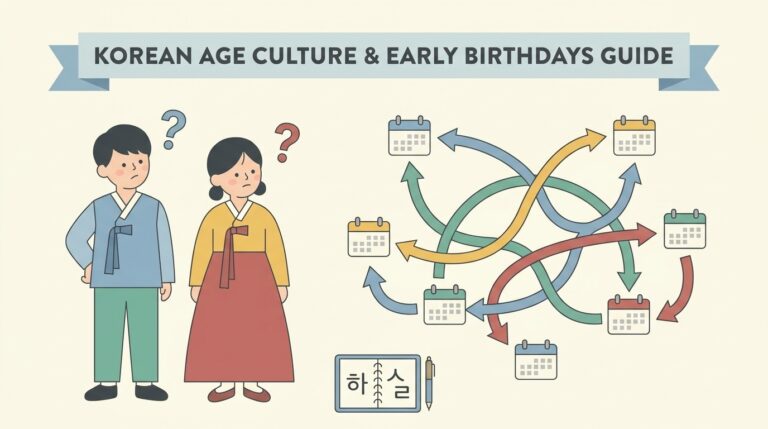
In Korea, your birth year dictates your place in the social hierarchy. But until 2009, the school year started in March. Kids born in January and February started school with kids born in the previous year. This creates a massively tangled web of relationships known as “꼬인 족보” (tangled family tree).
If you don’t know this concept, you might accidentally disrespect someone or get completely lost when your Korean friends start arguing over who buys dinner. Let’s untangle this mystery together!
(Note: This guide is based on real questions from our B1-level learners who survived the Korean age matrix!)
Phase 2: Core Expressions Deep Dive
1. 족보가 꼬이네요 (Jokboga kkoineyo)
- Pronunciation: [jok-bo-ga kko-i-ne-yo] + ‘Jok’ sounds like ‘joke’ without the ‘e’. ‘Kko’ is a hard, tense ‘K’ sound, like a chicken clucking.
- Meaning:
- Literal: The genealogy/family tree is tangled.
- Real Nuance: “Our age hierarchy/social rank just got really complicated.”
- K-Culture Moment: You are at a company dinner. A new employee born in ’95 finds out her coworker was born in ’96, but is an early ’96 who went to school with ’95s. The team leader laughs and says this phrase.
- Editor’s Insight: This phrase isn’t actually about your real family tree. It’s a witty, slightly exasperated way to acknowledge that deciding who is the Hyung/Oppa/Sunbae is going to be a headache. It breaks the ice in an awkward situation.
- Situation Spectrum:
- Casual (Friends): ✅
- Semi-formal (Coworkers): ✅
- Formal (Strict Boss/Elders): 🚫
- 🤔 Think About It: Why do Koreans use the word “족보 (genealogy/family tree)” to describe social relationships with strangers? What does this tell us about how Koreans view society as an extended family?
2. 혹시 빠른 년생이세요? (Hoksi ppareun nyeonsaeng-iseyo?)
- Pronunciation: [hok-si ppa-reun nyeon-saeng-i-se-yo?] + ‘Ppa’ is a sharp, airy ‘P’, like popping a balloon.
- Meaning:
- Literal: By any chance, are you an early birth year?
- Real Nuance: “Were you born in Jan/Feb? Because your school year and birth year don’t match, and I need to know how to address you.”
- K-Culture Moment: In K-Pop idol variety shows, when a new group meets a senior group, they immediately play the “Age Game.” When someone’s birth year doesn’t line up with their graduation year, someone always asks this question to establish the pecking order.
- Editor’s Insight: The word ‘혹시 (Hoksi – by any chance)’ is your best friend here. It softens the question, making it polite rather than intrusive.
- Situation Spectrum:
- Casual (Friends): ✅
- Semi-formal (Coworkers): ✅
- Formal (Strict Boss/Elders): ⚠️ (Better to avoid asking elders about their exact birth months directly)
- 🤔 Think About It: If someone is an “early” birthday, they spent their whole childhood acting like the older age. How would you feel if society suddenly told you to act younger in your 20s?
3. 그냥 동갑하기로 했어요 (Geunyang donggap-hagiro haesseoyo)
- Pronunciation: [geu-nyang dong-gap ha-gi-ro haes-seo-yo] + ‘Geu’ uses the ‘eu’ (으) sound, which sounds like the disgusted sound you make when stepping in gum.
- Meaning:
- Literal: We just decided to do same-age.
- Real Nuance: “It was too confusing, so we agreed to just be friends and treat each other as equals.”
- K-Culture Moment: When two actors are interviewed about their new K-Drama and they have a complicated “early birthday” situation, they’ll often smile and say this to show fans they have a great, relaxed chemistry.
- Editor’s Insight: This is the ultimate peace treaty in Korean culture. It means dropping the formal honorifics (jondaemal) and using casual speech (banmal) without anyone getting offended.
- Situation Spectrum:
- Casual (Friends): ✅
- Semi-formal (Coworkers): ⚠️ (Only if you are on the same rank level)
- Formal (Strict Boss/Elders): 🚫
- 🤔 Think About It: In English, you are just “friends” regardless of age. Why is it necessary in Korean to actively decide (하기로 하다) to be friends?
Phase 3: Textbook vs Real Korean
[Situation 1: Asking someone’s age to establish hierarchy]
* 📖 Textbook Korean: 나이가 어떻게 되십니까? (How old are you? – Very formal)
* 🗣️ Real Korean: 몇 년생이세요? (What year were you born?)
* 💡 Why is it different?: Asking the birth year is much more accurate than asking age, because it prevents the “Korean age vs. International age vs. Early birthday” confusion. It instantly establishes the hierarchy.
[Situation 2: Realizing the hierarchy is a mess]
* 📖 Textbook Korean: 관계가 복잡합니다. (The relationship is complicated.)
* 🗣️ Real Korean: 아, 족보 꼬였네요! (Ah, the family tree is tangled!)
* 💡 Why is it different?: Using slang like “족보 꼬이다” adds humor to an otherwise awkward social standoff, turning a potentially tense moment into a joke.
[Situation 3: Suggesting to drop the formalities]
* 📖 Textbook Korean: 우리 편하게 이야기합시다. (Let’s speak comfortably.)
* 🗣️ Real Korean: 그냥 말 놓을까요? / 친구 할까요? (Should we just drop the honorifics? / Should we be friends?)
* 💡 Why is it different?: In Korea, “friend (친구)” strictly means someone of the exact same age/status. You are literally offering them the “same-age friend” status.
Bottom Note: As a B1 learner, using phrases like “몇 년생이세요?” and “족보가 꼬이네요” will immediately make Koreans see you as someone who deeply understands their culture, not just the language!
Phase 4: Cultural Context — K-Culture Deep Dive
4-1. Non-verbal Element: The Power of Nunchi (눈치)
When the “early birthday” conversation happens, watch Koreans’ eyes. This is a masterclass in Nunchi (reading the room). When two people realize their hierarchy is tangled, there’s usually a 2-second pause. They will subtly scan each other’s expressions to see who is willing to yield. If you are the younger one (by birth year), it’s polite to slightly lower your head and wait for the older/higher-status person to say, “Let’s just be friends.”
4-2. K-Pop Connection: The Idol Group Hierarchy
If you are a K-Pop fan, you’ve definitely seen the “early birthday” chaos. Idol groups are essentially families that live together, and their internal age hierarchy is crucial for group dynamics.
For example, if Member A is born in ’97 and Member B is an “early ’98” (born in Jan/Feb), Member B might call Member A Hyung on broadcasts to avoid confusing the public, but use casual speech behind the scenes because they went to the same school grade. Fans love tracking these dynamics! When writing fan letters on Weverse or during a fan meeting, fans often use this to their advantage: “I’m an early ’00, so can I call you Oppa?” It’s a great conversation starter with your favorite idol!
Phase 5: Real-Life Roleplay Scenario
Scenario A: The Tangled Team Dinner
- Setting: Friday night, 7 PM. A smoky Samgyeopsal (pork belly) restaurant in Gangnam. Soju bottles line the table. You are sitting with your new Korean coworkers.
- Characters:
- YOU: An expat who joined the team a week ago. Eager to make friends.
- Min-su (Male, 28): Your friendly coworker, born in 1995.
- Ji-eun (Female, 28): The bright new hire, born in January 1996.
Min-su: 다들 친하게 지냅시다! OO 씨는 몇 년생이세요? 😊
(Dadeul chinhage jinaepsida! OO ssineun myeot nyeonsaeng-iseyo?)
(영어) Let’s all get along! What year were you born, OO?
YOU: 저는 95년생이에요!
(Jeoneun gusibo-nyeonsaeng-ieyo!)
(영어) I was born in ’95!
Ji-eun: 어머! 진짜요? 우리 동갑이네요! 반가워요. ✨
(Eomeo! Jinjjayo? Uri donggap-ineyo! Bangawoyo.)
(영어) Oh my! Really? We are the same age! Nice to meet you.
Min-su: 잠깐만. 지은 씨는 96년생 아니에요?
(Jamkkanman. Jieun ssineun gusimyung-nyeonsaeng anieyo?)
(영어) Wait a minute. Aren’t you born in ’96, Ji-eun?
Ji-eun: 저 빠른 96이잖아요! 학교 95년생들이랑 같이 다녔어요.
(Jeo ppareun gusimyung-ijanayo! Hakgyo gusibo-nyeonsaeng-deurirang gachi danyeosseoyo.)
(영어) I’m an early ’96! I went to school with the ’95s.
Min-su: 아… 또 족보 꼬이네. 나는 95년 10월생인데.
(Ah… tto jokbo kkoine. Naneun gusibo-nyeon siwol-saeng-inde.)
(영어) Ah… the family tree is tangling again. I was born in Oct ’95.
(🎭 Stage Direction: Min-su rubs his neck, pretending to be stressed)
Ji-eun: 그러니까 저한테 그냥 친구 하시면 돼요!
(Geureonikka jeohante geunyang chingu hasimyeon dwaeyo!)
(영어) So you can just treat me as a friend!
Min-su: 에이, 그래도 태어난 연도가 다른데 오빠라고 해봐요. 😎
(Ei, geuraedo tae-eo-nan yeondoga dareunde oppa-rago haebwayo.)
(영어) Hey, the birth year is different anyway, try calling me Oppa.
Ji-eun: 안 해요! OO 씨, 우리 그냥 말 놓을까요?
(An haeyo! OO ssi, uri geunyang mal noeulkkayo?)
(영어) No way! OO, should we just drop the honorifics?
🔀 Your Turn! How will you respond to Ji-eun?
– A) “안 돼요. 저는 오빠/언니라고 부를게요.” (No. I will call you Oppa/Unnie.)
– B) “좋아요! 우리 그냥 동갑하기로 해요.” (Sounds good! Let’s just be the same age.)
– C) “대박! 야, 반갑다!” (Awesome! Hey, nice to meet ya!)✅ Best Choice: B — It acknowledges the situation smoothly and accepts the friendship using a natural Korean compromise.
⚠️ Choice C Analysis: “야 (Ya / Hey)” is way too casual for someone you literally just met at a company dinner, even if you are the same age!
Scenario B: K-Culture Bonus Roleplay (Fan Meeting Edition)
- Setting: A bright, noisy fan sign event. You finally meet your favorite idol!
Idol: 안녕하세요! 이름이 뭐예요? 💕
(Annyeonghaseyo! Ireumi mwoyeyo?)
(영어) Hello! What’s your name?
YOU: 저는 OO이에요. 저 혹시 오빠라고 불러도 돼요? 저 빠른 00년생이에요!
(Jeoneun OO-ieyo. Jeo hoksi oppa-rago bulleodo dwaeyo? Jeo ppareun gonggong-nyeonsaeng-ieyo!)
(영어) I’m OO. Can I call you Oppa by any chance? I’m an early 2000 baby!
Idol: 아 진짜요? 저 99년생이니까… 음, 족보 꼬이는데? 😅
(Ah jinjjayo? Jeo gugu-nyeonsaeng-inikka… eum, jokbo kkoineunde?)
(영어) Ah really? I’m a ’99 baby so… hmm, the family tree is tangled?
YOU: 그냥 동갑하기로 해요! 친구야 반가워!
(Geunyang donggap-hagiro haeyo! Chinguya bangawo!)
(영어) Let’s just be the same age! Nice to meet you, friend!
Phase 6: 10-Second Shadowing Drill
Time to speak like a local! Follow the intonation marks (/) for pauses.
😅 아, / 족보가 좀 / 꼬이네요~
(Ah, / jokboga jom / kkoineyo~)
Tip: Say it with a slightly awkward but friendly smile.
😊 저 / 빠른 95년생인데, / 그냥 말 편하게 하세요!
(Jeo / ppareun gusibo-nyeonsaeng-inde, / geunyang mal pyeonhage haseyo!)
Tip: Emphasize ‘빠른 (ppareun)’ to make sure they catch the early birthday part!
Phase 7: K-Culture Mini Dictionary
| Korean | Romanization | English | Context/Meaning |
|---|---|---|---|
| 족보 | jokbo | Family Tree | Originally “genealogy book.” Slang for social hierarchy among peers. |
| 빠른 년생 | ppareun nyeonsaeng | Early Birthday | Born in Jan/Feb. Went to school a year earlier. |
| 동갑 | donggap | Same Age | People of the exact same age/birth year. They can be ‘chingu’ (friends). |
| 말 놓다 | mal nota | To drop honorifics | Transitioning from polite speech (jondaemal) to casual speech (banmal). |
| 학번 | hakbeon | Entering Class Year | University ID year (e.g., entering in 2020 = 20 hakbeon). Often overrides age in college! |
Phase 8: Traveler Survival Kit
Even if you are just traveling to Korea, you might face the age question!
🆘 Survival Phrases: The Age Question
– 🇰🇷 “몇 년생이세요?” (Myeot nyeonsaeng-iseyo?)
– Wait, what did they ask? -> They are asking your birth year!
– 🇰🇷 “저는 95년생이에요.” (Jeoneun gusibo-nyeonsaeng-ieyo.)
– Pronunciation Guide: Just say “Goo-sheeb-oh” (95) + nyeonsaeng-ieyo.
– 📍 Where to use: Guesthouses, language exchanges, making local friends at cafes.
– 💡 Pro Tip: In English, asking age immediately is rude. In Korea, it’s the exact opposite! They need your age to know how to politely address you. Don’t be offended; they are trying to be respectful!📌 Editor’s Travel Note
– Do foreigners have “early birthdays”? Technically, no. Koreans usually just apply international birth years to foreigners. But if you know the “early birthday” rule and use it, Koreans will be deeply impressed by your cultural knowledge!
Phase 9: Critical Thinking Corner — “One Step Deeper”
🧠 Think Deeper: Language & Power (언어와 권력)
In the Korean language, age is not just a number; it is the fundamental framework of grammar. The “Early Birthday” chaos exists precisely because Korean society relies on a strict Confucian hierarchy where even a one-year difference completely changes the verb endings, vocabulary, and body language you must use. The fact that the school system (academic year) clashed with the biological birth year created a massive loophole in this power dynamic, forcing people to negotiate their status through phrases like “족보가 꼬이다”.
💬 Your Turn: Does your native language change based on the age of the person you are talking to? How do you establish respect in your culture? Share in the comments!
Phase 10: FAQ & Avoiding Common Mistakes
Q: Do kids in Korea still use “Early Birthdays”?
A: Not anymore! The law changed in 2009. Kids born after 2003 go to school strictly based on their birth year. However, anyone in their 20s and older still heavily deals with the early birthday legacy!
Q: If someone is an early birthday but we are the same age, can I just call them “Friend”?
A: Maybe. Wait for them to suggest “그냥 동갑하기로 해요 (Let’s just be same-age friends)”. If they insist on being treated as older, it’s safer to use honorifics.
❌ Common Mistake #1: Immediately calling anyone older “Hyung” or “Oppa” in a professional setting.
✅ Do this instead: At work, always use their title (e.g., 대리님, 팀장님). Only use family/age titles in purely social, casual settings!
Phase 11: Summary & Action Items
One-Liner Summary: The “Early Birthday” system tangles Korean social hierarchy, but you can smoothly navigate it by using “족보가 꼬이네요” and offering to “그냥 동갑하기로 해요”!
🔥 Action Mission:
– 🥉 Bronze (Solo): Say “아, 족보가 꼬이네요” in the mirror 3 times with an exasperated smile.
– 🥈 Silver (Online): Find your favorite K-Pop group’s birth years. Who is the “early birthday”? Share it in a Korean learning community!
– 🥇 Gold (Real Life): Next time a Korean friend asks your age, tell them your birth year and ask, “혹시 빠른 년생이세요?”
🎬 K-Culture Mission: Watch a variety show like Knowing Bros (아는 형님). Because the concept of the show is “everyone is in the same class,” watch how they hilariously drop honorifics despite huge age gaps!
Phase 12: Quiz — Interactive Challenge
1. Situational Judgment:
You were born in May 1994. A Korean you just met at a language exchange was born in February 1994, but they are an “early ’94” who went to school with ’93s. They look confused about how to talk to you. What is the most sensible thing to say?
– A) 형/오빠라고 부르세요. (Call me Hyung/Oppa.)
– B) 아, 족보가 꼬이네요! 그냥 동갑하기로 해요. (Ah, the family tree is tangled! Let’s just be the same age.)
– C) 나이가 어떻게 되십니까? (How old are you?)
2. Fill in the Blank:
To ask if someone was born in Jan/Feb, you say:
“혹시 _______ 년생이세요?”
3. True or False — K-Culture Edition:
In Korea, it is considered very rude and invasive to ask someone’s birth year within 5 minutes of meeting them. (T/F)
(Answers: 1. B, 2. 빠른(ppareun), 3. False – It’s totally normal and necessary!)
Frequently Asked Questions (FAQ)
Q: What does "족보가 꼬이네요 (Jokboga kkoineyo)" mean in Korean and how do you pronounce it?
A: In Korean, "족보가 꼬이네요 (Jokboga kkoineyo)" is pronounced [jok-bo-ga kko-i-ne-yo] and means: Literal: The genealogy/family tree is tangled.
Q: What does "혹시 빠른 년생이세요? (Hoksi ppareun nyeonsaeng-iseyo?)" mean in Korean and how do you pronounce it?
A: In Korean, "혹시 빠른 년생이세요? (Hoksi ppareun nyeonsaeng-iseyo?)" is pronounced [hok-si ppa-reun nyeon-saeng-i-se-yo?] and means: Literal: By any chance, are you an early birth year?
Q: What does "그냥 동갑하기로 했어요 (Geunyang donggap-hagiro haesseoyo)" mean in Korean and how do you pronounce it?
A: In Korean, "그냥 동갑하기로 했어요 (Geunyang donggap-hagiro haesseoyo)" is pronounced [geu-nyang dong-gap ha-gi-ro haes-seo-yo] and means: Literal: We just decided to do same-age.







