

Phase 1: Empathy & The “K-Culture Moment”
Hello! This is your Daily Hangul Editor.
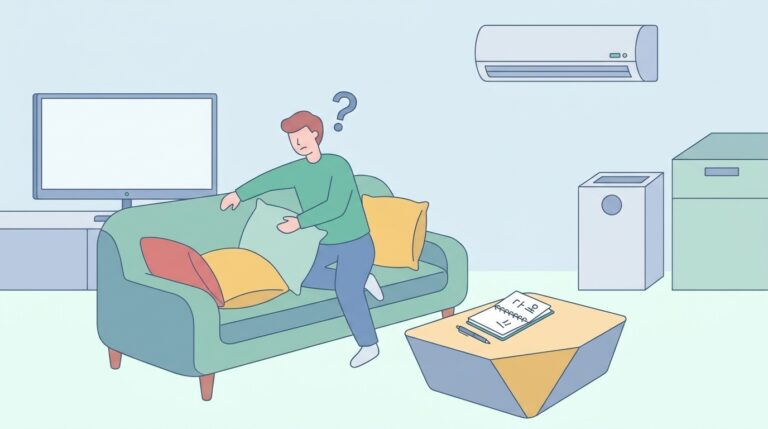
Picture this: You are relaxing on the sofa in a cozy Korean Airbnb located in the heart of Hongdae. You’ve just unpacked your crispy Korean fried chicken and spicy tteokbokki. You are ready to binge-watch the latest episode of Queen of Tears or catch a live K-Pop music show. You reach for the remote control… but wait. Where is it?
You look under the cushions. You check the coffee table. Nothing. You want to ask your Korean friend or text your Airbnb host, but how do you say, “Where is the remote?”
In K-Dramas, there is a famous trope: the Korean dad who falls asleep on the living room floor while holding the remote control like a trophy. The moment someone tries to gently take it from his hand to change the channel, he magically wakes up and says, “Hey, I’m watching that!”
Knowing how to talk about home appliances (and especially finding the remote) is essential for everyday survival in Korea. Whether you are staying at a hotel, an Airbnb, or visiting a friend’s house, this guide will save you from staring at a blank TV screen while your food gets cold. Let’s dive in!
Phase 2: Core Expression Deep Dive
Here are the 3 most important phrases you need for this situation. Since you are an absolute beginner (A1), we will focus on the most practical, easy-to-remember expressions.
1. 리모컨 어디 있어요? (Where is the remote?)
- Pronunciation: [ri-mo-keon eo-di i-sseo-yo?]
- Tip: “eo” sounds like the ‘u’ in “uh-oh.” “ri-mo-keon” sounds like “Ree-mo-con”.
- Meaning: Where is the remote control?
- K-Culture Moment: You are in a hotel room in Myeongdong. Korean hotels often have a “master remote” that controls not just the TV, but also the air conditioner and the room lights! Losing this little gadget means you can’t even turn off the lights to sleep.
- Editor’s Insight: This phrase is a magic key. You can replace “리모컨” with ANYTHING you are looking for. (e.g., 화장실 어디 있어요? = Where is the restroom?)
- Situation Spectrum:
- Close Friends (Casual): ⚠️ (Say “리모컨 어딨어?” instead)
- Co-workers (Semi-formal): ✅
- Boss/Elders (Formal): ✅ (Polite enough for everyday use)
- 🤔 Think About It: Why does “리모컨” sound so much like “remote control”? In Korean, many modern appliances use adapted English words called “Konglish.” Can you guess what “에어컨 (ee-o-keon)” means?
2. 못 찾겠어요. (I can’t find it.)
- Pronunciation: [mot chat-ge-sseo-yo]
- Tip: “mot” sounds like “moat” but cut the ‘t’ very short.
- Meaning: I can’t find it. (Literal: I won’t be able to find it.)
- K-Culture Moment: Your Korean host asks you to turn on the TV, but you’ve looked everywhere. You say this with a slightly apologetic smile.
- Editor’s Insight: Korean culture values effort. Adding “겠” (ge) gives the nuance of “I’ve tried my best, but I’m unable to.” It sounds much softer and more polite than just saying “It’s not here.”
- Situation Spectrum:
- Close Friends (Casual): ⚠️ (Say “못 찾겠어”)
- Co-workers (Semi-formal): ✅
- Boss/Elders (Formal): ✅
- 🤔 Think About It: In your culture, do you apologize when you can’t find something that belongs to someone else, or do you just state “I don’t see it”?
3. TV 좀 켜 주세요. (Please turn on the TV.)
- Pronunciation: [ti-bi jom kyeo ju-se-yo]
- Tip: “kyeo” rhymes with “yo” but starts with a ‘ky’ sound. “jom” rhymes with “home.”
- Meaning: Please turn on the TV.
- K-Culture Moment: You finally found the remote, but it has 50 buttons in Korean! You politely hand it to your friend and ask them to do it.
- Editor’s Insight: The word “좀 (jom)” literally means “a little,” but Koreans use it all the time to make a request sound softer and more polite.
- Situation Spectrum:
- Close Friends (Casual): ⚠️ (Say “TV 좀 켜 줘”)
- Co-workers (Semi-formal): ✅
- Boss/Elders (Formal): ✅
Phase 3: Textbook vs. Real Korean
Let’s see how real Koreans actually speak compared to what language apps teach you!
[Asking where the remote is]
* 📖 Textbook Korean: 텔레비전 리모컨이 어디에 있습니까? (Very robotic and formal)
* 🗣️ Real Korean: 리모컨 어딨어요? (rimokeon eodisseoyo?)
* 💡 Why the difference?: Koreans love efficiency. The particle “에 (at)” is dropped, and “어디 있어요” blends into “어딨어요” for faster speaking.
[Asking someone to turn on the TV]
* 📖 Textbook Korean: 텔레비전을 켜 주십시오. (Sounds like a military order)
* 🗣️ Real Korean: TV(티비) 좀 켜 주세요. (Tibi jom kyeo juseyo.)
* 💡 Why the difference?: Nobody says “Television” in full in daily life. Everyone says “티비 (TV)”. Adding “좀” makes the request polite and natural.
Bottom Note: For A1 beginners, it is perfectly fine to use the “~요 (~yo)” endings. It is polite, safe, and natural for almost any situation!
Phase 4: Cultural Context — K-Culture Deep Dive
4-1. Non-verbal Cues
When looking for the remote or asking your host to turn on an appliance, use “눈치 (Nunchi)”—the art of reading the room. If your host is busy cooking the instant ramen in the kitchen, try to look for the remote yourself first. If you must hand the remote to an older person to turn the TV on, give it to them using both hands.
4-2. The “Konglish” Phenomenon
The word “리모컨 (rimokeon)” is a perfect example of “Konglish” (Korean + English). It is a shortened version of “Remote Control.”
When modern appliances entered Korea, many English names were adopted but shortened to fit the rhythmic flow of the Korean language.
– Air Conditioner ➡️ 에어컨 (ee-o-keon)
– Apartment ➡️ 아파트 (a-pa-teu)
By knowing this, your English vocabulary already gives you a huge head start in learning Korean home appliance terms!
Phase 5: Real-Life Roleplay Scenario
Setting: Friday night, 8:00 PM. You are at your Korean friend Min-su’s apartment in Seoul. The delivery guy just dropped off a huge box of Fried Chicken and two cold beers. The Korean national soccer team is playing a match tonight!
Characters:
– YOU: An A1 Korean learner visiting Seoul.
– Min-su (30): Your friendly Korean host.
Dialogue:
Min-su: 치킨 왔어요! 빨리 앉아요. 🍗
(Chikin wasseoyo! ppalli anjayo.)
[The chicken is here! Hurry and sit down.]
(🎭 Stage Direction: Min-su places the chicken on the table and opens the beer)
YOU: 우와, 냄새 진짜 좋아요!
(Uwa, naemsae jinjja joayo!)
[Wow, it smells really good!]
Min-su: 축구 시작해요!
(Chukgu sijakaeyo!)
[The soccer game is starting!]
YOU: TV 좀 켜 주세요. 리모컨 어디 있어요?
(Tibi jom kyeo juseyo. Rimokeon eodi isseoyo?)
[Please turn on the TV. Where is the remote?]
Min-su: 소파 위에 없어요?
(Sopa wie eopseoyo?)
[Is it not on the sofa?]
(🎭 Stage Direction: You lift the pillows, look under the blanket… nothing.)
🔀 YOUR TURN! How should you reply?
– A) “못 찾겠어요.” (I can’t find it.)
– B) “어디 있어요?” (Where is it?)
– C) “리모컨 나빠요.” (The remote is bad.)✅ Best Choice: A — This shows you tried looking but failed. It’s natural and slightly apologetic.
⚠️ Choice B Analysis: You already asked this, so repeating it might sound a bit demanding.
❌ Choice C Analysis: This is grammatically correct but sounds like a toddler complaining to a toy!
YOU: 못 찾겠어요.
(Mot chatgesseoyo.)
[I can’t find it.]
Min-su: 아! 내 주머니에 있네. 하하.
(Ah! nae jumeonie inne. Haha.)
[Ah! It’s in my pocket. Haha.]
YOU: 아 다행이다! 빨리 켜 주세요.
(Ah dahaeng-ida! ppalli kyeo juseyo.)
[Oh, what a relief! Please turn it on quickly.]
Min-su: 네, 짠합시다! 건배! 🍻
(Ne, jjanhapsida! Geonbae!)
[Yes, let’s clink glasses! Cheers!]
Phase 6: 10-Second Shadowing Drill
Practice speaking out loud! Pay attention to the pauses (/) and the emotion tags.
- 🥺 앗, / 리모컨 / 어딨어요?
(at, / rimokeon / eo-di-sseo-yo?)
[Oops, where is the remote?] -
😢 아무리 찾아도 / 못 찾겠어요.
(a-mu-ri cha-ja-do / mot chat-ge-sseo-yo.)
[No matter how much I look, I can’t find it.] -
😊 여기요! / TV 좀 / 켜 주세요!
(yeo-gi-yo! / ti-bi jom / kyeo ju-se-yo!)
[Here you go! Please turn on the TV!]
Phase 7: K-Culture Mini Dictionary
| Korean | Romanization | English | Context |
|---|---|---|---|
| 리모컨 | rimokeon | Remote control | Short for “Remote Control.” Used everywhere. |
| 에어컨 | eeokeon | Air conditioner | Short for “Air Conditioner.” |
| 소파 | sopa | Sofa / Couch | Exactly the same as English, but spoken with a ‘p’ sound! |
| 치맥 | chimaek | Chicken & Beer | A cultural staple. Eating fried chicken and drinking beer while watching TV. |
| 건배 | geonbae | Cheers | Used when clinking glasses. |
Phase 8: Traveler Survival Kit 🧳
If you are staying at a Korean Airbnb or Hotel, you WILL need to deal with appliances. Remember, Korean hotel remotes often control the lights and the room temperature too!
🆘 Survival Expressions for Accommodations
– 🇰🇷 “에어컨 어떻게 켜요?” (eeokeon eotteoke kyeyo?)
– 🗣️ English meaning: How do I turn on the AC?
– 📍 Where to use: Texting your Airbnb host, asking hotel staff.
– 💡 Pro Tip: Look for the button that says “전원 (jeon-won)”. That is the Power button!📌 Editor’s Travel Note
– The Floor Heating (Ondol): Korea has a unique underfloor heating system called “보일러 (Boiler)”. Its controller is usually on the wall, not on the TV remote.
– Smart Remotes: Don’t panic if your remote has 50 buttons. Look for “채널 (Channel)” and “음량 (Volume)”.
Phase 9: Critical Thinking Corner — “One Step Deeper”
🧠 Think Deeper: Korean in the Global Era
Why does the Korean language use so many English loanwords (Konglish) for home appliances, like rimokeon, eeokeon, and keompyuteo?
Many modern home appliances were introduced to Korea from the West during a period of rapid modernization. Instead of inventing entirely new traditional words, Koreans efficiently adapted the English words to fit the Korean alphabet (Hangeul) and pronunciation system. This shows how language adapts practically to global technology. Konglish is not “broken English”; it is a localized cultural language!
💬 Your Turn: Does your native language borrow words from other languages for modern technology, or do you invent entirely new words? Share with us in the comments!
Phase 10: FAQ & Avoiding Common Mistakes
Q: Can I use “TV 좀 켜 주세요” to my boss or an older person?
Yes! The “~요” ending with the word “좀” makes it perfectly polite for daily interactions with elders or colleagues.
Q: Can I say “켜 주세요 (kyeo juseyo)” to ask someone to open a door or a window?
No! “켜다 (kyeoda)” is strictly used for turning on electronics/appliances (TV, AC, lights, phone). To open a door, you use “열어 주세요 (yeoreo juseyo)”.
❌ Common Mistake #1: Trying to translate “remote control” literally using a dictionary and saying “원격 조종기 (won-gyeok jo-jong-gi)”.
✅ Do this instead: Just say “리모컨”! If you say the literal translation, a Korean person might think you are talking about flying a military drone!
Phase 11: Summary & Action Items
✨ One-Liner Summary:
When you want to watch TV but can’t find the clicker, just ask, “리모컨 어디 있어요?” (Where is the remote?)
🎯 Action Mission:
– 🥉 Bronze (Solo): Look around your living room right now. Point at the remote and say “리모컨” out loud 3 times.
– 🥈 Silver (Online): Leave a comment below using the phrase “[Item name] 어디 있어요?”
– 🥇 Gold (Real World): Next time you are with a Korean friend, hand them the remote and ask them, “TV 좀 켜 주세요!”
📺 K-Culture Mission:
Watch a K-Drama tonight. Try to spot the TV remote in a living room scene. Notice where they keep it—is it on the table, the sofa, or in the dad’s hand?
Phase 12: Interactive Quiz
Q1. You are at an Airbnb and it’s too hot. You want to text the host. What is the most natural word for Air Conditioner?
1. 에어 (Air)
2. 에어컨 (Eeokeon)
3. 콜드 머신 (Cold machine)
Q2. Fill in the blank: You searched everywhere for the remote but failed. What do you say?
“미안해요, _________.”
1. 못 찾겠어요. (mot chatgesseoyo)
2. TV 좀 켜 주세요. (tibi jom kyeo juseyo)
Q3. True or False – K-Culture Edition:
In Korean hotels, the TV remote is only used for the TV, so you need a separate remote for the lights and AC. (T/F)
(Answers: Q1 – 2, Q2 – 1, Q3 – False. Hotel remotes in Korea are often all-in-one smart remotes!)
Frequently Asked Questions (FAQ)
Q: What does "리모컨 어디 있어요? (Where is the remote?)" mean in Korean and how do you pronounce it?
A: In Korean, "리모컨 어디 있어요? (Where is the remote?)" is pronounced [ri-mo-keon eo-di i-sseo-yo?] and means: a key conversational Korean expression covered in this lesson.
Q: What does "못 찾겠어요. (I can't find it.)" mean in Korean and how do you pronounce it?
A: In Korean, "못 찾겠어요. (I can't find it.)" is pronounced [mot chat-ge-sseo-yo] and means: a key conversational Korean expression covered in this lesson.
Q: What does "TV 좀 켜 주세요. (Please turn on the TV.)" mean in Korean and how do you pronounce it?
A: In Korean, "TV 좀 켜 주세요. (Please turn on the TV.)" is pronounced [ti-bi jom kyeo ju-se-yo] and means: a key conversational Korean expression covered in this lesson.







