

Phase 1: Empathy (Immersive Open)
Hello there! It’s your lead editor from Daily Hangul.
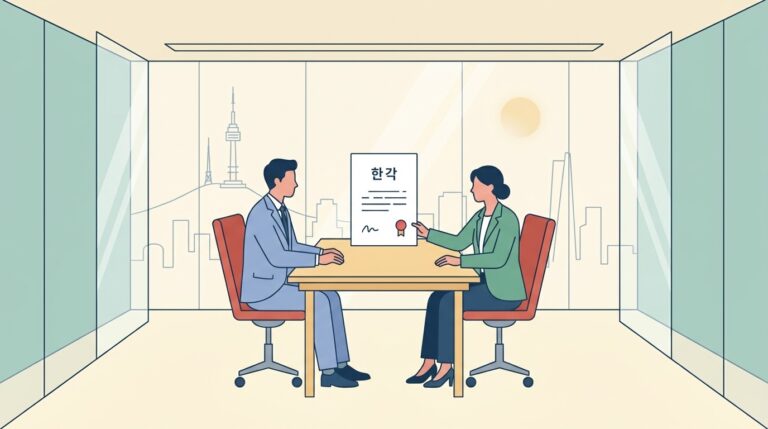
Picture this: A sleek, glass-walled boardroom overlooking the Han River in Yeouido. Two corporate teams sit across from each other. A crisp, flawlessly printed document is slid across the mahogany table. If you’ve watched K-Dramas like Vincenzo or Extraordinary Attorney Woo, you know this is the exact moment the background music shifts to a tense, rhythmic beat.
The document? A Non-Disclosure Agreement (비밀유지협약, NDA).
As an advanced (C2) Korean learner and a professional, your Korean has to evolve from ordering iced Americanos to navigating high-stakes business negotiations. In the Korean corporate world, telling a potential partner “I disagree with this clause” isn’t just about translating the words; it’s about mastering the delicate dance of polite pushback. You need the vocabulary of a seasoned lawyer and the cultural tact of a seasoned diplomat. If you miss the nuance here, you might inadvertently insult a future partner or, worse, legally bind your company to a “Gap-Eul” (갑을) nightmare.
Today, we are going deep. We’ll explore the sophisticated, velvet-glove-iron-fist language used to negotiate NDAs in Korea.
Phase 2: Core Expressions Deep Dive
Let’s unpack the essential phrases you need when reviewing and amending an NDA.
1. 비밀유지 의무 기간을 조정하고 싶습니다.
- Pronunciation: [Bimil-yuji uimu giganeul jojeonghago sipseumnida.] /bee-meel-yoo-jee wee-moo gee-gan-eul joh-jeong-ha-go sheep-seum-nee-da/
- Sound Analogy: Think of ‘jo’ like the ‘Jo’ in ‘Joker’, and ‘jeong’ like the ‘jung’ in ‘jungle’.
- Meaning: (Literal) I want to adjust the confidentiality obligation period. / (Real Nuance) We need to shorten or cap the duration of this NDA.
- K-Culture Moment: This is the opening gambit. In a K-Drama boardroom, this is said with a polite smile, leaning slightly forward. It sets a collaborative rather than combative tone.
- Editor’s Insight: The operative word here is 조정 (adjustment/coordination). Korean business etiquette shuns absolute demands like “change this” (바꿔주세요). “Adjustment” implies a mutual tuning process, preserving harmony (기분, gibun) while clearly stating your intent.
- Situation Spectrum:
- Casual Business (Startups): ⚠️ (A bit stiff, they might use more English loanwords)
- Standard Corporate (Semi-formal): ✅
- High-Level Legal Counsel (Formal): ✅
- 🤔 Think About It: Why do Koreans prefer the word “adjust” (조정) over “change” (변경) in negotiations? How does this reflect the Confucian ideal of social harmony and face-saving?
2. 이 부분은 독소조항이 될 소지가 있습니다.
- Pronunciation: [I bubuneun doksojohangi doel sojiga itseumnida.] /ee boo-boon-eun dok-so-jo-hang-ee dwel so-jee-ga it-seum-nee-da/
- Sound Analogy: ‘Dok’ sounds like ‘dock’, ‘so’ like ‘sew’.
- Meaning: (Literal) This part has the room to become a poison clause. / (Real Nuance) This clause is highly unfair and poses a severe liability to us; it must be removed.
- K-Culture Moment: This is the mic-drop moment for in-house counsel. It’s a firm, uncompromising boundary disguised in objective, academic-sounding grammar.
- Editor’s Insight: 독소조항 (Toxic Clause / Poison Pill) is a native, high-level corporate term. By saying “it has the potential to become” (~할 소지가 있다) rather than “it is” (~입니다), you soften the accusation against the drafter while maintaining an ironclad objection to the content.
- Situation Spectrum:
- Casual Business: 🚫 (Too aggressive/legalistic)
- Standard Corporate: ✅ (When things get serious)
- High-Level Legal Counsel: ✅
- 🤔 Think About It: Does your language use biological metaphors like “toxic” or “poisonous” to describe unfair legal contracts?
3. 손해배상액의 예정은 다소 과도한 측면이 있습니다.
- Pronunciation: [Sonhaebasang-aegui yejeongeun daso gwadohan cheungmyeoni itseumnida.] /son-hae-bae-sang-eg-wee ye-jeong-eun da-so gwa-do-han cheung-myeon-ee it-seum-nee-da/
- Sound Analogy: ‘Gwa’ sounds like ‘gwa’ in ‘guacamole’.
- Meaning: (Literal) The pre-estimation of damages has a somewhat excessive aspect. / (Real Nuance) The penalty fee you are threatening us with is way too high. Let’s lower it.
- K-Culture Moment: Used when the counterpart company (the “Gap” or superior party) tries to slap a massive liquidated damages clause on a minor breach.
- Editor’s Insight: Notice the layers of softening: 다소 (somewhat) + 과도한 (excessive) + 측면이 있다 (has the aspect of). It’s three layers of bubble wrap around a very sharp “No.”
- Situation Spectrum:
- Casual Business: ⚠️
- Standard Corporate: ✅
- High-Level Legal Counsel: ✅
Phase 3: Textbook vs. Real Korean
Let’s see how textbook grammar translates into real boardroom dynamics.
[Refusing a Clause]
* 📖 Textbook Korean: 이 조항은 동의할 수 없습니다. (I cannot agree to this clause.)
* 🗣️ Real Korean: 이 조항은 저희 쪽에서 수용하기 조금 곤란한데요. (It’s a bit “difficult/awkward” for our side to accept this clause.)
* 💡 Why the difference?: Direct refusal (동의할 수 없다) feels like a personal attack in Korea. “곤란하다” (to be put in a difficult/embarrassing position) shifts the blame to the situation, not the person.
[Requesting a Revision]
* 📖 Textbook Korean: 이 문장을 수정해 주십시오. (Please revise this sentence.)
* 🗣️ Real Korean: 이 부분 워딩(wording)을 조금 마일드하게 다듬어주실 수 있을까요? (Could you smooth out the wording here to be a bit milder?)
* 💡 Why the difference?: Modern Korean corporate culture (especially in tech and marketing) heavily utilizes English loanwords like “wording” and “mild” to depersonalize and soften feedback.
[Suggesting an Alternative]
* 📖 Textbook Korean: 대신 이렇게 합시다. (Let’s do it this way instead.)
* 🗣️ Real Korean: 그렇다면, 예외 조항을 두는 방향으로 가닥을 잡으면 어떨까요? (In that case, how about we set the direction toward including an exception clause?)
* 💡 Why the difference?: “가닥을 잡다” (to catch the thread/set the direction) is a sophisticated idiom showing you want collaborative problem-solving, not unilateral dictation.
Phase 4: Cultural Context — K-Culture Deep Dive
4-1. Non-Verbal Cues: The Nunchi of the Boardroom
When negotiating a contract in Korea, the words are only 50% of the conversation.
– The Document Pass: When you hand the amended NDA back, you must use two hands, and the document must be facing the other person so they can read it immediately. Sliding it across the table with one hand (like in Hollywood movies) is considered incredibly arrogant.
– The Silence: If the Korean counterpart looks at the contract and sucks air through their teeth (that “Sssss” sound), it means “This is going to be difficult.” Don’t interrupt this silence. Let them process it.
4-2. The K-Drama Corporate Trope
If you’ve watched any legal or corporate K-Drama (Misaeng, Suits Korea), you’ve seen the classic “Seal vs. Signature” scene. While Western business relies on the power of the pen, traditional Korean contracts are validated by the Dojang (도장, personal or corporate seal). The dramatic stamping of the red ink onto the paper is the ultimate cinematic climax of a negotiation.
* Critical View: While dramas make it seem like every contract requires a dramatic stamping of an antique seal, modern Korean businesses (especially tech startups) widely use digital signatures like DocuSign or simple pen signatures (서명) for NDAs.
Phase 5: Real-life Roleplay Scenario
Setting: 2:00 PM on a Tuesday. A minimalist conference room in a Pangyo tech hub. You are representing an international software company. You are reviewing the NDA before entering a joint venture with a major Korean conglomerate.
Characters:
– YOU: The meticulous foreign director who needs to protect your company’s IP.
– Manager Choi (최 팀장): 40s, lead negotiator for the Korean conglomerate. Polite, strategic, but representing the “Gap” (the bigger company).
Dialogue:
Manager Choi: 이사님, 보내주신 NDA 초안은 잘 검토했습니다. 다만, 비밀유지 기간이 영구적으로 되어 있더군요. 📄
(Isanim, bonaejusin NDA choaneun jal geomtohaetseumnida. Daman, bimilyuji gigani yeonggujeogeuro doe-eo itdeogunyo.)
[Director, we’ve reviewed the NDA draft you sent. However, I noticed the confidentiality period is set to perpetual.]
(🎭 Stage Direction: Manager Choi taps his pen lightly on the specific clause.)
YOU: 네, 저희 핵심 기술이 포함된 프로젝트라 그 부분은 타협하기 어렵습니다. 🛡️
(Ne, jeohui haeksim gisuri pohamdoen peurojekteura geu bubuneun tahyeophagi eoryeopseumnida.)
[Yes, as this project involves our core technology, that part is difficult to compromise on.]
Manager Choi: 이해합니다만, 저희 법무팀에서는 5년으로 조율을 원하십니다. 영구 유지는 다소 과도한 측면이 있어서요.
(Ihaehamnidaman, jeohui beommutimeseoneun onyeoneuro joyureul wonhasimnida. Yeonggu yujineun daso gwadohan cheungmyeoni isseoseoyo.)
[I understand, but our legal team wants to tune it to 5 years. A perpetual term has a somewhat excessive aspect to it.]
🔀 Your Turn! How do you respond?
– A) “안 됩니다. 무조건 영구 유지해야 합니다.” (No. It must absolutely be kept perpetual.)
– B) “그럼, 5년으로 하되 특정 핵심 기술에 대해서만 예외 조항을 두는 건 어떨까요?”
– C) “5년은 너무 짧아요. 10년으로 합시다.”✅ Best Choice: B — “Then, how about we set it to 5 years but include an exception clause specifically for the core technology?” This uses the collaborative “어떨까요?” (how about) and offers a strategic compromise.
⚠️ Choice A Analysis: “안 됩니다” (No) and “무조건” (unconditionally) are relationship-killers in Korean business. It breaks the harmony and stalls the negotiation.
Manager Choi: 아, 예외 조항이요? 나쁘지 않은 제안이네요. 법무팀과 다시 가닥을 잡아보겠습니다. 🤝
(A, yeeoe johang-iyo? Nappeuji aneun je-anineyo. Beommutimgwa dasi gadageul jababogetseumnida.)
[Ah, an exception clause? That’s not a bad proposal. I will re-establish the direction with the legal team.]
Phase 6: 10-Second Shadowing Drill
Time to practice your boardroom voice. Speak this clearly, calmly, and with a polite smile.
😤 이 조항은 / 저희 쪽에서 수용하기 / 조금 곤란한데요.
(ee jo-hang-eun / jeo-hui jjok-eseo soo-yong-ha-gi / jo-geum gol-lan-han-de-yo.)
Focus: Pause slightly at the slashes (/). The intonation drops naturally at the end of “데요” to show firmness, but keep your facial expression relaxed to show you are open to alternatives.
Phase 7: K-Culture Mini Dictionary (Corporate Edition)
| Korean | Romanization | English | Contextual Meaning |
|---|---|---|---|
| 갑을관계 | gabeulgwangye | Gap-Eul relationship | The hierarchical dynamic between a buyer/client (Gap) and seller/contractor (Eul). Recognizing who is Gap and Eul dictates the tone of the negotiation. |
| 독소조항 | doksojohang | Toxic clause / Poison pill | A highly disadvantageous or malicious clause hidden in a contract. |
| 조율 | joyul | Tuning / Coordination | The Korean way of saying “negotiation.” It implies harmonizing different instruments rather than a zero-sum battle. |
| 도장 | dojang | Personal/Corporate seal | A registered stamp used in place of a signature on official contracts. |
| 법무팀 | beommutim | Legal team | The in-house legal department, often cited as the “bad cops” in negotiations to save face. (e.g., “I want to agree, but my legal team won’t allow it.”) |
Phase 8: Expat Survival Kit (Everyday Contracts)
You might not be negotiating a million-dollar corporate NDA today, but if you live in Korea, you will sign contracts: housing leases (부동산 계약서), gym memberships, or employment contracts. The power dynamics are the same!
🆘 Survival Phrases for Everyday Contracts
– 🇰🇷 “이 항목은 정확히 무슨 뜻인가요?” (i hangmogeun jeonghwakhi museun tteusingayo?)
– 🗣️ “What exactly does this clause mean?”
– 📍 Use it: At the real estate agency or bank.
- 🇰🇷 “계약서 사본 하나 챙겨주시겠어요?” (gyeyakseo sabon hana chaenggyeojusigesseoyo?)
- 🗣️ “Could you provide me with a copy of the contract?”
- 📍 Use it: After signing anything.
🇰🇷 “여기에 서명하면 되나요, 아니면 도장이 필요한가요?” (yeogie seomyeonghamyeon doenayo, animyeon dojangi piryohangayo?)
- 🗣️ “Should I sign here, or is a seal required?”
- 📍 Use it: When finalizing a lease or bank document.
📌 Editor’s Life Note
When signing a housing lease in Korea (especially Jeonse/전세), always check the special agreements section (특약사항). Landlords often sneak in “toxic clauses” (독소조항) here, such as “Tenant is responsible for all boiler repairs.” Don’t be afraid to politely push back using the phrases we learned today!
Phase 9: Critical Thinking — “One Step Deeper”
Language & Power (언어와 권력): The ‘Gap-Eul’ Reality in Korean Contracts
In Western law, a contract theoretically assumes two equal parties entering an agreement. In Korean business culture, the deeply ingrained concept of 갑을관계 (Gap-Eul relationship) means absolute equality rarely exists. The ‘Gap’ (the buyer, the larger conglomerate, the landlord) inherently wields more societal and linguistic power than the ‘Eul’ (the supplier, the startup, the tenant).
This asymmetrical power dynamic is exactly why the “polite pushback” language we learned today evolved. An ‘Eul’ cannot bluntly say “No” to a ‘Gap’ without risking the entire relationship. Thus, the language of the ‘Eul’ is heavily padded with buffers like “조금” (a little), “다소” (somewhat), and “곤란하다” (difficult/awkward). Understanding an NDA in Korea requires reading between these heavily buffered lines.
💬 Your Turn: Does your culture have an equivalent to the “Gap-Eul” dynamic in business? How does it affect the way contracts are negotiated? Share your thoughts below!
Phase 10: FAQ & Avoiding Misunderstandings
Q: “Can I just say ‘안 됩니다’ (No, it is not allowed) if the clause is genuinely terrible?”
A: Yes, but only as a last resort. If you are the ‘Gap’ (the buyer/client), you can be more direct. If you are the ‘Eul’, using “수용하기 어렵습니다” (It is difficult to accept) is much safer and achieves the same legal outcome without burning bridges.
Q: “Do I absolutely need a physical ‘Dojang’ (seal) to sign contracts in Korea as a foreigner?”
A: Mostly no, but sometimes yes. For most corporate NDAs and everyday contracts, a physical signature (서명) is perfectly legal and accepted. However, for highly official transactions like buying real estate or registering a corporation, an official registered seal (인감도장, Ingam Dojang) may be required.
❌ Common Mistake #1: Pointing the pen aggressively at a specific clause and saying “이거 틀렸어요” (This is wrong).
✅ Do this instead: Use an open palm to gesture to the document and say “이 부분 수정을 제안드리고 싶습니다” (I would like to suggest a revision for this part).
Phase 11: Summary & Action Items
- One-Liner Summary: In Korean contract negotiations, protect your legal rights by mastering the art of the heavily buffered, polite “No.”
-
Action Mission:
- 🥉 Bronze: Say “이 부분은 수용하기 조금 곤란한데요” three times in front of the mirror with a confident but pleasant face.
- 🥈 Silver: Draft a hypothetical email in Korean asking to “adjust” (조정) a meeting time using today’s vocabulary.
- 🥇 Gold: The next time you sign any document in Korea (even a gym contract), use a survival phrase to ask what a specific clause means.
- K-Culture Mission: Watch an episode of Extraordinary Attorney Woo or Vincenzo. Spot a scene where lawyers negotiate across a table. Listen closely—do they use direct refusal, or do they use words like ‘조율’ (tuning) and ‘곤란하다’ (difficult)?
Phase 12: Quiz — Interactive Challenge
1. Situational Judgment: You are reviewing an NDA from a massive Korean conglomerate. There is a clause that forces you to hand over your intellectual property. How should you object?
– A) “이 조항은 불법입니다! 당장 지우세요!” (This clause is illegal! Delete it immediately!)
– B) “이 부분은 독소조항이 될 소지가 있습니다. 예외 조항으로 가닥을 잡으시죠.”
– C) “저희는 서명하지 않겠습니다.”
(Answer: B. It is firm, uses high-level corporate terminology, and suggests a collaborative alternative.)
2. True or False — K-Culture Edition: In modern Korean corporate culture, it is common to use English loanwords like “wording” or “mild” to soften the impact of critical feedback on a contract.
(Answer: True. Mixing Konglish into business feedback is a common psychological buffer in Korean offices.)
3. Fill in the Blank:
Instead of saying “Let’s change this” (이것을 바꿉시다), a sophisticated Korean negotiator will say “Let’s _________ this” (이것을 ______ 해보시죠).
(Answer: 조율 (joyul – tune/coordinate) or 조정 (jojeong – adjust))
Frequently Asked Questions (FAQ)
Q: What does "비밀유지 의무 기간을 조정하고 싶습니다." mean in Korean and how do you pronounce it?
A: In Korean, "비밀유지 의무 기간을 조정하고 싶습니다." is pronounced [Bimil-yuji uimu giganeul jojeonghago sipseumnida.] and means: (Literal) I want to adjust the confidentiality obligation period. / (Real Nuance) We need to shorten or cap the duration of this NDA.
Q: What does "이 부분은 독소조항이 될 소지가 있습니다." mean in Korean and how do you pronounce it?
A: In Korean, "이 부분은 독소조항이 될 소지가 있습니다." is pronounced [I bubuneun doksojohangi doel sojiga itseumnida.] and means: (Literal) This part has the room to become a poison clause. / (Real Nuance) This clause is highly unfair and poses a severe liability to us; it must be removed.
Q: What does "손해배상액의 예정은 다소 과도한 측면이 있습니다." mean in Korean and how do you pronounce it?
A: In Korean, "손해배상액의 예정은 다소 과도한 측면이 있습니다." is pronounced [Sonhaebasang-aegui yejeongeun daso gwadohan cheungmyeoni itseumnida.] and means: (Literal) The pre-estimation of damages has a somewhat excessive aspect. / (Real Nuance) The penalty fee you are threatening us with is way too high. Let's lower it.







