

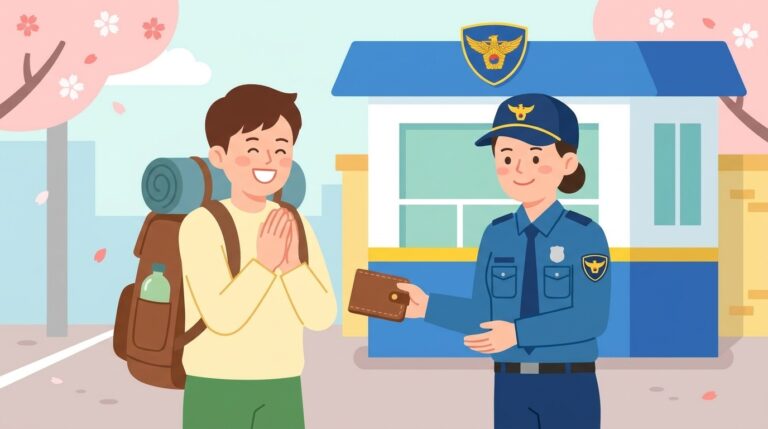
The Ultimate K-Drama Plot Twist: How to Say “I Lost My Wallet (and Found It!)” in Korean
Phase 1: The Heart-Dropping Moment 😱
Hello! I’m the Lead Editor at Daily Hangul, your veteran tutor and cultural navigator.
Imagine this: You’re walking down the bustling streets of Hongdae. You just finished a delicious plate of Tteokbokki, and you reach into your pocket or bag to grab your card. But… it’s empty. Your wallet is gone. Your heart drops to your stomach.
In a K-Drama, this is the exact moment the camera zooms in on the protagonist’s panicked face, complete with a dramatic sound effect. Losing something valuable in a foreign country is terrifying. But in South Korea, this story often comes with a plot twist: a very high chance of getting it back!
Today, we are going to learn how to talk about this rollercoaster of a past experience. By mastering these expressions, you won’t just learn the past tense—you’ll learn how to share a dramatic story like a true local.
Phase 2: Core Expressions Deep Dive
Let’s look at the essential phrases you need to explain this situation.
1. 지갑을 잃어버렸어요. (I lost my wallet.)
- Pronunciation: jigabeul ileobeoryeosseoyo [ji-ga-beul ee-reo-beo-ryeo-sso-yo]
- Meaning: I lost my wallet (and I’m sad/regretful about it).
- K-Culture Moment: You run back to the cafe you just left, breathless. The barista looks at you, concerned. You utter this phrase, and they immediately start helping you look under the tables.
- Editor’s Insight: You might wonder why we don’t just say “지갑을 잃었어요” (which literally means ‘lost’). Koreans add “-어 버리다” to the end of verbs to express that an action is completely finished, usually leaving a feeling of regret, sadness, or relief. Here, it adds that “Oh no, it’s gone!” flavor.
- Situation Spectrum:
- Casual (Friends): 지갑 잃어버렸어! ✅
- Semi-formal (Colleagues/Strangers): 지갑 잃어버렸어요. ✅
- Formal (Boss/Elders): 지갑을 잃어버렸습니다. ✅
- 🤔 Think About It: Why do Koreans attach their emotions (regret, sadness) directly into the grammar structure itself (-어 버리다)? Does your language have a way to embed feelings into the verb?
2. 다행히 다시 찾았어요! (Thankfully, I found it again!)
- Pronunciation: dahaenghi dasi chajasseoyo [da-haeng-hee da-shee cha-ja-sso-yo]
- Meaning: Fortunately, I found it.
- K-Culture Moment: The moment you reunite with your friends after finding your wallet at the police station. You sigh deeply, holding the wallet up like a trophy.
- Editor’s Insight: “다행히” (fortunately/thankfully) is a word Koreans use constantly. It shows a shared sense of relief. When you say this, the listener will usually respond with “아, 진짜 다행이다!” (Oh, that’s such a relief!). Note: In Korean, “찾다” means both “to look for” and “to find.” The past tense “찾았어요” clarifies that the search is over!
- Situation Spectrum:
- Casual: 다행히 찾았어! ✅
- Semi-formal: 다행히 찾았어요. ✅
- Formal: 다행히 찾았습니다. ✅
- 🤔 Think About It: In English, “find” is the result, and “look for” is the process. Why do you think Korean uses the same verb (찾다) for both the journey and the destination?
3. 누가 경찰서에 맡겨줬어요. (Someone left it at the police station for me.)
- Pronunciation: nuga gyeongchalseoe matgyeojwosseoyo [noo-ga gyung-chal-seo-e mat-gyeo-jwo-sso-yo]
- Meaning: Someone turned it into the police station.
- K-Culture Moment: Explaining the “K-Conscience” miracle to your family back home.
- Editor’s Insight: The ending “-아/어 주다” means “to do something for someone.” By saying “맡겨줬어요,” you aren’t just stating a fact; you are expressing gratitude toward the anonymous person who did you a favor.
- Situation Spectrum:
- Casual: 누가 파출소에 맡겨줬어. ✅
- Semi-formal: 누가 경찰서에 맡겨줬어요. ✅
- Formal: 누군가 경찰서에 맡겨주셨습니다. ✅
- 🤔 Think About It: How does adding “주다” (to give/do for someone) change the warmth of the sentence compared to simply saying “It was at the police station”?
Phase 3: Textbook vs. Real Korean
Let’s compare what you learn in grammar books with what you actually hear on the streets of Seoul.
[Explaining Your Panic]
* 📖 Textbook Korean: 저는 어제 지갑을 분실했습니다. (I lost my wallet yesterday. – Very stiff, sounds like an official report.)
* 🗣️ Real Korean: 아, 나 어제 지갑 잃어버린 줄 알았잖아! (Ah, I totally thought I lost my wallet yesterday!)
* 💡 Why the difference?: Using “-(으)ㄴ 줄 알았잖아” (I thought that…) is a dramatic, engaging way to start a story and grab your friend’s attention.
[Expressing Extreme Relief]
* 📖 Textbook Korean: 다시 찾아서 무척 기쁩니다. (I am very glad to have found it.)
* 🗣️ Real Korean: 와, 진짜 십년감수했어! (Wow, I literally lost 10 years of my life!)
* 💡 Why the difference?: “십년감수하다” is a brilliant idiom. It means you were so scared or stressed that your lifespan shortened by 10 years. It’s the ultimate way to express “phew!” in Korean.
Phase 4: Cultural Context — K-Culture Deep Dive
4-1. Non-Verbal Cues
When telling a story about a near-disaster, Koreans use specific body language. Place your hand on your chest, let out a long breath (“하아…”), and shake your head slightly. It shows how much the situation affected you. The listener’s job is to nod vigorously and say “어떡해!” (What do we do! / Oh no!).
4-2. The “K-Conscience” & High-Trust Society
If you watch YouTube vlogs about traveling in Korea, you’ve probably seen the “Cafe Laptop Experiment.” People leave their expensive laptops, phones, and wallets on cafe tables to go to the restroom, and nobody steals them.
If you drop your wallet in Korea, it is very common for someone to pick it up and either leave it exactly where it fell, hand it to a nearby store owner, or take it to a 파출소 (local police box). Telling the story of “losing and finding” something is almost a rite of passage for expats living in Korea!
Phase 5: Interactive Roleplay Scenario
Setting: A cozy indie cafe in Yeonnam-dong. You just rushed in, 15 minutes late to meet your Korean friend. You are out of breath but smiling.
Characters:
– YOU (The Learner): An expat living in Seoul, recovering from a mini heart attack.
– Jimin (지민): Your close Korean friend, holding an iced Americano.
Dialogue:
지민: 야! 왜 이렇게 늦었어? 무슨 일 있었어?
(Ya! Wae ireoke neujeosseo? Museun il isseosseo?)
[Hey! Why are you so late? Did something happen?]
YOU: 미안해! 오다가 지갑을 잃어버렸어.
(Mianhae! Odaga jigabeul ileobeoryeosseo.)
[I’m sorry! I lost my wallet on the way here.]
지민: 헐! 대박. 진짜? 어떡해! 안에 카드랑 신분증 다 있었지?
(Heol! Daebak. Jinjja? Eotteokhae! Ane kadeurang sinbunjeung da isseotji?)
[Omg! No way. Really? What are you gonna do! All your cards and ID were in there, right?]
YOU: 응… 머리가 하얗게 되더라고.
(Eung… Meoriga hayake doedeorago.)
[Yeah… My mind went completely blank.]
지민: 그래서? 지금은 괜찮아? 경찰서에 신고했어?
(Geuraeseo? Jigeumeun gwaenchana? Gyeongchalseoe singohaesseo?)
[So? Are you okay now? Did you report it to the police?]
🔀 Your Turn! How should you respond to tell her the good news?
– A) “다행히 다시 찾았어.” (Safe and polite, but maybe a bit dry)
– B) “야… 완전 십년감수했어. 누가 파출소에 맡겨줬더라고!” (Dramatic, native-like, full of emotion)
– C) “경찰이 줬어.” (Too direct, misses the nuance of gratitude)✅ Best Choice: B — Korean conversations among friends thrive on shared emotion. Using “십년감수했어” shows how stressed you were, and “맡겨줬더라고” expresses gratitude to the kind stranger.
지민: 와… 대한민국 시민의식 대박이다. 진짜 다행이다!
(Wa… Daehanminguk siminuiseung daebagida. Jinjja dahaengida!)
[Wow… The civic awareness of Korean citizens is amazing. What a relief!]
YOU: 내 말이! 오늘 커피는 내가 쏠게!
(Nae mari! Oneul keopineun naega ssolge!)
[That’s what I’m saying! I’m buying coffee today!]
Phase 6: 10-Second Shadowing Drill
Let’s practice the rhythm of relief! Read out loud, pausing at the slashes.
😭 진짜 / 십년감수했어요. / 😊 다행히 / 누가 경찰서에 / 맡겨줬어요!
(jinjja / simnyeongamsuhaesseoyo. / dahaenghi / nuga gyeongchalseoe / matgyeojwosseoyo!)
Phase 7: K-Culture Mini-Dictionary
Here are some keywords related to losing items in Korea.
| 한국어 | Romanization | English | Cultural Context |
|---|---|---|---|
| 파출소 | pachulso | Local police box | Smaller than a main police station, found in almost every neighborhood. The first place to check for lost items! |
| 분실물 | bunsilmul | Lost item | Used in official signs, like “분실물 센터” (Lost and Found). |
| 십년감수하다 | simnyeongamsuhaeda | To be scared half to death | Literally “lifespan reduced by 10 years.” Used when a crisis is averted. |
| 멘붕 | menbung | Mental breakdown | Slang (멘탈 붕괴). Used when you realize your wallet is missing. |
| 양심 | yangsim | Conscience | Often mentioned when discussing why Koreans return lost wallets. |
Phase 8: Traveler Survival Kit 🆘
If you ever find yourself panicking over a lost item in Korea, use these survival phrases.
🆘 Survival Expression #1: Asking around
– 🇰🇷 “혹시 이 근처에서 까만색 지갑 못 보셨어요?”
– 🗣️ (hoksi i geuncheoeseo kkaman-saek jigap mot bosyeosseoyo?)
– 📍 Meaning: Did you happen to see a black wallet around here?🆘 Survival Expression #2: At the station
– 🇰🇷 “분실물 센터가 어디예요?”
– 🗣️ (bunsilmul senteoga eodiyeyo?)
– 📍 Meaning: Where is the lost and found center?🆘 Survival Expression #3: Asking for help
– 🇰🇷 “경찰서에 신고하고 싶은데 도와주실 수 있나요?”
– 🗣️ (gyeongchalseoe singohago sipeunde dowajusil su innayo?)
– 📍 Meaning: I want to report this to the police, could you help me?📌 Editor’s Travel Note
– LOST112: The Korean National Police Agency runs a unified lost and found website/app called LOST112. If someone turns your wallet in, it will likely be registered here!
– Cards First: Immediately pause your credit cards using your banking app. Even in a high-trust society, it’s better to be safe.
Phase 9: Critical Thinking — A Step Deeper
Brain Check: Language & High-Trust Society
Korea is internationally famous as a country where you can “leave your laptop on a cafe table to go to the bathroom.” This stems from a mix of widespread CCTV coverage, a fast-paced society where people mind their own business, and a strong cultural emphasis on “양심” (conscience) regarding personal belongings. Notice how in the phrase “누가 찾아줬어요” (Someone found it for me), the use of “-아/어 주다” (to give/do for someone) implies an expectation of mutual aid in the community. The language itself assumes that the stranger who picked up your wallet did you a deliberate favor, rather than just performing a legal duty.
💬 Your Turn: Have you ever lost something in your home country? Did you get it back? How does the “lost and found” culture in your country compare to Korea’s? Let me know in the comments!
Phase 10: FAQ & Avoiding Misunderstandings
- Q: Can I use “잃어버렸어요” for people? Like if I lost my friend in a crowd?
- No! If you say “친구를 잃어버렸어요,” it sounds like your friend literally vanished from existence or passed away. If you get separated from a friend, use “친구랑 길이 엇갈렸어요” (We went different ways/lost each other) or “길을 잃었어요” (I lost my way).
- Q: Should I offer a reward to the person who found it?
- By law, a finder can claim 5~20% of the value, but in reality, most Koreans will decline money. A polite bow, a massive “정말 감사합니다!” and offering to buy them a coffee or handing them a small vitamin drink (like Bacchus) from a convenience store is the ultimate polite gesture.
❌ Common Mistake: Translating “I am finding my wallet” directly to “지갑을 찾고 있어요.”
✅ How to fix it: In English, “finding” is the success at the end. In Korean, “찾고 있어요” means “I am currently looking for it.” If you successfully got it back, you must use the past tense: “찾았어요!”
Phase 11: Summary & Action Items
- One-Liner Summary: Use “지갑을 잃어버렸어요” to explain the crisis, and “다행히 다시 찾았어요” to share the happy ending!
Action Mission 3 Steps:
– 🥉 Bronze (Solo): Stand in front of a mirror, look incredibly relieved, and say “다행히 찾았어요!” 3 times.
– 🥈 Silver (Online): Write a short 2-sentence story in the comments about a time you lost something using today’s grammar.
– 🥇 Gold (Real World): Tell your language exchange partner or Korean tutor about a time you had a “멘붕” (mental breakdown) because you lost something, using “-어 버리다”.
K-Culture Mission:
The next time you are in a Korean cafe, observe the tables. Count how many people leave their phones or bags unattended while ordering. It’s a fun way to witness the high-trust society in action!
Phase 12: Quiz — Interactive Challenge
1. Fill in the Blank:
“아휴, 진짜 십년( )했어요! 누가 지갑을 찾아줬어요.”
A) 감사
B) 감수
C) 감동
2. Situational Judgment:
You are looking under the cafe table because you dropped your card. The staff asks what you are doing. What do you say?
A) 카드를 찾고 있어요.
B) 카드를 찾았어요.
C) 카드를 잃어버렸어요.
3. True or False – K-Culture Edition:
In Korea, it is culturally acceptable to leave your laptop on a table to reserve it while you go to the bathroom. (T/F)
(Answers: 1. B – 십년감수, 2. A – You are currently looking for it, 3. True – It’s very common, though always exercise your own judgment!)
Frequently Asked Questions (FAQ)
Q: What does "지갑을 잃어버렸어요. (I lost my wallet.)" mean in Korean and how do you pronounce it?
A: In Korean, "지갑을 잃어버렸어요. (I lost my wallet.)" is pronounced [jigabeul ileobeoryeosseoyo [ji-ga-beul ee-reo-beo-ryeo-sso-yo] and means: I lost my wallet (and I'm sad/regretful about it).
Q: What does "다행히 다시 찾았어요! (Thankfully, I found it again!)" mean in Korean and how do you pronounce it?
A: In Korean, "다행히 다시 찾았어요! (Thankfully, I found it again!)" is pronounced [dahaenghi dasi chajasseoyo [da-haeng-hee da-shee cha-ja-sso-yo] and means: Fortunately, I found it.
Q: What does "누가 경찰서에 맡겨줬어요. (Someone left it at the police station for me.)" mean in Korean and how do you pronounce it?
A: In Korean, "누가 경찰서에 맡겨줬어요. (Someone left it at the police station for me.)" is pronounced [nuga gyeongchalseoe matgyeojwosseoyo [noo-ga gyung-chal-seo-e mat-gyeo-jwo-sso-yo] and means: Someone turned it into the police station.







