

Phase 1: Empathy
Hello! I am the Lead Editor of Daily Hangul.
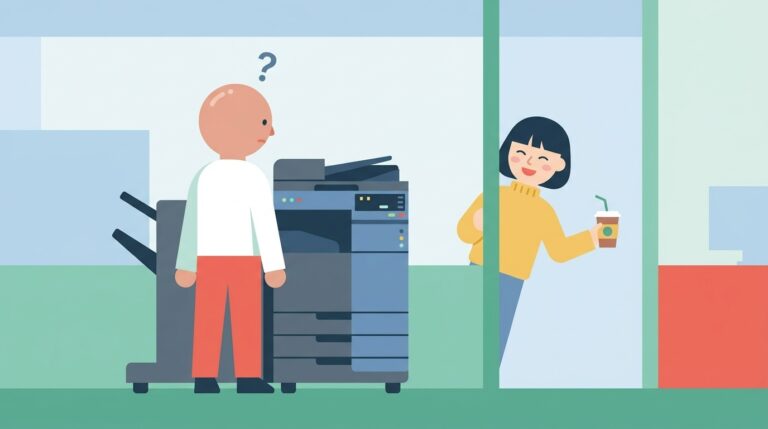
Picture this: You are the new employee in a Korean office. You’ve seen this scene a hundred times in K-Dramas like Misaeng or Business Proposal. The office is buzzing, your boss hands you a stack of papers and says, “I need this for the meeting in 5 minutes!” You rush to the giant, spaceship-like photocopier in the corner. You press a button. Suddenly, a red light blinks. The machine beeps. Everyone looks at you. Panic sets in. You want to say, “I’m sorry, I don’t know how to use this!” but you just stand there, frozen.
Don’t worry! Every K-Drama protagonist starts out making mistakes at the photocopier. It’s almost a rite of passage! If you don’t know the basic phrases for this situation, you might end up staring at a paper jam for 20 minutes. But if you know just three simple A1-level Korean phrases, a friendly coworker will swoop in to save the day, and you’ll become an instant ‘Insider’ (인싸 – In-ssa) in the office.
This guide is created based on the real-life panic moments of my beginner students who started working in Seoul. Let’s conquer the office monster together!
Phase 2: Core Expressions Deep Dive
1. 이거 복사해 주세요 (Igeo boksa-hae juseyo)
- Pronunciation: [I-geo bok-sa-hae joo-se-yo]
Sound guide: ‘bok-sa’ sounds like “box-ah”, and ‘hae’ sounds like “hey” but a bit softer.- Meaning: Please copy this. (Literal: This copy-do please give.)
- K-Culture Moment: You will hear this constantly. The team leader hands a document to the maknae (the youngest team member) without even looking up from their iced americano: “Igeo boksa-hae juseyo.”
- Editor’s Insight: This is the ultimate “magic wand” phrase. If you are the boss, you say this. If you are at a print shop asking for a service, you say this. It’s polite but direct.
- Situation Spectrum:
- Casual (To a friend): ✅ (Just drop the ‘yo’: 이거 복사해 줘)
- Semi-formal (To a coworker): ✅
- Formal (To a boss): 🚫 (You wouldn’t usually ask your boss to make copies for you!)
- 🤔 Think About It: In Korean, the word ‘juseyo’ literally means “give me,” but it’s used to politely ask someone to do an action for you. Why do you think Korean culture frames doing a favor as “giving” something? How do you ask for favors in your culture?
2. 어떻게 해요? (Eotteoke haeyo?)
- Pronunciation: [Uh-ddeoh-keh heh-yo?]
Sound guide: ‘Uh-ddeoh’ sounds like a short “uh-oh” with a ‘d’ in the middle.- Meaning: What do I do? / How do I do this?
- K-Culture Moment: If you listen to K-Pop, you’ve definitely heard “Eotteoke!” (What do I do?! / Oh no!). In the office, adding ‘haeyo’ makes it a polite plea for help when the printer screen shows an error message you can’t read.
- Editor’s Insight: This is your best survival tool. It doesn’t just mean “How does this machine work?” It also means “I’m helpless right now, please save me.” Say it with slightly widened, desperate eyes for maximum effect.
- Situation Spectrum:
- Casual: ✅ (어떻게 해?)
- Semi-formal: ✅
- Formal: ⚠️ (To a boss, it might sound a bit too helpless, but acceptable for a pure beginner.)
- 🤔 Think About It: Why is it sometimes better to admit you don’t know something right away in a fast-paced environment, rather than trying to figure it out silently? How does “Nunchi” (reading the room) apply here?
3. 종이가 없어요 (Jong-i-ga eopseoyo)
- Pronunciation: [Jong-ee-ga uhp-suh-yo]
Sound guide: ‘Jong’ rhymes with “song”, ‘eop’ sounds like “up”.- Meaning: There is no paper. (Literal: Paper is not here.)
- K-Culture Moment: You open the paper tray. It’s empty. You look around the office. Who has the key to the supply room? You gently tap your coworker’s shoulder and whisper this phrase.
- Editor’s Insight: ‘Eopseoyo’ is an incredibly versatile word. No paper? Jong-i-ga eopseoyo. No coffee? Keopi-ga eopseoyo. No money? Don-i eopseoyo. Master this word, and you master 50% of beginner Korean complaints!
- Situation Spectrum:
- Casual: ✅ (종이 없어)
- Semi-formal: ✅
- Formal: ✅
- 🤔 Think About It: Instead of saying “I ran out of paper,” Koreans say “Paper doesn’t exist.” The subject is the object, not you. How does this subtle shift remove the blame from the speaker?
Phase 3: Textbook vs. Real Korean
[When asking a coworker how to use the machine]
* 📖 Textbook Korean: 복사기계 사용법을 가르쳐 주시겠습니까? (Would you please teach me how to use the photocopy machine?)
* 🗣️ Real Korean: 대리님, 이거 어떻게 해요? (Assistant Manager, how do I do this?)
* 💡 Why the difference?: Korean offices value speed (빨리빨리 – ppalli-ppalli). Long, robotic sentences waste time. A polite but short question gets you immediate help!
[When the machine eats your paper]
* 📖 Textbook Korean: 종이가 걸렸습니다. (The paper has jammed.)
* 🗣️ Real Korean: 헉, 종이 걸렸어요. (Gasp, the paper jammed.)
* 💡 Why the difference?: Adding a little reaction sound like ‘헉’ (heok) or ‘아’ (ah) shows genuine surprise and makes you sound much more native, rather than like an AI reporting an error.
Phase 4: Cultural Context — K-Culture Deep Dive
4-1. Non-Verbal Cues in the Office
When you ask a coworker for help with the photocopier, don’t just shout across the room. Walk over to their desk, wait until they are not aggressively typing, and use a soft tone. When the copies are done, and you hand them to your boss, always use two hands. Handing a document to a superior with one hand is a major faux pas in Korean corporate culture!
4-2. The K-Drama Office Trope
The photocopier is a legendary K-Drama set piece. It’s where the grumpy boss yells at the protagonist, but it’s also where the handsome coworker leans in just a bit too close to show the female lead which button to press, suddenly making her heart flutter. While your real-life office might lack the slow-motion romance and soft lighting, the dynamic is real: asking for help with office equipment is a great icebreaker to build friendships (or romance!) with your Korean colleagues.
Phase 5: Real-Life Roleplay Scenario
Setting: Monday morning, 8:50 AM. You need 10 copies of an agenda for the 9:00 AM team meeting. The photocopier screen is entirely in Korean. You spot Min-su (30, your friendly coworker who always has a coffee in hand) walking by.
Characters:
– YOU: The foreign newbie, slightly panicked but eager to do a good job.
– Min-su: Your savior, carrying an extra large iced americano.
Dialogue:
YOU: 민수 씨, 바빠요? 🥺
(Min-su ssi, bappayo?)
[Min-su, are you busy?]
(🎭 Stage Direction: You wave your hand nervously)
Min-su: 아니요, 괜찮아요. 무슨 일이에요? ☕
(Aniyo, gwaenchanayo. Museun irieyo?)
[No, I’m okay. What’s up?]
YOU: 이거 복사… 어떻게 해요? 📄
(Igeo boksa… eotteoke haeyo?)
[This copy… how do I do it?]
Min-su: 아! 이거요. 그냥 이 버튼 누르세요.
(Ah! Igeoyo. Geunyang i beoteun nureuseyo.)
[Ah! This. Just press this button.]
(🎭 Stage Direction: Min-su presses a big green button. The machine whirs… then stops and beeps angrily.)
Min-su: 어? 이상하네.
(Eo? Isanghane.)
[Huh? That’s strange.]
YOU: 종이가 없어요? 🤷♂️
(Jong-i-ga eopseoyo?)
[Is there no paper?]
Min-su: 잠시만요… 아, 종이가 걸렸어요.
(Jamsimanyo… Ah, jong-i-ga geollyeosseoyo.)
[Wait a second… Ah, the paper jammed.]
🔀 YOUR TURN! How should you react?
– A) “안녕히 계세요.” (Goodbye.)
– B) “헉, 어떻게 해요?” (Gasp, what do we do?)
– C) “빨리빨리!” (Hurry, hurry!)✅ Best Choice: B — Showing a little shared panic with ‘헉’ (heok) and asking ‘What do we do?’ builds teamwork.
⚠️ Choice C Analysis: Telling a Korean coworker “Ppalli-ppalli!” when they are helping you is a surefire way to lose your office ally!
Min-su: 제가 할게요. 회의실 먼저 가세요.
(Jega halgeyo. Hoe-ui-sil meonjeo gaseyo.)
[I’ll do it. Go to the meeting room first.]
YOU: 아, 정말 감사합니다!
(Ah, jeongmal gamsahamnida!)
[Ah, thank you so much!]
Phase 6: 10-Second Shadowing Drill
Practice these lines out loud. Pay attention to the pauses (/) and the emotion tags!
- 🥺 절박하게 (Desperately):
대리님 / 이거 / 어떻게 해요? (Daeri-nim / i-geo / eo-tteo-ke / hae-yo?) - 😲 놀라며 (Surprised):
헉! / 종이가 / 없어요! (Heok! / jong-i-ga / eop-seo-yo!) - 😊 안도하며 (Relieved):
도와주셔서 / 감사합니다~ (Do-wa-ju-syeo-seo / gam-sa-ham-ni-da~)
Phase 7: K-Culture Mini Dictionary
| Korean | Romanization | English | Context |
|---|---|---|---|
| 눈치 | nunchi | Nunchi | The art of reading the room. Knowing when NOT to print 100 pages right before a meeting. |
| 막내 | maknae | Youngest/Junior | The youngest person in the team, usually tasked with making copies and ordering coffee. |
| 회의 | hoe-ui | Meeting | Korean office life is full of these. You always need copies for them! |
| 아아 | a-a | Iced Americano | Abbreviation for ‘Iced Americano’. The official lifeblood of the Korean office worker. |
Phase 8: Traveler Survival Kit
You might think, “I’m just visiting Korea, I won’t use an office photocopier!” But what if you need to print your flight itinerary, concert tickets, or visa documents? In Korea, you can do this at a PC Bang (PC Room) or large convenience stores!
🆘 Survival Phrases for Travelers
– 🇰🇷 “프린트 돼요?” (Peurinteu dwaeyo?)
– 🗣️ English pronunciation: [Poo-rin-teu dway-yo?]
– 📍 Where to use: Convenience stores, PC Bangs, Hotel lobbies.
– 💡 Meaning: Can I print here?📌 Editor’s Travel Note
– USB vs Email: Many print shops or PC bangs prefer you to log into your email to download the file rather than using a USB due to virus concerns.
– Payment: In a PC Bang, you usually pay for printing at the front desk with a card (T-money sometimes works too!).
– Color vs B&W: Be careful! Color printing (컬러 – keolleo) is significantly more expensive than black and white (흑백 – heuk-baek).
Phase 9: Critical Thinking Corner — “One Step Deeper”
Media vs Reality: The K-Drama Illusion
🧠 Think Deeper:
In K-Dramas, office life is often portrayed as highly glamorous—perfect suits, dramatic boardroom takeovers, and rooftop confessions. However, the reality of Korean office life is much more grounded in everyday tasks, strict hierarchical communication, and teamwork (like fixing a jammed printer together). While media creates a fantasy of individual heroism, real Korean corporate culture heavily emphasizes collective harmony and knowing your place within the team structure. The seemingly mundane act of making sure everyone has a printed copy of the agenda is actually a profound display of respect for the group’s time.💬 Your Turn: Does media from your country accurately represent what it’s actually like to work in an office there? Share your thoughts in the comments!
Phase 10: FAQ & Avoiding Mistakes
Q: Can I just point at the machine and say “Boksa?”
No! Unless you are talking to yourself, dropping the politeness markers (like ‘juseyo’ or ‘haeyo’) and just saying “Boksa” to a colleague sounds rude and demanding.
Q: How do I call my coworker to ask for help?
Do not use “You” (당신 – Dangsin) or just their first name. Always use their title + nim (e.g., 대리님 – Daeri-nim, 과장님 – Gwajang-nim) or their name + ssi (민수 씨 – Min-su ssi) if they are of equal or lower rank.
❌ Common Mistake #1: Trying to forcefully pull out jammed paper. Korean printers are usually leased, and breaking them is a headache! Ask for help instead of using brute force.
✅ Do this instead: Say “종이 걸렸어요 (Jong-i geollyeosseoyo)” to the office manager. They know exactly how to open the secret compartments to fix it.
Phase 11: Summary & Action Items
One-Liner Summary: Surviving the Korean office printer only takes three phrases: ask for a copy, say there’s no paper, or just ask “What do I do?!”
Action Mission 3 Steps:
– 🥉 Bronze (Solo): Look at your own printer at home/school and say “어떻게 해요?” (Eotteoke haeyo?) with dramatic K-Drama acting.
– 🥈 Silver (Online): Write in our community forum: “At my job, I always have to [Action]. Eotteoke haeyo?”
– 🥇 Gold (Real World): Next time you are at a hotel in Korea or a PC Bang, point to a printer and ask the staff “프린트 돼요?” (Can I print?).
🎬 K-Culture Mission: Watch one episode of a Korean office drama (like Business Proposal or Misaeng) and see if you can spot the massive office printer. Bonus points if you catch them saying “Boksa”!
Engagement: Have you ever had a funny misunderstanding with office equipment in a foreign country? Tell me your story below! 👇
Frequently Asked Questions (FAQ)
Q: What does "이거 복사해 주세요 (Igeo boksa-hae juseyo)" mean in Korean and how do you pronounce it?
A: In Korean, "이거 복사해 주세요 (Igeo boksa-hae juseyo)" is pronounced [I-geo bok-sa-hae joo-se-yo] and means: Please copy this. (Literal: This copy-do please give.)
Q: What does "어떻게 해요? (Eotteoke haeyo?)" mean in Korean and how do you pronounce it?
A: In Korean, "어떻게 해요? (Eotteoke haeyo?)" is pronounced [Uh-ddeoh-keh heh-yo?] and means: What do I do? / How do I do this?
Q: What does "종이가 없어요 (Jong-i-ga eopseoyo)" mean in Korean and how do you pronounce it?
A: In Korean, "종이가 없어요 (Jong-i-ga eopseoyo)" is pronounced [Jong-ee-ga uhp-suh-yo] and means: There is no paper. (Literal: Paper is not here.)







