

Phase 1: Empathy & K-Culture Cold Open
Hello! I am the Lead Editor of Daily Hangul.
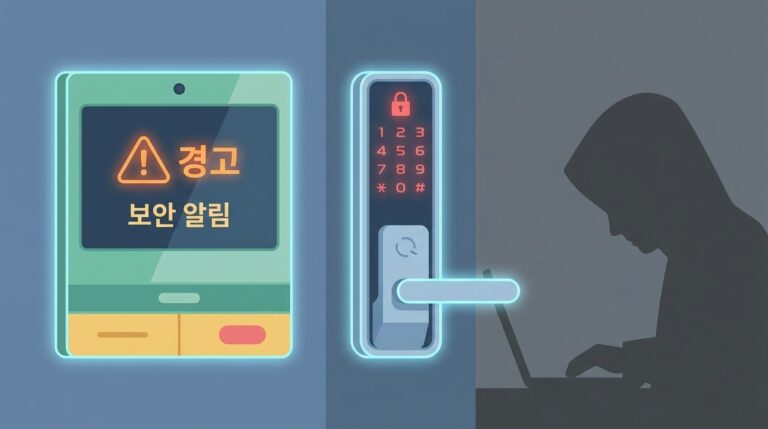
Picture this: It is 2:00 AM. You are watching a tense K-Drama thriller. The protagonist is sleeping soundly in their high-tech Seoul apartment. Suddenly, the digital door lock outside beeps—beep, beep, beep, beep, trill! Or worse, the ‘Wall Pad’ (월패드, the smart home control panel) in the living room lights up on its own, and the home CCTV slowly rotates towards the bedroom. The hacker is inside the network.
In Korea’s hyper-connected society, where even your rice cooker might be connected to Wi-Fi, Internet of Things (IoT) security is not just an IT textbook topic; it is a daily survival skill. As an advanced (C2) Korean learner, being able to discuss cybersecurity vulnerabilities (보안 취약점) and countermeasures (대책) will not only protect your privacy but also elevate your professional and conversational fluency to native-like mastery.
Are you ready to learn how to secure your digital life in Korean? This guide is built from real questions by expats navigating Korea’s smart infrastructure!
Phase 2: Deep Dive into Core Expressions
At the C2 level, we move beyond basic vocabulary to understand the nuance and cultural weight of expressions.
1. 초기 비밀번호를 방치하다
- Pronunciation: chogi bimilbeonhoreul bangchihada [cho-gee bee-mil-beon-ho-reul bang-chee-ha-da]
- Meaning: (Literal) To neglect the initial password / (Real nuance) To carelessly leave the default password unchanged, leaving yourself wide open to attacks.
- K-Culture Moment: You just bought a ‘홈캠’ (home pet camera) to watch your cat while you are at your office in Pangyo. Your Korean colleague warns you not to just plug it in and leave the factory settings as they are.
- Editor’s Insight: The word ‘방치하다’ (to neglect/abandon) carries a strong tone of irresponsibility. It’s not just ‘forgetting’; it implies you didn’t care enough to take action.
- Situation Spectrum:
- Casual: ✅
- Semi-formal: ✅
- Formal/News: ✅ (Highly used in news reports about cyber crimes)
- 🤔 Think About It: Why is Korea, a global IT powerhouse, often vulnerable to these basic hacks? The Korean ‘빨리빨리’ (hurry-hurry) culture prioritizes speed and convenience (plug and play) over the tedious process of setting up security networks. How does your culture balance convenience and security?
2. 해킹에 무방비로 뚫리다
- Pronunciation: haeking-e mubangbiro ttullida [hae-king-eh moo-bang-bee-ro ttool-lee-da]
- Meaning: (Literal) To be pierced defenselessly by hacking / (Real nuance) To be completely compromised/hacked without any security measures in place.
- K-Culture Moment: The morning news anchor reports on a massive apartment complex where the shared network was compromised, broadcasting residents’ daily lives on the dark web.
- Editor’s Insight: ‘뚫리다’ means ‘to be pierced’ or ‘to have a hole poked through’. Koreans visually imagine security as a physical wall or shield. When a system is hacked, the wall is ‘pierced’.
- Situation Spectrum:
- Casual: ✅
- Semi-formal: ✅
- Formal: ⚠️ (In highly formal official corporate apologies, ‘침해당하다’ – to be breached – is preferred over ‘뚫리다’)
- 🤔 Think About It: Physical metaphors for digital concepts are fascinating. In English, we say a system is ‘breached’. In Korean, it’s ‘pierced’ (뚫리다) or ‘털리다’ (shaken/robbed). Does this physicalization make the digital threat feel more real?
3. 최신 펌웨어로 업데이트를 진행하다
- Pronunciation: choesin peomwe-eoro eopdeiteureul jinhaenghada [chweh-shin pum-weh-uh-ro up-day-teu-reul jin-haeng-ha-da]
- Meaning: (Literal) To proceed with an update to the latest firmware / (Real nuance) To update the firmware to the latest version.
- K-Culture Moment: An IT support engineer visits your office to fix a smart printer that was acting as a backdoor for malware.
- Editor’s Insight: At the C2 level, you should notice the use of ‘진행하다’ (to proceed/carry out). Koreans love using ‘진행하다’ in professional settings instead of simply ‘하다’ (to do) to sound more systematic, official, and authoritative.
- Situation Spectrum:
- Casual: 🚫 (Too stiff for friends)
- Semi-formal: ✅
- Formal: ✅
- 🤔 Think About It: The corporate preference for ‘진행하다’ over ‘하다’ reflects the Korean business culture’s emphasis on process and formality. Have you noticed this in Korean business emails?
Phase 3: Textbook vs. Real Korean
[Situation 1: Discovering your smart home device was hacked]
* 📖 Textbook: 제 사물인터넷 기기가 해킹되었습니다. (My IoT device has been hacked.)
* 🗣️ Real Korean: 내 홈캠 완전 다 털렸어. (My home cam got completely robbed/swept clean.)
* 💡 Why the difference?: ‘털리다’ (to be robbed/dusted off) is the ultimate slang for losing data, money, or privacy. It captures the emotional devastation of the breach much better than the sterile ‘해킹되다’.
[Situation 2: Advising someone to change their password]
* 📖 Textbook: 초기 비밀번호를 반드시 변경하십시오. (Please make sure to change the initial password.)
* 🗣️ Real Korean: 비번 안 바꾸면 해커들 맛집 돼. (If you don’t change your PW, you’ll become a ‘famous restaurant’ for hackers.)
* 💡 Why the difference?: ‘맛집’ literally means a famously delicious restaurant. Koreans use it metaphorically to describe a place that is an easy and popular target (e.g., ‘해킹 맛집’ = a system so easy to hack that hackers flock to it).
[Situation 3: Explaining a security flaw]
* 📖 Textbook: 이 기기는 보안 취약점이 존재합니다. (This device has a security vulnerability.)
* 🗣️ Real Korean: 이거 보안 1도 없어. 완전 허벌이야. (This has zero security. It’s completely wide open.)
* 💡 Why the difference?: ‘1도 없어’ is a popular pop-culture phrase (meaning ‘not even 1%’). ‘허벌’ is a slang term for something that is overly loose or unguarded, though use it with caution as it is extremely casual.
Phase 4: Cultural Context — K-Culture Deep Dive
4-1. The Non-verbal ‘Nunchi’ of Digital Security
When typing a password on a digital door lock in Korea, it is an unspoken rule of Nunchi (눈치) to cover your hand entirely, or for the person standing next to you to actively turn their head away or stare at the ceiling. If a Korean friend violently turns their back to you while you open your door, don’t be offended! They are demonstrating their politeness by refusing to look at your ‘비번’ (password).
4-2. The ‘Wall Pad’ Hacking Crisis in K-Reality
In recent years, real-life news in Korea mirrored K-Dramas when hackers breached the central network of new apartment complexes. Korean apartments are famous for their integrated ‘Wall Pads’ (월패드)—tablets on the living room wall that control heating, lights, elevators, and even allow you to see who is at the front door. Because many apartments shared a single internal network to cut costs, if one unit’s IoT device was compromised, the entire building of 1,000 households was laid bare (무방비로 뚫리다). This sparked a national conversation about the double-edged sword of Korea’s hyper-convenient smart housing.
Phase 5: Real-Life Roleplay Scenario
Setting: Friday afternoon. You just moved into a brand new, highly automated ‘Officetel’ in Gangnam. Everything is controlled via an app. You are unboxing a cheap smart pet feeder you bought online. Your Korean friend, Min-su, is helping you unpack.
Characters:
– YOU: An expat working in Korea, highly cautious about digital privacy.
– Min-su (32): Your friendly, fast-paced Korean friend who thinks you worry too much.
Dialogue:
Min-su: 와, 이 오피스텔 진짜 좋다. 월패드로 엘리베이터도 부를 수 있네?
(Wa, i opiseutel jinjja jota. Wolpaedeuro ellibeiteodo bureul su inne?)
[Wow, this officetel is really nice. You can even call the elevator with the wall pad?]
(🎭 Min-su taps the wall screen excitedly)
YOU: 응, 편하긴 한데 보안이 좀 걱정돼. 아파트 네트워크 하나 뚫리면 다 털린다며.
(Eung, pyeonhagin hande boani jom geokjeongdwae. Apateu neteuwokeu hana ttullimyeon da teollindamyeo.)
[Yeah, it’s convenient, but I’m worried about security. I heard if one apartment network is pierced, everything gets robbed.]
Min-su: 에이, 설마. 그나저나 그 고양이 급식기도 와이파이 연결하는 거야?
(Ei, seolma. Geunajeona geu goyangi geupsikgido waipai yeongyeolhaneun geoya?)
[No way, come on. Anyway, does that cat feeder connect to Wi-Fi too?]
YOU: 어, 근데 이거 중국산 저가형이라 초기 비밀번호 방치하면 해킹에 무방비로 뚫릴 것 같아.
(Eo, geunde igeo jungguksan jeogahyeongira chogi bimilbeonho bangchihaemyeon haeking-e mubangbiro ttullil geot gata.)
[Yeah, but it’s a cheap Chinese model, so I feel like if I neglect the default password, it’ll be defenselessly pierced by hacking.]
Min-su: 야, 누가 고양이 밥 먹는 걸 해킹해서 본다고 그래. 그냥 귀찮은데 대충 써~ 초기 비번 0000 아니야?
(Ya, nuga goyangi bap meongneun geol haekinghaeseo bondago geurae. Geunyang gwichaneunde daechung sseo~ chogi bibeon 0000 aniya?)
[Hey, who would hack to watch a cat eat? It’s annoying, just use it as is~ Isn’t the default PW 0000?]
🔀 Your Turn! How will you respond to Min-su?
– A) “그래? 그럼 그냥 써야겠다.” (Really? I guess I’ll just use it then.)
– B) “무슨 소리야! IoT 기기는 펌웨어 업데이트랑 비번 변경이 필수라고!”
– C) “너나 그렇게 살아!”✅ Best Choice: B — Reason: You are asserting your C2 level vocabulary while correctly pointing out the security flaw.
⚠️ Choice C Analysis: “Live like that yourself!” is way too aggressive, even for close friends.
(Continuing with B)
YOU: 무슨 소리야! IoT 기기는 펌웨어 업데이트랑 비번 변경이 필수라고! 카메라 마이크 통해서 내 사생활 다 노출될 수 있어.
(Museun soriya! IoT gigineun peomwe-eo eopdeiteurang bibeon byeongyeongi pilsurago! Kamera maikeu tonghaeseo nae sasaenghwal da nochuldoel su isseo.)
[What are you talking about! Firmware updates and PW changes are mandatory for IoT devices! My private life could be exposed through the camera’s mic.]
Min-su: 오… 듣고 보니 무섭네. 나도 집 도어락 비번 4자리인데 당장 바꿔야겠다.
(O… deutgo boni museomne. Nado jip doeorak bibeon 4jariinde dangjang bakkwoyagetda.)
[Oh… hearing that makes it scary. My house door lock PW is 4 digits too, I should change it right away.]
Phase 6: 10-Second Shadowing Drill
Master the intonation! Slashes (/) indicate where to pause. Read the bold parts with emphasis.
😤 단호하고 전문적으로 (Firmly and professionally)
“초기 / 비밀번호는 / 해킹에 / 무방비로 뚫리기 쉬우니까 / 반드시 / 바꾸셔야 돼요!”
(chogi / bimilbeonhoneun / haeking-e / mubangbiro ttulligi swiunikka / bandeusi / bakkusyeoya dwaeyo!)
Phase 7: K-Culture Mini Dictionary
| Korean | Romanization | English | Cultural Context |
|---|---|---|---|
| 비번 | bibeon | Password | Abbreviation of ‘비밀번호’. Native speakers almost exclusively use ‘비번’ in daily texts and speech. |
| 월패드 | wolpaedeu | Wall Pad | The smart home control screen built into the walls of modern Korean apartments. |
| 홈캠 | homkaem | Home Cam / IP Camera | Used heavily by Korea’s massive single-person household population to monitor pets. |
| 털리다 | teollida | To be robbed/hacked | Slang. Used for getting hacked, losing all your money, or being verbally defeated. |
| 도어락 | doeorak | Door lock | Physical keys are practically extinct in Korea; every home uses a digital door lock. |
Phase 8: Traveler’s Survival Kit
Even if you are just visiting Korea, you will interact with IoT devices—mostly at your Airbnb (digital door lock) and cafes (public Wi-Fi).
🆘 Survival Expressions for Smart Travel
– 🇰🇷 “여기 와이파이 비번이 뭐예요?” (yeogi waipai bibeoni mwoyeyo?)
– What is the Wi-Fi password here?
– 🇰🇷 “도어락 비밀번호 어떻게 변경하나요?” (doeorak bimilbeonho eotteoke byeongyeonghanayo?)
– How do I change the door lock password? (Crucial for long-term Airbnbs)
– 🇰🇷 “에어컨 리모컨이 안 먹혀요. 월패드로 켜야 되나요?” (eeokeon rimokeoni an meokhyeoyo. wolpaedeuro kyeoya doenayo?)
– The AC remote isn’t working. Do I have to turn it on via the wall pad?📌 Editor’s Travel Note
If you use public Wi-Fi in Seoul (which is everywhere and incredibly fast), avoid logging into banking apps. While physical crime in Korea is extremely low, digital phishing (피싱) and smishing (스미싱) are rampant. Don’t let your guard down digitally just because you feel physically safe!
Phase 9: Critical Thinking Corner — “One Step Deeper”
🧠 Think Deeper: Media vs. Reality – The Irony of IT Powerhouse Korea
Korea is renowned globally for its lightning-fast internet and early adoption of smart home technology. In K-Dramas, hackers type furiously on multiple screens, bypassing military-grade encryption in seconds. However, the reality of Korean cybersecurity is often much more mundane and ironic.
Despite having top-tier hardware, the general public’s software security awareness historically lagged due to the “빨리빨리” (hurry-hurry) culture. People prioritized seamless connectivity over tedious authentication steps. When the massive ‘Wall Pad’ hacking incident occurred, it wasn’t a sophisticated zero-day exploit that caused the most damage; it was the fact that builders had skipped installing firewalls between individual apartment units to save time and money. The crisis forced a cultural shift—moving from blindly trusting technology for convenience, to actively practicing digital hygiene.
💬 Your Turn: Does your culture prioritize digital convenience or strict security? Have you ever felt paranoid about IoT devices in your own home? Share your thoughts in Korean in the comments!
Phase 10: FAQ & Avoiding Mistakes
Q1: Can I use ‘털렸어’ (got robbed/hacked) when speaking to my boss?
– No. ‘털리다’ is slang. If your company’s server is breached, absolutely do not say “서버가 털렸습니다.” Use formal vocabulary: “서버가 해킹 공격에 노출되었습니다” (The server was exposed to a hacking attack) or “보안망이 뚫렸습니다” (The security network was breached).
Q2: Is it rude to cover the keypad completely when typing my password in front of a Korean friend?
– Not at all. It is expected. In fact, many digital locks in Korea have a ‘허수 기능’ (fake number function) where you can type random numbers before your actual password so bystanders can’t guess it from your hand movements.
❌ Common Mistake #1: Saying “패스워드” (Password) exclusively.
✅ Do this instead: While Koreans understand ‘패스워드’, they naturally say ‘비밀번호’ or ‘비번’ in 99% of daily situations. Using ‘비번’ instantly makes you sound like a local.
Phase 11: Summary & Action Items
One-Liner Summary: To survive in Korea’s hyper-connected smart homes, don’t neglect your default passwords (초기 비밀번호를 방치하지 마세요) and keep your firmware updated to avoid being breached (무방비로 뚫리다).
Action Mission 3 Steps:
– 🥉 Bronze (Solo): Look at your home router or pet camera and say loudly: “비번을 변경하자!” (Let’s change the password!)
– 🥈 Silver (Online): Write a comment below in Korean explaining why IoT security is important to you.
– 🥇 Gold (Action): Actually log into your smart devices right now and update the firmware (펌웨어 업데이트를 진행하다)!
K-Culture Mission: Watch a modern Korean thriller movie (like Door Lock or Unlocked) and listen carefully for the words ‘비번’, ‘도어락’, and ‘해킹’. You’ll be surprised how often they pop up!
Phase 12: Quiz — Interactive Challenge
1. Situational Judgment: Your company’s smart printer was hacked because the IT team left the default password as ‘admin’. How would you describe this situation professionally in a meeting?
– A) 프린터가 완전히 털렸습니다.
– B) 프린터 초기 비밀번호가 방치되어 보안망이 뚫렸습니다.
– C) 프린터 비번이 맛집입니다.
2. Fill in the Blank:
“____ 안 바꾸면 해커한테 무방비로 당해!”
(If you don’t change the ____, you’ll be defenselessly attacked by hackers!)
– Hint: The 2-syllable abbreviation for password.
3. True or False – K-Culture Edition:
When entering your apartment password, Koreans consider it polite to stare at your fingers to ensure you don’t make a mistake. (T/F)
(Answers: 1: B, 2: 비번, 3: False – Always look away!)
Frequently Asked Questions (FAQ)
Q: What does "초기 비밀번호를 방치하다" mean in Korean and how do you pronounce it?
A: In Korean, "초기 비밀번호를 방치하다" is pronounced [chogi bimilbeonhoreul bangchihada [cho-gee bee-mil-beon-ho-reul bang-chee-ha-da] and means: (Literal) To neglect the initial password / (Real nuance) To carelessly leave the default password unchanged, leaving yourself wide open to attacks.
Q: What does "해킹에 무방비로 뚫리다" mean in Korean and how do you pronounce it?
A: In Korean, "해킹에 무방비로 뚫리다" is pronounced [haeking-e mubangbiro ttullida [hae-king-eh moo-bang-bee-ro ttool-lee-da] and means: (Literal) To be pierced defenselessly by hacking / (Real nuance) To be completely compromised/hacked without any security measures in place.
Q: What does "최신 펌웨어로 업데이트를 진행하다" mean in Korean and how do you pronounce it?
A: In Korean, "최신 펌웨어로 업데이트를 진행하다" is pronounced [choesin peomwe-eoro eopdeiteureul jinhaenghada [chweh-shin pum-weh-uh-ro up-day-teu-reul jin-haeng-ha-da] and means: (Literal) To proceed with an update to the latest firmware / (Real nuance) To update the firmware to the latest version.







