

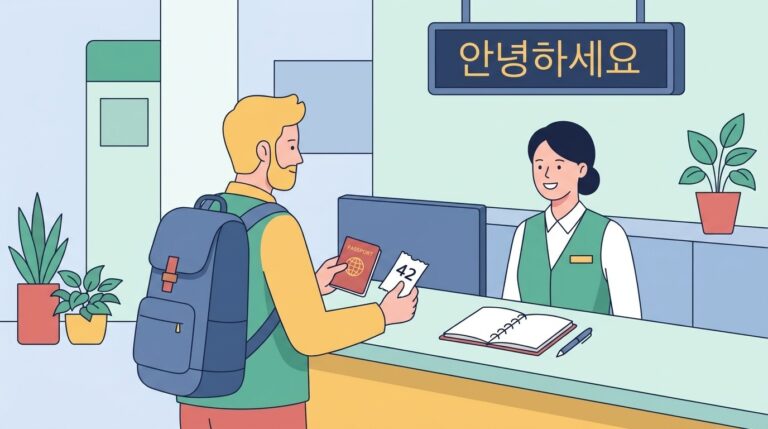
Phase 1: Empathy & The “K-Drama” Moment
Hello! I’m your Daily Hangul Editor.
Picture this K-Drama scene: The main character bursts through the glass doors of a bright, busy building, grabs a small piece of paper from a machine, and sits down with a heavy sigh. Then, a voice chimes through the speaker: “Ding-dong! Number 104, please come to counter 3.”
Welcome to the Korean 구청 (Gu-cheong, District Office)!
Whether you need to apply for a Korean passport for your dual-citizen child, renew your visa, or register your address, visiting a public office in Korea can feel like a high-speed mission. Korean bureaucracy is famous worldwide for its Ppalli-ppalli (hurry up) efficiency, but if you don’t know the basic vocabulary, that speed can be intimidating.
Don’t worry! I’ve been there with many of my students. Today, we’re going to learn the A2-level survival phrases for public offices. We’ll focus on the situation of “Applying for a Passport/ID,” but these phrases work magic for almost any paperwork you need to do in Korea. Let’s make you look like a confident local!
Phase 2: Core Expressions Deep Dive
Here are the top three expressions you will definitely use or hear at a public office.
1. 여권 만들러 왔어요. (I came to make a passport.)
- Pronunciation: yeogwon mandeulleo wasseoyo [yeo-gwon man-deul-leo wa-sseo-yo]
- Tutor Tip: The ‘으’ (eu) in ‘deul’ sounds like the disgusted sound you make when stepping in gum! Keep your lips flat.
- Meaning: Literal: “I came to make a passport.” / Real nuance: “I’d like to apply for a passport, please.”
- K-Culture Moment: You approach the information desk. The volunteer (often a friendly older citizen) asks how they can help. Saying this immediately gets you the right form and the right ticket number!
- Editor’s Insight: In English, we say “apply for” or “issue.” In conversational Korean, we simply say 만들다 (to make). It sounds much more natural and friendly than using complex administrative words!
- Situation Spectrum:
- Casual with friends: ✅ (만들러 왔어)
- Public office counter (Polite): ✅
- Very formal written form: ⚠️ (Use 발급 신청하러 왔습니다 instead)
- 🤔 Think About It: Why do Koreans use a simple word like “make” for official documents? It reflects how modern Korean everyday speech prefers efficiency and simplicity over stiff bureaucratic jargon.
2. 신분증 주세요. (Please give me your ID.)
- Pronunciation: sinbunjeung juseyo [shin-boon-jeung joo-se-yo]
- Meaning: Literal: “Give me ID card.” / Real nuance: “May I see your ID, please?”
- K-Culture Moment: You finally sit at the counter. The officer types rapidly on their keyboard without looking up, holds out one hand, and says this phrase. Don’t panic! It’s not rude; it’s just the sound of Korean efficiency.
- Editor’s Insight: 신분증 (sinbunjeung) is a blanket term for any valid ID (Alien Registration Card, Driver’s License, or standard ID). Just hand over your ARC (외국인등록증)!
- Situation Spectrum:
- Friends: 🚫 (Why would you ask for their ID?)
- Officer to you: ✅
- You to the officer: 🚫
- 🤔 Think About It: In many cultures, officials use long, polite sentences to ask for things (“Could you please provide your identification?”). In Korea, politeness is carried by the ending ~세요 (~seyo), allowing the sentence itself to remain extremely short and fast.
3. 여기에 서명해 주세요. (Please sign here.)
- Pronunciation: yeogie seomyeonghae juseyo [yeo-gi-e seo-myoung-hae joo-se-yo]
- Meaning: “Please sign here.”
- K-Culture Moment: The officer flips a small electronic signature pad toward you. You scribble your name with a plastic stylus.
- Editor’s Insight: You might also hear “여기에 사인(sign)해 주세요.” Both are perfectly fine! ‘서명’ is the native Korean word, while ‘사인’ is Konglish.
- Situation Spectrum:
- Formal/Public Office: ✅
- Delivery driver asking for signature: ✅
Phase 3: Textbook vs. Real Korean
How does real-life public office Korean differ from what’s in your textbook?
[Situation 1: Giving instructions to fill out a form]
* 📖 Textbook: 신청서를 작성해 주십시오. (Please fill out the application form.)
* 🗣️ Real Korean: 이거 쓰시면 돼요. (You can just write on this.)
* 💡 Why the difference?: ‘작성하다’ (to fill out/compose) is a Sino-Korean word used in writing. Spoken Korean strongly prefers native verbs like ‘쓰다’ (to write) for immediate clarity.
[Situation 2: Telling you to wait]
* 📖 Textbook: 잠시만 기다려 주시길 바랍니다. (We hope you wait for a moment.)
* 🗣️ Real Korean: 잠시만요~ / 조금만 기다려 주세요. (Just a sec~ / Please wait a little bit.)
* 💡 Why the difference?: Long, formal sentences slow things down. The “~요” ending maintains respect while keeping the interaction fast and breezy.
(Bottom Note: As an A2 learner, focus on mastering basic verbs like 쓰다(write), 주다(give), and 기다리다(wait) with the ~세요 ending!)
Phase 4: Cultural Context — K-Culture Deep Dive
4-1. Non-Verbal Communication: The Two-Handed Rule
When the officer says “신분증 주세요” (ID, please), do not toss your card on the desk or hand it over with one hand while looking at your phone. Always use two hands, or support your right elbow with your left hand. This physical gesture is just as important as speaking polite Korean!
4-2. K-Beauty & Travel Connection: The Magic of Korean Passport Photos
If you are applying for a passport, visa, or ARC in Korea, you need a 증명사진 (jeungmyeong-sajin, ID photo).
Did you know that taking an ID photo in Korea is practically a tourist attraction? Korean photo studios (사진관) are famous for their Photoshop magic. The photographer will smooth your skin, fix your hair asymmetry, and even adjust the shape of your shoulders while you sit next to them giving feedback.
Editor’s Warning: Don’t let them edit it too much, or the immigration officer might look at the photo, look at you, and ask: “Is this really you?” (이거 본인 맞아요?) 😅
Phase 5: Real-Life Role-Play Scenario
Setting: A Tuesday morning at the Jongno District Office (구청). The electronic board beeps “Ding-Dong.” It’s your turn. You walk up to Counter 4.
Characters:
– YOU: A foreigner who needs to submit an application form for an ID/passport.
– Officer Kim: A busy but polite Korean public worker.
Dialogue:
Officer Kim: 어떻게 오셨어요? (What brings you here today?)
eotteoge osyeosseoyo?
YOU: 안녕하세요, 여권 만들러 왔어요.
annyeonghaseyo, yeogwon mandeulleo wasseoyo.
[Hello, I came to make a passport.]
Officer Kim: 네, 신청서 쓰셨어요?
ne, sincheongseo sseusyeosseoyo?
[Yes, did you write the application form?]
YOU: 네, 여기 있어요.
ne, yeogi isseoyo.
[Yes, here it is.]
(🎭 Stage Direction: You hand the paper politely with two hands.)
Officer Kim: 신분증 주세요.
sinbunjeung juseyo.
[ID, please.]
🔀 YOUR TURN! How do you hand over your ID?
– A) “자요!” (Here you go!) while handing it with one hand.
– B) “네, 여기 있습니다.” (Yes, here it is.) with two hands.
– C) Say nothing and just slide it across the desk.✅ Best Choice: B — Saying “여기 있습니다” (Here it is) while using two hands is the gold standard of Korean politeness.
⚠️ Choice A Analysis: “자요” sounds like you are treating the officer like a small child! Never use this with adults or in official settings.
Officer Kim: (Typing rapidly) 네, 확인됐습니다. 여기에 서명해 주세요.
ne, hwagindwaetseumnida. yeogie seomyeonghae juseyo.
[Yes, confirmed. Please sign here.]
YOU: 네, 다 했어요.
ne, da hesseoyo.
[Yes, I’m all done.]
Officer Kim: 수수료는 5만 원입니다. 카드로 하시겠어요?
susuryoneun oman wonimnida. kadeuro hasigesseoyo?
[The fee is 50,000 won. Will you pay by card?]
YOU: 네, 카드로 결제할게요.
ne, kadeuro gyeoljehalgeyo.
[Yes, I will pay by card.]
Phase 6: 10-Second Shadowing Drill
Practice your intonation! Follow the slashes (/) for natural pauses.
- 😊 밝게 (Brightly): 안녕하세요! / 여권 / 만들러 왔어요.
(an-nyeong-ha-se-yo! / yeo-gwon / man-deul-leo wa-sseo-yo.) -
🥺 공손하게 (Politely): 네, / 여기 / 신분증이요.
(ne, / yeo-gi / shin-boon-jeung-i-yo.)
Phase 7: K-Culture Mini Dictionary
| 한국어 (Korean) | Romanization | English | Context |
|---|---|---|---|
| 구청 | gu-cheong | District Office | Where most administrative magic happens! |
| 번호표 | beonhopyo | Numbered Ticket | ALWAYS pull this from the machine first when you enter a bank or public office. |
| 신분증 | sinbunjeung | Identification Card | Usually refers to your ARC or passport for foreigners. |
| 증명사진 | jeungmyeong-sajin | ID Photo | The highly photoshopped 3.5cm x 4.5cm photos. |
| 수수료 | susuryo | Processing Fee | What you pay to get the document issued. |
Phase 8: Traveler Survival Kit
If you are traveling or newly living in Korea, navigating offices and photo studios can be tricky. Here are your lifesavers!
🆘 Survival Phrases for Public Offices
– 🇰🇷 “어디로 가야 돼요?” (eo-di-ro ga-ya dwae-yo?)
– 🇬🇧 Meaning: “Where should I go?”
– 📍 Where to use: Asking the information desk which floor or counter you need.
– 💡 Pro Tip: Show them your document or phone screen. They will point you to the exact counter!📌 Editor’s Travel Note
– The Ticket Rule: In Korea, never just stand in a line at a bank or public office counter. Look for the machine that says 번호표 (Number Ticket), press the button, and sit down until your number is called.
– Card is King: Most Korean public offices accept credit cards (even foreign ones sometimes, like Visa/Mastercard) for fees (수수료), but it’s always safe to bring a little cash just in case the system is acting up!
Phase 9: Critical Thinking — “One Step Deeper”
🧠 Think Deeper: The “Ppalli-Ppalli” Bureaucracy
In many countries, going to a government office means waiting for hours, bringing piles of paperwork, and moving slowly. In Korea, public services are heavily digitized, and the culture of “Ppalli-ppalli” (hurry up) applies even to government workers. They process documents at lightning speed because Korean society values time efficiency over almost everything else. This is why their language at the counter is also abbreviated to quick, polite commands like “신분증 주세요” (ID, please) instead of long, flowery sentences.
💬 Your Turn: How long does it usually take to renew a passport or get an ID card in your home country? Share your experience in the comments!
Phase 10: FAQ & Avoiding Mistakes
Q: Can I use English at a Korean District Office?
Maybe. In major areas like Gangnam or Jongno, they might speak some English, or they will call a translation hotline for you. But knowing these basic Korean phrases will make the process 10 times smoother and faster!
Q: Do I need an appointment?
For Immigration Offices (출입국관리사무소) to get your ARC, YES, you must book online weeks in advance (HiKorea). For local District Offices (구청), you usually just walk in and grab a number ticket.
❌ Common Mistake #1: Forgetting to bring your ARC (Alien Registration Card).
✅ How to fix: If you live in Korea, your ARC is your ultimate 신분증. Always carry it when doing anything official! A foreign passport is often not enough for local district tasks.❌ Common Mistake #2: Standing awkwardly in front of a busy counter without a number ticket.
✅ How to fix: Find the 번호표 (number ticket) machine immediately!
Phase 11: Summary & Action Items
One-Liner Summary: To survive a Korean public office, remember to pull a number ticket, use two hands, and say “만들러 왔어요” (I came to make…)!
Action Mission:
– 🥉 Bronze (Solo): Stand in front of your mirror, hold out an imaginary ID card with two hands, and say “네, 여기 신분증이요.”
– 🥈 Silver (Online): Comment below with what kind of Korean ID or document you want to “make” (만들다) in the future!
– 🥇 Gold (Real Life): Next time you need to take an ID photo in Korea, ask the studio: “여권 사진 찍으러 왔어요” (I came to take a passport photo)!
K-Culture Mission: Open Naver Map or Kakao Map right now and search for “구청” (Gu-cheong) near your favorite Korean neighborhood. Look at the street view of the building!
Phase 12: Interactive Quiz
1. Fill in the Blank:
You finally reach the counter. You want to say, “I came to apply for a passport.”
여권 _______ 왔어요.
A) 사러 (to buy)
B) 만들러 (to make)
C) 주러 (to give)
2. True or False – K-Culture Edition:
In a Korean public office, you should line up physically behind the person currently at the counter. (T/F)
3. Situational Judgment:
The officer says “신분증 주세요.” What should you do?
A) Throw your ID on the table.
B) Hand over your ID using both hands.
C) Ask them for their ID first.
(Answers: 1: B, 2: False – Take a number ticket and sit down!, 3: B)
Frequently Asked Questions (FAQ)
Q: What does "여권 만들러 왔어요. (I came to make a passport.)" mean in Korean and how do you pronounce it?
A: In Korean, "여권 만들러 왔어요. (I came to make a passport.)" is pronounced [yeogwon mandeulleo wasseoyo [yeo-gwon man-deul-leo wa-sseo-yo] and means: a key conversational Korean expression covered in this lesson.
Q: What does "신분증 주세요. (Please give me your ID.)" mean in Korean and how do you pronounce it?
A: In Korean, "신분증 주세요. (Please give me your ID.)" is pronounced [sinbunjeung juseyo [shin-boon-jeung joo-se-yo] and means: Literal: "Give me ID card." / Real nuance: "May I see your ID, please?"
Q: What does "여기에 서명해 주세요. (Please sign here.)" mean in Korean and how do you pronounce it?
A: In Korean, "여기에 서명해 주세요. (Please sign here.)" is pronounced [yeogie seomyeonghae juseyo [yeo-gi-e seo-myoung-hae joo-se-yo] and means: "Please sign here."






