

Phase 1: Empathy & Immersion (The K-Culture Open)
Hello! I’m your Daily Hangul editor.
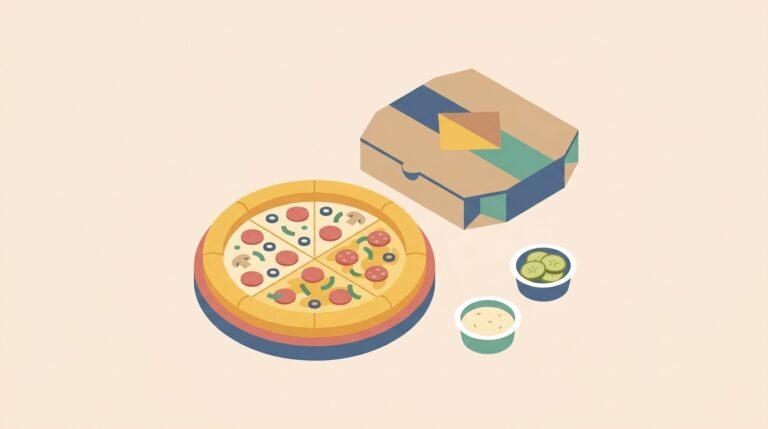
Picture this: You are watching your favorite K-Drama. The main characters have just solved a massive mystery or survived a tough day at work. What do they do? They sit on the floor, open a giant delivery box, and pull apart a slice of pizza loaded with Bulgogi, dripping with cheese, and surrounded by a bright yellow sweet potato crust.
Your mouth waters. You open a Korean food delivery app (like Baemin or Yogiyo) to order the exact same thing. But suddenly, you are faced with a wall of Korean text. Crust options? Half-and-half? Review events? Request to the rider?
Ordering pizza in Korea isn’t just about saying “Pepperoni, please.” It’s an entire cultural experience involving endless customization, lightning-fast delivery, and a side of sweet pickles. If you don’t know the right vocabulary, you might end up with a plain cheese pizza when you could have had a legendary K-Pizza masterpiece.
Don’t worry! I’ve helped hundreds of expats and students navigate the beautiful, delicious world of Korean food delivery. This guide is built from their real-life late-night cravings. Let’s dive in!
Phase 2: Core Expressions Deep Dive
Let’s learn the most essential phrases you need to conquer the pizza menu!
1. 반반 피자 되나요?
- Pronunciation: ban-ban pi-ja doe-na-yo? [Sounds like: ‘barn-barn’ (without the r) + ‘pee-jah’ + ‘dweh-nah-yo?’]
- Meaning: (Literal) Does half-and-half pizza work? / (Real nuance) Can I order a half-and-half pizza?
- K-Culture Moment: You are with a friend. You want Spicy Chicken, they want Sweet Potato. In Korea, you never have to fight. You just say “Ban-ban!” It’s the same logic used for Korean fried chicken (Yangnyeom and Fried).
- Editor’s Insight: ‘반’ (ban) means ‘half’. Repeating it means ‘half and half’. This phrase is a lifesaver because Koreans love variety.
- Situation Spectrum:
- Casual with friends: ✅ (반반 하자! – Let’s do half-and-half!)
- Ordering on the phone/app: ✅
- Formal: ⚠️ (Not usually used in formal business settings, but perfectly fine for ordering food)
- 🤔 Think About It: Why is “half-and-half” so popular in Korea? Could it be related to the culture of sharing meals rather than eating individual portions?
2. 고구마 무스 추가해 주세요.
- Pronunciation: go-gu-ma mu-seu chu-ga-hae ju-se-yo. [go-goo-mah moo-seu choo-gah-heh joo-seh-yo]
- Meaning: (Literal) Please add sweet potato mousse. / (Real nuance) I’d like the sweet potato crust, please.
- K-Culture Moment: K-Pizza is famous globally for its sweet and savory combinations. The golden ring of sweet potato mousse around the edge of the pizza is a staple. If you haven’t tried it, you haven’t truly experienced Korean pizza.
- Editor’s Insight: ‘추가하다’ (chu-ga-ha-da) means ‘to add’. You can use this magic word for anything: extra cheese, extra pepperoni, or extra sauce!
- Situation Spectrum:
- Adding toppings on an app: ✅
- Asking a waiter: ✅
- Talking to older people: 🚫 (Not a conversational phrase, strictly for ordering)
- 🤔 Think About It: Koreans love mixing sweet and savory (단짠단짠 – dan-jjan-dan-jjan). Do you have a favorite sweet and savory combo in your home country?
3. 문 앞에 두고 가주세요.
- Pronunciation: mun a-pe du-go ga-ju-se-yo. [moon ah-peh doo-go gah-joo-seh-yo]
- Meaning: (Literal) Please put it in front of the door and go. / (Real nuance) Please leave it at the door.
- K-Culture Moment: You’re in your pajamas, totally unprepared for human interaction. Thanks to Korea’s ultra-safe delivery culture, contactless delivery is the default.
- Editor’s Insight: This is arguably the most typed sentence on Korean delivery apps. You will often see a checkbox for this exact phrase when checking out.
- Situation Spectrum:
- Writing in the delivery app notes: ✅
- Speaking to the delivery rider on the intercom: ✅
- Talking to friends: 🚫
- 🤔 Think About It: How much trust does a society need to have for “leaving food/packages at the door” to become the absolute norm?
Phase 3: Textbook vs. Real Korean
Let’s see how people actually speak when ordering.
[Situation 1: Asking for a split pizza]
* 📖 Textbook Korean: 피자를 반씩 다르게 만들어 주실 수 있습니까? (Can you make the pizza differently by halves?)
* 🗣️ Real Korean: 불고기, 포테이토 반반(이)요. (Bulgogi, Potato half-and-half, please.)
* 💡 Why the difference?: Korean is a highly contextual language. We drop unnecessary verbs and subjects. Just saying the nouns + “Ban-ban” is the most efficient and natural way.
[Situation 2: Giving Delivery Instructions]
* 📖 Textbook Korean: 도착하시면 문 앞에 놓아 주시기를 바랍니다. (I hope you place it in front of the door when you arrive.)
* 🗣️ Real Korean: 문 앞에 두고 벨 눌러주세요. (Leave it at the door and ring the bell.)
* 💡 Why the difference?: Delivery riders are incredibly busy in the Bbali Bbali (hurry hurry) culture. Keep instructions short, polite, and to the point.
Bottom Note: At the A2 level, you don’t need complex sentences to order food. Using nouns and simple polite endings (~주세요 / please give me) is the smartest strategy!
Phase 4: Cultural Context — K-Culture Deep Dive
4-1. The Non-Verbal Vibe
When the delivery rider rings your intercom, don’t panic! You don’t need to have a long conversation. Just say “네~ 문 앞에 두고 가주세요” (Yes~ please leave it at the door) and press the button to open the main building door. In Korea’s fast-paced delivery culture, speed is a sign of respect.
4-2. K-Food Connection: The Holy Trinity of K-Pizza
When your pizza arrives, you might be surprised by what’s inside the plastic bag.
1. Pickles (피클): Korean pizza ALWAYS comes with a small tub of sweet, crunchy pickles. Eating pizza without pickles in Korea is almost a crime.
2. Garlic Dipping Sauce (갈릭 디핑 소스): A sweet and savory garlic mayo sauce. You dip your pizza crust into it. It is life-changing.
3. Hot Sauce (핫소스): Tiny packets of hot sauce are standard.
Critical Point: Why is Korean pizza so sweet? Korean cuisine traditionally balances spicy, salty, and sweet. The sweet potato mousse or sweet bulgogi acts as a perfect counter-balance to salty cheese and spicy hot sauce!
Phase 5: Real-Life Roleplay Scenario
Setting: Friday night. You are hanging out at your Korean friend Minji’s apartment. You’re both binge-watching a new thriller K-Drama. Suddenly, Minji pauses the TV and grabs her phone.
Characters:
– YOU: A hungry expat who wants to experience authentic K-Pizza.
– Minji (28): Your Korean friend who knows all the best delivery spots.
Dialogue:
Minji: 아, 배고프다. 우리 피자 배달 시킬까? 🍕
(a, bae-go-peu-da. u-ri pi-ja bae-dal si-kil-kka?)
[Ah, I’m hungry. Should we order pizza delivery?]
YOU: 완전 좋지! 나 배고파.
(wan-jeon jo-chi! na bae-go-pa.)
[Totally! I’m hungry.]
Minji: 무슨 맛 먹고 싶어?
(mu-seun mat meok-go si-peo?)
[What flavor do you want to eat?]
🔀 Your Turn! How will you answer?
– A) “그냥 치즈 피자!” (Just cheese pizza!)
– B) “불고기랑 고구마 반반 어때?” (How about Bulgogi and Sweet Potato half-and-half?)
– C) “아무거나! 네가 골라.” (Anything! You choose.)✅ Best Choice: B — You are showing off your K-Culture knowledge! You get two amazing flavors in one.
⚠️ Choice C Analysis: “Anything” is polite, but in Korea, friends appreciate it when you express your preference clearly, especially for shared food!
(Assuming you chose B)
Minji: 오~ 역시! 반반 피자로 해야겠다. 크러스트는 고구마 무스 추가할까?
(o~ yeok-si! ban-ban pi-ja-ro hae-ya-get-da. keu-reo-seu-teu-neun go-gu-ma mu-seu chu-ga-hal-kka?)
[Oh~ as expected! We should do half-and-half. Should we add sweet potato mousse to the crust?]
YOU: 당연하지! 고구마 무스 꼭 추가해 주세요~!
(dang-yeon-ha-ji! go-gu-ma mu-seu kkok chu-ga-hae ju-se-yo~!)
[Of course! Please definitely add sweet potato mousse~!]
Minji: (Typing on the app) 오케이, 주문 완료! ‘문 앞에 두고 벨 눌러주세요’라고 남겼어.
(o-ke-i, ju-mun wal-ryo! ‘mun a-pe du-go bel nul-reo-ju-se-yo’ra-go nam-gyeot-seo.)
[Okay, order complete! I left a note saying ‘Please leave at the door and ring the bell’.]
Phase 6: 10-Second Shadowing Drill
Time to practice! Repeat this sentence out loud. Pay attention to the rhythm.
😊 불고기 피자 / 고구마 피자 / 반반 되나요?
(bul-go-gi pi-ja / go-gu-ma pi-ja / ban-ban / doe-na-yo?)
Emotion: Friendly and excited! Raise your pitch slightly at the end to make it a polite question.
😤 문 앞에 / 두고 / 가주세요.
(mun a-pe / du-go / ga-ju-se-yo.)
Emotion: Polite but direct. No need to sound too excited here.
Phase 7: K-Culture Mini Dictionary
Here are some keywords you will see on every Korean food delivery app.
| Korean | Romanization | English | Context |
|---|---|---|---|
| 배달팁 | baedaltip | Delivery fee | The extra fee charged for delivery. Usually ranges from 2,000 to 5,000 KRW. |
| 리뷰 이벤트 | ribyu ibenteu | Review Event | A promotion where restaurants give you free sides (like extra cheese) if you promise to leave a 5-star photo review! |
| 사이드 메뉴 | saideu menyu | Side Menu | Options like cheese balls (치즈볼), spaghetti, or wings. |
| 갈릭 디핑 소스 | gallik diping soseu | Garlic Dipping Sauce | The ultimate savory dipping sauce for your pizza crust. |
Phase 8: Traveler Survival Kit
Ordering delivery to a hotel or an Airbnb? Here is what you need to know!
🆘 Survival Phrase #1: Finding your location
– 🇰🇷 “여기 (호텔 이름/주소) 인데요.” (yeo-gi [Hotel name] in-de-yo.)
– 🗣️ Pronunciation: yuh-gee [Hotel name] in-deh-yo.
– 📍 Where to use: If the rider calls you because they are lost.
– 💡 Pro Tip: Hotel lobbies usually don’t allow delivery riders to go up to your room. You will likely have to go down to the 1st floor lobby to meet them. Say: “1층 로비로 갈게요” (il-cheung ro-bi-ro gal-ge-yo / I will go to the 1st floor lobby).
📌 Editor’s Travel Note:
– Delivery Apps: Apps like Baemin (배달의민족) and Yogiyo (요기요) are great, but they often require a Korean phone number and credit card. If you are a tourist, try the app Shuttle Delivery—it’s fully in English and accepts foreign cards!
– Payment: If you manage to use a Korean app but can’t pay online, select the “만나서 결제” (Pay upon meeting) option. You can pay the rider directly with cash or a physical credit card.
Phase 9: Critical Thinking — “One Step Deeper”
🧠 Think Deeper: Food & Identity (The Culture of Sharing)
Why do Koreans rarely order individual, personal-sized pizzas? In Korea, food is deeply tied to community and togetherness (Jeong – 정). Eating a meal together means sharing the same dish. That’s why large pizzas, meant to be placed in the center of the table, are the standard. The invention of the “Half-and-Half” (반반) pizza is the ultimate compromise—allowing everyone to share one large meal while still respecting different taste preferences. It reflects a society that values collective harmony over individual separation.
💬 Your Turn: In your culture, do people prefer ordering individual dishes, or sharing a large meal together? Let me know in the comments!
Phase 10: FAQ & Avoiding Misunderstandings
Q: Should I tip the pizza delivery rider in Korea?
A: NO! 🚫 There is absolutely no tipping culture in Korea. The delivery fee (배달팁) is already included in your bill. Trying to hand cash to the rider as a tip will only confuse them!
Q: Can I just write instructions in English on the app?
A: It’s risky. While some riders might understand basic English, they are driving fast and looking at their phones quickly. Use the Korean phrase: “문 앞에 두고 가주세요” to ensure there are no mix-ups.
❌ Common Mistake #1: Forgetting to write your apartment building and unit number.
✅ Do this instead: Korean addresses can be tricky. Always double-check your “동” (Building number) and “호” (Unit number). For example: 101동 203호 (Building 101, Unit 203).
Phase 11: Summary & Action Items
One-Liner Summary: To order pizza like a true local, remember to ask for Half-and-Half (반반) and always request Sweet Potato Mousse (고구마 무스)!
Your Action Missions:
– 🥉 Bronze: Say “문 앞에 두고 가주세요” out loud 3 times right now.
– 🥈 Silver: Leave a comment below telling us what your favorite “Ban-ban” pizza combination would be!
– 🥇 Gold: Next time you are in Korea, successfully order a pizza to your hotel or Airbnb using the phrases you learned today.
🍕 K-Culture Mission: Go to Google Images and search “한국 반반 피자” (Korean Half-and-Half Pizza). Look at how wild and creative the toppings get. Which one looks the tastiest to you?
Phase 12: Quiz — Interactive Challenge
Let’s test your K-Pizza knowledge!
1. Situational Judgment: You want to order a pizza with two different flavors. What should you say?
– A) 불고기 피자 하나, 치즈 피자 하나 주세요.
– B) 불고기, 치즈 반반 되나요?
– C) 고구마 무스 추가해 주세요.
2. True or False – K-Culture Edition: When the delivery driver arrives, you should give them a 10% tip for being so fast.
– True / False
3. Fill in the blank: You want the delivery person to leave the food at your door because you are in your pajamas.
“문 앞에 ( ______ ) 가주세요.”
(Toggle for Answers below)
Click here to see the answers!
1. B (A means you are ordering TWO whole pizzas. B is the “half-and-half” magic word!)
2. False (No tipping in Korea! Ever!)
3. 두고 (du-go, meaning “put and”)
Frequently Asked Questions (FAQ)
Q: What does "반반 피자 되나요?" mean in Korean and how do you pronounce it?
A: In Korean, "반반 피자 되나요?" is pronounced [ban-ban pi-ja doe-na-yo? [Sounds like: 'barn-barn' (without the r] and means: (Literal) Does half-and-half pizza work? / (Real nuance) Can I order a half-and-half pizza?
Q: What does "고구마 무스 추가해 주세요." mean in Korean and how do you pronounce it?
A: In Korean, "고구마 무스 추가해 주세요." is pronounced [go-gu-ma mu-seu chu-ga-hae ju-se-yo. [go-goo-mah moo-seu choo-gah-heh joo-seh-yo] and means: (Literal) Please add sweet potato mousse. / (Real nuance) I'd like the sweet potato crust, please.
Q: What does "문 앞에 두고 가주세요." mean in Korean and how do you pronounce it?
A: In Korean, "문 앞에 두고 가주세요." is pronounced [mun a-pe du-go ga-ju-se-yo. [moon ah-peh doo-go gah-joo-seh-yo] and means: (Literal) Please put it in front of the door and go. / (Real nuance) Please leave it at the door.






