

Phase 1: Empathy (Welcome to the Real Korean Street!)
Hello! I’m your Daily Hangul Editor.
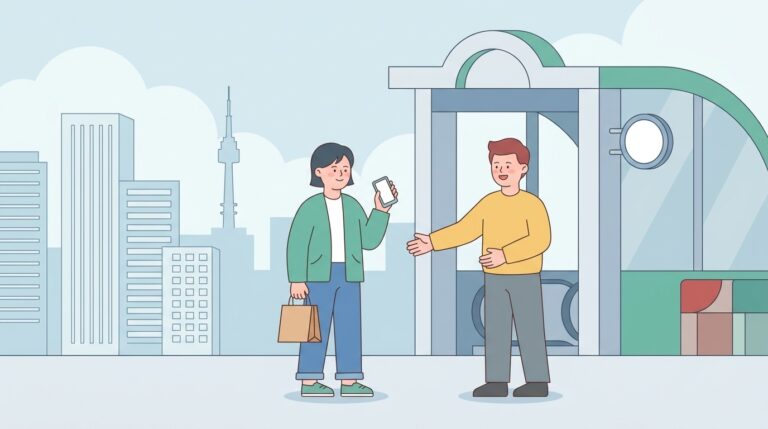
Imagine this: You are standing outside Exit 3 of Gangnam Station on a Friday evening. You have your phone in one hand and a small paper bag in the other. You are looking around anxiously, making awkward eye contact with strangers. Is it a K-Drama scene where the main character waits for a blind date? No! You are about to do a 직거래 (In-person transaction) for a K-Pop photocard you found online!
Suddenly, someone approaches you and says, “Are you… a carrot?” Wait, what? A carrot?
If you don’t know the cultural context behind Korea’s massive second-hand trading app, ‘Danggeun Market’ (Karrot), you might think you misheard them. Today, we are going to learn the essential survival phrases for making second-hand trades in Korea. Knowing these will not only help you safely get your hands on that limited-edition album or affordable winter coat, but you’ll also look like a total local “Insider” (인싸)!
(Note: This guide is tailored for A1 beginners based on real experiences of our expat students in Seoul!)
Phase 2: Deep Dive into Core Expressions
1. 당근이세요? (Are you Karrot?)
- Pronunciation: [danggeun-iseyo?] Sounds like: dang-gun-ee-say-yo?
- Meaning: Literal: “Are you a carrot?” / Real Nuance: “Are you the person from the Karrot market app?”
- K-Culture Moment: You’ll see this everywhere. In cafes, subway stations, and convenience stores, two strangers awkwardly lock eyes and whisper, “Danggeun-iseyo?” It’s practically a national password for second-hand buyers and sellers.
- Editor’s Insight: The word ‘Danggeun’ (Carrot) sounds like ‘Dang-yeon’ (Of course) in Korean. The app’s name is a pun! It’s spoken with a slightly rising, questioning tone, almost like you are carefully knocking on a door.
- Situation Spectrum:
- Casual (Strangers on the street): ✅
- Formal/Business: 🚫 (Don’t say this in a corporate meeting!)
- 🤔 Think About It: Why do Koreans use the app’s name instead of asking “Are you the seller?” How do you identify online buyers in your home country?
2. 이거 맞아요? (Is this correct?)
- Pronunciation: [igeo majayo?] Sounds like: ee-guh ma-ja-yo? (The ‘j’ is soft)
- Meaning: Literal: “Is this right?” / Real Nuance: “Is this the right item?” or “Is this the right amount of money?”
- K-Culture Moment: The seller hands you the K-Pop album. Before you hand over the cash, you quickly check the photocard inside and say, “Igeo majayo?” to confirm. It’s polite but ensures you aren’t getting scammed.
- Editor’s Insight: This is a magic phrase for A1 learners! You can use it when pointing at a menu, checking a subway map, or confirming a transaction.
- Situation Spectrum:
- Casual / Semi-formal: ✅
- Formal (Boss/Elders): ⚠️ (Use ‘이거 맞습니까?’ instead)
- 🤔 Think About It: Koreans value fast transactions (빨리빨리 – ppalli-ppalli). Asking “Igeo majayo?” directly gets right to the point without wasting time.
3. 감사합니다. 많이 파세요! (Thank you. Sell a lot!)
- Pronunciation: [gamsahamnida. mani paseyo!] Sounds like: gam-sa-ham-ni-da. ma-nee pa-say-yo!
- Meaning: Literal: “Thank you. Sell a lot!” / Real Nuance: “Thanks for the good deal, wishing you success!”
- K-Culture Moment: The transaction is done. You bow your head slightly, take your item, and say this before turning around.
- Editor’s Insight: “Sell a lot” is a very traditional Korean well-wishing phrase used for store owners, but it has naturally carried over to peer-to-peer second-hand trades!
- Situation Spectrum:
- To a seller (Any age): ✅
- 🤔 Think About It: Why do Koreans wish a random stranger financial success (“Sell a lot”)? It shows the Korean culture of ‘Jeong’ (정 – warm community feeling) even in quick business deals.
Phase 3: Textbook vs. Real Korean
[Identifying the Person]
* 📖 Textbook Korean: 중고 거래하러 오셨습니까? (Did you come for the second-hand transaction?)
* 🗣️ Real Korean: 당근이세요? 🥕 (Are you Karrot?)
* 💡 Why the difference?: The Karrot app dominates the market so completely that the brand name became the verb/noun for the action itself (like Googling).
[Handing over the money]
* 📖 Textbook Korean: 여기 현금이 있습니다. (Here is the cash.)
* 🗣️ Real Korean: 계좌이체 할게요. (I will do a bank transfer) OR 여기요~ (Here you go~)
* 💡 Why the difference?: Korea is a highly cashless society. Most people prefer instant bank transfers right on the spot rather than dealing with coins.
Phase 4: Cultural Context — K-Culture Deep Dive
4-1. Non-Verbal Elements: The Art of the ‘Bowing Hand-off’
Even though it’s just a quick trade, Koreans use 두 손 (Two hands). When taking the item or giving cash, use both hands, or place your left hand lightly under your right arm or elbow. Give a slight nod of the head (a mini-bow). Don’t stare too intensely into their eyes; a soft, brief eye contact is enough. This shows ‘눈치’ (Nunchi) — reading the room to keep the vibe polite but brief.
4-2. The Ultimate K-Pop & K-Travel Connection
If you love K-Pop, you will eventually do a 포카 양도 (Photocard transfer). The most common meeting place? Subway turnstiles (개찰구).
Sellers will often say: “개찰구 밖으로 나오지 마세요” (Don’t come out of the turnstile).
Why? Because in Korea, you get charged if you exit and re-enter the subway! So, the buyer and seller meet over the barrier. One person is inside the gate, one is outside. It’s a classic Seoul survival tactic!
Phase 5: Practical Roleplay Scenario
Setting: Friday evening, 6:00 PM. Hongik University Station, Exit 2. You are buying a rare BTS photocard. You see someone holding a small envelope.
Characters:
– YOU: An A1 Korean learner, very excited but nervous.
– Ji-eun (20s): The seller, looking at her phone, tapping her foot.
Dialogue:
YOU: 저기요… 혹시… 당근이세요?
(jeogiyo… hoksi… danggeun-iseyo?)
[Excuse me… by any chance… are you Karrot?]
(🎭 Stage Direction: You cautiously approach, holding up your phone screen)
Ji-eun: 아, 네! 포카 사시는 분 맞으시죠?
(Ah, ne! Poka sasineun bun majeusi-jyo?)
[Ah, yes! You’re the one buying the photocard, right?]
YOU: 네! 이거 맞아요?
(Ne! Igeo majayo?)
[Yes! Is this it?]
Ji-eun: 네, 확인해 보세요.
(Ne, hwaginhae boseyo.)
[Yes, please check it.]
🔀 Your Turn! How do you finish the transaction politely?
– A) “오케이. 바이.” (Okay. Bye.)
– B) “감사합니다. 안녕히 가세요!” (Thank you. Goodbye!)
– C) “사랑해요!” (I love you!)✅ Best Choice: B — Always end with a polite “Thank you” and “Goodbye.”
⚠️ Choice A & C Analysis: ‘Okay. Bye’ sounds rude and way too casual for a stranger. ‘I love you’ is hilarious but will definitely creep the seller out!
Phase 6: 10-Second Shadowing Drill
Let’s practice the golden phrase. Pay attention to the pauses (/) and the emotion!
🥺 (Shyly but clearly) 저기요... / 당근이세요? (jeo-gi-yo... / dang-geun-i-se-yo?)
😊 (Brightly) 감사합니다! / 안녕히 가세요! (gam-sa-ham-ni-da! / an-nyeong-hi ga-se-yo!)
Phase 7: K-Culture Mini Dictionary
| Korean | Romanization | English | Context |
|---|---|---|---|
| 당근 | danggeun | Carrot / The App | Short for Danggeun Market (Karrot). The #1 second-hand app. |
| 직거래 | jikgeorae | Direct Trade | Meeting in person to buy/sell, avoiding shipping fees. |
| 포카 | poka | Photocard | Short for 포토카드. The most traded K-pop merchandise! |
| 네고 | nego | Negotiation | Asking for a discount. (e.g., “네고 되나요?” = Can you lower the price?) |
Phase 8: Traveler’s Survival Kit
Meeting a stranger in a foreign country can be scary. Here are the top 3 phrases you need to survive a street meet-up!
🆘 Survival Phrases
– 🇰🇷 “어디로 갈까요?” (eodiro galkkayo?)
– 🗣️ Pronunciation: [uh-dee-ro gal-kka-yo?]
– 📍 Meaning: Where should I go? (To ask for the meeting spot)
- 🇰🇷 “도착했어요.” (dochakaesseoyo.)
- 🗣️ Pronunciation: [do-chak-hae-sseo-yo.]
- 📍 Meaning: I have arrived.
🇰🇷 “잠시만요.” (jamsimanyo.)
- 🗣️ Pronunciation: [jam-shi-man-yo.]
- 📍 Meaning: Just a moment. (Crucial when you need time to check the item or count money!)
📌 Editor’s Travel Note
– Best Meeting Spots: Subway exits (지하철 출구) or right in front of convenience stores (편의점). They are well-lit, safe, and have CCTV.
– Punctuality: Koreans are extremely punctual (Korean Time is fast!). Do not be late for a 직거래!
Phase 9: Critical Thinking — “One Step Deeper”
🧠 Think Deeper: High Trust Society & “Manner Temperature”
Why are in-person trades so popular and safe in Korea? It reflects Korea’s status as a ‘High-Trust Society’. In cafes, Koreans leave their laptops unattended to go to the restroom. This same trust applies to the Danggeun app, which uses a system called “Manner Temperature” (매너온도). You start at 36.5°C (human body temp) and it goes up if you are polite and punctual. It proves that in Korean culture, your reputation and manners are your most valuable currency.
💬 Your Turn: Does your country have a popular second-hand app? How do people ensure trust when meeting strangers? Let us know in the comments!
Phase 10: FAQ & Mistake Prevention
Q: “Can I ask for a discount (Nego) when we meet face-to-face?”
– NO! This is considered very bad manners in Korea. All price negotiations must be done in the app before you meet. If you try to lower the price on the spot, the seller will leave.
Q: “Should I give a tip if the seller traveled far to meet me?”
– NO. Korea has absolutely no tipping culture. If you give them extra money, they will get confused and think you made a mistake.
❌ Common Mistake #1: Speaking in Banmal (Casual Korean) just because you are the buyer.
✅ Do this instead: Always use “-요 (-yo)” or “-습니다 (-seumnida)” endings. Just because you are giving them money doesn’t make you their boss!
Phase 11: Summary & Action Items
- One-Liner Summary: Find your seller by asking “당근이세요?”, check the item, and always say “감사합니다” to complete the perfect Korean street trade!
-
Action Mission 3 Steps:
- 🥉 Bronze (Solo): Look in the mirror and practice asking “당근이세요?” with a polite smile.
- 🥈 Silver (Online): Look up ‘당근마켓 직거래’ on YouTube and watch a vlog of Koreans doing it.
- 🥇 Gold (Real Life): Next time you visit Korea, try buying something cheap (like a $2 photocard or cute sticker) on a second-hand app and do a real 직거래!
- K-Culture Mission:
Search for K-Pop photocards on X (Twitter) or Korean forums and see how many times the word “직거래” or “양도” (transfer) comes up!
Phase 12: Quiz — Interactive Challenge
1. Situational Judgment: You arrive at Gangnam Station Exit 3. You see a person looking at their phone. What is the most natural first thing to say?
– A) 중고 거래하러 오셨습니까? (Did you come for the trade?)
– B) 이름이 뭐예요? (What is your name?)
– C) 당근이세요? (Are you Karrot?)
2. True or False – K-Culture Edition:
– It is common and polite to negotiate the price after you meet the seller face-to-face. (T / F)
3. Fill in the Blank:
You need to check if the K-Pop album has any scratches before paying. You say: “____ 맞아요?”
– A) 저기
– B) 이거
– C) 고기
(Answers: 1. C, 2. F – Negotiate beforehand!, 3. B)
Frequently Asked Questions (FAQ)
Q: What does "당근이세요? (Are you Karrot?)" mean in Korean and how do you pronounce it?
A: In Korean, "당근이세요? (Are you Karrot?)" is pronounced [danggeun-iseyo?] and means: Literal: "Are you a carrot?" / Real Nuance: "Are you the person from the Karrot market app?"
Q: What does "이거 맞아요? (Is this correct?)" mean in Korean and how do you pronounce it?
A: In Korean, "이거 맞아요? (Is this correct?)" is pronounced [igeo majayo?] and means: Literal: "Is this right?" / Real Nuance: "Is this the right item?" or "Is this the right amount of money?"
Q: What does "감사합니다. 많이 파세요! (Thank you. Sell a lot!)" mean in Korean and how do you pronounce it?
A: In Korean, "감사합니다. 많이 파세요! (Thank you. Sell a lot!)" is pronounced [gamsahamnida. mani paseyo!] and means: Literal: "Thank you. Sell a lot!" / Real Nuance: "Thanks for the good deal, wishing you success!"







