

Phase 1: Empathy (Immersion Open)
Hello! I am the Lead Editor of Daily Hangul.
Picture this: You are watching your favorite K-Drama. The male and female leads are arguing in the pouring rain. Suddenly, the male lead steps closer, looks deeply into her eyes, and drops the ‘yo’ (요) at the end of his sentence. The female lead freezes, her eyes widen, and the background music swells. The subtitles just say, “I like you,” but you can feel a massive shift in the atmosphere.
Why did that one little missing syllable make everyone’s heart skip a beat?
Welcome to the magic—and sometimes the terror—of Speech Levels (화계, Hwagye) in Korean! If you’re at the B1 level, you already know how to conjugate verbs. But knowing how to conjugate is only half the battle. Knowing when to use Jondaetmal (Polite/Formal) versus Banmal (Casual) is the real secret to surviving and thriving in Korea.
Using the wrong level can make you sound like a robot, or worse, accidentally rude. But master it? You’ll instantly earn that ‘Insider’ (인싸) respect from locals. This guide is built on real questions from students just like you, who have frozen in a convenience store wondering, “Wait, do I use -yo with this cashier?”
Let’s decode the hidden social matrix of the Korean language.
Phase 2: In-Depth Analysis of Core Expressions
To master Korean speech levels, you don’t need a textbook chart; you need to feel the ‘vibe’ of these three core endings.
1. [~아/어요]
- Pronunciation: [-a/eo-yo] + [Sounds like a soft, bouncy ‘yo’ at the end of your breath]
- Meaning: Polite / Standard level (해요체)
- K-Culture Moment: You walk into a cozy cafe in Hongdae. The barista smiles and asks, “주문하시겠어요?” (Would you like to order?). You reply, “아이스 아메리카노 하나 주세요.” (One iced americano, please). It’s smooth, respectful, and safe.
- Editor’s Insight: This is your Golden Shield. When in doubt, end your sentence in ‘yo’. It’s polite but not overly stiff. It says, “I respect you, but we can still be friendly.”
- Situation Spectrum:
- Close Friends (Casual): ⚠️ (Too distant!)
- Co-workers (Semi-formal): ✅
- Boss / Elders / Strangers (Formal): ✅
- 🤔 Think About It: Why do Koreans use ‘yo’ even with people they see every day at work? How does your culture maintain boundaries and respect with colleagues?
2. [~ㅂ/습니다]
- Pronunciation: [-p/seum-ni-da] + [The ‘ㅂ/습’ is sharp, like snapping a briefcase shut]
- Meaning: Formal / Deferential level (하십시오체)
- K-Culture Moment: You are watching a news broadcast, or a K-Pop idol is giving an official acceptance speech at an award ceremony: “팬 여러분, 진심으로 감사합니다!” (Fans, thank you from the bottom of my heart!).
- Editor’s Insight: This is the ‘suit and tie’ of Korean endings. It’s highly respectful, public, and objective. If you use this with a friend at a pub, they will think you are acting in a historical drama or making a joke.
- Situation Spectrum:
- Close Friends (Casual): 🚫
- Co-workers (Semi-formal): ⚠️ (Only in meetings)
- Boss / Public Speaking (Formal): ✅
- 🤔 Think About It: Why do idols switch from energetic ‘yo’ to stiff ‘seumnida’ when they receive an award? What does this say about the importance of ‘public image’ in Korea?
3. [~아/어]
- Pronunciation: [-a/eo] + [Just chop off the ‘yo’. Let the vowel hang in the air!]
- Meaning: Casual / Intimate level (해체 / 반말 – Banmal)
- K-Culture Moment: Two high school friends in a webtoon are walking home, sharing tteokbokki. “너 이거 먹을래?” (You wanna eat this?). “아니, 배불러.” (Nah, I’m full).
- Editor’s Insight: Banmal is the ultimate sign of closeness. But it’s a double-edged sword. Dropping the ‘yo’ without permission to an older person or a stranger is considered incredibly disrespectful. It’s like walking into someone’s house with muddy shoes.
- Situation Spectrum:
- Close Friends (Casual): ✅
- Co-workers (Semi-formal): 🚫 (Unless explicitly agreed upon)
- Boss / Elders (Formal): 🚫 (Never!)
- 🤔 Think About It: In English, we just use “You” for everyone. But in Korean, moving from Jondaetmal to Banmal requires a mutual agreement. Why is social hierarchy so deeply embedded in Korean grammar?
Phase 3: Textbook vs. Real Korean
[Situation 1: Meeting a colleague of the exact same age]
* 📖 Textbook Korean: “우리는 나이가 같네요. 반말을 합시다.” (We are the same age. Let us speak casually.) – Robot alert!
* 🗣️ Real Korean: “어? 동갑이네요? 우리 말 편하게 할까요?” (Oh? We’re the same age? Shall we speak comfortably?)
* 💡 Why the difference?: Koreans don’t just abruptly switch to Banmal. Asking “Shall we speak comfortably?” (말 편하게 할까요?) shows high Nunchi and respects the other person’s boundaries.
[Situation 2: Asking for something at a local restaurant]
* 📖 Textbook Korean: “사장님, 물 한 잔 주시겠습니까?” (Boss, would you please give me a glass of water?) – Too formal!
* 🗣️ Real Korean: “이모님~ 여기 물 좀 주세요!” (Auntie~ Please give us some water here!)
* 💡 Why the difference?: Using familial terms like ‘이모’ (Aunt) mixed with the polite ‘-yo’ creates a warm, community-like vibe rather than a cold business transaction.
Bottom Note: At the B1 level, your goal isn’t just to be correct; it’s to be appropriate. Default to Jondaetmal (-yo), but learn the art of asking to switch to Banmal when you make close friends!
Phase 4: Cultural Context — K-Culture Deep Dive
4-1. Non-Verbal Elements
Language is only 50% of the message. When you use Jondaetmal (-yo or -seumnida), your body language must match the speech level:
– The Two-Hand Rule: If you are speaking Jondaetmal while handing something (like a credit card to a cashier or pouring Soju for a senior), use two hands. Or, support your right elbow with your left hand.
– The Bow: A slight nod of the head naturally accompanies Jondaetmal greetings.
– Nunchi (눈치): If an older colleague says, “You can speak comfortably with me” (말 편하게 해), don’t immediately say “Okay, thanks!” (응, 고마워!). Wait a bit. Often, it’s safer to keep using Jondaetmal until you are truly close.
4-2. K-Culture Connection: The Drama ‘Banmal Drop’
In K-Dramas, the moment characters switch from Jondaetmal to Banmal is a pivotal plot point.
If they are a couple, dropping the ‘yo’ signifies that they have crossed the boundary from acquaintances to lovers. It’s an auditory kiss.
But beware! If two strangers are arguing (for example, a car accident scene) and one suddenly uses Banmal (e.g., “야, 네가 먼저 쳤잖아!” – Hey, you hit me first!), it is a declaration of war. By dropping the respect, they are essentially saying, “I don’t respect you as a member of society.”
Phase 5: Real-Life Roleplay Scenario
Setting: Friday night, 7 PM. A smoky Samgyeopsal (pork belly) restaurant near Gangnam Station. Green Soju bottles line the table. The chatter is loud.
Characters:
– YOU: A foreigner working in Korea, currently at a team dinner (회식 – Hoesik).
– Minsu: (32) Your friendly Korean co-worker who is the exact same age as you. You two agreed to use Banmal yesterday.
– Manager Kim: (45) Your strict but caring boss.
Dialogue:
Minsu: (Grabbing the tongs) 야, 오늘 고기는 내가 쏜다! 🥩
Ya, oneul gogineun naega ssonda!
[Hey, the meat is on me today!]
(🎭 Stage Direction: Minsu flips the pork belly with flair)
YOU: 오, 진짜? 잘 먹을게!
O, jinjja? jal meogeulge!
[Oh, really? I’ll eat well!]
Minsu: 많이 먹어. 일주일 동안 고생 많았어.
Mani meogeo. Iljuil dongan gosaeng manasseo.
[Eat up. You worked hard this week.]
YOU: 너도 수고했어. 건배할까?
Neodo sugohaesseo. Geonbae-halkka?
[You worked hard too. Shall we toast?]
(🎭 Stage Direction: Just as you clink glasses, Manager Kim walks in and sits at your table.)
Manager Kim: 오, 두 사람 벌써 시작했어요?
O, du saram beolsseo sijakhaesseoyo?
[Oh, you two already started?]
🔀 Your Turn! How do you respond to Manager Kim?
– A) “응! 부장님도 빨리 앉아!” (Yeah! You sit down quickly too, Manager!)
– B) “네, 부장님! 빨리 오셨네요. 여기 앉으세요!” (Yes, Manager! You arrived quickly. Please sit here!)
– C) “어, 부장님 오셨어요. 앉아.” (Oh, Manager is here. Sit.)✅ Best Choice: B — Reason: Instant context switch! Even though you were just speaking Banmal with Minsu, the moment Manager Kim speaks, you must immediately switch your brain to Jondaetmal. Notice how B uses the honorific ‘-시-‘ (오셨네요, 앉으세요) to show extra respect.
⚠️ Choice A & C Analysis: This is a one-way ticket to getting fired (or at least making things incredibly awkward). You cannot use Banmal with your boss, even outside the office!
Manager Kim: (Smiling) 네, 고마워요. 많이들 먹어요.
Ne, gomawoyo. Manideul meogeoyo.
[Yes, thank you. Eat a lot, everyone.]
Phase 6: 10-Second Shadowing Drill
Practice switching the ‘vibe’. Follow the slash (/) for pauses and the emotion tags!
😊 Friendly/Casual (With friends):
나 / 이거 / 진~~~짜 좋아해!
(na / igeo / jin~~~jja joahae!)
I really like this!
🥺 Polite/Warm (With colleagues/cafes):
저는 / 이거 / 진~~~짜 좋아해요!
(jeo-neun / igeo / jin~~~jja joahaeyo!)
I really like this!
😤 Formal/Professional (Presentation):
저는 / 이것을 / 매우 좋아합니다!
(jeo-neun / igeoseul / mae-u joahamnida!)
I highly favor this!
Phase 7: K-Culture Mini Dictionary
| 한국어 (Korean) | Romanization | English | Context/Meaning |
|---|---|---|---|
| 존댓말 | jondaetmal | Polite/Honorific speech | The standard polite language. Ends in -yo or -seumnida. The default for adults. |
| 반말 | banmal | Casual speech | Literally ‘half words’. Used with close friends, children, or those younger than you (with permission). |
| 말 놓다 | mal nota | To lower speech | Literally ‘to put words down’. The act of transitioning from Jondaetmal to Banmal. |
| 동갑 | donggap | Same age | A magic word in Korea. Being the same age makes it instantly easier to become close friends and drop the ‘yo’. |
| 눈치 | nunchi | Social sense | The ability to read the room. Crucial for knowing when it’s appropriate to switch speech levels. |
Phase 8: Traveler’s Survival Kit
Even if you aren’t living in Korea, Speech Levels matter when you travel. When interacting with service workers (taxis, cafes, convenience stores), ALWAYS use Jondaetmal (-yo).
🆘 Survival Phrases (Polite Default)
– 🇰🇷 “이거 얼마예요?” (igeo eolmayeyo?)
– 🗣️ How much is this?
– 📍 Where to use: Markets, convenience stores.
- 🇰🇷 “여기서 세워 주세요.” (yeogiseo sewo juseyo.)
- 🗣️ Please pull over here.
- 📍 Where to use: Taxis. (Do NOT say “세워!” – that sounds like a movie villain!)
🇰🇷 “화장실 어디예요?” (hwajangsil eodiyeyo?)
- 🗣️ Where is the restroom?
- 📍 Where to use: Anywhere.
📌 Editor’s Travel Note
– Age doesn’t matter here: Even if the convenience store worker looks 10 years younger than you, they are providing a service, and you are a customer. Use Jondaetmal. Mutual respect is key!
– Language Apps: Papago and Google Translate usually default to Jondaetmal, which is safe. But if you hear Koreans speaking to each other on the subway, don’t just copy their words—they might be using Banmal because they are friends!
Phase 9: Critical Thinking — “One Step Deeper”
🧠 Think Deeper: Language & Power (언어와 권력)
Why does Korean have such a complex system of respect? In English, you use the same “You” for your 5-year-old nephew and the President. But in Korea, language is a mirror of the social hierarchy, which is deeply rooted in Confucian values (유교 문화). Age, status, and intimacy aren’t just background details; they are the very foundation of how a sentence is built.
However, it’s not just about ‘submission’ to older people. Jondaetmal implies a social contract. If an older person uses Banmal to a younger person, they are also taking on the responsibility to care for them (like paying for the meal or giving advice). Language isn’t just about power; it’s about defining the relationship’s boundaries and responsibilities.
💬 Your Turn: Does your native language have formal and informal pronouns (like ‘tu’ and ‘vous’ in French, or ‘tú’ and ‘usted’ in Spanish)? Does it feel different from the Korean system? Share your thoughts in the comments!
Phase 10: FAQ & Avoiding Misunderstandings
Q: “Can I write my fan letter to my favorite K-Pop idol in Banmal? We feel so close!”
Editor’s Answer: Maybe! On platforms like Weverse or in fan letters, many fans use a cute, affectionate Banmal. Idols often use Banmal back to create a ‘boyfriend/girlfriend’ or ‘best friend’ vibe. However, at a formal fan sign event, it’s safer to start with Jondaetmal until they tell you otherwise!
Q: “If an older Korean uses Banmal to me, can I use it back?”
Editor’s Answer: NO! 🚫 In Korea, relationships can be asymmetrical. An older person might use Banmal to you to show affection and closeness, but you must continue using Jondaetmal to show respect.
❌ Common Mistake #1: Translating “You” as “당신” (Dangsin)
Foreigners often look up “You” in the dictionary and use “당신”. In real life, “당신” is only used between married couples, in poetic songs, or when you are picking a fight with a stranger!
✅ Do this instead: Drop the subject entirely (e.g., “밥 먹었어요?” instead of “당신은 밥 먹었어요?”), or use their title (e.g., “민수 씨”, “선생님”).
Phase 11: Summary & Action Items
💡 One-Liner Summary: Treat Jondaetmal (-yo) as your default protective armor in Korea, and save Banmal (dropping the -yo) as a special gift for your close friends.
🎬 Action Missions:
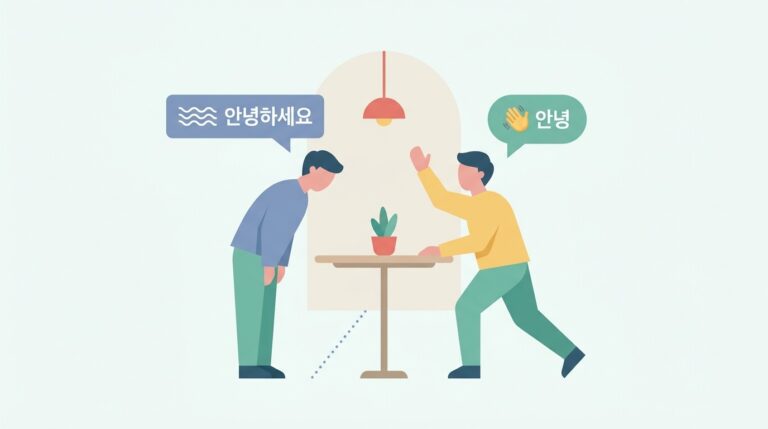
– 🥉 Bronze (Solo): Look in the mirror and say “안녕하세요” (Polite) with a slight bow, then say “안녕!” (Casual) with a friendly wave.
– 🥈 Silver (Online): Find a Korean study buddy or post on a language exchange app. Ask them: “우리 말 편하게 할까요?” (Shall we speak casually?)
– 🥇 Gold (Real World): Next time you order at a Korean restaurant or cafe, confidently finish your sentence with “~주세요” (Jondaetmal) and use both hands to receive your card!
🌟 K-Culture Mission:
Watch one episode of a K-Drama today. Try to spot the exact moment two characters switch from Jondaetmal to Banmal. Notice how their body language and tone change. Did the relationship just get romantic, or did a fight just start?
Drop a comment below: What’s the hardest part about using Jondaetmal and Banmal for you? Have you ever made a funny mistake? Let’s chat! 👇
Phase 12: Quiz — Interactive Challenge
Test your Nunchi! Check your answers below.
1. Situational Judgment: You just started a new job in Seoul. A coworker who is 3 years younger than you says, “점심 맛있게 드셨어요?” (Did you have a good lunch?). How should you reply?
A) “응, 맛있게 먹었어! 너는?” (Banmal because they are younger)
B) “네, 맛있게 먹었어요. 민수 씨는요?” (Jondaetmal because you are colleagues)
2. True or False – K-Culture Edition:
“If a taxi driver looks older than your grandfather, it is polite to call him ‘할아버지’ (Grandfather) and use Banmal like you would with your real grandfather.”
3. Fill in the Blank:
You want to suggest to your new language exchange partner (same age) that you both drop the formalities.
“우리 나이도 같은데, 말 _____ 할까요?”
(Scroll down for answers!)
🗝️ Click to reveal answers!
1. Answer: B. In the workplace, age takes a backseat to professional boundaries. Unless you both explicitly agree to use Banmal privately, always maintain Jondaetmal with colleagues, regardless of age.
2. Answer: False. Never use Banmal with service workers or strangers, regardless of age! Also, calling a driver ‘할아버지’ can be slightly offensive as it emphasizes their old age. Use ‘기사님’ (Driver) and stick to Jondaetmal.
3. Answer: 편하게. “말 편하게 할까요?” (Shall we speak comfortably?) is the most natural way to suggest dropping the formalities.
Frequently Asked Questions (FAQ)
Q: What does "[~아/어요]" mean in Korean and how do you pronounce it?
A: In Korean, "[~아/어요]" is pronounced [-a/eo-yo] and means: Polite / Standard level (해요체)
Q: What does "[~ㅂ/습니다]" mean in Korean and how do you pronounce it?
A: In Korean, "[~ㅂ/습니다]" is pronounced [-p/seum-ni-da] and means: Formal / Deferential level (하십시오체)
Q: What does "[~아/어]" mean in Korean and how do you pronounce it?
A: In Korean, "[~아/어]" is pronounced [-a/eo] and means: Casual / Intimate level (해체 / 반말 - Banmal)







