

Phase 1: Empathy (The K-Culture Cold Open)
Hello! Daily Hangul Editor here.
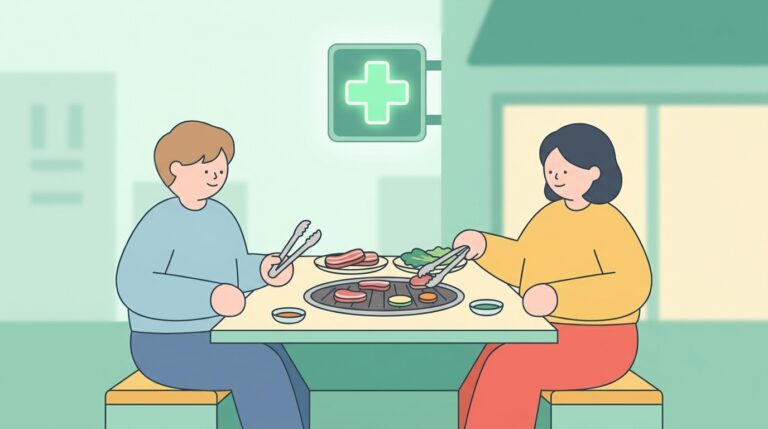
Picture this: It’s 7:30 PM on a Friday in Gangnam. You’re at an authentic K-BBQ joint (고깃집). The air is thick with the savory smoke of samgyeopsal (pork belly), clinking soju glasses, and lively chatter. Feeling confident, you grab the tongs to flip the meat like you’ve seen in countless K-Dramas. Sizzle! POP! A rogue drop of hot oil splatters right onto the back of your hand. Ouch!
Suddenly, the table falls silent. Your Korean friends look concerned. The Ahjumma (restaurant auntie) rushes over. In this split second, saying “I’m sorry” or “It hurts” isn’t going to cut it. You need ice, you need ointment, and above all, you need to assure everyone you’re okay without causing a scene.
As an advanced (C2) Korean learner, you know the basics. But navigating a Korean pharmacy (약국) for burn care involves highly specific vocabulary and a deep understanding of K-Beauty’s obsession with preventing scars. This guide is based on real frantic texts I’ve received from expat friends standing cluelessly in front of a Korean pharmacist. Let’s make sure you never have to panic!
Phase 2: Core Expressions Deep Dive
At the C2 level, we’re moving past the textbook “화상을 입었습니다” (I sustained a burn). Here is how locals actually speak when a minor grilling accident happens.
1. 기름이 튀어서 살짝 데였어요.
- Pronunciation: gireum-i twieoseo deyeosseoyo. [gee-reum-ee twee-uh-suh deh-yut-suh-yo]
- Meaning: Literal: Oil splashed so I got slightly burned. / Real Nuance: I got a minor grease burn.
- K-Culture Moment: This is the exact phrase you use to calm down the panicked table at the BBQ restaurant or to explain your situation accurately to the pharmacist. It immediately establishes that it’s a minor everyday accident, not a 119 (911) emergency.
- Editor’s Insight: Notice the verb 데이다 (to get burned). While 화상(을) 입다 is the medical term, 데이다 is the everyday colloquial verb for touching something hot. Adding 살짝 (slightly) is crucial—it’s a social cue that means “Don’t worry too much, I just need a band-aid.”
- Situation Spectrum:
- Casual (Friends): ✅ (앗 뜨거! 기름에 데였어)
- Semi-formal (Colleagues): ✅ (살짝 데인 것 같아요)
- Formal (Doctors/Elders): ✅ (기름이 튀어서 데였습니다)
- 🤔 Think About It: Why do Koreans feel the need to downplay their injuries with words like 살짝 (slightly) even when it hurts? How does this reflect the Korean “눈치” (Nunchi) culture of not wanting to be a burden or ruin the group’s mood?
2. 일단 찬물에 대고 화기부터 빼야 해요.
- Pronunciation: ildan chanmul-e daego hwagi-buteo ppaeya haeyo. [eel-dan chan-mool-eh dae-go hwa-gee-boo-tuh ppay-yah hae-yo]
- Meaning: Literal: First, put it under cold water and we must remove the fire energy. / Real Nuance: You need to run it under cold water to draw the heat out first.
- K-Culture Moment: If you get burned, a Korean mom, coworker, or restaurant owner will inevitably say this while dragging you to the sink.
- Editor’s Insight: 화기 (火氣) literally means “fire energy” or “heat.” 빼다 means “to extract.” Koreans treat burns as a process of “extracting the trapped heat” from the skin. It’s a fantastic, highly native collocation that proves you’re at a C2 level.
- Situation Spectrum:
- Casual: ✅ (빨리 화기부터 빼!)
- Semi-formal: ✅ (화기부터 빼시는 게 좋겠어요)
- Formal: ✅ (화기를 먼저 빼야 합니다)
- 🤔 Think About It: Traditional Eastern medicine heavily influences everyday Korean vocabulary (like 화기, 기운). Do you have similar medical-turned-everyday phrases in your native language?
3. 흉터 안 지게 습윤 밴드(메디폼) 붙이세요.
- Pronunciation: hyungteo an jige seubyun baendeu (medipom) buchuseyo. [hyoong-tuh ahn jee-geh seub-yoon ban-deu boo-chee-seh-yo]
- Meaning: Literal: So a scar doesn’t form, attach a moist band (Medifoam). / Real Nuance: Put a hydrocolloid patch on it so it doesn’t leave a scar.
- K-Culture Moment: Korean pharmacies and skincare are intrinsically linked. A pharmacist won’t just give you ointment; they will prescribe a whole regimen to ensure your skin remains flawless.
- Editor’s Insight: 흉터가 지다 or 흉터가 남다 means “to leave a scar.” At C2, you should know that Koreans rarely use the generic term ‘hydrocolloid dressing’ (습윤 밴드). Instead, they use the brand name 메디폼 (Medifoam) or 듀오덤 (Duoderm) like a regular noun, much like “Band-Aid” or “Kleenex.”
- Situation Spectrum:
- Casual: ✅
- Semi-formal: ✅
- Formal: ✅
Phase 3: Textbook vs. Real Korean
As an advanced learner, it’s time to ditch the robotic textbook phrases and sound like a local who’s lived in Seoul for a decade.
[Situation 1: Explaining the accident]
* 📖 Textbook Korean: 저는 불에 손을 화상 입었습니다. (I sustained a burn on my hand from the fire.)
* 🗣️ Real Korean: 아, 고기 굽다가 불판에 살짝 데였어요. (Ah, I slightly burned myself on the grill while cooking meat.)
* 💡 Why it’s different: “화상을 입다” sounds like you need an ambulance. “불판에 데이다” is precise, everyday language that identifies the exact culprit (the hot grill plate).
[Situation 2: Asking the pharmacist for medicine]
* 📖 Textbook Korean: 화상 치료 약을 주십시오. (Please give me burn treatment medicine.)
* 🗣️ Real Korean: 화상 연고랑 메디폼 좀 주세요. 물집은 안 잡혔어요. (Please give me burn ointment and Medifoam. A blister hasn’t formed.)
* 💡 Why it’s different: Proactively stating whether a blister (물집) has formed saves the pharmacist from asking, showing high-level communication skills and cultural competence.
Bottom Note: At the C2 level, your goal is precision. Knowing the difference between 연고 (ointment), 밴드 (regular band-aid), and 메디폼 (hydrocolloid patch) makes your Korean incredibly natural.
Phase 4: Cultural Context — K-Culture Deep Dive
4-1. Non-verbal Communication at the Pharmacy
In Korea, pharmacists (약사님) are highly respected medical professionals. When you enter a pharmacy, you don’t just grab an ointment from a shelf and pay. You walk up to the counter, explain your symptoms to the pharmacist, and they select the best medication for you. Make eye contact, nod as they explain how to apply it, and receive the medicine with two hands to show respect.
4-2. The K-Food Connection: The Danger of the Shared Grill
Why is minor burn vocabulary so essential in Korea? Because communal table-top cooking is the heart of K-Food! Whether it’s Samgyeopsal (pork belly), Dakgalbi (spicy stir-fried chicken), or boiling Jeongol (hot pot), Koreans cook their food while eating it.
This creates a unique social dynamic. The person manning the grill (often the youngest or the host) takes on a mild physical risk to serve the group. If they get burned, the group’s collective “Jeong” (정 – affection/care) kicks in. You might see an auntie run over with ice wrapped in a towel, or jokingly suggest pouring Soju on it to sterilize it! (Note: Please don’t actually pour Soju on a burn!).
Critical Perspective: K-Dramas often romanticize the male lead perfectly grilling meat for his love interest. In reality, grease splatters everywhere, you smell like smoke for days, and minor burns are a very real occupational hazard of eating Korean BBQ.
Phase 5: Real-Life Roleplay Scenario
Setting: Friday, 8:00 PM. A bustling Korean BBQ restaurant in Hongdae. The music is loud, the exhaust pipes are humming, and the grill is sizzling.
Characters:
– YOU: An expat who’s been living in Korea for a few years. You’re grilling the meat for your team.
– Min-su: Your 32-year-old Korean coworker. Friendly, a bit dramatic, and very caring.
– Pharmacist: Professional, fast-talking, located at the pharmacy next door.
Dialogue:
YOU: (Flipping the pork belly) 자, 이제 먹어도 될 것 같아요. 드세요!
(ja, ije meogeodo doel geot gatayo. deuseyo!)
[Translation] Alright, I think it’s ready to eat. Dig in!
(🎭 Stage Direction: A loud POP from the grill. Hot oil splatters on your wrist.)
YOU: 앗, 뜨거!
(at, tteugeo!)
[Translation] Ouch, hot!
Min-su: 헐, 괜찮아요? 기름 엄청 크게 튀었는데! 크게 데인 거 아니에요?
(heol, gwaenchanayo? gireum eomcheong keuge twieonneunde! keuge de-in geo anieyo?)
[Translation] Gasp, are you okay? A huge drop of oil just splattered! Did you get a bad burn?
YOU: 아, 다행히 살짝 데인 것 같아요. 화기만 빼면 될 듯요.
(a, dahaenghi saljjak de-in geot gatayo. hwagiman ppaemyeon doel deuryo.)
[Translation] Ah, thankfully I think it’s just a minor burn. I just need to draw the heat out.
Min-su: 제가 얼음물 좀 달라고 할게요. 이모님~!
(jega eoreummul jom dallago halgeyo. imonim~!)
[Translation] I’ll ask for some ice water. Auntie~!
(🎭 Stage Direction: 15 minutes later, you walk to the pharmacy next door just to be safe.)
Pharmacist: 어서 오세요. 어떻게 오셨어요?
(eoseo oseyo. eotteoke osyeosseoyo?)
[Translation] Welcome. How can I help you?
YOU: 아까 고기 굽다가 기름에 살짝 데였는데요.
(akka gogi gupdaga gireume saljjak deyeonneundeyo.)
[Translation] I got slightly burned by hot oil while grilling meat earlier.
Pharmacist: 어디 한 번 볼까요? 아, 다행히 물집은 안 잡혔네요. 연고 드릴까요?
(eodi han beon bolkkayo? a, dahaenghi muljibeun an japhyeonneyo. yeongo deurilkkayo?)
[Translation] Let me take a look. Ah, thankfully a blister hasn’t formed. Shall I give you some ointment?
🔀 Your Turn! How should you respond as a C2 speaker?
– A) 네, 화상 약 주세요. (Yes, give me burn medicine.)
– B) 네, 화상 연고 하나 주시고요, 흉터 안 지게 메디폼도 같이 주세요.
– C) 병원에 가야 할까요? (Should I go to the hospital?)✅ Best Choice: B — Why: It shows absolute fluency. You’re anticipating the healing process (preventing scars) and using the specific vocabulary (연고, 흉터, 메디폼) that a native Korean adult would use.
⚠️ Choice A Analysis: A bit too basic and blunt for a C2 speaker.
Pharmacist: 네, 연고 얇게 바르시고, 그 위에 이 얇은 메디폼 붙이시면 흉터 안 남을 거예요.
(ne, yeongo yalpge bareusigo, geu wie i yalbeun medipom buchisimeyon hyungteo an nameul geoeyo.)
[Translation] Yes, apply a thin layer of the ointment, and if you put this thin Medifoam over it, it won’t leave a scar.
Phase 6: 10-Second Shadowing Drill
Time to perfect your pacing. Read this out loud, focusing on the pauses (/) and the natural intonation.
🥺 약사님, / 고기 굽다가 / 기름에 살짝 데였는데, / 흉터 안 지는 / 화상 연고 하나 주시겠어요?
(yaksanim, / gogi gupdaga / gireume saljjak deyeonneunde, / hyungteo an jineun / hwasang yeongo hana jusigesseoyo?)
Emotion Tag: Slightly distressed but polite (🥺). Make sure to raise your pitch slightly at the end of “주시겠어요?” to sound gentle and approachable.
Phase 7: K-Culture Mini Dictionary
Master these terms to navigate any Korean pharmacy like a pro.
| Korean | Romanization | English | Cultural Context |
|---|---|---|---|
| 화기 | hwagi | Heat / Fire energy | Used mostly with verbs like 빼다 (to extract) or 가라앉히다 (to soothe) when dealing with burns. |
| 물집이 잡히다 | muljib-i japhida | To get a blister | The passive voice ‘잡히다’ (to be caught/formed) is uniquely Korean. Blisters ‘catch’ onto you! |
| 흉터 | hyungteo | Scar | K-Beauty influence means Korean pharmacies have a massive array of scar-prevention products. |
| 메디폼 / 듀오덤 | medipom / dyuodeom | Hydrocolloid patch | Brand names used as generic terms for thick, moisture-retaining bandages used for burns and acne. |
| 심야약국 | simya yakguk | Late-night pharmacy | Essential survival knowledge. Regular pharmacies close by 8 PM, but these stay open late. |
Phase 8: Traveler’s Survival Kit
Burns happen when you least expect them—especially when you’re trying new, hot Korean street food or DIY BBQ.
🆘 Survival Expressions for Emergencies
– 🇰🇷 “근처에 심야약국 있나요?” (geuncheo-e simya yakguk innayo?)
– Is there a late-night pharmacy nearby?
– 🇰🇷 “가장 가까운 응급실이 어디예요?” (gajang gakkaun eunggeupsir-i eodiyeyo?)
– Where is the nearest emergency room?
– 🇰🇷 “소독약이랑 화상 연고 주세요.” (sodogyag-irang hwasang yeongo juseyo.)
– Please give me antiseptic and burn ointment.
– 📍 Where to use: Asking hotel concierges, taxi drivers, or convenience store workers late at night.📌 Editor’s Travel Note
– Finding a Pharmacy: Look for the word 약 (Yak) or a brightly lit Green Cross sign.
– Late Night: If pharmacies are closed, convenience stores (CU, GS25) sell very basic first-aid supplies (안전상비의약품), including basic ointments and band-aids, but usually not specialized burn ointments.
– Emergency Number: Dial 119 for medical emergencies (Fire/Ambulance). They offer translation services!
Phase 9: Critical Thinking Corner — “Going Deeper”
Food & Identity: The Ritual of the Shared Grill
Why do Koreans insist on cooking meat at the table, despite the smoke, the smell, and the constant risk of grease burns? In many Western cultures, the chef cooks in the kitchen and presents the finished dish. In Korea, cooking is the social event. The communal grill represents 정 (Jeong)—a deep, collective bond.
Taking the tongs to cook for others, risking a minor burn to ensure your coworkers get the perfectly crisped piece of pork belly, is an act of care and hierarchy. It transforms a simple meal into an active, shared struggle and triumph. The minor burns are almost like battle scars of a good night out.
💬 Your Turn: Does your culture have a dining tradition that requires active, somewhat risky participation from the diners (like fondue or hot pot)? How does it affect the mood of the meal? Share in the comments!
Phase 10: FAQ & Avoiding Misunderstandings
Q: Can I just ask for antibiotics for a burn at the pharmacy?
No. Unlike some countries where you can buy mild antibiotics over the counter, Korea strictly requires a doctor’s prescription (처방전) for all oral antibiotics and many strong antibiotic ointments.
Q: Is it polite to point at my burn when talking to the pharmacist?
Yes! In fact, it’s encouraged. Pharmacists need to visually assess whether you need basic ointment (연고) or if you need to be redirected to a dermatologist (피부과).
❌ Common Mistake #1: Confusing 데이다 (to get burned) with 베이다 (to get cut).
– “칼에 데였어요” (I got burned by a knife) ❌
– “불에 베였어요” (I got cut by the fire) ❌
✅ How to fix it: Memorize the pairs: 기름/불에 데이다 (Burned by oil/fire) vs. 칼/종이에 베이다 (Cut by knife/paper).
Phase 11: Summary & Action Items
One-Liner Summary: To handle minor burns like a local, remember to cool it down (화기를 빼다), ask for ointment (화상 연고), and prevent scars with a hydrocolloid patch (메디폼).
Action Mission:
– 🥉 Bronze: Say “기름이 튀어서 살짝 데였어요” out loud 3 times with a dramatic “Ouch!” face.
– 🥈 Silver: Search “심야약국” (late-night pharmacy) on Naver Maps or KakaoMap near your current or future Korean hotel.
– 🥇 Gold: Next time you go to a K-BBQ restaurant, take the tongs and safely grill the meat for your friends. If grease splatters, you know exactly what to say!
K-Culture Mission: Watch a K-Drama scene involving a hospital or pharmacy. Notice how the pharmacist interacts with the patient. Are they behind a high counter? Do they hand over the medicine with specific instructions? Notice the cultural respect embedded in the interaction!
Phase 12: Quiz — Interactive Challenge
1. Situational Judgment: You spilled hot Ramyeon broth on your finger. It’s red and stinging, but not blistering. What is the most natural thing to say to your Korean friend?
– A) 병원을 호출해 주세요. (Please summon a hospital.)
– B) 화상을 입어서 고통스럽습니다. (I sustained a burn and am in agony.)
– C) 앗 뜨거! 살짝 데인 것 같아요. 찬물에 화기 좀 뺄게요. (Ah, hot! I think I got a minor burn. I’ll draw the heat out in cold water.)
2. Fill in the Blank:
“약사님, 흉터 안 지게 ______ 하나 주시겠어요?”
(Pharmacist, could you give me a ______ so it doesn’t scar?)
– Hint: A popular brand of hydrocolloid patch.
3. True or False – K-Culture Edition:
“If you get a burn at 11 PM, you can buy specialized burn ointment with antibiotics at any GS25 convenience store.”
(Answers: 1. C | 2. 메디폼 (Medifoam) | 3. False. Convenience stores only carry the most basic first-aid supplies. You need to find a 심야약국 (late-night pharmacy) for specialized burn ointments.)
Frequently Asked Questions (FAQ)
Q: What does "기름이 튀어서 살짝 데였어요." mean in Korean and how do you pronounce it?
A: In Korean, "기름이 튀어서 살짝 데였어요." is pronounced [gireum-i twieoseo deyeosseoyo. [gee-reum-ee twee-uh-suh deh-yut-suh-yo] and means: Literal: Oil splashed so I got slightly burned. / Real Nuance: I got a minor grease burn.
Q: What does "일단 찬물에 대고 화기부터 빼야 해요." mean in Korean and how do you pronounce it?
A: In Korean, "일단 찬물에 대고 화기부터 빼야 해요." is pronounced [ildan chanmul-e daego hwagi-buteo ppaeya haeyo. [eel-dan chan-mool-eh dae-go hwa-gee-boo-tuh ppay-yah hae-yo] and means: Literal: First, put it under cold water and we must remove the fire energy. / Real Nuance: You need to run it under cold water to draw the heat out first.
Q: What does "흉터 안 지게 습윤 밴드(메디폼) 붙이세요." mean in Korean and how do you pronounce it?
A: In Korean, "흉터 안 지게 습윤 밴드(메디폼) 붙이세요." is pronounced [hyungteo an jige seubyun baendeu (medipom] and means: Literal: So a scar doesn't form, attach a moist band (Medifoam). / Real Nuance: Put a hydrocolloid patch on it so it doesn't leave a scar.







