

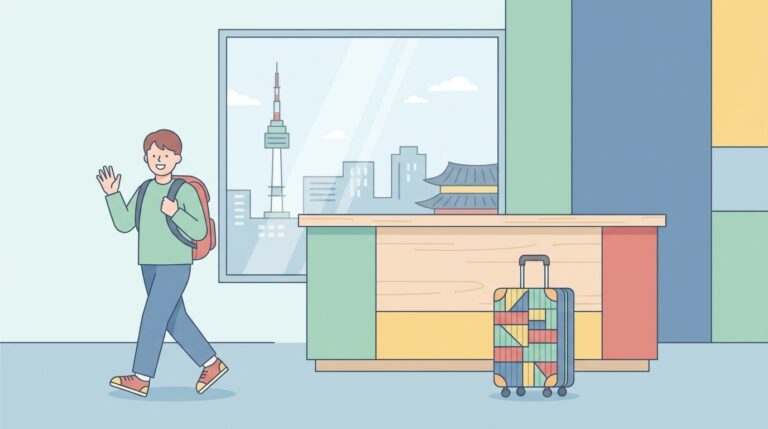
Hello! I’m your Daily Hangul Editor. Imagine this: You’ve finally landed in Seoul. You took the airport express train, and arrived at your beautiful hotel in Hongdae. But wait… it’s only 11 AM, and check-in isn’t until 3 PM! You want to run straight to a K-BBQ restaurant or explore a K-Drama filming site, but your massive 20kg suitcase is holding you back. Do you drag it around the crowded streets? Absolutely not!
Today, we’ll learn the magic phrase that will set you free. Trust me, mastering this simple A1-level phrase will make you look like a seasoned traveler. Let’s dive in!
Phase 2: Core Expression Deep Dive
1. 짐 좀 맡겨도 되나요? (Can I leave my luggage?)
- Pronunciation: jim jom matgyeodo doenayo? [Jeem johm mat-gyuh-doh dweh-nah-yo?]
- Sound-alike guide: Think of ‘짐 (jim)’ like the English word ‘gym’. For ‘맡 (mat)’, think of a door ‘mat’.
- Meaning: Can I leave my luggage? (Literal: Is it okay if I entrust my luggage a little?)
- K-Culture Moment: In K-Dramas, wealthy protagonists are always on the move. When they arrive at a luxurious Seoul hotel, they confidently drop their bags at the concierge before running off to a dramatic romantic encounter. You can have that main character energy too!
- Editor’s Insight: The word ‘좀’ (jom) literally means ‘a little’, but Koreans use it as a conversational softener. It makes your request sound much more polite and gentle, almost like saying ‘please’.
- Situation Spectrum:
- Hotel staff / Strangers (Formal): ✅
- Friends (Casual): 🚫 (Use “가방 좀 맡아줘” instead)
- 🤔 Think About It: Why do Koreans add “a little (좀)” to so many requests? How does softening a sentence show respect in Korean culture? Does your native language have a similar ‘softener’?
Phase 3: Textbook vs. Real Korean
Requesting Luggage Storage
* 📖 Textbook Korean: 제 수하물을 보관해 주시겠습니까? (je suhamureul bogwanhae jusigesseumnikka? – “Would you please store my baggage?”)
* 🗣️ Real Korean: 짐 좀 맡겨도 되나요? (jim jom matgyeodo doenayo? – “Can I leave my luggage?”)
* 💡 Why the difference?: “수하물” (baggage) and “보관하다” (to store) are formal, written words mostly used in airport announcements. In everyday life, even at luxury hotels, Koreans simply say “짐” (luggage) and “맡기다” (to entrust)!
Phase 4: Cultural Context — K-Culture Deep Dive
4-1. Non-verbal Nunchi (눈치)
When asking this, make gentle eye contact and gesture toward your bags. Don’t just shove the bags at the staff! A polite bow of the head (just a slight nod) works wonders and shows great manners.
4-2. The Korean Service Culture (K-Travel)
Korea is highly praised for its quick and accommodating service. Almost all hotels, guesthouses, and even some Airbnbs in Korea will gladly hold your bags for free before check-in or after check-out. It’s part of the famous Korean “Jeong (정 – warmth/hospitality).” Also, if you are not near your hotel, major subway stations have amazing coin lockers (물품보관함) where you can easily store your bags!
Phase 5: Real-Life Roleplay Scenario
Setting: 11:30 AM at a trendy boutique hotel in Myeongdong. The lobby smells like expensive signature perfume. You just arrived from the airport.
Characters:
– YOU: A tired but excited traveler who just wants to go eat street food.
– Ji-hoon (28): The friendly front desk receptionist.
Dialogue:
Ji-hoon: 어서 오세요. 체크인 도와드릴까요?
(eoseo oseyo. chekeuin dowadeurilkkayo?)
[Welcome. Can I help you check in?]
YOU: 안녕하세요. 저… 체크인 전인데, 짐 좀 맡겨도 되나요?
(annyeonghaseyo. jeo… chekeuin jeoninde, jim jom matgyeodo doenayo?)
[Hello. Um… it’s before check-in, can I leave my luggage?]
Ji-hoon: 네, 가능합니다. 예약자 성함이 어떻게 되시죠?
(ne, ganeunghamida. yeyakja seonghami eotteoke doesijyo?)
[Yes, it’s possible. What is the name on the reservation?]
🔀 Your Turn! How should you respond?
– A) “제 이름은 데이비드입니다.” (Textbook style)
– B) “데이비드요.” (Natural and simple)
– C) “나 데이비드.” (Too casual/Rude)✅ Best Choice: B — In spoken Korean, simply adding ‘요 (yo)’ to the end of a noun is the most natural and polite way to answer a quick question!
⚠️ Choice C Analysis: Using ‘나’ (I) and dropping the polite endings is ‘banmal’ (informal language). Using this to a staff member is considered rude!
Phase 6: 10-Second Shadowing Drill
Follow the slashes for natural pauses, and try to match the emotion!
😊 안녕하세요! / 체크인 전인데, / 짐 좀 / 맡겨도 되나요?
(annyeonghaseyo! / chekeuin jeoninde, / jim jom / matgyeodo doenayo?)
Phase 7: K-Culture Mini Dictionary
| Korean | Romanization | English | Context |
|---|---|---|---|
| 짐 | jim | Luggage / Burden | Used for bags, suitcases, or even emotional burdens! |
| 맡기다 | matgida | To entrust / leave | Leaving your bag, leaving your coat, or leaving a task to someone. |
| 프론트 | peuronteu | Front desk | Konglish! Koreans use this instead of “reception”. |
| 정 | jeong | Warmth / Affection | The invisible bond and warm hospitality in Korean culture. |
Phase 8: Traveler Survival Kit
🆘 Survival Phrases for Luggage
– 🇰🇷 “체크아웃 후에도 짐 맡길 수 있나요?” (chekeuaut huedo jim matgil su innayo?)
– 🗣️ English: Can I leave my luggage even after check-out?
– 📍 Where to use: At the hotel on your last day before heading to the airport.
– 💡 Pro Tip: Need a locker in the subway? Look for “물품보관함” (mulpum bogwanham). You can usually pay with your credit card or T-Money transit card! Look for the English menu on the screen.📌 Editor’s Travel Note
– Useful Apps: Download Naver Map or KakaoMap. Google Maps doesn’t give walking directions in Korea!
– Stairs Warning: Many older subway stations in Seoul only have stairs. If you have heavy luggage, always look for the elevator (엘리베이터) signs before swiping your card.
Phase 9: Critical Thinking — “One Step Deeper”
Language & High-Trust Society (언어와 신뢰 사회)
Have you heard that in Korea, you can leave your laptop or smartphone on a cafe table to go to the restroom, and no one will steal it? This amazing level of social trust extends to your luggage. When you use the verb “맡기다” (to entrust), it reflects a high-trust society where people automatically take responsibility for the belongings you leave with them. You’re not just ‘storing’ an object; you’re ‘entrusting’ it to their care, knowing it will be safe.
💬 Your Turn: Would you feel safe leaving your luggage or laptop unattended in your home country? Share your thoughts in the comments!
Phase 10: FAQ & Avoiding Mistakes
❌ Common Mistake #1: Saying “이거 가지세요” (Take this).
✅ Why it’s wrong: This literally means “You can keep this forever as a gift!” The hotel staff will be very confused why you are giving them your dirty laundry suitcase! Always use “맡겨도 되나요?” (Can I entrust?).
K-Culture Specific FAQ:
– Q: “Do I need to tip the hotel staff for holding my bag?”
– A: Absolutely NOT! Korea is a strict no-tipping culture. Handing cash to the bellboy or receptionist will only cause awkwardness and confusion. A bright smile, a slight bow, and a sincere “감사합니다 (Thank you)” is the best tip you can give!
Phase 11: Summary & Action Items
One-Liner Summary: Free yourself from heavy bags by simply asking the hotel, “짐 좀 맡겨도 되나요?” (Can I leave my luggage?).
Action Mission 3 Steps:
– 🥉 Bronze (Solo): Say “짐 좀 맡겨도 되나요?” out loud 3 times while looking at your suitcase today.
– 🥈 Silver (Online): Write down the phrase in your travel planner or phone notes app right now.
– 🥇 Gold (Real Life): Use it confidently at your hotel or guesthouse when you visit Korea!
K-Culture Mission:
Go to Google Maps or Naver Map, find the hotel you want to stay at in Seoul, look at the street view or photos of the lobby, and vividly imagine yourself walking up to the desk to say this phrase!
Phase 12: Quiz — Interactive Challenge
1. Situational Judgment: You want to ask the hotel to hold your bags because you arrived early. What is the most natural, everyday way to say it?
A) 제 수하물을 보관해 주시겠습니까?
B) 짐 좀 맡겨도 되나요?
C) 가방 가져가세요.
Click for Answer
Answer: B! A is grammatically correct but sounds like a robot or a textbook. C means “Take my bag away permanently.”
2. True or False: You should always give a $1 or $2 tip to the person holding your bags at a Korean hotel.
Click for Answer
Answer: False! Tipping is not practiced in Korea and can make the staff very uncomfortable. Just say “Thank you!”
Frequently Asked Questions (FAQ)
Q: What does "짐 좀 맡겨도 되나요? (Can I leave my luggage?)" mean in Korean and how do you pronounce it?
A: In Korean, "짐 좀 맡겨도 되나요? (Can I leave my luggage?)" is pronounced [jim jom matgyeodo doenayo? [Jeem johm mat-gyuh-doh dweh-nah-yo?] and means: Can I leave my luggage? (Literal: Is it okay if I entrust my luggage a little?)







